The key point is that increases (declines) in demand can bring sharply rising (falling) house prices when supply is constrained. However, when land supply is not regulated, it adjusts to demand and house price volatility is reduced.
As long as commentators focus primarily on the demand side of the housing market, whilst ignoring supply-side constraints, they will never fully understand the drivers of housing bubbles and busts. The resulting incorrect diagnosis will inevitably lead to poor policy prescriptions and outcomes.
The economic forces underpinning the housing affordability crisis
12 May 2015 2 Comments
in applied price theory, economics of regulation, politics - Australia, politics - New Zealand, politics - USA, urban economics Tags: housing affordability, land supply, land use regulation, RMA, zoning
Housing affordability and land regulation around the globe
11 May 2015 Leave a comment
in politics - Australia, politics - New Zealand, politics - USA, urban economics Tags: land supply, land use regulation, NIMBYs, RMA, zoning
Auckland is up with London and New York in terms of housing unaffordability relative to median incomes. US cities with responsive land regulation don’t experience housing bubbles.
Glaeser and Gyourko summarised the findings of a number of studies on land supply and housing prices:
Recent research also indicates that house prices are more volatile, not just higher, in tightly regulated markets …. price bubbles are more likely to form in tightly regulated places, because the inelastic supply conditions that are created in part from strict local land-use regulation are an important factor in supporting ever larger price increases whenever demand is increasing.
…. It is more difficult for house prices to become too disconnected from their fundamental production costs in lightly regulated markets because significant new supply quickly dampens prices, thereby busting any illusions market participants might have about the potential for ever larger price increases.
Via The Truth About the U.S. Housing Market | Seeking Alpha.
Land use regulation knocks 10 points of US GDP!
10 May 2015 Leave a comment
in economic growth, economics of regulation, income redistribution, macroeconomics, politics - New Zealand, politics - USA, rentseeking, urban economics Tags: Enrico Moretti, Green Left, housing affordability, Inner-city Left, labour mobility, land supply, land use planning, land use regulation, NIMBYs, regional mobility, RMA, zoning
Bloomberg Business highlighted a great new study by Enrico Moretti on power of the regulatory restrictions on land supply to destroy wealth.

Moretti focused on the impact that restrictions on land supply have on the ability of workers to move to higher productivity cities. Moretti is the second best urban economist working at the moment. The best is Ed Glaeser. Moretti concluded that
A limited number of American workers can have access to these very high-productivity cities
He concluded that a more efficient distribution would be “a general benefit for the entire economy.”
The secret of his analysis was to look at how different US cities, the high productivity cities, contributed to national economic growth. He then explore the implications of fewer and fewer workers been able to move to these cities to take advantage of the great productive potential. The barrier to them moving was high housing prices and high rents.
For example, labour productivity grew quickly in San Francisco, New York and San Jose overt 45-years. All of these cities are famous for their human capital-intensive industries including technology and finance. These cities weren’t America’s growth engine:
The reason is that the main effect of the fast productivity growth in New York, San Francisco, and San Jose was an increase in local housing prices and local wages, not in employment.
Despite the large difference in local GDP growth between New York, San Jose, and San Francisco and the Rust Belt cities, both groups of cities had roughly the same contribution to aggregate output growth.
The drivers of US growth between 1964 and 2009 were southern U.S. cities and 19 other large cities. These cities attracted many residents because of good weather and abundant supply of cheap housing.
The lesson both the US and for New Zealand, and Auckland in particular, is this reallocation of population away from the expensive cities with restricted land supply reduced national output because these population movements bring workers to cities "where the marginal product of labour is low."
In a technology boom town such as San Francisco, it is now what like New Zealand will be as Generation Rent runs its course – 65% of residents are renters:
Over the past year, the City and County of San Francisco boasted the second strongest labour market in the nation, adding 25,000 new jobs. Yet only 2,548 new housing units were permitted and even fewer were built.
Just think: 25,000 new workers and their families have been knocking on San Francisco doors, but there are new units for less than 10 percent of them. It is not surprising that apartment prices get bid up.
Housing unaffordability in New Zealand, 1988–2013
29 Apr 2015 Leave a comment
in politics - New Zealand, urban economics Tags: housing affordability, land supply, RMA, zoning
There has been a steady decline in housing affordability in New Zealand. The position is critical of the bottom 20% of the income ladder with now four in 10 of them spending more than 30% of their disposable income on housing costs in relatively good economic times.
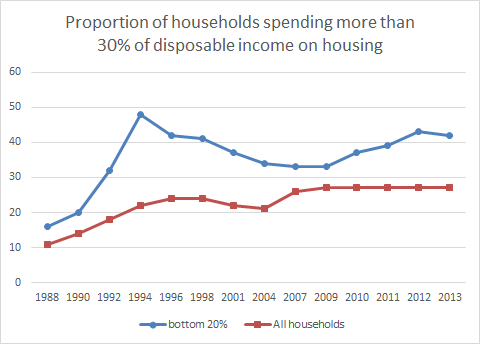
via Statistics New Zealand, New Zealand Social Indicators, Housing affordability.
% spent on housing as a share of disposable income, OECD members, 2014
28 Apr 2015 Leave a comment
in politics - Australia, politics - New Zealand, politics - USA, urban economics Tags: housing affordability, RMA, supply of land, zoning
New Zealand is pretty much on top of the world as to the amount of income that households must spend keep a roof. That success is a product of local council restrictions on the supply of land and national and local regulations such as under the Resource Management Act (RMA) that increase the costs of bringing lands in the market.
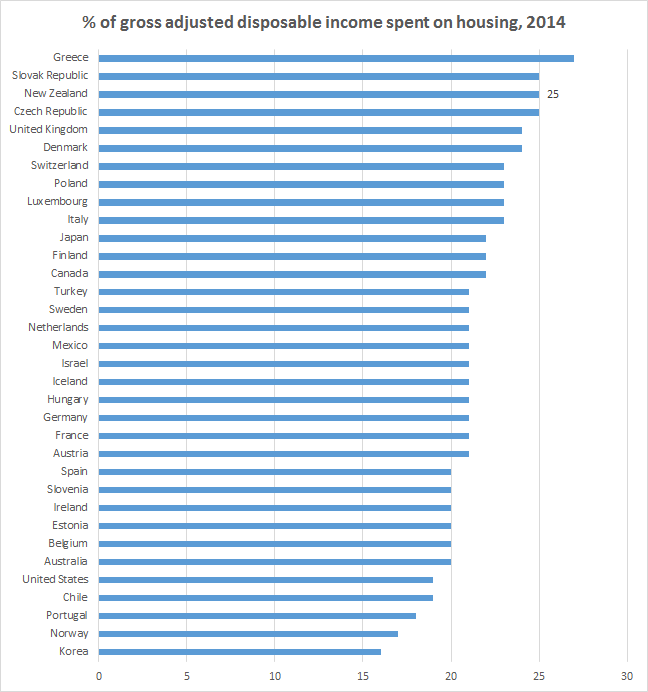
Source: OECD Better Life Index.
Note: Household net adjusted disposable income is the maximum amount that a household can afford to consume without having to reduce its assets or to increase its liabilities. It’s obtained, as defined by the System of National Accounts – SNA, adding to people’s gross income (earnings, self-employment and capital income, as well as current monetary transfers received from other sectors) the social transfers in-kind that households receive from governments (such as education and health care services), and then subtracting the taxes on income and wealth, the social security contributions paid by households as well as the depreciation of capital goods consumed by households.
The rapid emergence of Generation Rent in the UK and New Zealand
17 Apr 2015 1 Comment
in politics - New Zealand, urban economics Tags: Generation Rent, housing affordability, land supply restrictions, UK politics, zoning

I thought I should reproduce this chart for New Zealand to show the extent to which a Generation Rent has emerged in New Zealand in the last 10 years.
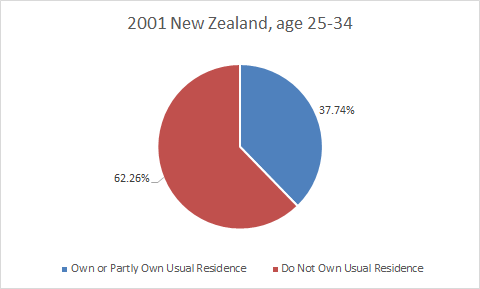
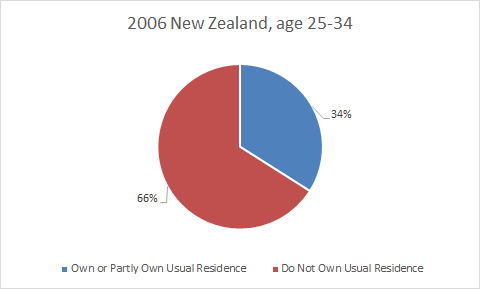
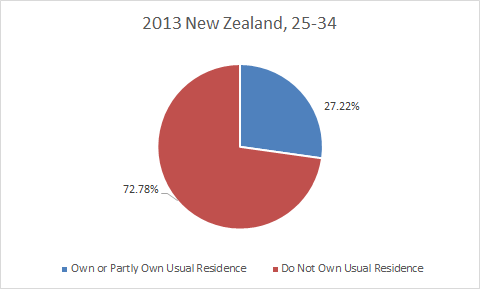
Source: 2013 Census QuickStats about housing.
Might be more interesting to breakdown the pie charts as a single time series for 25 to 29 and 30 to 34 year-olds as the latter are more likely to be settling down and buying a house.
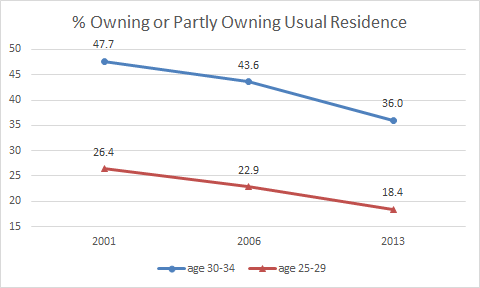
Source: 2013 Census QuickStats about housing.
The number of New Zealanders who own or partly owned their residence in the really 30s has dropped from almost one in two falling towards one in three since 2001. Generation Rent is very much the majority of New Zealanders aged 30 to 34.
For those New Zealanders aged 25 to 29, instead of one in four at least partly owning their residences, as was the case in 2001, the number of those aged 25 to 29 buying or owning their own house has dropped to less than one in five.
Generation Rent for those aged 25 to 29 has gone from a majority tendency to the dominant state for those in their late 20s. In both cases, the emergence of Generation Rent has sped up since 2006.
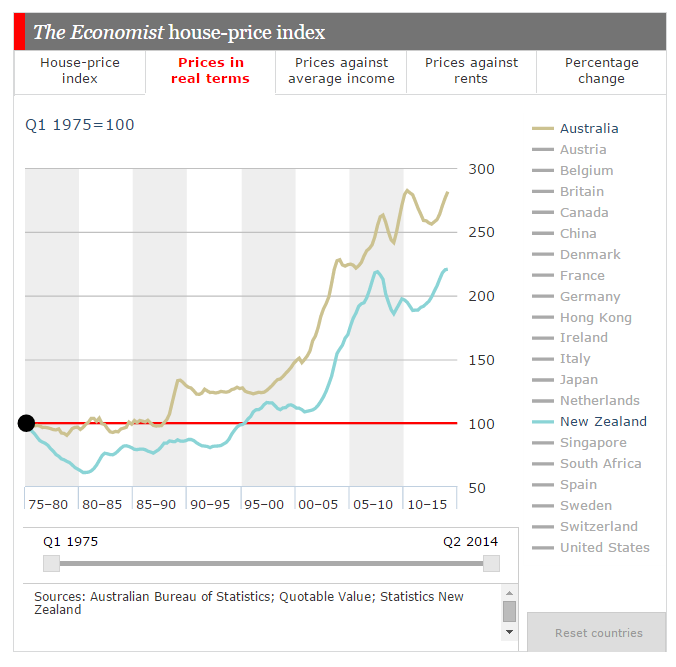
The emergence of generation rent coincided with a sharp increase in prices in real terms in New Zealand while housing prices against rents became far less competitive.
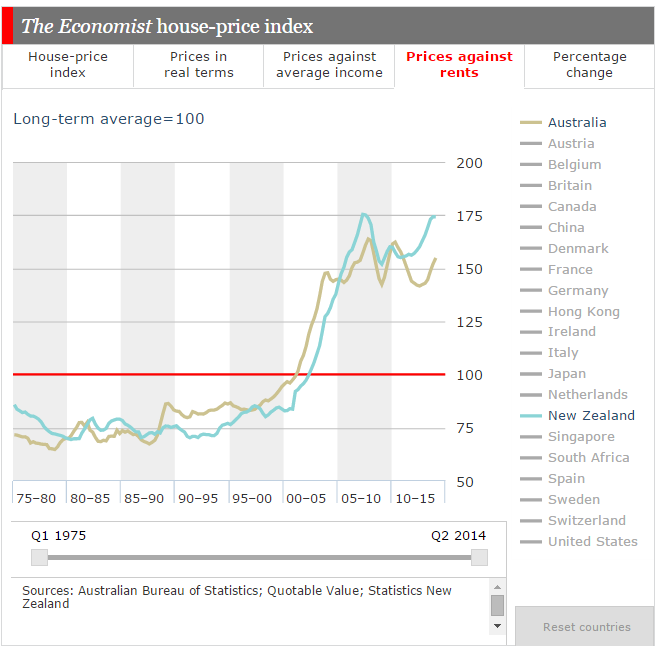
HT: Global house prices: Location, location, location | The Economist.
.
A lot of young adults in Southern Europe still live with their parents
13 Apr 2015 Leave a comment
in population economics, urban economics Tags: economics of family, Eurosclerosis, family demographics, housing prices, rent controls, supply of land, zoning

New Zealand, Australian and US real housing price index, 1975–2014, 2005 base
12 Apr 2015 Leave a comment
in business cycles, global financial crisis (GFC), great recession, macroeconomics, politics - Australia, politics - New Zealand, politics - USA, urban economics Tags: GFC, housing prices, land supply, zoning
The housing spikes in Australia and New Zealand preceded the global financial crisis, starting in about 1999, and were largely unaffected by the GFC. Housing prices in the USA were pretty calm except in the lead up to the GFC, and took a dive with the onset of the global financial crisis and great recession.
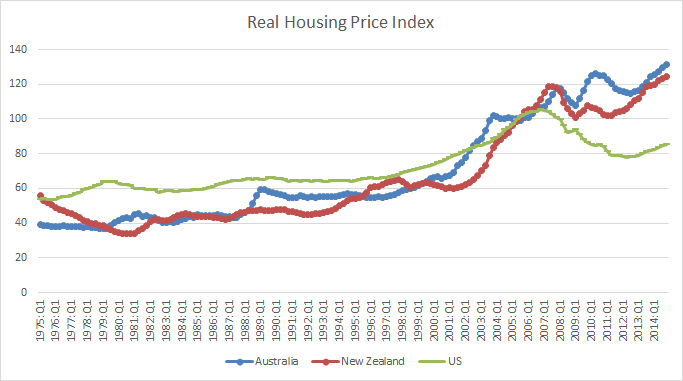
Source: Dallas Fed; Housing prices deflated by personal consumption expenditure (PCE) deflator.
.
@NZNationalParty housing policy defies the laws of supply and demand for land
05 Apr 2015 1 Comment
in applied price theory, economics of regulation, politics - New Zealand, urban economics Tags: housing affordability, RMA, supply of land, zoning
If homebuyers access additional lines of funding because they can tap into their KiwiSaver retirement savings, they will use this to bid up the price of housing and land.
If the supply of land is fixed or otherwise constrained from expanding much, such as by the Resource Management Act and the metropolitan urban limit in Auckland, the only thing that will happen is that the price will go up with more money chasing the same amount of land and housing.

The price of land and housing must go up in the absence of some reforms that increase the supply of land. Rather than increase access to housing among those with don’t own a house, allowing homebuyers to access their KiwiSaver retirement savings entrenches the prospects of Generation Rent.
The causes of housing unaffordability
01 Apr 2015 Leave a comment
in politics - New Zealand, politics - USA, urban economics Tags: Don Brash, land supply, Resource Management Act, zoning
There is no housing bubble in US cities with a flexible land supply
21 Mar 2015 Leave a comment
in applied price theory, economics of regulation, environmental economics, politics - New Zealand, politics - USA, urban economics Tags: land supply, land use regulation, RMA, supply and demand, zoning

In areas with a readily available supply of land on which to construct new homes—either because of geography or few land-use restrictions—builders have been sensitive to increases in local demand and existing-home prices. When existing houses rise in price relative to the cost of new homes, prospective buyers are willing and able to buy new units.
Supply conditions determine how house price and construction react to shifting demand. When housing demand rises—perhaps due to rising incomes, lower mortgage interest rates or easier credit standards—the outward shift in demand produces sharply higher house prices with a small increase in the supply of newly built units in areas with less-plentiful land. By comparison, when there is a more-plentiful land supply, the amount of housing is more supply sensitive and a rise in demand results in a less-pronounced rise in house prices and a greater increase of newly constructed homes.
As a result, house prices rise less in these supply-sensitive areas during booms and they fall less in downturns. Similarly, prices swing more and homebuilding varies less in regions with less-sensitive housing supply.


Edward Glaeser on regulation and housing prices
24 Feb 2015 Leave a comment
in urban economics Tags: Edward Gleaser, housing affordability, land supply, land use regulation, zoning
When fighting child poverty, don’t mention housing costs
22 Feb 2015 Leave a comment
in labour economics, liberalism, politics - New Zealand, poverty and inequality, urban economics, welfare reform Tags: child poverty, housing affordability, land supply, Left-wing hypocrisy, RMA, zoning

The relationship between housing prices and the Wharton Land Use Index
24 Jan 2015 Leave a comment
in rentseeking, urban economics Tags: Edward Gleaser, green rent seeking, land supply, land use regulation, zoning

Note: the Wharton Land Use Index measures the restrictiveness of a metropolitan area’s land use regulations.
 Utopia, you are standing in it!
Recent Comments