By Anton Korinek, Charles I. Jones, Szymon Sacher, Tess Cotter, and Peter McCrory, a strong line-up from Anthropic. They are sober, reasoned, scientific, and (for the most part) dynamically consistent. Here is the paper, here is the abstract: This paper presents a framework for assessing the economic consequences of AI between 2026 and 2030. In…
Economic Scenarios for Transformative AI
Economic Scenarios for Transformative AI
10 Sep 2026 Leave a comment
in applied price theory, economic growth, industrial organisation, macroeconomics Tags: creative destruction
Some Comments on the Significance of Labor Unions for Economic Policy – Items – Collected Works of Milton Friedman
08 Sep 2026 Leave a comment
in applied price theory, economic history, history of economic thought, industrial organisation, labour supply, Milton Friedman, survivor principle, unions
How Much Redistribution Will AI Require?
07 Sep 2026 Leave a comment
in labour economics, entrepreneurship, industrial organisation, applied price theory, labour supply, unemployment, poverty and inequality Tags: creative destruction
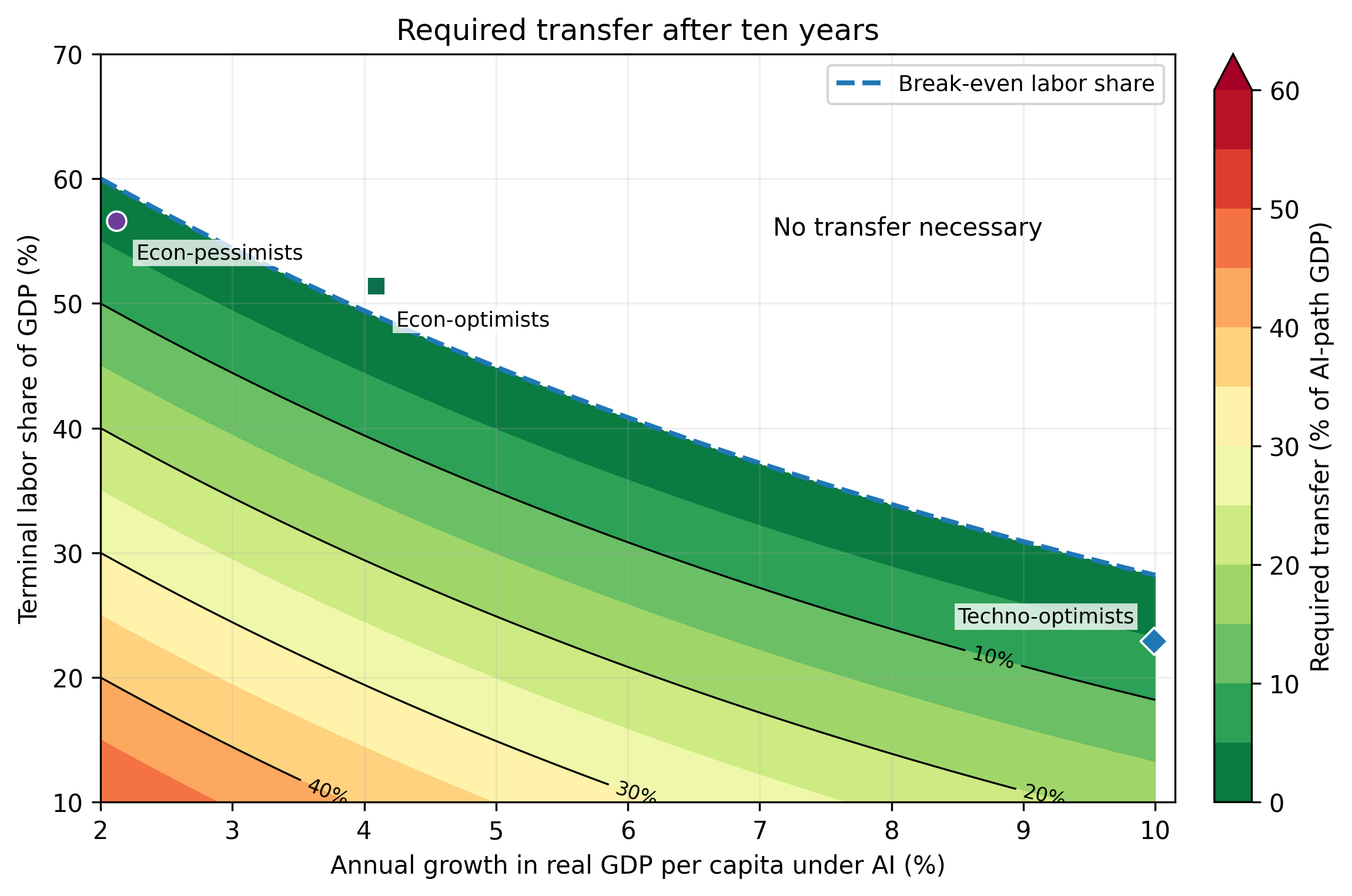
How much redistribution will AI require? A common scenario is that AI raises output enormously, but labor’s share of income collapses. GDP per capita goes up but workers get poorer, and making workers whole requires massive redistribution. In my latest paper, I run the numbers and conclude that this is probably incorrect. The idea is…
How Much Redistribution Will AI Require?
Quotation of the Day…
05 Sep 2026 Leave a comment
in applied price theory, industrial organisation, international economics
Tweet… is from page 213 of Menzie Chinn’s and Douglas Irwin’s superb 2025 textbook, International Economics: The past few decades have been an era of globalization. Most countries have moved to reduce trade barriers and take advantage of growing world trade. How have they done so? One way a country can reduce its tariff and…
Quotation of the Day…
State Film Subsidies Lose Money. Trump Wants To Try the Idea Nationally.
04 Sep 2026 1 Comment
in applied price theory, movies, politics - USA, Public Choice, rentseeking, television, TV shows Tags: corporate welfare

There’s “no reason to think a federal incentive would work any differently from state incentives,” says one expert.
State Film Subsidies Lose Money. Trump Wants To Try the Idea Nationally.
‘The Use of Knowledge in Society,’ by Friedrich A. Hayek
01 Sep 2026 Leave a comment
in applied price theory, Austrian economics, economics of information, entrepreneurship, F.A. Hayek, history of economic thought, industrial organisation, Ludwig von Mises, market efficiency, Ronald Coase, Ronald Coase, Ronald Coase, theory of the firm

The wealth and technological sophistication of modern society are readily apparent. Less visible, but no less remarkable, is its ability to coordinate the actions of billions of people who know almost nothing about one another’s circumstances. Every day we make decisions without possessing most of the information on which those decisions ultimately depend. We purchase…
‘The Use of Knowledge in Society,’ by Friedrich A. Hayek
Do labour markets behave like competitive markets?
01 Sep 2026 Leave a comment
in applied price theory, econometerics, history of economic thought, industrial organisation, labour economics, labour supply Tags: competition law, monopsony
The American evidence is that they frequently do not. For over a century there was a separate Department of Labour, which was amalgamated into that vast miscellaneous department, the Ministry of Business, Innovation and Employment. Today there is no Minister of Labour, while the portfolios of workplace relations and safety and of immigration are held […]
Do labour markets behave like competitive markets?
‘The Logic of Political Survival,’ by Bruce Bueno de Mesquita, Alastair Smith, Randolph M. Siverson & James D. Morrow
31 Aug 2026 Leave a comment
in applied price theory, comparative institutional analysis, constitutional political economy, economic history, economics of bureaucracy, income redistribution, Public Choice, rentseeking
Since the COVID-19 pandemic and the political upheavals that followed, concerns have grown that many Western democracies face authoritarian pressure and are becoming less democratic. This shift has renewed interest in one of political science’s most influential frameworks for understanding democratic and nondemocratic rule: Selectorate Theory, developed by Bruce Bueno de Mesquita, Alastair Smith, Randolph…
‘The Logic of Political Survival,’ by Bruce Bueno de Mesquita, Alastair Smith, Randolph M. Siverson & James D. Morrow
How Low Should Seasonal Discounts Be?
30 Aug 2026 Leave a comment
in applied price theory, industrial organisation
Retailers often mark down seasonal merchandise to clear inventory, but how big should the discount be? An Impact Analytics article describes a clothing retailer that initially discounts winter coats by 20%, observes the resulting sales, and then increases the discount to 35% when inventory remains too high. This is a simple pricing decision in which…
How Low Should Seasonal Discounts Be?
Vice signalling
29 Aug 2026 1 Comment
in applied price theory, economics of information, politics - USA Tags: signaling
Vice signalling is the opposite of virtue signalling, although it is not nearly as established as a technical term. Political scientists are more likely to discuss transgressive signalling, norm violation, incivility, performative transgression, or out-group hostility. Research on populism, for example, explicitly treats deliberate breaches of conventional standards of political behaviour as part of a political style. A […]
Vice signalling
The Austrian Approach to Competition | Israel M. Kirzner
27 Aug 2026 Leave a comment
in applied price theory, Austrian economics, history of economic thought, industrial organisation Tags: competition law
Whiskey taxes, revenue and voting by members of Congress in history
25 Aug 2026 Leave a comment
in applied price theory, econometerics, history of economic thought, Public Choice, public economics
See Revenue over reason: A case for home distilling by Ben Semark of the Competitive Enterprise Institute. After an excerpt from Semark’s article, I discuss how this relates to voting by congressmen on bills during the Federalist period, the subject of my Ph. D. dissertation.Excerpt from Semark:”Creating home-brewed spirits was not a niche or commercial practice…
Whiskey taxes, revenue and voting by members of Congress in history
College-educated women have maintained stable marriage rates by partnering with high-earning non-college men, shrinking the pool of economically viable partners available to non-college women
24 Aug 2026 Leave a comment
in applied price theory, discrimination, econometerics, economics of love and marriage, gender, human capital, labour economics, labour supply, law and economics, occupational choice, population economics, poverty and inequality
See Gender Disparities in College Enrollment and Marriage Patterns by Clara Chambers, Benjamin Goldman & Joseph Winkelmann.”Over the past half-century, the gender composition of American college campuses has shifted from predominantly male to predominantly female. Today, 1.6 million more women than men attend four-year colleges in the US. Over the same time period, the economic status…
College-educated women have maintained stable marriage rates by partnering with high-earning non-college men, shrinking the pool of economically viable partners available to non-college women
 Utopia, you are standing in it!
Recent Comments