One clause of the Magna Carta says: All merchants shall have safe and secure exit from England, and entry to England, with the right to tarry there and to move about as well by land as by water, for buying and selling by the ancient and right customs, quit from all evil tolls So tariffs […]
Did you know the Magna Carta was against tariffs?
Did you know the Magna Carta was against tariffs?
13 Mar 2025 Leave a comment
in applied price theory, economic history, history of economic thought, industrial organisation, international economics Tags: 2024 presidential election, constitutional law, tariffs
Trump Doubles Down on Protectionist Failure
12 Mar 2025 1 Comment
in applied price theory, industrial organisation, international economics, politics - USA, survivor principle Tags: 2024 presidential election, tarrifs
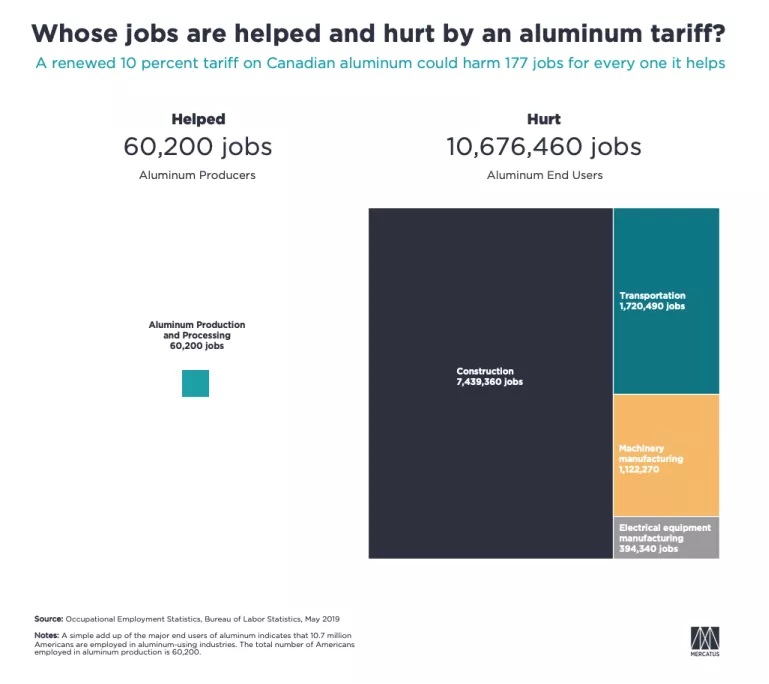
I shared a “Trade 101 for Trumpies” presentation last month in hopes of educating people about the foolishness of protectionism. Perhaps it should have been a remedial class because the president has just announced another increase in taxes on steel and aluminum from Canada. This is insanely bad economic policy for the simple reason that […]
Trump Doubles Down on Protectionist Failure
Is your master’s degree worthless?
11 Mar 2025 Leave a comment
in applied price theory, econometerics, economics of education, human capital, labour economics, labour supply
Economist: In America returns are especially large in computer science and in engineering. They are slightly smaller in other science subjects, in part because an undergraduate degree in these already bumps up salaries by quite a lot. Teachers who bag graduate degrees in education tend to earn more, even if wages for the profession as…
Is your master’s degree worthless?
Working paper: Why nationalize the production of public goods?
09 Mar 2025 Leave a comment
in applied price theory, comparative institutional analysis, constitutional political economy, economic history, economics of bureaucracy, entrepreneurship, health economics, history of economic thought, Public Choice, public economics, rentseeking
I have a new working paper out. It proposes a price theory-based explanation of why states nationalize the production of “public goods” (i.e., non-excludable and non-rivalrous). This is different than existing explanations as the theory ignores whether private provision is efficient or superior to public provision. I call it the “redistributive engine” theory whereby the […]
Working paper: Why nationalize the production of public goods?
Bernanke on inflation targeting
09 Mar 2025 Leave a comment
in applied price theory, budget deficits, business cycles, economic growth, economic history, financial economics, fiscal policy, history of economic thought, inflation targeting, labour economics, macroeconomics, monetary economics, politics - New Zealand, unemployment Tags: monetary policy

Former chairman of the Federal Reserve Board of Governors (and FOMC), Ben Bernanke, was yesterday the first of two keynote speakers at the Reserve Bank’s conference to mark 35 years of inflation targeting, which first became a formalised thing here in New Zealand. He indicated that he’d be speaking about inflation targeting in general and […]
Bernanke on inflation targeting
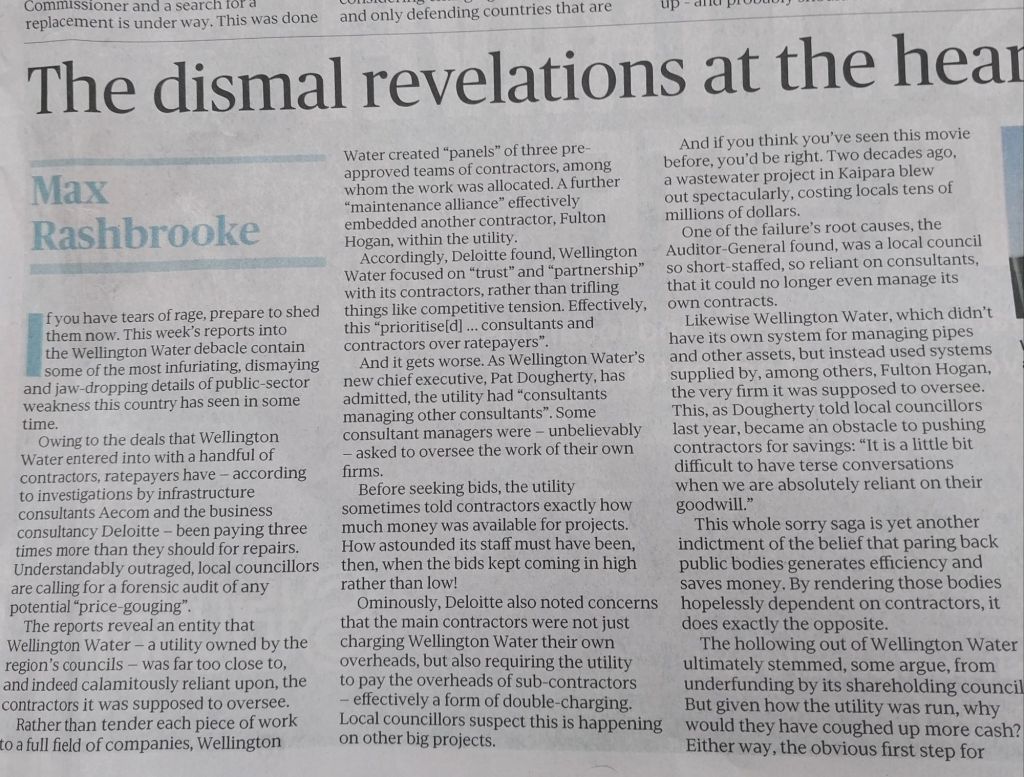
Max Rashbrooke has been kidnapped again to be replaced by a neoliberal doppelganger
08 Mar 2025 Leave a comment
in applied price theory, comparative institutional analysis, economics of bureaucracy, industrial organisation, managerial economics, market efficiency, organisational economics, politics - New Zealand, Public Choice, public economics Tags: privatisation
How Much Do Tariffs Raise Prices?
08 Mar 2025 Leave a comment
in applied price theory, economic history, history of economic thought, industrial organisation, international economics, politics - USA Tags: 2024 presidential election, free trade, tariffs
We break down how much of a tariff is ‘passed through’ to customersBy Jason Douglas, Anthony DeBarros and Danny Dougherty of The WSJ. Excerpts:”For example, a 10% tariff on shoes from China would raise their sticker price 4% or so, but on wine or olive oil from Italy, almost 10%.Why the difference? Tariffs aren’t the…
How Much Do Tariffs Raise Prices?
The Licensing Racket
08 Mar 2025 Leave a comment
in applied price theory, economics of bureaucracy, entrepreneurship, human capital, income redistribution, industrial organisation, labour economics, labour supply, law and economics, occupational choice, occupational regulation, property rights, Public Choice, rentseeking
I review a very good new book on occupational licensing, The Licensing Racket by Rebecca Haw Allensworth in the WSJ. Most people will concede that licensing for hair braiders and interior decorators is excessive while licensing for doctors, nurses and lawyers is essential. Hair braiders pose little to no threat to public safety, but subpar […]
The Licensing Racket
Peter Navarro Conducts a Master Class In Looking Only at That Which Is Seen
06 Mar 2025 Leave a comment
in applied price theory, history of economic thought, industrial organisation, international economic law, international economics, International law, survivor principle Tags: current account, free trade, tariffs
TweetHere’s a letter to USA Today. Editor: Defending Pres. Trump’s aluminum tariffs, Peter Navarro focuses exclusively on the effects of these tariffs on U.S. aluminum producers (“Trump tariffs will save American jobs and level the playing field,” Feb. 28). He points out what no serious defender of free trade denies, namely, that punitive taxation of…
Peter Navarro Conducts a Master Class In Looking Only at That Which Is Seen
Australia’s Pandemic Exceptionalism
05 Mar 2025 Leave a comment
in applied price theory, applied welfare economics, budget deficits, economic growth, economics of bureaucracy, economics of natural disasters, economics of regulation, health economics, labour economics, labour supply, macroeconomics, monetary economics, politics - Australia, politics - New Zealand, Public Choice, unemployment Tags: economics of pandemics

That’s the title of a 2024 book by a couple of Australian academic economists, Steven Hamilton (based in US) and Richard Holden (a professor at the University of New South Wales). The subtitle of the book is “How we crushed the curve but lost the race”. It is easy to get off on the wrong […]
Australia’s Pandemic Exceptionalism
15 years of US research on the minimum wage elasticity of employment
04 Mar 2025 Leave a comment
in applied price theory, econometerics, economic history, economics of regulation, labour economics, labour supply, minimum wage, poverty and inequality
It’s time to pick up my recent thread of posts on the minimum wage (most recently in this post). I want to return for a moment to more conventional research on the minimum wage, specifically looking at the effects of higher minimum wages on employment. The majority of minimum wage research has focused on estimating…
15 years of US research on the minimum wage elasticity of employment
More Deficient Economic Thinking
03 Mar 2025 Leave a comment
in applied price theory, industrial organisation, international economics Tags: current account, free trade, tarrifs
TweetHere’s a letter to the Wall Street Journal. Editor: Anthony deBarros and Peter Santilli report on “the countries fueling America’s $1.2 trillion goods trade deficit” (March 1). With respect, what’s the point of such a report? Eighty percent of U.S. GDP is produced by the service sector – implying that the vast majority of Americans…
More Deficient Economic Thinking
The 2023 Merger Guidelines Will Remain: What Does That Mean?
03 Mar 2025 Leave a comment
in applied price theory, economics of regulation, entrepreneurship, industrial organisation, politics - USA, survivor principle Tags: 2024 presidential election, competition law, merger law enforcement
Under current law, any US companies considering a merger or acquisition that is above $125 million in size must first report it to the government. The most recent data for 2023 says that 1,805 such transactions were reported in 2023, which was a relatively low number for recent years. In 2021 and 2022, for example,…
The 2023 Merger Guidelines Will Remain: What Does That Mean?
The cost of Reserve Bank regulation
02 Mar 2025 Leave a comment
in applied price theory, business cycles, economics of bureaucracy, economics of natural disasters, economics of regulation, inflation targeting, macroeconomics, monetary economics, politics - New Zealand, Public Choice Tags: monetary policy
Roger Partridge writes: A new submission to the Committee from banking experts Andrew Body and Simon Jensen provides fresh evidence of these costs. Their analysis shows the Reserve Bank’s capital rules add between 0.25 and 0.375 percentage points to mortgage rates compared with Australia. For a million-dollar mortgage, that means between $2,500 and $3,750 in […]
The cost of Reserve Bank regulation
BP Faces “Existential Crisis” After Ruinous Attempt to Go Green
02 Mar 2025 Leave a comment
in applied price theory, economics of climate change, energy economics, entrepreneurship, environmental economics, environmentalism, financial economics, global warming, industrial organisation, politics - USA, survivor principle Tags: 2024 presidential election, climate activists, climate alarmism, efficient markets hypothesis, greenwashing
BP’s green pivot has backfired spectacularly, hammering profits and leaving the company vulnerable to a hedge fund siege, writes Jonathan Leake in the Telegraph.
BP Faces “Existential Crisis” After Ruinous Attempt to Go Green
 Utopia, you are standing in it!
Recent Comments