Tweet… is from page 496 of the 2011 revised and enlarged edition of Thomas Sowell’s 2009 book Intellectuals and Society (original emphasis): Another common tactic and flaw in the arguments of the intelligentsia is eternalizing the transient. Thus statistical trends in the share of the nation’s income going to “the rich” (however defined) and “the…
Quotation of the Day…
Quotation of the Day…
07 Jan 2025 Leave a comment
in applied price theory, entrepreneurship, human capital, income redistribution, labour economics, labour supply, occupational choice, poverty and inequality, Public Choice, Thomas Sowell
Some Links
06 Jan 2025 Leave a comment
in applied price theory, economics of bureaucracy, economics of regulation, entrepreneurship, income redistribution, industrial organisation, politics - USA, Public Choice, rentseeking, survivor principle
TweetScott Lincicome decries Biden’s abuse of national security to block Nippon Steel’s acquisition of U.S. Steel. Two slices: Today, President Joe Biden blocked Nippon Steel’s proposed acquisition of US Steel on the grounds that “there is credible evidence” the Japanese steelmaker “might take action that threatens to impair the national security of the United States.” What…
Some Links
Another big tobacco black market bust
05 Jan 2025 Leave a comment
in applied price theory, economics of regulation, health economics, politics - New Zealand Tags: black markets, economics of smoking
NewstalkZB reports: Police have restrained more than $2.5 million in assets, including four properties in Gisborne, after a discovery of undeclared tobacco was intercepted at the border. It comes after Customs intercepted 110kg of loose tobacco and more than 230,000 cigarettes – approximately 10,000 packets – concealed in Chinese tea packets in November last year, bound for residential and […]
Another big tobacco black market bust
Some Links
03 Jan 2025 1 Comment
in applied price theory, comparative institutional analysis, constitutional political economy, defence economics, economic history, economics of crime, economics of regulation, industrial organisation, international economics, International law, law and economics, politics - USA, war and peace
TweetArnold Kling ponders producers versus parasites. A slice: What I notice is that the elites on the Republican side tend to earn a living as producers. They make things that other people want or need. In contrast, elites on the Democratic side include many people one may think of as parasites. They depend on producers…
Some Links
Some Links
02 Jan 2025 Leave a comment
in applied price theory, economics of regulation, history of economic thought, industrial organisation, politics - USA
TweetMike Munger explains that “the only way to gain jobs is to lose jobs.” Two slices: Politicians want to create jobs, “good-paying union jobs,” in existing industries. But that’s not what markets do. The “destructive” part of creative destruction eliminates jobs in existing industries. In a dynamic economy, innovations indivision of labor can create good-paying…
Some Links
Nordhaus on the Perils of Long-Term Forecasting
01 Jan 2025 Leave a comment
in applied price theory, econometerics, economic history Tags: The Great Enrichment
When people try to think about the long-term future, by which I mean here looking a half-century or a century ahead, they often suffer a lack of imagination. As a common example, they take today’s problems and just multiply them by a factor of ten. Or they assume that improved central planning, in one form…
Nordhaus on the Perils of Long-Term Forecasting
On the Great F.A. Hayek
30 Dec 2024 Leave a comment
in applied price theory, applied welfare economics, economic history, F.A. Hayek, history of economic thought
TweetJonathan Fortier and his colleagues at Libertarianism.org produced this truly splendid 21-minute-long video to commemorate the 50th anniversary of Hayek’s receipt of the Nobel Prize in economics. The post On the Great F.A. Hayek appeared first on Cafe Hayek.
On the Great F.A. Hayek
Top MR Posts of 2024!
30 Dec 2024 Leave a comment
in applied price theory, discrimination, gender, health and safety, human capital, international economics, labour economics, labour supply, occupational choice, politics - USA, poverty and inequality Tags: economics of immigration, gender wage gap, Internet, political correctness, regressive left
The number one post this year was Tyler’s The changes in vibes — why did they happen? A prescient post and worth a re-read. Lots of quotable content that has become conventional wisdom after the election: The ongoing feminization of society has driven more and more men, including black and Latino men, into the Republican […]
Top MR Posts of 2024!
On Trump On Panama Canal Fees
29 Dec 2024 Leave a comment
in applied price theory, international economics, International law, politics - USA Tags: 2024 presidential election, tarrifs
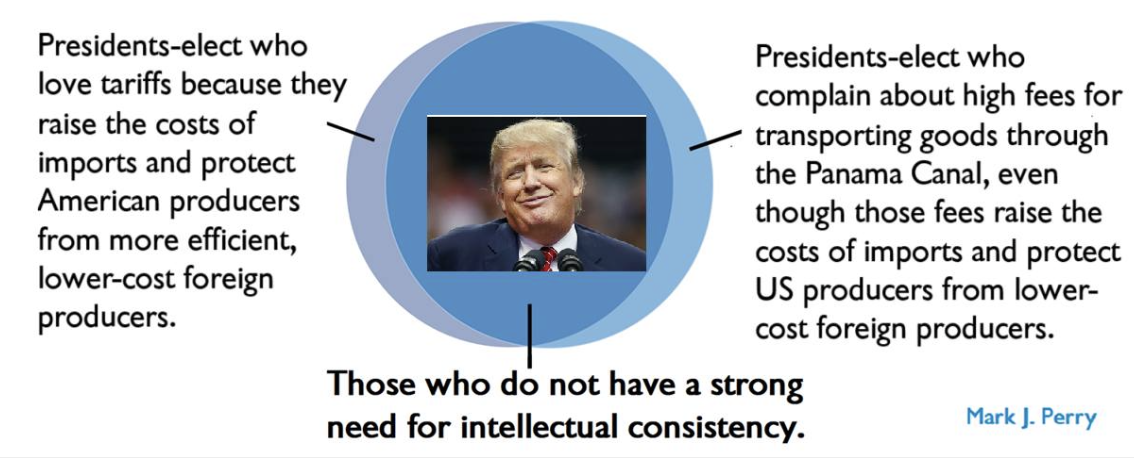
TweetThis letter of mine appears in today’s New York Times: To the Editor: Donald Trump complains that the fees Panama charges for ships to use its canal are a “complete ‘rip-off.’” How mysterious. Given Mr. Trump’s belief that “the most beautiful word in the dictionary is ‘tariff,’” he should be pleased that these fees are…
On Trump On Panama Canal Fees
More Police, Fewer Prisons, and Other Ways to Reduce Crime
29 Dec 2024 Leave a comment
in applied price theory, economics of crime, human capital, labour economics, labour supply, law and economics, occupational choice, politics - USA Tags: crime and punishment, criminal deterrence, law and order
What does the existing research evidence say about how to reduce crime? Jennifer Doleac offers and over overview in “Why Crime Matters, and What to Do About It.” It appear as an essay in a book published by the Aspen Economic Strategy Group, Strengthening America’s Economic Dynamism, edited by Melissa Kearney and Luke Pardue. You…
More Police, Fewer Prisons, and Other Ways to Reduce Crime
Two examples of wages rising for one occupation leading workers to move into it from other occupations
29 Dec 2024 Leave a comment
in applied price theory, economic history, human capital, labour economics, labour supply, minimum wage, occupational choice, poverty and inequality
See $500,000 Pay, Predictable Hours: How Dermatology Became the ‘It’ Job in Medicine: Americans’ newfound obsession with skin care has medical students flocking to this specialty by Te-Ping Chen of The WSJ. Excerpts:”Four-day workweeks, double the salary of some colleagues and no emails at night. If those perks sound like they belong to a few vaunted…
Two examples of wages rising for one occupation leading workers to move into it from other occupations
The Changing US Labor Market
28 Dec 2024 Leave a comment
in applied price theory, economic history, history of economic thought, human capital, labour economics, labour supply, occupational choice, poverty and inequality, unemployment Tags: creative destruction

There is a widespread belief that the US labor market has been undergoing a period of unprecedented chance in the last decade or two. On one hand, David Deming, Christopher Ong, and Lawrence H. Summers case doubt on this historical claim in their essay, ” Technological Disruption in the US Labor Market”–that is, they argue…
The Changing US Labor Market
The New FDA and the Regulation of Laboratory Developed Tests
28 Dec 2024 Leave a comment
in applied price theory, economics of bureaucracy, economics of regulation, health economics, politics - USA, Public Choice Tags: drug lags
The FDA under President Trump and new FDA head Martin Makary should rapidly reverse the FDA’s powergrab on laboratory developed tests. To recap, laboratory developed tests (LDTs) are the kind your doctor orders, they are a service not a product and are not sold directly to patients. Congress has never given the FDA the authority […]
The New FDA and the Regulation of Laboratory Developed Tests
Scandinavian Governments Are Greedy, not Socialist
27 Dec 2024 Leave a comment
in applied price theory, economic growth, entrepreneurship, fiscal policy, human capital, income redistribution, labour economics, labour supply, liberalism, macroeconomics, Marxist economics, politics - USA, poverty and inequality, Public Choice, public economics Tags: Denmark, Norway, social insurance, Sweden, taxation and entrepreneurship, taxation and investment, taxation and labour supply
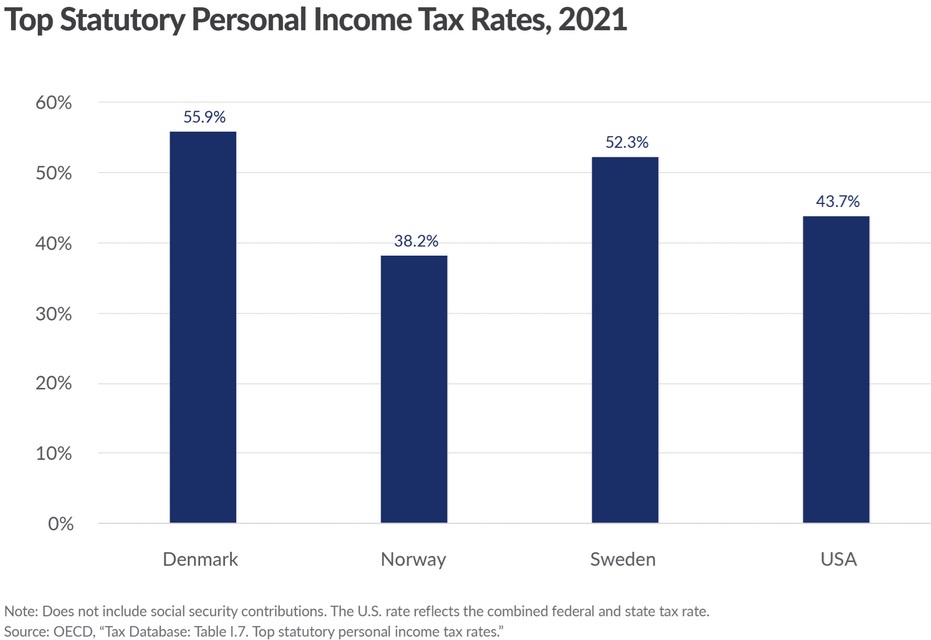
Scandinavian nations are not socialist, at least if we’re using the technical definition (government ownership, central planning, and price controls). But those countries do have big welfare states. And that means stifling tax burdens. And those harsh taxes don’t just apply to rich taxpayers. Lower-income and middle-class people also get pillaged. I’ve already explained that punitive value-added […]
Scandinavian Governments Are Greedy, not Socialist
“This Orange County…They Don’t Play”: California’s Tougher Shoplifting Law Receives Curious Endorsement
27 Dec 2024 Leave a comment
in applied price theory, economics of crime, Gary Becker, law and economics, politics - USA Tags: crime and punishment, criminal deterrence, law and order

Proposition 36, which increases punishments for some retail theft and drug possession offenses, overwhelmingly passed in California despite the opposition of Gov. Gavin Newsom and most Democrats. Newsom denounced the measure as something that “takes us back to the 1980s, mass incarceration.” Despite discussing her tough-on-crime record in the election, Vice President Kamala Harris refused […]
“This Orange County…They Don’t Play”: California’s Tougher Shoplifting Law Receives Curious Endorsement
 Utopia, you are standing in it!
Recent Comments