When it comes to the question of how best to avoid a banking collapse and multi-billion dollar bailout that can drag a whole nation into depression, the best solution, according to Chicago-Stanford economist, John Cochrane, is to require banks to set aside a fraction of their own funds as reserves to cover losses they may…
Caught out! The NZ Initiative’s Article in the Herald Blaming the RBNZ for our Rip-Off Big Banks is Contradicted by its Own Expert Witness. (Willis Beware).
Caught out! The NZ Initiative’s Article in the Herald Blaming the RBNZ for our Rip-Off Big Banks is Contradicted by its Own Expert Witness. (Willis Beware).
06 Jun 2024 Leave a comment
in applied price theory, global financial crisis (GFC), great recession, industrial organisation, law and economics, macroeconomics, monetary economics, politics - New Zealand Tags: competition law
Did the British Empire REALLY Drive the Industrial Revolution? IEA Debates
06 Jun 2024 Leave a comment
in applied price theory, comparative institutional analysis, constitutional political economy, economic history, economics of bureaucracy, growth disasters, growth miracles, income redistribution, Public Choice, rentseeking Tags: Age of Discovery, age of empires, economics of colonialism
The 2024 Hayek Lecture: Phil Gramm & John Early on “The Myth of American…
04 Jun 2024 Leave a comment
in applied price theory, applied welfare economics, economic history, economics of education, entrepreneurship, human capital, labour economics, labour supply, occupational choice, politics - USA, poverty and inequality
Prediction Markets As Investments
04 Jun 2024 Leave a comment
in applied price theory, financial economics Tags: efficient markets hypothesis

Supporters of prediction markets tend to emphasize how they are great tools for aggregating information to produce accurate forecasts. If you want to know e.g. who is likely to win the next election, you can watch every poll and listen to pundits for hours, or you can take ten seconds to check the odds. This […]
Prediction Markets As Investments
Pushback on Pessimism About Randomized Controlled Trials
03 Jun 2024 Leave a comment
in applied price theory, econometerics, economics of crime, law and economics Tags: crime and punishment, criminal deterrence, law and order
Back in January, I posted about an article that was getting some attention in my world. Megan T. Stevenson is an active researcher in the criminal-justice-and-economics literature. She argues that when you look at the published studies that use randomized control trial methods to evaluate ways of reducing crime, most of the studies don’t show a…
Pushback on Pessimism About Randomized Controlled Trials
Has Worker Pay Kept Up with Productivity Growth?
02 Jun 2024 Leave a comment
in applied price theory, econometerics, economic history, human capital, labour economics, labour supply, poverty and inequality

You will be astonished, gentle reader, to learn that the question of whether worker pay has kept up with productivity growth turns out to depend on 1) how you measure worker pay; and 2) how you measure productivity growth. Scott Winship considers the alternatives and issues in “Understanding Trends in Worker Pay over the Past…
Has Worker Pay Kept Up with Productivity Growth?
*Best Things First*
01 Jun 2024 Leave a comment
in applied price theory, applied welfare economics, development economics, growth disasters, health economics Tags: The Great Escape
The author is Bjorn Lomborg, and the subtitle is The 12 most efficient solutions for the world’s poorest and our global SDG promises. I missed this book when it first came out last year. Here is what Lomborg presents as the twelve best global investments, in no particular order: Tuberculosis Maternal and newborn health Malaria […]
*Best Things First*
Updated estimates on immigration and wages
30 May 2024 Leave a comment
in applied price theory, applied welfare economics, econometerics, human capital, labour economics, labour supply, politics - USA Tags: economics of immigration
In this article we revive, extend and improve the approach used in a series of influential papers written in the 2000s to estimate how changes in the supply of immigrant workers affected natives’ wages in the US. We begin by extending the analysis to include the more recent years 2000-2022. Additionally, we introduce three important […]
Updated estimates on immigration and wages
‘Arguments Libertarians shouldn’t make’ with David Friedman
30 May 2024 Leave a comment
in applied price theory, comparative institutional analysis, constitutional political economy, David Friedman, defence economics, economic history, economics of crime, environmental economics, history of economic thought, law and economics, liberalism, libertarianism
Development Policies with the Best Benefit-Cost Ratios
29 May 2024 Leave a comment
in applied price theory, applied welfare economics, development economics, econometerics, growth disasters, growth miracles, public economics
In a world with lots of problems and even more proposed policies to address each of these problems, it makes sense to study the possibilities–and then to prioritize policies with highest estimated ratio of benefits to costs. The Copenhagen Consensus think tank carried out this exercise and came up with 12 policies. A special issue…
Development Policies with the Best Benefit-Cost Ratios
India, Dependency, and the 17th Theorem of Government
28 May 2024 Leave a comment
in applied price theory, development economics, economic history, financial economics, growth disasters, growth miracles, income redistribution, macroeconomics, Public Choice, public economics, rentseeking Tags: India
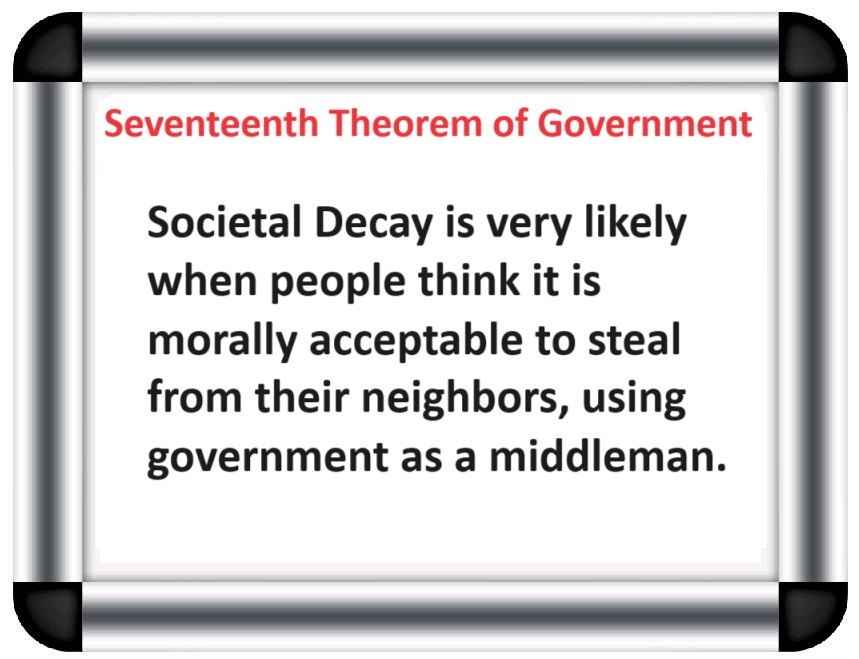
I released my First Theorem of Government in 2015 and today I’m going to unveil the 17th iteration in the series. But I’ll confess upfront that I’m doing a bit of recycling. My latest Theorem is very similar to something I shared back in 2014. I decided to upgrade my 2014 column to a Theorem […]
India, Dependency, and the 17th Theorem of Government
There’s Nothing More Expensive Than A Cheap EV
25 May 2024 Leave a comment
in applied price theory, energy economics, environmental economics, global warming Tags: electric cars
That’s a variation on an old joke about BMW’s, but it’s turning out to be even more true of EV’s: iSeeCars reported in January that, on average, “electric cars have a five-year depreciation rate of 49.1%… compared to an overall industry average of a 38.8% five-year depreciation rate.” Executive analyst Karl Brauer added, “This pattern will […]
There’s Nothing More Expensive Than A Cheap EV
Almost Observable Human Capital
24 May 2024 Leave a comment
in applied price theory, economic history, economics of education, history of economic thought, human capital, industrial organisation, labour economics, labour supply, occupational choice

Previously, we could observe a higher proportion of men than women in, say, steel fabrication and suspect that men have “some sort” of physical or mental comparative advantage related to steel fabrication. But what does that mean?
Almost Observable Human Capital
New article by some middling economists about Biden Admin. merger policy
24 May 2024 Leave a comment
in applied price theory, econometerics, industrial organisation, law and economics Tags: competition law, merger law enforcement
DETERRENCE IN MERGER REVIEW: LIKELY EFFECTS OF RECENT U.S. POLICY CHANGESBy Luke M. Froeb, Steven T. Tschantz & Gregory J. WerdenWe model likely effects of Biden Administration changes in merger enforcement on five discrete decisions in the review process. We find that the policy changes can be expected to stop many bad mergers but only at the cost…
New article by some middling economists about Biden Admin. merger policy
Claude 3 on why the US leads China and the EU in economic dynamism
21 May 2024 Leave a comment
in applied price theory, comparative institutional analysis, development economics, economics of regulation, entrepreneurship, growth miracles, industrial organisation, managerial economics, organisational economics, public economics, survivor principle Tags: taxation and entrepreneurship, taxation and investment
QUESTION TO CLAUDE 3: The EU and China lag behind the US in economic dynamism, measured by start-up activity, number of unicorns, age of unicorns (younger indicates more rapid innovation), and in productivity growth. Can you document this and tell me why?ANSWER: Here is the data to document the economic dynamism gap between the US,…
Claude 3 on why the US leads China and the EU in economic dynamism
 Utopia, you are standing in it!
Recent Comments