
This is an “oldie but goodie”. One can always count on Dr. Thomas Sowell to make sense. I wish it were a characteristic more widely available. We could surely use more of it around in these perilous days.
I Didn’t Watch The Debate. Smartest Thing I Did Today.
13 Sep 2019 Leave a comment
I did not watch the debate tonight. I am tired of this whole bunch who are vying to see who can offer the best thing to buy the peoples’ votes. Did anyone watch the whole thing?
I’ve seen lots of comments, which only make me glad I did not watch. Best analysis was from John Hinderaker at PowerLine blog.
1) Joe Biden was the winner tonight. He pretended to be sane, and did a decent imitation.
2) Julian Castro–did anyone remember that he was on the stage?–is running to be Elizabeth Warren’s VP. He did her dirty work tonight.
3) It’s time to pull the plug on Bernie Sanders. It’s not just that he is a raving maniac–he is an extremely elderly raving maniac. I hope he made it through the night.
4) Early on in the campaign, I thought Kamala Harris had a good shot. I was wrong.
5)…
View original post 59 more words
Oliver Garner: The Benn-Burt Extension Act: A roadblock to a No-deal Brexit?
13 Sep 2019 Leave a comment

 Introduction: extension and the Rule of Law
On 9 September, the EU (Withdrawal) (No.2) Act 2019 (‘Benn-Burt Extension Act’) received Royal Assent. The Benn-Burt Extension Act imposes a statutory duty upon the Prime Minister (if the relevant conditions are met) to request and accept an extension of the withdrawal negotiating period under Article 50(3) TEU. However, the Prime Minister has repeatedly stated that he will not request such an extension, ostensibly in clear conflict with the statutory obligations in the Act.
This reticence has prompted criticism over the Government’s commitment to the Rule of Law, and has given rise to speculation as to whether the obligations of the Benn-Burt Extension Act can be circumvented legally. The Foreign Secretary has even stated that the Government will ‘test the law to the limit’. Boris Johnson faces a trilemma: (1) avoiding an extension to Article 50; (2) remaining Prime Minister; and (3) not…
View original post 1,116 more words
Sky News Arabia omits fact that deceased Palestinian prisoner was a terrorist
13 Sep 2019 Leave a comment

The death of Hamas-affiliated Palestinian terrorist Bassam as-Sayeh, 47, in an Israeli prison last Sunday received a considerable amount of attention from Arabic-language Western media outlets, which are often quite eager to amplify Palestinian Authority propaganda when dealing with such matters.
Having learned that as-Sayeh died of cancer, the outlets (AFP on Sep. 9, Independent Arabia on Sep. 9 and Sky News Arabia on Sep. 8) uncritically quoted Palestinian officials who leveled allegations at “the Occupation” (i.e, Israel) for “medical negligence”, “withholding treatment” and engaging in a “slow-motion execution” – though without providing any evidence of such conduct.
Even more telling was the fact that all three outlets ignored as-Sayeh’s conviction in an Israeli court for a series of terrorist acts, the most significant being his role in the murder of Eitam and Na’ama Henkin in October 2015.
 Rabbi Eitam and Naama Henkin (Photo courtesy of…
View original post 285 more words
Robert Craig: What Could Happen Next If the Government Resigns Rather than Send the Letter to the EU?
12 Sep 2019 Leave a comment
 This post follows on from a previous piece where I attempted to set out the general rules, and a flowchart, to create a route map in the event of a vote of no confidence. This post seeks to address the narrower question of what could happen if the Prime Minister (‘PM’) refused to send the letter to extend the Article 50 process and instead decided to announce the resignation of the Government before the deadline. This post assumes that the resignation would be by the whole Government on the grounds that collective responsibility on its central policy would apply in all the circumstances.
The deadline for sending the letter under the Benn-Burt Bill (now European Union (Withdrawal) (No. 2) Act 2019 (‘EUW2’)) is 19 October 2019 which is a Saturday.
It is a convention that prime ministers should, where possible, give sufficient notice of their resignation so that an…
View original post 1,779 more words
Pope Francis Rejects Prosperity for Developing Nations
12 Sep 2019 Leave a comment

I first opined about Pope Francis in 2013, when I told a BBC audience why the Pope was wrong on economic policy.
The following year, I expanded on that point, explaining that statist policies are bad for the poor. And I revisited the issue again last year.
I’m not the only one making these arguments. In a column for Reason, Stephanie Slade explained why Pope Francis is deeply misguided.
I’ve had some harsh words to describe Pope Francis. …the pontiff’s ignorance of basic economics has led him to a bad conclusion about which public policies are best able to reduce the crushing yoke of poverty in the world.
…as a matter of empirical fact, markets are the single greatest engine for growth and enrichment that humanity has yet stumbled upon. …He seems to be arguing that an outlook that places the individual above “the common good” is morally…
View original post 489 more words
Richard A. Posner, “The Embattled Corporation”
12 Sep 2019 Leave a comment
in applied price theory, comparative institutional analysis, economic history, economics of information, economics of regulation, financial economics, industrial organisation, law and economics, managerial economics, organisational economics, property rights, Public Choice, Richard Posner, survivor principle Tags: adverse selection, moral hazard
National television networks refuse to air First-Amendment commercial featuring JFK
12 Sep 2019 Leave a comment

A news release from the Freedom from Religion Foundation (FFRF) tells us that while this FFRF commercial featuring John F. Kennedy was played three years ago on the ABC television network, it was rejected by ABC for airing during the Democratic debates in Houston tomorrow. This was after ABC refused a much more provocative ad, one featuring Ron Reagan, the former President’s son (see it here).
From the FFRF:
“Every year we ask the major networks to reconsider and run our commercial,” explains FFRF Co-President Annie Laurie Gaylor. “We were disappointed, but not surprised, when ABC once again refused to run the Reagan endorsement spot.”
But, Gaylor says, she was shocked that ABC next rejected a commercial largely featuring a video excerpt of a famous speech by John F. Kennedy. As a presidential candidate, JFK gave a talk to a gathering of Protestant ministers in Houston in 1960, intending…
View original post 227 more words
“Politically Incorrect” Speakers Are Seen As More Authentic — Especially If The Audience Already Shares Their Views
11 Sep 2019 Leave a comment
Was William really a Conqueror?
11 Sep 2019 Leave a comment

by Tim Harding
The ‘Norman Conquest’ is generally regarded as an epic event in English history – it was more than just a change of royal dynasty. There is no doubt that William I[1] built castles and drastically changed the composition of the nobility and clergy, dispossessing many of their estates. However, the extent of legal and administrative changes he made to England is contested by different historians. I intend to show that William initially minimised these changes to help legitimise his claim to the English throne. He emphasised continuity in English law and customs, to avoid the appearance of a Norman French takeover of England. But he later abandoned this strategy, and made some major and lasting changes to English law and administration.
 William I of England
As the legitimacy of William’s claim to the English throne is of central relevance to the initial strategy of his reign…
View original post 4,405 more words
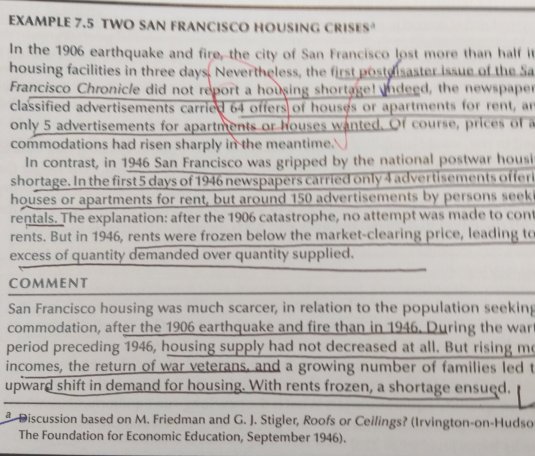
Econ Duel: Why Is the Rent So Damn High?
11 Sep 2019 Leave a comment
in applied price theory, comparative institutional analysis, economic history, economics of regulation, law and economics, politics - Australia, politics - New Zealand, politics - USA, property rights, Public Choice, rentseeking, urban economics Tags: housing affordability, land supply, rent control
Paul Craig: Prorogation: Three Assumptions
10 Sep 2019 Leave a comment
 Litigation is often predicated on certain assumptions. These may be the result of argumentation of the parties, the reasoning of the courts or an admixture of the two. The assumptions can take on an axiomatic character, and become ‘unchallengeable’. They may be regarded as expressive of uncontroversial facts, or perceived as inherent in the nature of adjudication. Such matters may be unpacked after the event, in academic discourse or subsequent litigation. Reflection after the event may be rewarding, but it does not change the prior decision. The importance of the present case therefore warrants some brief thoughts about three assumptions that are related but distinct, which have characterized the litigation thus far.
Assumption 1: Prorogation entails high policy
It is unsurprising that characterization of the case as involving high policy has featured prominently in the present litigation. It is a natural argument for government to make, the consequential contention being…
View original post 1,339 more words
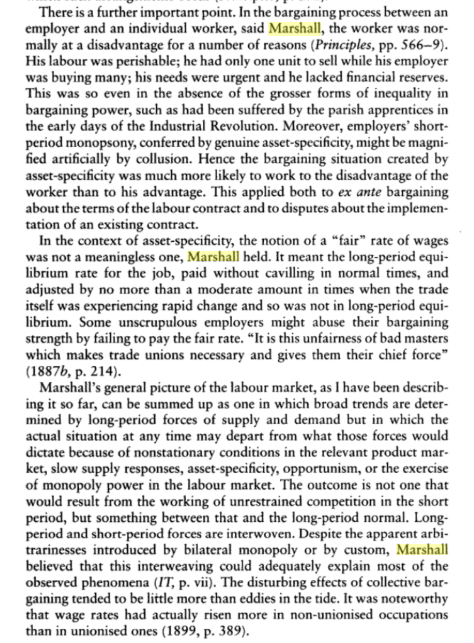
Alfred Marshall on worker’s bargaining power and the union wage premium
10 Sep 2019 1 Comment
in Alfred Marshall, applied price theory, history of economic thought, labour economics, labour supply, unions
Barely Legal: Victorian Wind Industry Furious As Noise Affected Neighbours Finally Get Justice
10 Sep 2019 Leave a comment


The wind industry’s Victorian onslaught has hit the wall, as lawyered up neighbours pursue noise nuisance cases against their tormentors.
It all started at a place called Bald Hills with a lawyer named Dominica Tannock – and her firm, DST Legal: Litigation Breakout: Victorian Wind Farm Neighbours Pursuing $Millions from Wind Developers for Noise Nuisance
Dominica’s clients at Bald Hills pursued the wind power outfit responsible for their thumping, grinding misery under the Public Health and Wellbeing Act, that prohibits noise “which is, or is liable to be, dangerous to health or offensive”. In “determining whether a nuisance arising from [noise] is, or is liable to be, dangerous to health or offensive regard must not be had to the number of persons affected or that may be affected; and regard may be had to the degree of offensiveness.” Where “offensive” means “noxious or injurious to personal comfort”. For more on…
View original post 1,344 more words


Recent Comments