Discrimination: A mountain of evidence (but analysis stopped with money left on the table – chances to profit from countering discrimination)
28 Nov 2018 Leave a comment
in applied price theory, discrimination, econometerics, gender, labour economics Tags: racial discrimination, sex discrimination
US Climate Assessment shows @jamespeshaw that the cost of even runaway #globalwarming is small
27 Nov 2018 Leave a comment
in applied price theory, applied welfare economics, energy economics, environmental economics, global warming, politics - New Zealand, politics - USA Tags: climate alarmism
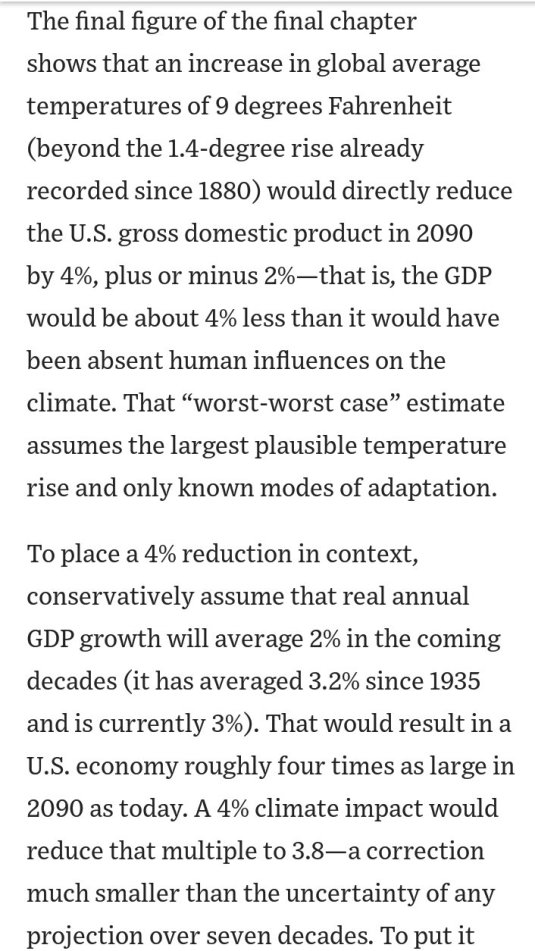
From WSJ
Milton Friedman – A Conversation On Safety Regulations
27 Nov 2018 Leave a comment
in applied price theory, economic history, environmental economics, health economics, industrial organisation, law and economics, Milton Friedman, survivor principle Tags: Product safety, road safety
Brendan O’Neill on the singling out of Israel for Leftist opprobrium
27 Nov 2018 Leave a comment

This well-argued Spectator piece by Brendan O’Neill is behind a paywall, but I’ve put some excerpts from it below. His argument, with which I happen to agree, is that the singling out of Israel among all states for special opprobrium by the Left reflects anti-Semitism constantly disguised with the euphemism “anti-Zionism.” As you’ll see in the excerpts below, O’Neill answers some Leftist arguments for why Israel deserves to be singled out, and, at the end, he argues that the hysterical anti-Israel sentiment of the Left may be responsible for the rise in anti-Semitism in the West.

Some excerpts:
Airbnb has taken the extraordinary decision to stop advertising homes for rent in Jewish settlements in the West Bank. It is extraordinary because Airbnb still advertises places to stay in Tibet, a place many Tibetans consider to be unjustly dominated by China. And in Crimea, recently annexed by Russia. And in Northern…
View original post 649 more words
Offenders discounted….. Victims forgotten
27 Nov 2018 Leave a comment

What a week it has been in the Courts.
A 14 year old was sentenced for murder. A recidivist drink driver was sentenced to home detention. A 39 year old woman was sentenced for a brutal and violent home invasion. All crimes committed against more innocent victims!
Without exception in all of these cases, justice has not been done! Our Justice System has once again failed the Victims.
Gavin Hawthorn was sentenced on his 12th drink driving charge. He received a pitiful sentence of 6 months home detention, 180 hours community service and disqualified from holding or obtaining a license for 2 years.
Hawthorn has a long history of horrendous offending. He has more than 60 prior convictions including burglary, assault and disorderly behaviour. But the worst offences, and something vitally important is that he is responsible for the death of 4 innocent victims.
An opinion piece written by Paul…
View original post 1,165 more words
As wildfires become more catastrophic, are we overlooking free-market ways to lower the cost of reducing them?
26 Nov 2018 Leave a comment

 Like many people, I’ve been monitoring, with dread, updates on the wildfires burning in California. The Camp Fire, which is burning north of Sacramento, has become the deadliest and most destructive wildfire on record for the state.
That fire is another sad reminder that more must be done to reduce fuel loads in many forests. Although this is a serious challenge, it’s also a significant opportunity for environmentalists to innovate. Fires not only kill and destroy property; they also damage watersheds and habitat. So environmentalists have much to gain from avoiding catastrophic wildfire, especially if they can find new ways to do so while minimizing the environmental impacts associated with traditional, commercial timber harvesting.
Reducing fuel loads is expensive. Even where projects avoid bureaucratic delays and litigation, paying for the projects can be a challenge. At a recent event hosted by PERC and the Heritage Foundation, the U.S. Forest Service’s…
View original post 460 more words
Jacindamania may fade – but not necessarily before the Nats rediscover their mojo
26 Nov 2018 Leave a comment
she lacks key political skills such as getting rid of political liabilities in cabinet and killing off political issues that are vote losers. Capital gains tax is one example. Another is not putting parameters on the abortion debate. Clark did not go near abortion law reform to she did not want to rocket the Christian parties over the 5% threshold. They were near back then.

Although the rest of the country may still be fingering the results of their Black Friday shopping, no such luck for the politicians as they move into the final phase of the parliamentary year.
Each of the main parties is desperate for a spark to lift performance (and perhaps polling).
PM Jacinda Ardern is taking a shellacking for her silence on China, its human rights offences, its cyber-bullying and in particular the Professor Anne-Marie Brady affair. And then, for reasons no-one can guess at, she has turned a blind eye to the disgraceful performance of Immigration Minister Iain Lees-Galloway in handling the issue of deporting Czech drug smuggler Karel Sroubek.
Is Jacindamania fading? Perhaps not yet, but it soon will, at this rate.
View original post 643 more words
New York Times celebrates Muhammad and Islam twice in one edition, emphasizing only the good deeds of the Prophet, and informing us that “true Islam” doesn’t kill blasphemers
26 Nov 2018 Leave a comment
If you had any doubt that the New York Times is going the way of Authoritarian Leftism, which includes whitewashing the nasty bits of Islam, have a look at the two articles that appeared this week—in the same op-ed section.
The first is by Haroon Moghul (click on screenshot below), described as “a fellow in Jewish-Muslim relations at the Shalom Hartman Institute of North America and the author of ‘How to Be a Muslim: An American Story’.”
Moghul recounts a time in his youth when he was on the verge of atheism, since he couldn’t personally connect with his faith. Then he took a trip to Medina with his brother, and there he had an epiphany that brought him back to Islam:
In Medina I realized I actually believed all the stories about him. That he buried the least loved of his fellow Arabs with his own hands. That…
View original post 2,426 more words
What Happened to the Transsexual Rights Movement? More on Percentages and Prevalence
26 Nov 2018 Leave a comment

In my previous post, we took a look at the claim that trans people “have always been here” in the numbers at which they’re now emerging, and found it wanting.
Now, I’d like to turn our attention to the fact that the trans rights movement has clearly undergone significant changes in the last two decades.
Twenty years ago, trans people were not making the claim that they had “always been” their preferred sex. They knew biological sex existed, and the idea of a non-transitioned, non-passing trans person entering into opposite-sex spaces was absurd.
Today, things are very different. Online trans activists are brash and bold with their claims that biological sex doesn’t exist and neither should sex-based protections. They also seem to share a belief unique to transgender people that they must be recognized as their preferred sex in order to exist at all.
When women notice…
View original post 1,352 more words
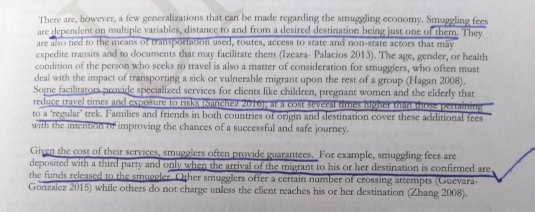
Gabrielle Sanchez on product differention and quality assurance in people smuggling
26 Nov 2018 Leave a comment
in applied price theory, development economics, economics of crime, economics of information, entrepreneurship, industrial organisation, international economic law, international economics, International law, labour economics, labour supply, law and economics, politics - USA, survivor principle Tags: asymmetric information, economics of immigration
What Have We Learned from the Collapse of Communism? by Peter Boettke
26 Nov 2018 Leave a comment
in applied price theory, Austrian economics, comparative institutional analysis, constitutional political economy, development economics, economic history, economics of bureaucracy, entrepreneurship, history of economic thought, industrial organisation, law and economics, Public Choice Tags: fall of communism
Adam Perry and Farrah Ahmed: Are Constitutional Statutes ‘Quasi-Entrenched’?
25 Nov 2018 Leave a comment


 The Supreme Court issued its decision inH v Lord Advocate (pdf) in 2012. The decision has been virtually ignored by constitutional scholars, but we believe it may be of great constitutional significance. In this post we explain why, starting with some background about constitutional statutes.
Commentators have lately considered how constitutional statutes should be interpreted (for example Tarunabh Khaitanon this blog), and what exactly makes a statute ‘fundamental’ or ‘constitutional’ (for example David Feldman in the latest issue of LQR). A third issue, and our focus here, is how a constitutional statute can be repealed.
In the well-known 2002 case of Thoburn v Sutherland City Council, Laws LJ (with whom Crane J agreed) claimed that a constitutional statute is susceptible to implied repeal in a much narrower range of circumstances than an ordinary statute. At first Laws LJ put the point categorically: ‘Ordinary statutes may be impliedly…
View original post 1,077 more words
Alexander Horne: Evidence under oath, perjury and parliamentary privilege
25 Nov 2018 Leave a comment
For those interested in implied repeals of the bill of rights
 The issue of select committee powers has received renewed interest during the 2010-15 Parliament, culminating in a report from Liaison Committee on Select committee effectiveness, resources and powers (in October 2012); and, subsequently, a report by the Joint Committee on Parliamentary Privilege in July 2013 (and a Government response later that year).
Although parliamentary select committees are frequently described as being powerful and influential, questions have arisen about their ability both to summon witnesses and punish those who are guilty of contempt or perjury.
In relation to the latter issue, the Government’s Green Paper on Parliamentary Privilege (Cm 8318, 2012), which preceded the Joint Committee’s report, had noted that:
The Houses’ power to punish non-members for contempt is untested in recent times. In theory, both Houses can summon a person to the bar of the House to reprimand them or order a person’s imprisonment. In addition, the House of Lords…
View original post 1,480 more words
Short review: Lukianoff and Haidt’s new book, and request for book suggestions
25 Nov 2018 Leave a comment
I’ve just finished reading a book that’s closely connected with many of our interests: Greg Lukianoff and Jon Haidt’s new volume, The Coddling of the American Mind: How Good Intentions and Bad Ideas Are Setting Up a Generation for Failure. Click on the screenshot to go to the Amazon site:
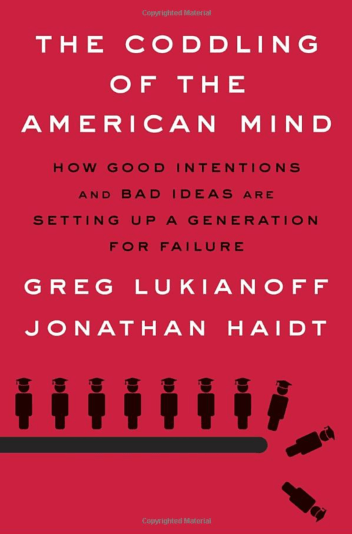
The issue is why so many students in American colleges and universities are behaving differently from in past years: they’re now ridden with anxiety and depression, demanding accommodation to their demands, protesting initiatives for free speech (or speakers they don’t like), constantly feeling “unsafe”, and making professors feel intimidated about speaking their minds. We know about these trends, but Lukianoff (head of FIRE, or the Foundation for Individual Rights in Education) and Haidt (a moral psychologist at NYU) document some of them with statistics.
Their worry is that students have absorbed what they call the Three Great Untruths, and these…
View original post 866 more words


Recent Comments