
European residential electricity prices increasing faster than prices in United States
25 Mar 2015 Leave a comment
in applied welfare economics, economic history, energy economics, environmental economics, global warming Tags: energy prices
How you adjust for inflation makes a big difference to long-term wages growth
24 Mar 2015 Leave a comment
in applied welfare economics, politics - USA
There are several measures of inflation. The measure that is used will have a substantial impact on reported growth in real wages.
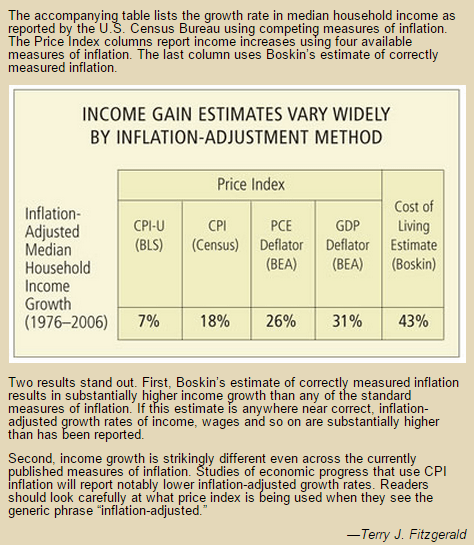
via Where Has All the Income Gone? | Federal Reserve Bank of Minneapolis.
Killer green activists – Greenpeace and golden rice
24 Mar 2015 Leave a comment
in applied welfare economics, development economics, economics of information, economics of media and culture, economics of regulation, growth miracles Tags: golden rice, Greenpeace, killer green activists
The Real "Truth About the Economy:" Have Wages Stagnated?
24 Mar 2015 Leave a comment
in applied welfare economics, technological progress Tags: CPI bias, middle-class wage stagnation
Why Are Unions So Focused on Fighting Trade Deals? – WSJ
23 Mar 2015 Leave a comment
in applied welfare economics, international economics, poverty and inequality, unions Tags: free trade agreements, middle-class wage stagnation

Half of all U.S. workers represented by unions work for governments, and another 12% are in education or health care. Trade has very little direct impact on them. Another 20% of workers represented by unions are in construction, wholesaling, retailing or transportation doing jobs that are largely immune from import competition.
Less than 10% of all the workers that U.S. unions represent today are in manufacturing or agriculture, the industries most exposed to harm from globalization. Trade creates winners and losers; a small fraction of union workers are among the obvious losers.
The reasons advanced by the American union movement is trade deals enhance the bargaining power of employers over workers and is a major contributor to the wage stagnation over the last 20 years.
I hope the Unions got that analysis of trade and wages growth right because most union members benefit from the lower prices from import competition.
via Why Are Unions So Focused on Fighting Trade Deals? – Washington Wire – WSJ.
Far Left Mana Movement admits it’s really cheap to feed the kids
23 Mar 2015 Leave a comment
in applied welfare economics, labour economics, politics - New Zealand, poverty and inequality, welfare reform Tags: activists, child poverty, Leftover Left, school breakfast programmes
Joe Trinder, the Mana News editor, today blogged about the great expense of feeding the kids for ordinary families. In the course of doing so, he showed how extremely cheap it was for parents to make their children breakfast. The Far Left has inadvertently capitulated on school breakfast programmes been outside the reach of ordinary families.

I completely agree with Joe. A 1 kg box of Weet-Bix costs $7 and a 2 L bottle of milk costs $5.55. I buy the cheaper brands of Weet-Bix than this myself.
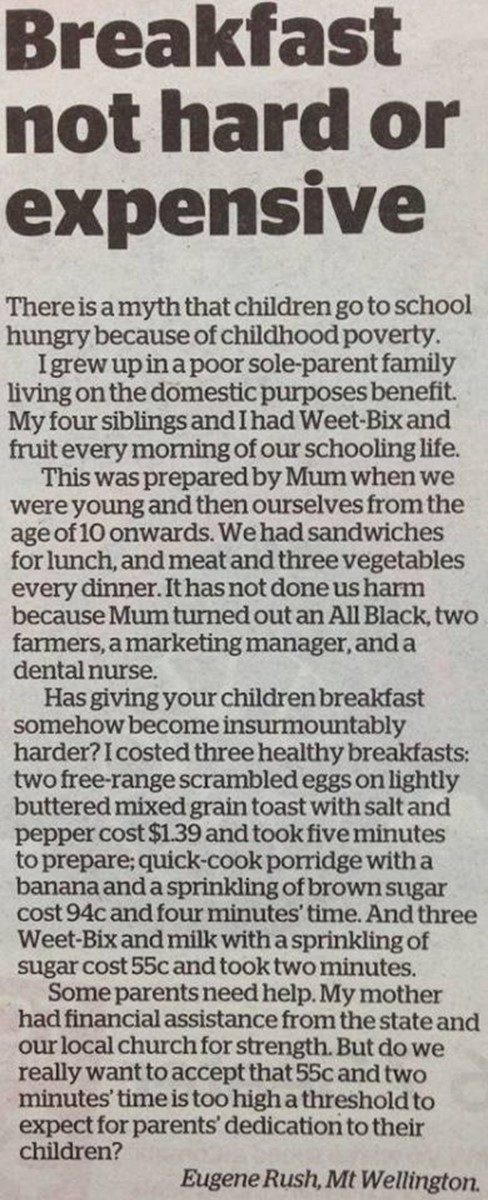
1 kg box of Weet-Bix will last maybe two weeks. 2 L of milk will last not much less than that if you pour the milk on Weet-Bix to the extent I do. Two weeks breakfast will cost much less than one dollar per breakfast as argued by Eugene Rush in her letter to the editor a few months ago.
If a family can’t find $.55 to make their children breakfast, they need targeted specific intervention from Work and Income New Zealand to see what additional financial assistance they need, including budget advice, and from the child protection agency, Child, Youth and Families.
- Providing a hungry child with breakfast at school through a Feed the Kids Bill is parliamentary grandstanding that doesn’t strike at the root of the problem.
- These hungry children are not provided with breakfast either at the weekend or during the school holidays. They are abandoned by the process set up under the Feed the Kids Bill championed by the hard left.
- Worst of all, what about the parents? No good parent would have breakfast while their child goes hungry.
No provision is made by the hard left in its Feed the Kids Bill to feed the parents of these hungry children who also go hungry every morning. There is no other charitable explanation as to why their children were not given breakfast. No one in the house can afford breakfast both during school days, at the weekend and in school holidays.

As shown from the screenshot above, the Otago University’s annual Food Cost Survey suggests that to meet basic needs, a family must spend $44 per week for a five-year-old and $34 per week for a four-year-old in Wellington, which is where I live. That is, it costs about five or six dollars per day per child to feed them. A liberal diet for a small child for a day costs not much more than a cup of coffee at a cafe where I’m going shortly. The real issue is the income of parents.
The best solution to poverty is to move people into a job. Simon Chapple is quite clear in his book in the middle of last year with Jonathan Boston that a sole parent in full-time work, and a two parent family with one earner with one full-time and one part-time worker, even at low wages, will earn enough to lift their children above most poverty thresholds.
Sustained full-time employment of sole parents and the fulltime and part-time employment of two parents, even at low wages, are sufficient to pull the majority of children above most poverty lines, given the various existing tax credits and family supports.
The best available analysis, the most credible analysis, the most independent analysis in New Zealand or anywhere else in the world that having a job and marrying the father of your child is the secret to escaping poverty is recently by the Living Wage movement in New Zealand.
According to the calculations of the Living Wage movement, earning only $18.80 per hour with a second earner working only 20 hours per week affords their two children, including a teenager, Sky TV, pets, international travel, video games and 10 hours childcare. This analysis of the Living Wage movement shows that finishing school so your job pays something reasonable and marrying the father of your child affords a comfortable family life.
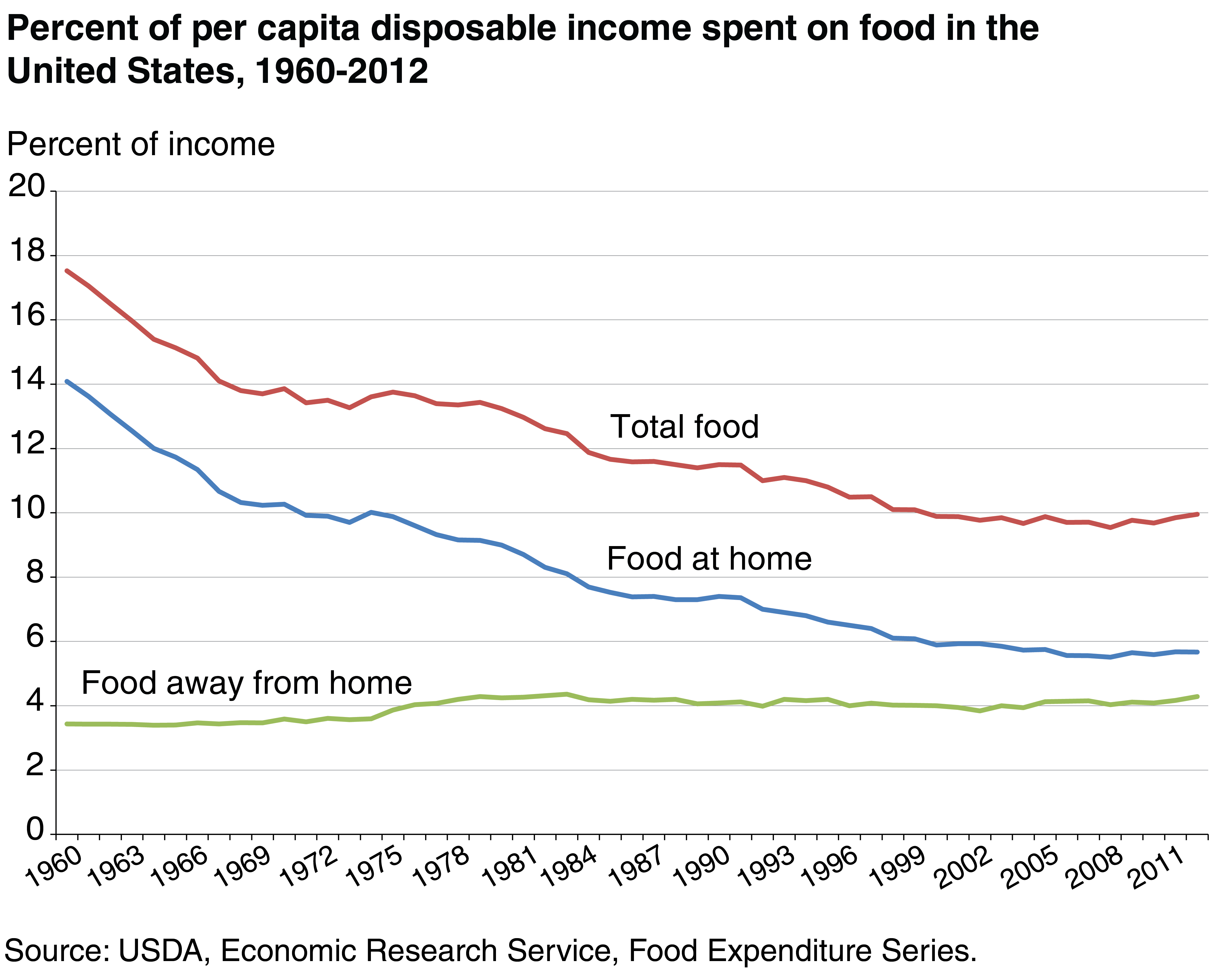
The share of income spent on food has plummeted in the US
21 Mar 2015 Leave a comment
in applied welfare economics, health economics Tags: The Great Enrichment
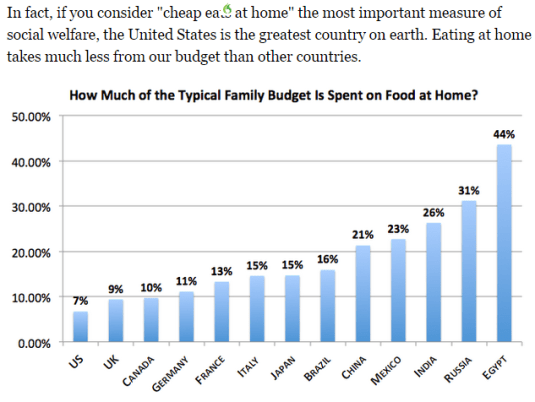
Why is it so expensive to eat in Europe as compared to America?
21 Mar 2015 Leave a comment
in applied welfare economics, economic growth, politics - USA
Sorry @WJRosenbergCTU the class war has been based on a measurement error! The real class enemy is the RMA and restricted land supply – updated again
21 Mar 2015 Leave a comment
in applied welfare economics, comparative institutional analysis, Marxist economics, politics - Australia, politics - New Zealand, politics - USA, poverty and inequality, urban economics Tags: Class war, Generation Rent, housing affordability, housing prices, land use regulation, RMA, Thomas Picketty, top 1%, wage stagnation
The other day, I replied to a rant by Bill Rosenberg about the decline in labour share of national income and its implications for income inequality and the great wage stagnation. The labour share of national income has dropped by at least 5% in most countries including New Zealand.

New data from the USA has found that the entire declining the value of the share of labour of national income is due to home ownership:
…the net capital share has increased since 1948, but when disaggregated this increase comes entirely from the housing sector: the contribution to net capital income from all other sectors has been zero or slightly negative, as the fall and rise have offset each other.
The capital share is rising because of the increased value of housing in countries with widespread home ownership. The concentration of capital ownership and wealth in the top 1% was a misplaced concern based on measurement error.
https://twitter.com/EconBizFin/status/581047721836060672
Piketty assumed the returns to capital were increasing across the entire economy. Rognlie found the trend to be almost entirely isolated to the housing sector. His 23 page long conference paper at the Brookings Institution started as a comment on a blog post on Marginal Revolution.

When Rognlie adjusted for the rapid depreciation inherent to investments in capital such as computer software, most of the rest of the increase in the capital share in recent decades in the USA and six other countries has came in housing.

A single sector such as housing is not the force that is shaping past and future of inequality as Piketty and others such as Bill Rosenberg in New Zealand have assumed. They attributed a growing share of income going to capital across the board as Tyler Cowan explains.
In the simplest version of the Piketty model, wealth grows more quickly than does the economy as a whole and thus the picture changes. The relative losers are no longer low earners but rather anyone who is not a capitalist. Any disparity is due not to their shortcomings in labour markets but rather to their lack of a high initial endowment.
The main driver of inequality is the tendency of returns on capital to exceed the rate of economic growth and company shares, businesses and other capital are owned by a narrow section of the community, and in particular by the top 1% of income earners. Trends in housing prices and the comings and goings of intangible capital is not part of that story.

Investment and depreciation of software and other intellectual property is not well handed, or even well measured in current national accounting systems as Edward Prescott has shown in a long research programme dating back 10 years. Intangible capital produced and owned by businesses is known to be big part of all investment in the economy but nearly all of it is recorded as an expense and therefore most is not part of GDP as currently measured.
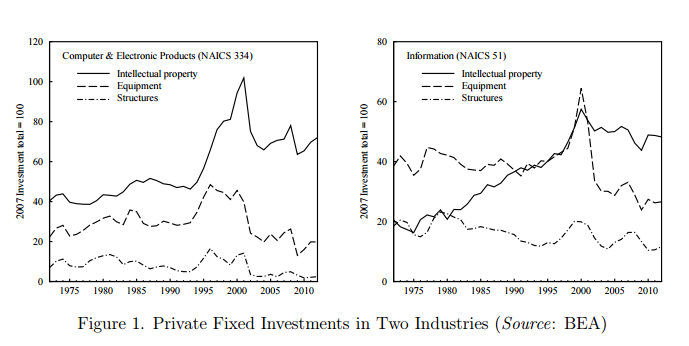
Source: Edward C. Prescott and Ellen R. McGrattan (2014)
Prescott estimated the value of intangible capital to be equal to about 60% of that of tangible capital in the US economy. Incorrect treatment of investment in intangible capital seriously underestimates investment, output, fluctuations in labour productivity and movements in the capital shares. The graph above shows that the recently introduced intellectual property classification in the US national accounts is both large and volatile relative to equipment and structures investments over the last 40 years. The graph below shows that including intangible capital completely changes the predictions of real business cycle models about trend US labour productivity in the 1990s.
Labor Productivity, for the Model, With and Without Intangible Investment (Real, Detrended) 1990-2003
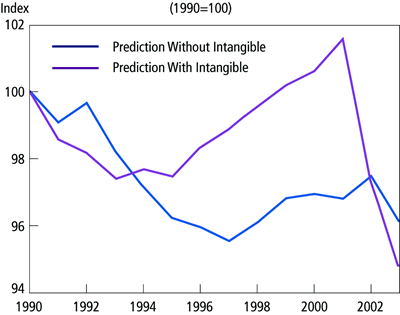
Source: McGrattan and Prescott, 2005, “Expensed and Sweat Equity,” Research Department Working Paper 636, Federal Reserve Bank of Minneapolis.
This depreciation adjustment for software investment is important because you can’t eat depreciation, as a shrewd observer noted. The rapid depreciation of software is depreciation – it cannot be redistributed from the top 1% to the downtrodden workers as some sort of income. Others have also earlier argued that Piketty’s claims rest on the recent increase in the price of housing.

The main reason for increases in the price of housing in New Zealand and elsewhere is restrictions on the supply of land by local councils. They are the real class enemy.

The metropolitan urban limit in Auckland increases land prices by 9 fold just inside that limit. As Tim Taylor said today:
The rise in capital income as a result of a long-term rise in land and housing prices across the high-income countries is a phenomenon that isn’t easily crammed into the usual disputes over whether capital owners are exploiting wage-earners.
The role of the housing sector and restrictions on land supply driving up housing prices in recent decades in shaping the future of inequality is perhaps underplayed given the many discussions of Generation Rent.

Housing affordability is a real crisis in New Zealand and many other countries with the younger generation no longer able to buy a house. They are condemned to decades of renting a house. They may never be able to afford a house on one income and perhaps two ordinary comes.
The future of inequality is between those who can and cannot afford a dream and a right for their parents and grandparents, which was to buy a house and pay the mortgage off within a couple of decades.

Young people used to buy a house shortly after leaving university and paid it off by their middle age when I was in my 20s and 30s. Back then, which was not all that long ago, ordinary workers could aspire to take out a mortgage and buy a house in the suburbs.

Unless there is a major deregulation of the supply of land in the big cities, home ownership for most in the community will really be a dream, rather than a dream of aspiration achieved by most by their 30s, if not often earlier through working and saving. The grandchildren of the baby boomers will become and perhaps already are Generation Rent.
Why are people so grumpy when everything is so much cheaper except housing?
20 Mar 2015 1 Comment
in applied welfare economics, economic history, politics - USA
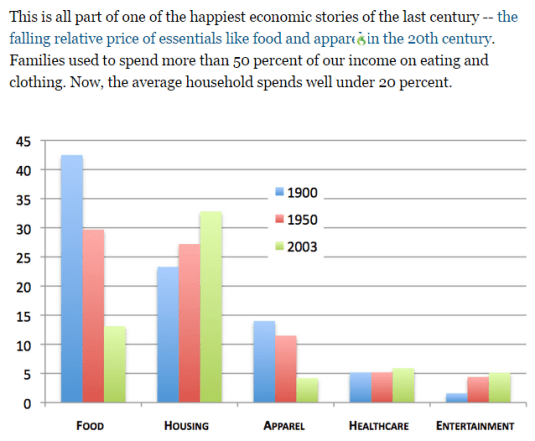
Class war warrior @WJRosenbergCTU inadvertently refutes the case for the class struggle
17 Mar 2015 Leave a comment
in applied welfare economics, economic growth, economic history, labour economics, poverty and inequality, unions
Today in the Dominion Post, Bill Rosenberg, a trade union self-described economist, argued that the workers are not getting their fair share of productivity gains in New Zealand over the last 35 years:
I calculate that wages in the 60 per cent of the economy studied by the commission would have been 12 per cent higher on average by March 2011, if they had kept up with productivity since 1978.
He then rounded up the usual Twitter Left suspects:
The commission’s study is important in that it finds that a large part of the fall in the labour share of income in the 1990s was due to high unemployment created by the radical restructuring of the economy that began in the 1980s and the Employment Contracts Act passed in 1991. Australia underwent similar restructuring during the period, but its labour income share fell only slightly. Its labour market is underpinned with an award system and other protections.
12%! 12% is at all that the class struggle is about over a 35 year period in terms of wage losses and labour surplus extract by the greedy bosses?
Figure 1: Real equivalised median household income (before housing costs) by ethnicity, 1988 to 2013 ($2013)

Source: Bryan Perry, Household incomes in New Zealand: Trends in indicators of inequality and hardship 1982 to 2013. Ministry of Social Development (July 2014).
As shown in figure 1, between 1994 and 2010, real equivalised median New Zealand household income rose by 47%; for Māori, this rise was 68%; for Pasifika, the rise in real equivalised median household income was 77%. Obviously these losses from the change in shares of GDP are dwarfed by the general increases in living standards over the last 20 years.
As is common with every member of the Left over Left that I run into these days, such as Bill Rosenberg, their analysis has no gender analysis.
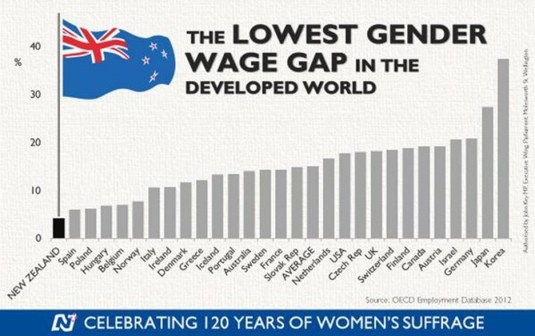
The Left over Left invariably fail to mention that New Zealand has the smallest gender wage gap of all the industrialised countries.
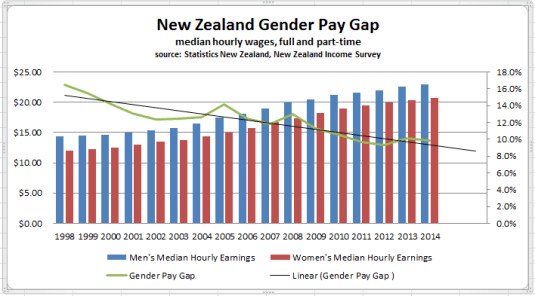
Over the last more than two decades in New Zealand, there has been sustained income growth spread across all of New Zealand society contrary to hopes and dreams of the Left over Left. Perry (2014) reviews the poverty and inequality data in New Zealand every year for the Ministry of Social Development. He concluded that:
Overall, there is no evidence of any sustained rise or fall in inequality in the last two decades. The level of household disposable income inequality in New Zealand is a little above the OECD median. The share of total income received by the top 1% of individuals is at the low end of the OECD rankings.
As for Rosenberg’s hypothesis that it’s all the fault of the Employment Contracts Act, that doesn’t stand up. Figure 2 shows that union membership has been in a long slow decline in New Zealand since the mid-1970s. This is been pretty much the pattern all round the world.
Figure 2: Union density, New Zealand, Australia, the UK and USA 1970-2013

Source: OECD Stats Extract
The much hated Employment Contracts Act 1991, much hated by the Left over Left, doesn’t really show up in the union density figures in figure 2. There is no sudden break in trend obvious in figure 2 in the early 1990s when the Employment Contract Act was passed.
Indeed, the passage of the Employment Contracts Act 1991 was followed by a 15 year economic boom in employment and economic growth, as shown in figure 3. This was after the lost decades of 1974 to 1992 when there was next to no growth in real GDP per New Zealander aged 15 to 64. The good old days when the Lost Decades for New Zealand.
Figure 3: Real GDP per New Zealander and Australian aged 15-64, converted to 2013 price level with updated 2005 EKS purchasing power parities, 1956-2013
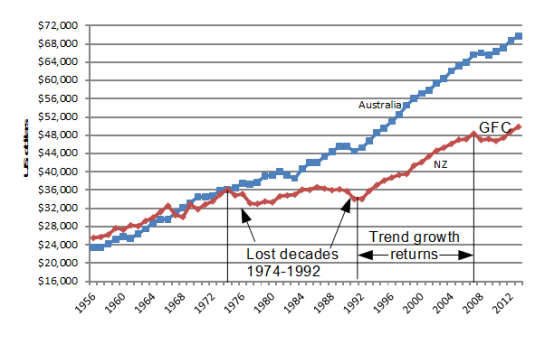
Source: Computed from OECD Stat Extract and The Conference Board, Total Database, January 2014.
Things are so grim for the class struggle in New Zealand that the leader of the Labour Party has had to redefine the working class because it is withering away so rapidly because so many workers are joining the middle-class:
Andrew Little is looking to update Labour's definition of the 'working class': stuff.co.nz/national/polit… http://t.co/AQ9mJL7CQf—
NZ Stuff Politics (@NZStuffPolitics) November 30, 2014
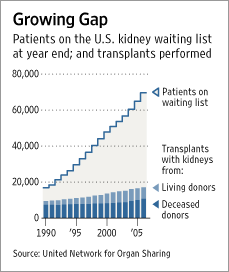
Managerial Econ: Want a kidney? Wait six years.
17 Mar 2015 Leave a comment
in applied price theory, applied welfare economics, health economics Tags: organ donation
The policy world and academia offer widely different opportunities for early career researchers
15 Mar 2015 Leave a comment
in applied price theory, applied welfare economics, economics of bureaucracy, economics of education, occupational choice, organisational economics, politics, Public Choice
Academia rewards findings that are different and unexpected. In policy it is more important to be right than novel—after all, millions of lives may be impacted by a policy decision. In academia, people argue a lot about the direction of an effect but very little about the magnitude: in policy it’s the reverse…


 Utopia, you are standing in it!
Recent Comments