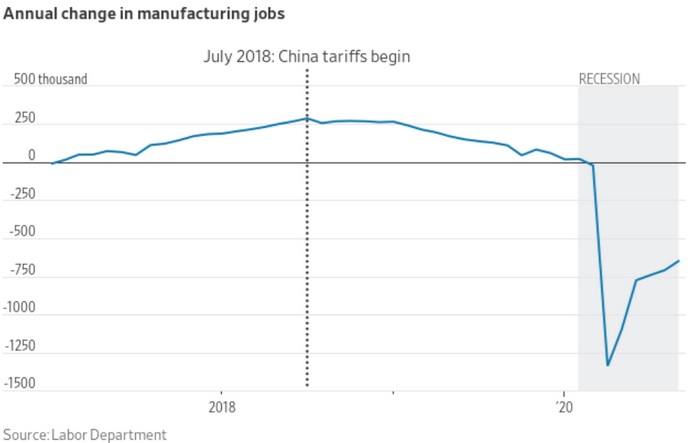
This short note shows that accounting for capital adjustment is critical when analyzing the long-run effects of trade wars on real wages and consumption. The reason is that trade wars increase the relative price between investment goods and labor by taxing imported investment goods and their inputs. This price shift depresses capital demand, shrinks the […]
Long-Run Effects of Trade Wars
24 Apr 2025 Leave a comment
in applied price theory, applied welfare economics, comparative institutional analysis, development economics, econometerics, history of economic thought, industrial organisation, labour economics, labour supply, politics - USA, unemployment Tags: 2024 presidential election, free trade, tariffs, unintended consequences
My debate with Dani Rodrik about tariffs and free trade
22 Apr 2025 Leave a comment
in applied price theory, applied welfare economics, comparative institutional analysis, development economics, economic history, history of economic thought, industrial organisation, international economic law, international economics, labour economics, politics - USA, unemployment Tags: 2024 presidential election, free trade, tariffs
This occurred in Knoxville, you can watch it here. Lots of fun, and p.s. I am more of a free trader than he is. We did have some disagreements.
My debate with Dani Rodrik about tariffs and free trade
The Protectionism Edition of Economics Humor
01 Apr 2025 Leave a comment
in applied price theory, applied welfare economics, comparative institutional analysis, economic history, history of economic thought, income redistribution, industrial organisation, international economics, politics - USA, Public Choice, rentseeking, survivor principle Tags: 2024 presidential election, free trade, tarrifs

It appears that Trump wants to repeat the mistakes of the 1930s with a global trade war. That is going to be very bad news for workers, consumers, taxpayers, manufacturers, farmers, and exporters. But there are two bits of good news. At least for small slices of the populations First, lobbyists will get rich as […]
The Protectionism Edition of Economics Humor
Institutional ownership of single-family housing
16 Mar 2025 Leave a comment
in applied price theory, applied welfare economics, econometerics, urban economics Tags: housing affordability
In the last decade, large financial institutions in the United States have purchased hundreds of thousands of homes and converted them to rentals. This paper studies the welfare consequences of institutional ownership of single-family housing. We build an equilibrium model of the housing market with two sectors: rental and homeownership. The model captures two key…
Institutional ownership of single-family housing
Australia’s Pandemic Exceptionalism
05 Mar 2025 Leave a comment
in applied price theory, applied welfare economics, budget deficits, economic growth, economics of bureaucracy, economics of natural disasters, economics of regulation, health economics, labour economics, labour supply, macroeconomics, monetary economics, politics - Australia, politics - New Zealand, Public Choice, unemployment Tags: economics of pandemics

That’s the title of a 2024 book by a couple of Australian academic economists, Steven Hamilton (based in US) and Richard Holden (a professor at the University of New South Wales). The subtitle of the book is “How we crushed the curve but lost the race”. It is easy to get off on the wrong […]
Australia’s Pandemic Exceptionalism
Must watch – Gigi Foster on lockdowns at PAEC
17 Feb 2025 Leave a comment
in applied price theory, applied welfare economics, comparative institutional analysis, econometerics, economics of natural disasters, health economics, politics - Australia Tags: economics of pandemics
Minimum Wages, Efficiency, and Welfare
17 Feb 2025 Leave a comment
in applied price theory, applied welfare economics, econometerics, labour economics, labour supply, minimum wage
Recently Alex raised some doubts, to say the least, about the Card-Krueger view of minimum wage hikes. Well, it turns out there is more, and a new consensus is on the verge of forming. Here are David Berger, Kyle Herkenhoff, and Simon Mongey, from a new Econometrica piece: Many argue that minimum wages can prevent efficiency […]
Minimum Wages, Efficiency, and Welfare
Trade 101 for Trumpies
08 Feb 2025 Leave a comment
in applied price theory, applied welfare economics, Austrian economics, comparative institutional analysis, constitutional political economy, development economics, entrepreneurship, industrial organisation, international economics, politics - USA Tags: 2024 presidential election

To augment my four-part video series about trade (dealing with the WTO, creative destruction, deficits, and economics), here’s part of my recent lecture about Trump’s trade policy to the Universidad de Libertad in Mexico City For those who (mistakenly) want to skip the video, my speech focused on these five themes. Trade deficits don’t matter. […]
Trade 101 for Trumpies
Some Links
06 Feb 2025 Leave a comment
in applied price theory, applied welfare economics, economic history, history of economic thought, international economics, politics - USA Tags: 2024 presidential election, free trade, game theory, tariffs
TweetNational Review‘s Charles Cooke explains that Trump’s trade war is needless. Two slices: How do I hate President Trump’s capricious levying of tariffs? Let me count the ways. They are constitutionally suspect, statutorily usurpative, diplomatically toxic, and culturally chaotic; they represent a profound political risk for the new administration — the potential upsides of which…
Some Links
Reviewing Covid experiences and policies
01 Feb 2025 Leave a comment
in applied price theory, applied welfare economics, comparative institutional analysis, economic growth, economics of bureaucracy, economics of regulation, health economics, macroeconomics, politics - New Zealand, Public Choice Tags: economics of pandemics

Michael Reddell writes – I’ve spent the last week writing a fairly substantial review of a recent book (“Australia’s Pandemic Exceptionalism: How we crushed the curve but lost the race”) by a couple of Australian academic economists on Australia’s pandemic policies and experiences. For all its limitations, there isn’t anything similar in New Zealand. What […]
Reviewing Covid experiences and policies
When politicians campaign on competition, be very worried
31 Jan 2025 Leave a comment
in applied price theory, applied welfare economics, Armen Alchian, Austrian economics, comparative institutional analysis, economics of information, economics of regulation, entrepreneurship, experimental economics, history of economic thought, law and economics, politics - New Zealand, property rights Tags: competition law
Targeting big existing businesses may be tempting to politicians, but ensuring market openness will do more good Eric Crampton writes – It’s fair to say that economists like competition. It’s also fair to say that when politicians start talking about competition, economists ought to get a little bit nervous.
When politicians campaign on competition, be very worried
Reviewing Covid experiences and policies
30 Jan 2025 Leave a comment
in applied price theory, applied welfare economics, economic history, economics of bureaucracy, economics of regulation, fiscal policy, health and safety, health economics, labour economics, labour supply, law and economics, macroeconomics, politics - Australia, politics - New Zealand, property rights, Public Choice Tags: economics of pandemics

I’ve spent the last week writing a fairly substantial review of a recent book (“Australia’s Pandemic Exceptionalism: How we crushed the curve but lost the race”) by a couple of Australian academic economists on Australia’s pandemic policies and experiences. For all its limitations, there isn’t anything similar in New Zealand. What we do have is […]
Reviewing Covid experiences and policies
Margaret Thatcher, Michael Curley, and the 19th Theorem of Government
16 Jan 2025 Leave a comment
in applied price theory, applied welfare economics, Austrian economics, comparative institutional analysis, constitutional political economy, economic growth, economic history, economics of regulation, energy economics, environmental economics, financial economics, fiscal policy, human capital, income redistribution, international economics, labour economics, labour supply, law and economics, liberalism, libertarianism, macroeconomics, Marxist economics, politics - USA, poverty and inequality, property rights, Public Choice, public economics, regulation, rentseeking
In this 12-second video, Margaret Thatcher is talking about the Labour Party in the United Kingdom, but her warning has universal application. And when I say her warning has universal application, I’m not joking. Politicians generally can’t resist the temptation to buy votes. And I fear that this can and will happen at all levels […]
Margaret Thatcher, Michael Curley, and the 19th Theorem of Government
One early report on congestion pricing in NYC
16 Jan 2025 1 Comment
in applied price theory, applied welfare economics, comparative institutional analysis, market efficiency, politics - USA, public economics, transport economics, urban economics Tags: road pricing
That is my latest Bloomberg column, here is one bit: The core version of the plan stipulates a $9 toll for drivers entering Manhattan below and including 60th Street. Implementation is by E-Z Pass, and the tolls can vary in complex ways. But if you don’t cross the line, you don’t pay. So residents below 60th Street are exempt, […]
One early report on congestion pricing in NYC
Climatists Make Their Case by Omitting Facts
15 Jan 2025 1 Comment
in applied price theory, applied welfare economics, economic history, economics of climate change, economics of regulation, energy economics, environmental economics, environmentalism, global warming, politics - USA Tags: climate activists, climate alarmism

One of the world’s top economists has written an expert court report that forcefully supports a group of children and young adults who have sued the federal government for failing to act on climate change. (Source: Inside Climate News here) Excerpts in italics with my bolds. Stiglitz, a Columbia University economics professor and former World […]
Climatists Make Their Case by Omitting Facts
Recent Comments