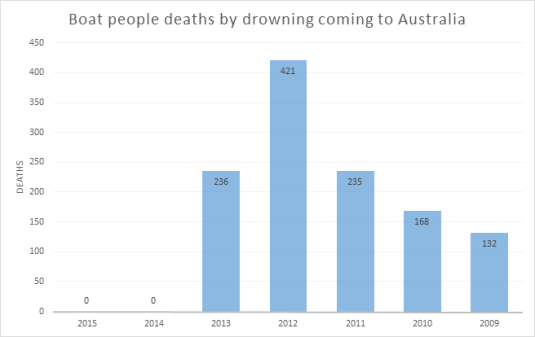
Arriving by boat in Australia does not increase the size of the refugee quota. It just changes who gets to the head of the queue and how many died trying to get to the head of the queue.
There is nothing compassionate about rewarding people for risking their lives. The chances of dying while attempting to come to Australia by boat are about 2%.
The recent experience in Europe confirms that just letting large numbers of refugees come to your country hardens the attitude of the majority of voters in that country to admitting refugees in general, much less more than their current quota.
The op-ed by Tim Hazledine today made a poor case against the Trans-Pacific Partnership agreement (TPPA). A much better case could be made but for his still fighting the 1990 election in New Zealand, which was about the future of economic reform.
One of the more gormless of the 1980s “Rogernomics” economic policy experiments was to slash tariffs on imports without seeking equivalent concessions from our trading partners.
That didn’t do us much good then, but means now that matching reductions under the TPP is relatively painless for New Zealand, because our tariffs are already so low.
He wants to put tariffs back up again so that the poor pay well over the odds to import goods that are often not made in New Zealand and when they were they were very expensive.
Henry Simons argued that economics and in particular applied price theory is most useful both to the student and the political leader as a prophylactic against popular fallacies. Paul Krugman explained the twisted logic of trade negotiations well in this tradition when he said:
Anyone who has tried to make sense of international trade negotiations eventually realizes that they can only be understood by realizing that they are a game scored according to mercantilist rules, in which an increase in exports – no matter how expensive to produce in terms of other opportunities foregone – is a victory, and an increase in imports – no matter how many resources it releases for other uses – is a defeat.
The implicit mercantilist theory that underlies trade negotiations does not make sense on any level, indeed is inconsistent with simple adding-up constraints; but it nonetheless governs actual policy.
The economist who wants to influence that policy, as opposed to merely jeering at its foolishness, must not forget that the economic theory underlying trade negotiations is nonsense – but he must also be willing to think as the negotiators think, accepting for the sake of argument their view of the world.
The logic of trade negotiations is they are about cutting tariffs we should have cut long ago in return to others cutting their tariffs which they too should have cut long ago if they had any concern for the welfare of their own country rather than special interests.
Tim Hazledine swallows the logic of trade negotiations hook, line and sinker with all the enthusiasm of a non-economist but he is a professional economist. Professional economists laugh at the mercantilist logic of trade negotiations.
I’ve described myself as a lukewarm opponent of the Trans-Pacific Partnership; although I don’t share the intense dislike of many progressives, I’ve seen it as an agreement not really so much about trade as about strengthening intellectual property monopolies and corporate clout in dispute settlement — both arguably bad things, not good, even from an efficiency standpoint….
What I know so far: pharma is mad because the extension of property rights in biologics is much shorter than it wanted, tobacco is mad because it has been carved out of the dispute settlement deal, and Republicans in general are mad because the labour protection stuff is stronger than expected. All of these are good things from my point of view. I’ll need to do much more homework once the details are clearer.
Krugman then reminded that a trade agreement is most politically viable when it is most socially harmful. This is the point that the opponents of the TPPA miss. They will not want to discuss how some trade agreements are good deals but others are bad. That would admit that trade agreements can be welfare enhancing, and sometimes they are but sometimes not.
Hazledine’s op-ed improves noticeably when he talks about sovereignty but this will backfire on him as I will show shortly:
what perhaps most concerns TPP doubters is possible loss of sovereignty – control by legitimate New Zealand governments over New Zealand policies and institutions: Pharmac, mining, greenhouse gases, fracking, biomedical patents, the Treaty of Waitangi and others have been raised as being at risk. TPP supporters have attempted to soothe such concerns, but I’d say they should come clean. Of course the TPP will weaken New Zealand’s sovereignty. That is what these things are supposed to do!
The fundamental idea or ideology behind the TPP is that national governments cannot be trusted to act independently on many issues, because they will inevitably succumb to local vested interests. Only the cleansing discipline of untrammelled global free-market forces will deliver efficient outcomes.
I fully understand the economic logic of this position, and could easily myself compile a long list of harmful effects of local vested interests, at the top of which would actually be those Canadian etc dairy and other agricultural policies.
But the basic premise is flawed. Most of the sovereignty we are giving up is not ceded to the invisible hand of free, competitive markets. It is not even handed over to larger sovereign states, such as the United States. It is largely to be conceded in the cause of making the world a safer place for huge, stateless multinational corporations to roam. Are we sure this is what we want?
I agree that treaties reduce sovereignty. That is what they are about. I am particularly concerned about treaties that reduce New Zealand’s sovereignty over its greenhouse gas emissions. These sovereignty arguments against trade agreements apply equally to climate treaties.
Likewise, trade agreements should not include trade and environmental standards as they limit the right of New Zealand to deregulate its labour market.
All too often unions point out that this or that International Labor Organisation convention signed decades ago conflicts with labour market deregulation. That undermines the sovereignty of New Zealand regarding the regulation of the economy just as much is the TPPA.
Economists do not know how to accurately measure the growth effects of most policies
Dynamic scoring relies on less-than-accurate, theory-based macro models
The macro models undergirding dynamic scoring have numerous controversial and unproven built-in assumptions
The assumptions embedded in the macro models are not always carefully empirically based
Macro models exclude theoretically and empirically supported evidence of supply-side effects of public investment
Macro models exclude evidence-based effects of economic inequality
Macro models exclude evidence-based effects of numerous policies
Macro models provide different estimates of growth impacts of policy depending on guesses of how the policy may be finance
Against that is dynamic scoringremoves the biasagainst pro-growth policies in current budgetary scoring:
[A] theoretical advantage of accurate dynamic scoring is that it is not biased against pro-growth policies compared to the current conventional scoring method. By ignoring macroeconomic effects, the conventional method overstates the true budgetary cost of pro-growth policies, such as infrastructure investments, and understates the cost of anti-growth policies.
The bigger problem is something I learnt when costing a tax proposal for an election campaign. There was an error because I did the costing on a spreadsheet while I had a bad head cold.
The advantage of the error was the policy, as a result of this minor error in the tabulations attracted considerable attention from the major parties.
I was advised by a very wise head that this tabulation error in the dynamic scoring was not so bad a problem. This was because the tabulation error gave our side a chance to have a go at them again in the media. The policy announcement stayed in the new cycles for longer than otherwise and attracted attention from the big parties.
If a policy is too good, too perfect, the other parties will kill it with silence. You get only one bite in the news cycle and that is it.
If your policy announcement is killed by silence, at least you are guaranteed a chance to go at it again when the proposed independent costings unit a week or so later in the election campaign. You might disagree of those costings just to attract attention in the next new cycle.
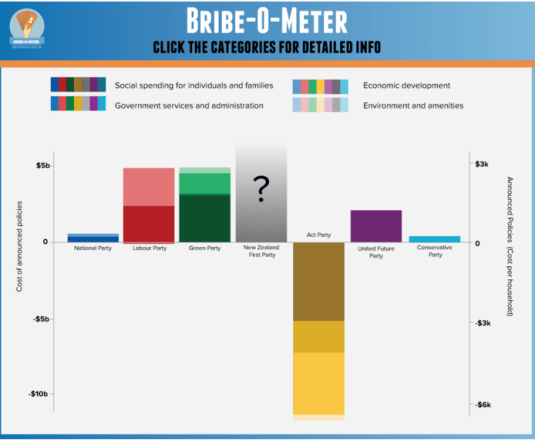
Given the size, ambition and nebulous externality content of Green party proposals, they will benefit considerably from getting another go by questioning the Parliamentary budget office costings. That guarantees at least two new cycles to every one of their budgetary and regulatory announcements. No wonder they have proposed this independent costings unit.
If the New Zealand Greens do not like the costing from their proposed independent costings unit, they can just rage against neoliberalism and the conservative bias of economists. They cannot lose in terms of another bite of the 24-hour news cycle.
As a starter to feigning disagreement with any independent costings of their tax, spending and regulation proposals, Milton Friedman argued that people agree on most social objectives, but they differ often on the predicted outcomes of different policies and institutions. This leads us to Robert and Zeckhauser’s taxonomy of disagreement:
Positive disagreements can be over questions of: 1. Scope: what elements of the world one is trying to understand? 2. Model: what mechanisms explain the behaviour of the world? 3. Estimate: what estimates of the model’s parameters are thought to obtain in particular contexts?
Values disagreements can be over questions of: 1. Standing: who counts? 2. Criteria: what counts? 3. Weights: how much different individuals and criteria count?
Any positive analysis tends to include elements of scope, model, and estimation, though often these elements intertwine; they frequently feature in debates in an implicit or undifferentiated manner. Likewise, normative analysis will also include elements of standing, criteria, and weights, whether or not these distinctions are recognised. There is a rich harvest for nit-picking to keep the story going.
If George Bush had not won the 2000 presidential election, Paul Krugman would have taken over as the best communicator of economics since Milton Friedman. Instead, he became patient number no.1 of George Bush derangement syndrome. Ann Coulter was patient no. 1 of Clintons derangement syndrome.
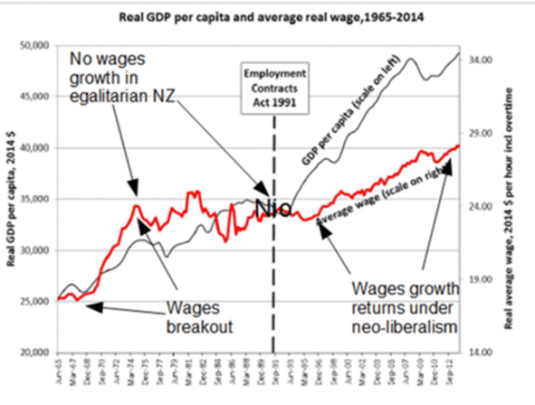
The union movement posted two excellent charts during the last election showing how well things have gone since the 1980s economic reforms and their consolidation in the early 1990s.
The charts show that real wage growth returned in the early 1990s after the passage of the Employment Contracts Act and the consolidation of government finances. This was after two decades of wage stagnation in what the unions regards as the good old days.
Furthermore, as the union chart shows, the average incomes of the top 1% in New Zealand is a pretty stable for several decades. Whatever else is happening New Zealand, you cannot blame it on the top 1% because they are lazy. What increase there was in average top incomes in New Zealand was followed by the return of real wage growth in New Zealand and a long economic boom where the unemployment rate drop below 3.5%
The main bugbear is housing affordability which is a result of the Resource Management Act passed in 1993 as the union chart shows. The unions, the Labour Party and Greens all support the laws that result in this housing unaffordability.
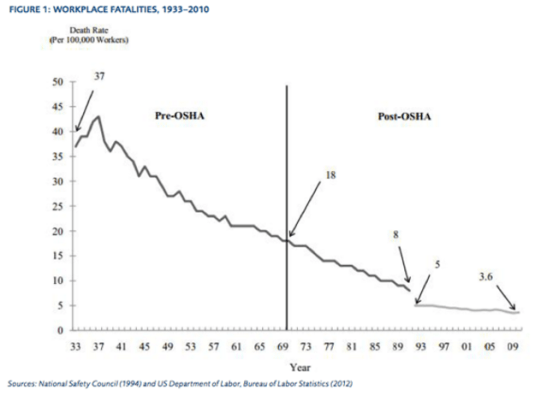
Workplace safety arises as a by-product of economic growth. Risks in the workplace and outside that would not countenance now were routine a few decades ago because the risk of eliminating them was high.
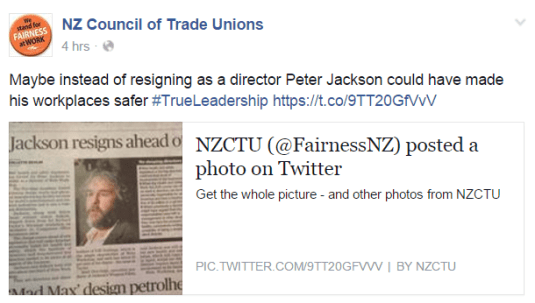
The soon to take effect New Zealand health workplace safety legislation makes it much more difficult to have independent directors and part-time directors of companies. That will both weaken the ability of shareholders to prevent insider control as well as introduce a diversity of views onto boards of directors.
The resignation of Sir Peter Jackson is an example of this. Talented entrepreneurs are no longer able to run large numbers by sitting on the board and intervening on a management by exception basis.
Rupert Murdoch as an example of an executive able to run a global empire. He would ring up the chief executives of his subsidiaries for one minute to month. If they are talking about something interesting, he would listen for longer. He was the ultimate one-minute manager who built a global empire around his supreme entrepreneurial talent.
The new legislation on workplace safety will increase the cost of building a successful business from the ground up. Entrepreneurs will not be able to quickly intervene in the company and dismiss underperforming executives who look after things while they are away. This is because they are not on the Board of Directors.
One constraint on the growth of any firm is entrepreneurs have a limited span of control (Coase 1937; Williamson 1967, Lucas 1978; Oi 1983a, 1983b). A span of control is the number of subordinates that an individual supervisor has to control and lead either directly or through a hierarchical managerial chain (Fox 2009). There are only so many tasks that even the most able of entrepreneurs can carry out in one day. Over-stretched spans of control motivate entrepreneurs to hire professional managers and delegate to them a wide range of decision-making rights over the firms they own (Williamson 1975; Foss, Foss and Klein 2008).
Entrepreneurs and the professional managers they hired to assist them must divide their respective time between monitoring employees, identifying new business opportunities, forecasting buyer demand and running the other aspects of their business (Lucas, 1978; Oi 1983, 1983b, 1988; Foss, Foss, and Klein 2008). The larger is the firm, the more employees there are for the entrepreneur to direct, monitor and reward. These costs of directing and monitoring employees will increase with the size of the firm and larger firms will encounter information problems not present in smaller firms (Alchian and Demsetz 1972; Stigler 1962)
The time of the more talented entrepreneurs is more valuable because they had the superior managerial skills and entrepreneurial alertness to make their firms large in the first place and remain deft enough to survive in competition. Time spent on the supervision of employees is time that is spent away from other uses of the talents that got these more able entrepreneurs to the top and keeps them there (Williamson 1967; Lucas 1978; Oi 1983b, 1988, 1990; Idson and Oi 1999; Black et al 1999).
Firms in the same industry tend to exhibit systematic differences in their organization of production and the structure of their workforces because entrepreneurial ability is the specific and scarce production input that limits the size of a firm (Lucas, 1978; Oi 1983b). The less able entrepreneurs tend to run the smaller firms while the better entrepreneurs tend to lead both the currently large firms and the smaller firms that are growing at the expense of market rivals (Lucas 1978, Oi 1983b; Stigler 1958; Alchian 1950).
There has been a tremendous improvement in the working conditions over the 20th century. The main driver was the incentive and employers to provide safe workplaces as real wages grew. Adam Smith noted that more dangerous and unpleasant jobs always attracted a wage premium as he explains in the Wealth of Nations:
The five following are the principal circumstances which, so far as I have been able to observe, make up for a small pecuniary gain in some employments, and counterbalance a great one in others: first, the agreeableness or disagreeableness of the employments themselves; secondly, the easiness and cheapness, or the difficulty and expense of learning them; thirdly, the constancy or inconstancy of employment in them; fourthly, the small or great trust which must be reposed in those who exercise them; and, fifthly, the probability or improbability of success in them.
First, the wages of labour vary with the ease or hardship, the cleanliness or dirtiness, the honourableness or dishonourableness of the employment. Thus in most places, take the year round, a journeyman tailor earns less than a journeyman weaver. His work is much easier. A journeyman weaver earns less than a journeyman smith. His work is not always easier, but it is much cleanlier. A journeyman blacksmith, though an artificer, seldom earns so much in twelve hours as a collier, who is only a labourer, does in eight. His work is not quite so dirty, is less dangerous, and is carried on in daylight, and above ground.
Honour makes a great part of the reward of all honourable professions. In point of pecuniary gain, all things considered, they are generally under-recompensed, as I shall endeavour to show by and by. Disgrace has the contrary effect.
The trade of a butcher is a brutal and an odious business; but it is in most places more profitable than the greater part of common trades. The most detestable of all employments, that of public executioner, is, in proportion to the quantity of work done, better paid than any common trade whatever.
Hunting and fishing, the most important employments of mankind in the rude state of society, become in its advanced state their most agreeable amusements, and they pursue for pleasure what they once followed from necessity. In the advanced state of society, therefore, they are all very poor people who follow as a trade what other people pursue as a pastime. Fishermen have been so since the time of Theocritus. A poacher is everywhere a very poor man in Great Britain. In countries where the rigour of the law suffers no poachers, the licensed hunter is not in a much better condition. The natural taste for those employments makes more people follow them than can live comfortably by them, and the produce of their labour, in proportion to its quantity, comes always too cheap to market to afford anything but the most scanty subsistence to the labourers.
Disagreeableness and disgrace affect the profits of stock in the same manner as the wages of labour. The keeper of an inn or tavern, who is never master of his own house, and who is exposed to the brutality of every drunkard, exercises neither a very agreeable nor a very creditable business. But there is scarce any common trade in which a small stock yields so great a profit…
The wages in any particular job will vary with the risks that are known to the worker in that job. That is an important qualification.
Competition in labour markets ensures that the net advantages of different jobs will tend to equality. This theory of the labour market originating in Adam Smith, which drives much of modern labour economics became to be known as the theory of compensating differentials.
Firms can choose their production technology to offer workers greater safety or they can economize on safety and offer the savings to workers in the form of higher wages. There is a trade-off in offering more safety or higher wages, holding constant the level of profits. As Kip Viscusi explains:
Wage premiums paid to U.S. workers for risking injury are huge—in 1990 they amounted to about $120 billion annually, which was over 2 percent of the gross national product, and over 5 percent of total wages paid.
These wage premiums give firms an incentive to invest in job safety because an employer who makes his workplace safer can reduce the wages he pays. Employers have a second incentive because they must pay higher premiums for workers’ compensation if accident rates are high.
One of the effects of safety regulation is the employers no longer have to pay this wage premium in more dangerous or disagreeable jobs but as Fishback wrote:
Studies of wages before and after the introduction of workers’ compensation show, however, that non-union workers’ wages were reduced by the introduction of workers’ compensation. In essence, the non-union workers “bought” these improvements in their benefit levels.
Even though workers may have paid for their benefits, they still seem to have been better off as a result of the introduction of workers’ compensation. Many workers had faced problems in purchasing accident insurance at the turn of the century. Workers’ compensation left them better insured, and allowed many of them to spend some of their savings that they had set aside in case of an accident.
What literature there is about suggest that workers overestimate small risks and underestimate large risks. Surveys of manufacturing employment show that one third of workers quit because they found out the job they accepted was more dangerous than they expected.
One clear trend of the 20th century is as countries got richer, workers demanded more safety at work and larger wage premiums. Market incentives for better worker safety dwarf legal incentives such as from being sued, which in turn dwarf regulatory incentives.
There is also evidence of a glass coffin effect. About 95% of workplace deaths of men. Indeed, there are some interesting journal papers about how occupational choice is affected by motherhood, sole motherhood and sole fatherhood. Single parents are more cautious about their occupational choices.
CHART: Here's a gender gap I don't think most women want to close. Next "Equal Job Fatality Day" occurs in 2026. pic.twitter.com/MNlovX0j52
It is unfortunate that the unions in New Zealand opposes a risk based system of workers’ compensation. The current system is not only no fault, employers pay premiums based on the risks of their industry, not of their individual workplace. There is plenty of evidence to show the charging premiums based on the risks of an accident and the previous record of workplace safety greatly reduces workplace deaths and injuries as Viscusi explains:
The workers’ compensation system that has been in place in the United States throughout most of this century also gives companies strong incentives to make workplaces safe. Premiums for workers’ compensation, which employers pay, exceed $50 billion annually. Particularly for large firms, these premiums are strongly linked to their injury performance.
Statistical studies indicate that in the absence of the workers’ compensation system, workplace death rates would rise by 27 percent. This estimate assumes, however, that workers’ compensation would not be replaced by tort liability or higher market wage premiums.
Why Evolution is True is a blog written by Jerry Coyne, centered on evolution and biology but also dealing with diverse topics like politics, culture, and cats.
In Hume’s spirit, I will attempt to serve as an ambassador from my world of economics, and help in “finding topics of conversation fit for the entertainment of rational creatures.”
“We do not believe any group of men adequate enough or wise enough to operate without scrutiny or without criticism. We know that the only way to avoid error is to detect it, that the only way to detect it is to be free to inquire. We know that in secrecy error undetected will flourish and subvert”. - J Robert Oppenheimer.



 Utopia, you are standing in it!
Recent Comments