Computers in 1964 vs. 2014: buff.ly/1NoBa3N http://t.co/4MFBCyk1D3—
HumanProgress.org (@humanprogress) June 28, 2015
50 years of creative destruction in desktops
13 Oct 2015 Leave a comment
in applied welfare economics, economic history, economics of media and culture, entrepreneurship, technological progress Tags: creative destruction, desktops, entrepreneurial alertness, innovation
How @MaxRashbrooke showed housing costs is the main driver of poverty when trying to argue rising inequality was not driven by housing costs
13 Oct 2015 Leave a comment
in applied welfare economics, economics of regulation, politics - New Zealand, poverty and inequality, Rawls and Nozick, rentseeking, urban economics
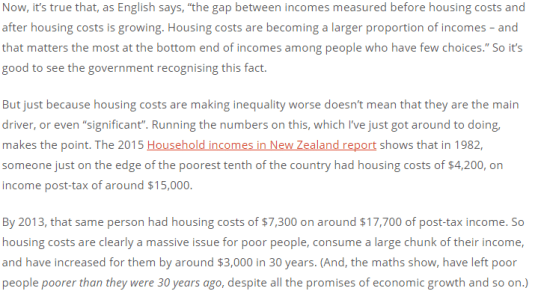
Rashbrooke then goes on to discuss how housing costs were not a main driver of the growing gap between the top 10% and the bottom 10% of the income distribution in New Zealand. My point is he is more concerned with the politics of envy than with building political support for action against poverty.
What children say about poverty #childpovertynz #itsnotchoice http://t.co/vYfxTn7aG7—
Child Poverty NZ (@povertymonitor) September 07, 2015
Rashbrooke showed that the main driver of poverty in New Zealand is rising housing costs. That is easy to redress but for the opposition of the left-wing parties to reforms to the Resource Management Act that will increase the supply of land and thereby drive down housing costs and rents.
Children's views on poverty #childpovertynz occ.org.nz/assets/Uploads… http://t.co/wZHJ19QcpN—
Child Poverty NZ (@povertymonitor) September 08, 2015
Housing costs gobbled up much of the rising incomes of the poor for many years now in New Zealand as Rashbrooke showed today. The New Zealand Labor Party and New Zealand Greens are doing nothing about it. The regulatory constraints on the supply of land could be gone by lunchtime if the self-proclaimed champions of the poor and social justice supported the reform of the RMA.
The proposals of the New Zealand Labour Party and Greens for the government to build more houses is pointless unless there is more land is supplied. If there is no increase in land supply, all the building of more houses by government does is build the same houses of private developers would have built on the same fixed supply of land. There must be an increase in the supply of land to drive housing costs down for the poor.

Creative destruction in car prices
09 Oct 2015 Leave a comment
in applied welfare economics, economic history, industrial organisation Tags: car prices, creative destruction, good old days
A century of progress: cars in 1913 vs. 2013. buff.ly/1OVS1iB #tech #wealth http://t.co/nzmW84la9R—
HumanProgress.org (@humanprogress) October 06, 2015
Average wages in 2014 US$PPP, selected OECD member countries
07 Oct 2015 2 Comments
in applied welfare economics, labour economics
I am surprised that Ireland and Switzerland are so high up in the game. Swedes are poorer than the British despite a much more generous welfare state. France is low in the rankings as is Finland. Japan is doing very poorly on a PPP basis, down there with Italy.
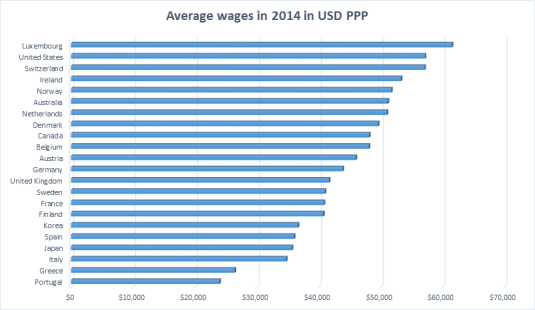
Source: OECD Economic Outlook, Vol. 2015, No. 1.
Data are unavailable on in New Zealand.
Creative destruction in car prices
07 Oct 2015 Leave a comment
in applied welfare economics, economic history, entrepreneurship, politics - USA, technological progress, transport economics Tags: creative destruction
CHART: Since 1995 the CPI for new vehicles has been flat, while the CPI (and wages) increased 60%. What a bargain! http://t.co/DOdlQn8pcK—
Mark J. Perry (@Mark_J_Perry) July 01, 2015

@jamespeshaw nails the #TPPA policy trade-off @NZGreens
06 Oct 2015 1 Comment
in applied price theory, applied welfare economics, comparative institutional analysis, economics of regulation, international economic law, international economics, International law, law and economics, politics - Australia, politics - New Zealand, politics - USA, property rights Tags: conspiracy theories, David Friedman, foreign direct investment, free trade agreements, FTI, international investment law, Leftover Left, New Zealand Greens, preferential trading agreements, TPPA, Twitter left
About 1% more GDP but higher drug prices.
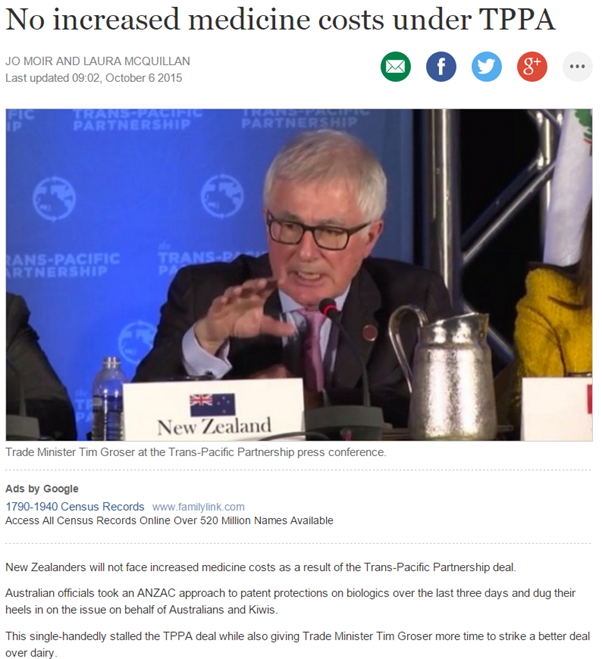
Source: No increased medicine costs under TPPA | Stuff.co.nz
.@MSF: Patients and treatment providers in developing countries the big losers of the #TPP bit.ly/TPPconcludes http://t.co/cbikANleyA—
MSF Access Campaign (@MSF_access) October 05, 2015
The next best arguments James Shaw made were xenophobia about foreign investment in land and some vast conspiracy theory regarding endangered dolphins.
When your next best argument is foreigners are coming to buy up all our land, you are playing from a weak populist hand. About half of million New Zealand born live in other countries.
About 80% of these live in Australia, the great majority as residents rather than as citizens. These New Zealanders living in Australia and elsewhere need protection under international agreements to ensure they are not the victim of populist outbreaks against the sale of land to foreigners.
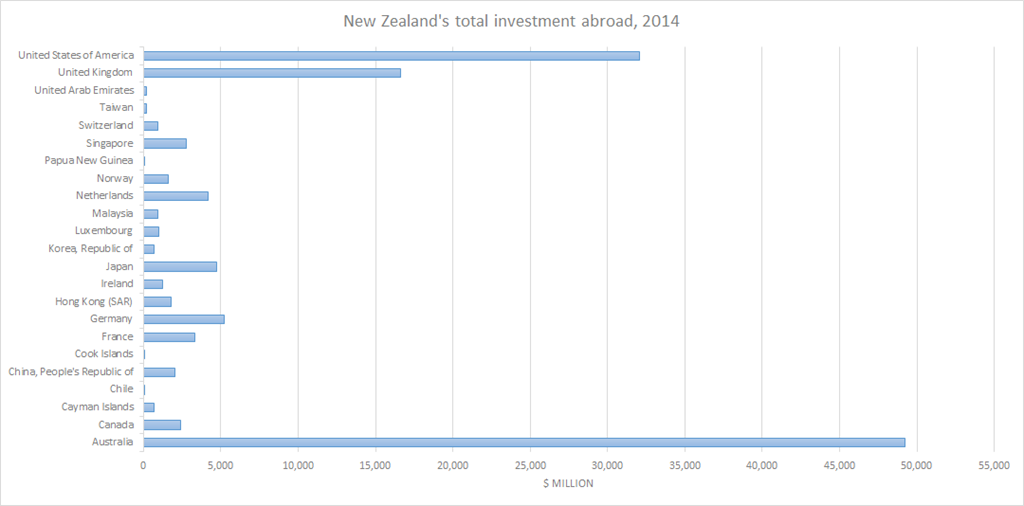
Source: Statistics New Zealand.
In addition, if a foreigner wants to pay over the odds for my house I am glad to separate a fool from his money.
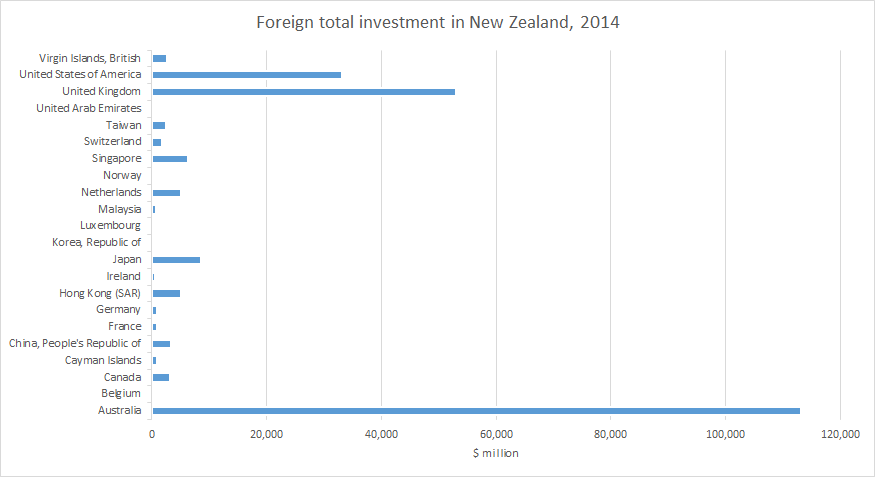
Source: Statistics New Zealand.
New Zealand has a strong interest in protecting the rights of its own expatriates as well as New Zealand foreign investors to buy land in other countries. As David Friedman explains:
Much more commonly, [economic imperialism] is used by Marxists to describe–and attack–foreign investment in “developing” (i.e., poor) nations. The implication of the term is that such investment is only a subtler equivalent of military imperialism–a way by which capitalists in rich and powerful countries control and exploit the inhabitants of poor and weak countries.
There is one interesting feature of such “economic imperialism” that seems to have escaped the notice of most of those who use the term. Developing countries are generally labour rich and capital poor; developed countries are, relatively, capital rich and labour poor. One result is that in developing countries, the return on labour is low and the return on capital is high–wages are low and profits high. That is why they are attractive to foreign investors.
To the extent that foreign investment occurs, it raises the amount of capital in the country, driving wages up and profits down. The effect is exactly analogous to the effect of free migration. If people move from labour-rich countries to labour-poor ones, they drive wages down and rents and profits up in the countries they go to, while having the opposite effect in the countries they come from.
If capital moves from capital-rich countries to capital-poor ones, it drives profits down and wages up in the countries it goes to and has the opposite effect in the countries it comes from. The people who attack “economic imperialism” generally regard themselves as champions of the poor and oppressed.
To the extent that they succeed in preventing foreign investment in poor countries, they are benefiting the capitalists of those countries by holding up profits and injuring the workers by holding down wages. It would be interesting to know how much of the clamour against foreign investment in such countries is due to Marxist ideologues who do not understand this and how much is financed by local capitalists who do.
What is so flash about #Singapore as an expat destination
04 Oct 2015 Leave a comment
in applied welfare economics, international economics, labour economics, labour supply, occupational choice Tags: economics of emigration, economics of immigration, expats
Which is the best country to be an expat? wef.ch/1j35Y1j #expats http://t.co/K58jgHSasy—
World Economic Forum (@wef) October 02, 2015
Milton Friedman on the ultimate consumer protection
03 Oct 2015 Leave a comment
in applied price theory, applied welfare economics, entrepreneurship, industrial organisation, Milton Friedman, survivor principle Tags: competition and monopoly, consumer protection, consumer sovereignty, The meaning of competition
US top incomes – average incomes
02 Oct 2015 Leave a comment
in applied welfare economics, economic history, entrepreneurship
The top 1% in the USA became rather more exclusive since about 1980 and the Reagan revolution. Up until then, far too many middle-class professionals were knocking at the door of the top 1% by having being just a little bit more successful than their peers.

Source: The World Top Incomes Database.
If our Marxist friends are to be believed, ruling class membership should be more exclusive than that. The Rothschilds and Rockefellers and the rest of the gang could not possibly be brushing shoulders with tradesmen made good at meetings of the executive committee of the ruling class.
Inequality in the UK
02 Oct 2015 Leave a comment
Stiglitz, Piketty – Jeremy Corbyn’s star ‘advisers’ are, like him, wrong about UK inequality: specc.ie/1OZZPPi http://t.co/seDpZIVRy1—
Fraser Nelson (@FraserNelson) September 27, 2015
UK top incomes – average incomes
02 Oct 2015 Leave a comment
in applied welfare economics, economic history
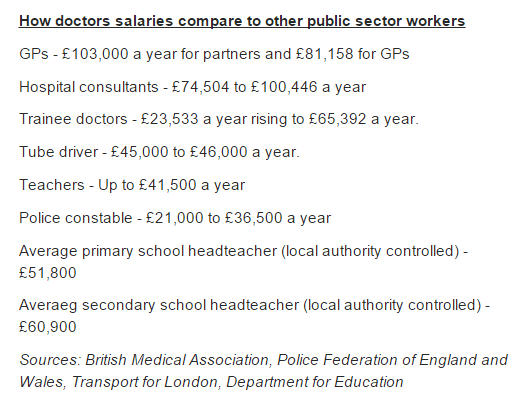
The top 1% in the UK is some somewhat exclusive because you have to be more than a doctor or a lawyer to get in.
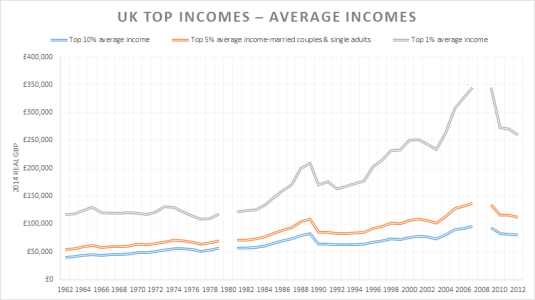
Source: The World Top Incomes Database
Poverty traps in America
02 Oct 2015 Leave a comment
in applied welfare economics, behavioural economics, labour economics, labour supply, politics - USA, poverty and inequality, public economics, welfare reform Tags: poverty traps, taxation and labour supply, welfare state
@RobinHoodTax @helenkellyCTU does the average worker earn less than 40 years ago?
30 Sep 2015 Leave a comment
in applied welfare economics, economic history, Marxist economics, politics - New Zealand, politics - USA Tags: good old days, living standards, measurement error, middle class stagnation, productivity measurement, The Great Enrichment, wage stagnation
https://twitter.com/RobinHoodTax/status/648963471690698752/photo/1
For Economic Justice, America Badly Needs Some Raises goo.gl/iA3Ecp #RobinHoodTaxUSA robinhoodtax.org/why http://t.co/0wx4kCpb4Q—
Robin Hood Tax (@RobinHoodTax) September 23, 2015
Innovation is letting us accomplish more with less. Learn more: buff.ly/1LmtAZD #tech #progress http://t.co/e2kQlGu3NA—
HumanProgress.org (@humanprogress) June 22, 2015


Recent Comments