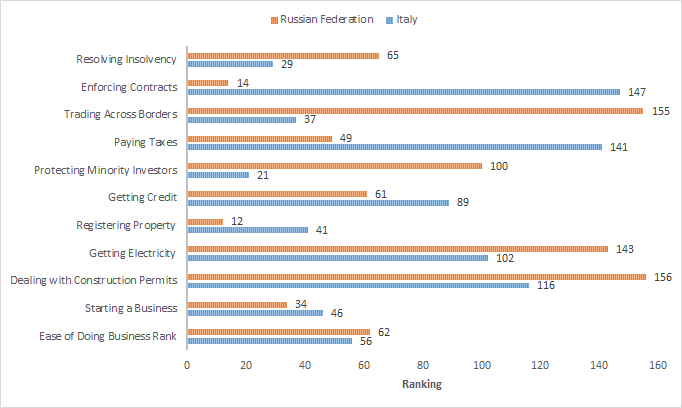
It is rather disturbing that it is a lot easier to register property and enforce contracts in Russia than in Italy and far harder to pay your taxes in Italy. Once again, Italy’s saving grace is the ability to trade across borders Because of its membership of the European Union.
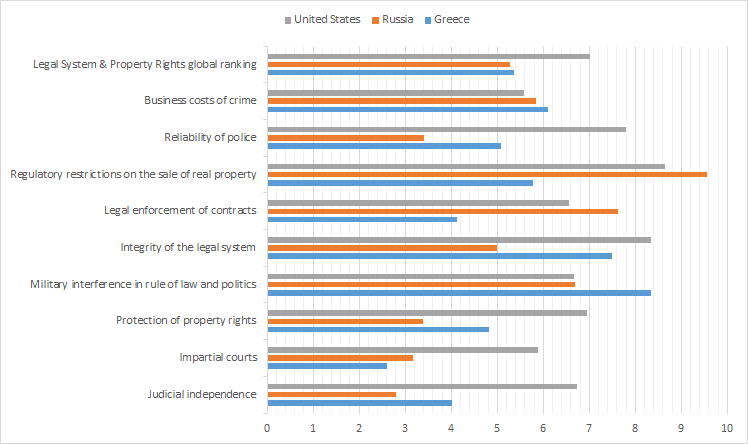
Overall, there are not that many differences between Greece and Russia in the quality of their legal systems and property rights. Don’t go to the police in Russia and good luck trying to enforce contracts in Greece.
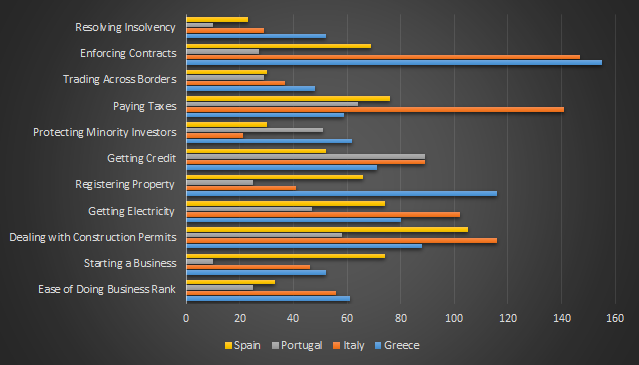
All in all, Italy and Greece are a dog of a place to enforce a contract. The long-suffering taxpayer is better off paying taxes in Greece than in Italy! Not surprisingly, trading across borders is the greatest strength in doing business in the PIGS. The European Union does have some benefits.
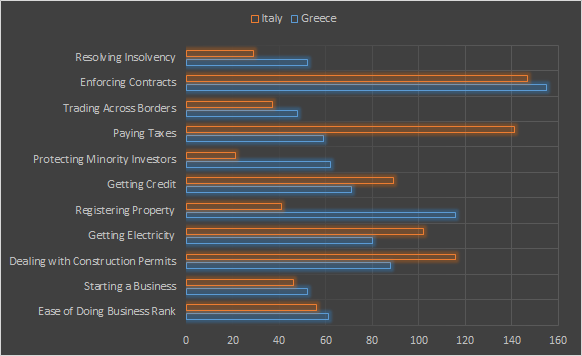
Figure 2: Doing Business rankings, Greece and Italy, 2014
All in all, Italy and Greece are equally bad places to do business and Italy is much worse when it comes to taxes. About the only saving graces of Italy is the registration of property and the protection of minority interests in companies.
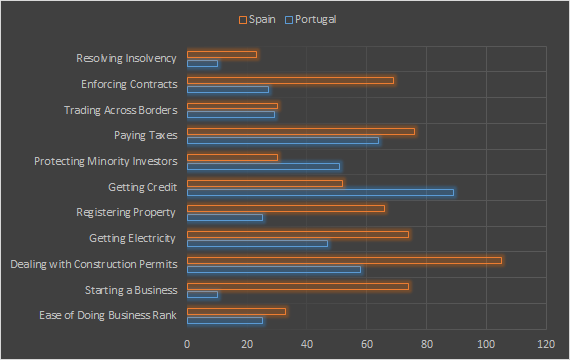
Figure 3: Doing Business rankings, Spain and Portugal, 2014
I had an unnerving near miss at my local roundabout tonight with a bike as I was turning left. The bicycle appeared out of nowhere on my right in the middle of the roundabout as I glanced of the left to check again while turning so I crash stopped.
The bike had a light at the front but wasn’t visible to me until it was halfway into the roundabout when I glanced of the right again. The bike rider was going into that roundabout at a good speed against a wall of car lights behind it, so it was impossible to see it until it was close to the door of my car because of the background of car lighting after dark.
Bike riders have an overinflated self-perception of their visibility at night. Not surprisingly, more accidents happen during peak hours when drivers think motorists can see them when they cannot.
Even on an empty road, bicycles are not easy to see at night – certainly there not as perceived as quickly as cars. Bicycles are a much more dangerous transport mode than driving a car.
A recent study found the bicycle lighting is overrated as a method of making bikes more conspicuous – perceptions of visibility do not necessarily match reality:
The presence of a bicycle light, whether static or flashing, did not enhance the conspicuity of the bicyclist; this may result in bicyclists who use a bicycle light being overconfident of their own conspicuity at night.
Consider this thought experiment. Suppose bicycles have never been invented until tonight. The business case for allowing them on to the road is as follows:
Certain pedestrians should be allowed to share the road with cars as long as these pedestrians travel quickly on a metal contraption that is slower than cars, but still allows them to move relatively quickly;
These fast moving pedestrians are near invisible in rear-view mirrors;
These fast moving pedestrians should be allowed on the road at night when their visibility is poor against an every-varying contrast of a moving landscape;
These pedestrians moving quickly at night on the road are overconfident in the extent to which drivers perceive their presence against a moving landscape; and
Older drivers are 50% less likely to perceive the presence of a bike with lights and illumination at night than are younger drivers.
Would that business case pass under the precautionary principle championed by environmentalists, many of whom are bicyclists? Would that business case pass under normal cost benefit analysis? I say no. Bicycles at night must go.
Why Evolution is True is a blog written by Jerry Coyne, centered on evolution and biology but also dealing with diverse topics like politics, culture, and cats.
In Hume’s spirit, I will attempt to serve as an ambassador from my world of economics, and help in “finding topics of conversation fit for the entertainment of rational creatures.”



Recent Comments