Hayek on the division of knowledge
15 Sep 2015 Leave a comment
in applied price theory, Austrian economics, economics of information, F.A. Hayek, industrial organisation, survivor principle Tags: capitalism and freedom, competition as a discovery procedure, The meaning of competition, The pretence to knowledge
Prices — what do they do?
13 Aug 2015 Leave a comment
in applied price theory, applied welfare economics, Austrian economics Tags: competition is a discovery procedure, market process, The meaning of competition
ABCT insights are predominantly a theory of unsustainable credit-induced booms
09 Aug 2015 Leave a comment
in Austrian economics, business cycles, global financial crisis (GFC), great depression, great recession, macroeconomics, monetarism, monetary economics Tags: Austrian business cycle theory, Austrian macroeconomics, booms and busts, central banking, monetary policy, Roger Garrison

via What Austrian business cycle theory does and does not claim as true | Institute of Economic Affairs
The fates of two islands under constant threat from a neighbouring military colossus
01 Aug 2015 Leave a comment
in applied price theory, applied welfare economics, Austrian economics, comparative institutional analysis, constitutional political economy, development economics, economics of media and culture, economics of regulation, growth disasters, growth miracles, income redistribution, industrial organisation, law and economics, liberalism, Marxist economics, property rights, Public Choice, rentseeking, survivor principle Tags: anticapitalist mentality, antimarket bias, capitalism and freedom, China, Cuba, expressive voting, Hong Kong, Leftover Left, public intellectuals, rational ignorance, rational irrationality, Twitter left
62 years ago North and South Korea signed a truce
28 Jul 2015 Leave a comment
in applied price theory, applied welfare economics, Austrian economics, comparative institutional analysis, constitutional political economy, development economics, economics of bureaucracy, growth disasters, growth miracles, income redistribution, liberalism, Marxist economics, Public Choice, rentseeking Tags: collapse of communism, economics of central planning, failed states, North Korea, South Korea
https://twitter.com/TheEconomist/status/625658259861598209/photo/1
Truce is signed and the fighting ends in Korea on this day in 1953. nyti.ms/1D1Yswe http://t.co/O9a8iJgE99—
NYT Archives (@NYTArchives) July 27, 2015
And the rich got richer, who cares
16 Jul 2015 Leave a comment
in applied price theory, applied welfare economics, Austrian economics, comparative institutional analysis, constitutional political economy, development economics, economic history, economics of bureaucracy, economics of education, economics of regulation, economics of religion, energy economics, entrepreneurship, environmental economics, financial economics, growth disasters, growth miracles, income redistribution, industrial organisation, international economics, labour economics, labour supply, liberalism, poverty and inequality, Public Choice, rentseeking, survivor principle, transport economics, urban economics Tags: Deirdre McCloskey, entrepreneurial alertness, The Great Enrichment, The Great Escape, The Great Fact, top 1%
"The rich got richer, true. But…" —@DeirdreMcClosk buff.ly/1Imdv4o http://t.co/M3ERx3JTIn—
HumanProgress.org (@humanprogress) June 28, 2015
Israel Kirzner’s Hayek Medal Lecture in Berlin — June 2015
02 Jul 2015 Leave a comment
in Austrian economics, F.A. Hayek Tags: Israel Kirzner
Mises on the Great Fact
29 May 2015 Leave a comment
in Austrian economics, comparative institutional analysis, economic history, Ludwig von Mises Tags: capitalism and freedom, The Great Enrichment, The Great Escape, The Great Fact

John Maynard Keynes on the usefulness of mathematical economists
15 May 2015 Leave a comment
in Austrian economics, economics Tags: John Maynard Keynes, mathematical economics, methodology of economics
A new biography of John Maynard Keynes reveals him to be something of a polymath econ.st/1FdudRL http://t.co/Rz0ui9V1lB—
The Economist (@EconBizFin) May 13, 2015
The Ten Pillars of Economic Wisdom
10 May 2015 Leave a comment
in applied price theory, applied welfare economics, Austrian economics, comparative institutional analysis, constitutional political economy, development economics, economic history, economics of education, economics of information, economics of media and culture, economics of regulation, energy economics, entrepreneurship, financial economics, health economics, history of economic thought, industrial organisation, survivor principle Tags: David Anderson, evidence-based policy, offsetting behaviour, pretence to knowledge, The fatal conceit, unintended consequences
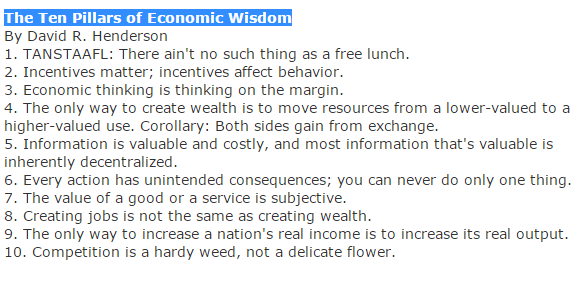
via The Ten Pillars of Economic Wisdom, David Henderson | EconLog | Library of Economics and Liberty.
FA Hayek on piecemeal analysis such as cost benefit analysis and evidence-based policy
09 May 2015 Leave a comment
in applied price theory, applied welfare economics, Austrian economics, comparative institutional analysis, constitutional political economy, economics of regulation, F.A. Hayek Tags: Constitution of Liberty, cost benefit analysis, evidence-based policy, offsetting behaviour, The fatal conceit, The pretence to knowledge, unintended consequences
Happy Birthday, F.A. Hayek!
(8 May 1899 – 23 March 1992) http://t.co/K431Kj9nok—
Screwed by State (@ScrewedbyState) May 09, 2015
Happy Birthday FA Hayek
09 May 2015 Leave a comment
in Austrian economics, F.A. Hayek Tags: FA Hayek


Recent Comments