Why does 1% of history have 99% of the wealth?
07 Jul 2015 Leave a comment
in applied price theory, applied welfare economics, comparative institutional analysis, economic growth, economic history, liberalism Tags: Deidre McCloskey, The Great Enrichment, The Great Escape, The Great Fact
Why Greece joined the Euro
06 Jul 2015 Leave a comment
in applied price theory, applied welfare economics, budget deficits, business cycles, comparative institutional analysis, constitutional political economy, currency unions, economic growth, economic history, Euro crisis, fiscal policy, fisheries economics, global financial crisis (GFC), international economics, macroeconomics, Public Choice, rentseeking Tags: Euro sclerosis, Greece, insurance attacks, sovereign defaults, speculative attacks
The roots of Greece’s crisis are simple. Before Greece joined the Eurozone, investors treated it as a middle-income country with poor governance — which is to say, a credit risk.
After Greece joined the Eurozone, investors thought that Greece was no longer a credit risk — they figured, if push came to shove, other Eurozone members like Germany would bail Greece out. They were wrong.

Michael Dooley put forward a theory of speculative attacks on currencies as insurance attacks on currencies for emerging markets after the East Asian financial crisis:
First generation models of speculative attacks show that apparently random speculative attacks on policy regimes can be fully consistent with rational and well-informed speculative behaviour.
Unfortunately, models driven by a conflict between exchange rate policy and other macroeconomic objectives do not seem consistent with important empirical regularities surrounding recent crises in emerging markets. This has generated considerable interest in models that associate crises with self-fulfilling shifts in private expectations.
In this paper we develop a first generation model based on an alternative policy conflict. Credit constrained governments accumulate reserve assets in order to self-insure against shocks to national consumption. Governments also insure poorly regulated domestic financial markets.
Given this policy regime, a variety of internal and external shocks generate capital inflows to emerging markets followed by successful and anticipated speculative attacks.
We argue that a common external shock generated capital inflows to emerging markets in Asia and Latin America after 1989. Country specific factors determined the timing of speculative attacks. Lending policies of industrial country governments and international organizations account for contagion, that is, a bunching of attacks over time.
His model was not within the context of a currency union but his basic theory is correct.
There are speculative attacks on a currency or a bank run after foreign markets revises their estimates of the available central bank reserves and international lines of credit to bail out the banking systems and/or foreign debt.
Michael Dooley was dealing with the emerging economies of Southeast Asia and their official lines of credit that insure their foreign exchange liabilities and domestic banking system. Greece is about lines of credit for similar purposes to other European union member states.
via 12 charts and maps that explain the Greek crisis – Vox and The Most Important Graphs of 2011 – The Atlantic.
Doing business in Russia and Italy – World Bank rankings compared
05 Jul 2015 Leave a comment
in applied price theory, applied welfare economics, comparative institutional analysis, economics of regulation, entrepreneurship, industrial organisation, international economics, law and economics, property rights, survivor principle Tags: doing business, Eurosclerosis, Italy, rule of law, Russia, transitional economies
Figure 1: Doing Business rankings, Russia and Italy, 2014
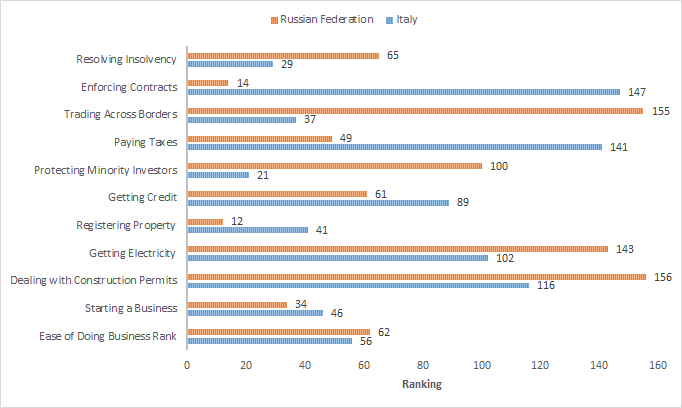
Source: World Bank Doing Business 2015.
It is rather disturbing that it is a lot easier to register property and enforce contracts in Russia than in Italy and far harder to pay your taxes in Italy. Once again, Italy’s saving grace is the ability to trade across borders Because of its membership of the European Union.
Legal systems and property rights in Greece and Russia – Index of Economic Freedom rankings compared
05 Jul 2015 Leave a comment
in applied price theory, applied welfare economics, comparative institutional analysis, constitutional political economy, development economics, economics of crime, economics of regulation, growth disasters, industrial organisation, law and economics, property rights Tags: capitalism and freedom, Greece, rule of law, Russia
Figure 1: Index of Economic Freedom rankings for legal systems and property rights, Greece, Russia and USA, 2012
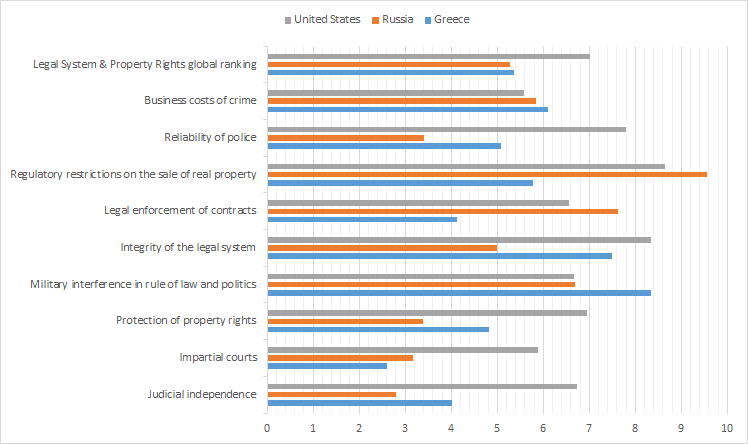
Source: Economic Freedom of the World – Annual Report 2014 | www.freetheworld.com.
Overall, there are not that many differences between Greece and Russia in the quality of their legal systems and property rights. Don’t go to the police in Russia and good luck trying to enforce contracts in Greece.
@MaxCRoser only one line in this chart about India matters
05 Jul 2015 Leave a comment
in comparative institutional analysis, constitutional political economy, development economics, economic history, growth disasters, growth miracles, poverty and inequality, Public Choice Tags: capitalism and freedom, extreme poverty, global poverty, India, Leftover Left, The Great Escape, The Great Fact, top 1%
In #India poverty is falling very, very rapidly – while inequality is rising.
More at: bit.ly/1KLT8Lh http://t.co/xTxlW1i06o—
Max Roser (@MaxCRoser) June 29, 2015


Dealing with the Spanish bureaucracy
28 Jun 2015 Leave a comment
in comparative institutional analysis, constitutional political economy, economics of bureaucracy, economics of regulation, industrial organisation, Public Choice, rentseeking, survivor principle Tags: cost of doing business, endogenous growth theory, Eurosclerosis, Spain
The different types of authoritarian personalities
28 Jun 2015 Leave a comment
in comparative institutional analysis, constitutional political economy, politics - Australia, politics - New Zealand, politics - USA, Public Choice Tags: antiforeign bias, antimarket bias, economics of personality traits, expressive voting, Leftover Left, makework bias, political psychology, rational ignorance, rational irrationality
Tom Sargent keynote address Emergency Economic Summit for Greece (1 June 2015)
26 Jun 2015 Leave a comment
in comparative institutional analysis, constitutional political economy, currency unions, Euro crisis, fiscal policy, macroeconomics, monetary economics Tags: EU, Euroland, Greece, sovereign borrowing, sovereign defaults, Thomas Sargent
HL Mencken on the Harmful Digital Communication Bill
26 Jun 2015 Leave a comment
in applied price theory, applied welfare economics, comparative institutional analysis, constitutional political economy, economics of crime, economics of media and culture, economics of regulation, law and economics, liberalism, politics - New Zealand, Public Choice Tags: chilling effect, disorderly conduct, free speech, infotopia, Internet trolls, meddlesome preferences, nanny state, offsetting behaviour, The fatal conceit, The pretence to knowledge, unintended consequences
Does the NZ Superannuation Fund recover the deadweight cost of the taxes that funded it?
24 Jun 2015 Leave a comment
in comparative institutional analysis, financial economics, income redistribution, politics - New Zealand, Public Choice, public economics Tags: ageing society, demographic crisis, New Zealand superannuation fund, old age pensions, social insurance, sovereign wealth funds, welfare state

The $30 billion New Zealand Superannuation Fund is the best performing sovereign wealth fund over the past five years, generating returns of more than 17 per cent a year.
Those returns easily beat all other sovereign wealth funds that publish their figures, according to a global study by JP Morgan. In the last three years alone, the fund returned an average of 21 per cent a year.
Good thing to do considering that the default deadweight cost of taxation is put by that Treasury to be 20%:
As a general rule, deadweight losses should be included if they are of sufficient size relative to the overall costs and benefits of the proposal that they are capable of altering the decision as to whether or not to proceed with the proposal.
Having said this, deadweight losses are notoriously difficult to quantify. Estimates vary from 14% up to 50% of the revenue collected.
Treasury suggests a rate of 20% as a default deadweight loss value in the absence of an alternative evidence based value. Thus public expenditures should be multiplied by a factor of 1.2 prior to discounting to incorporate the effects of deadweight loss.
This deadweight cost of taxation includes funds contributed to New Zealand government owned investment funds. In a speech last week, the Super Fund chairman Gavin Walker warned that the recent high returns were unlikely to continue in the long-term:
The last few years are likely to have been among the best years the fund will experience for some time,” he said. “On average and over the long-term we expect to earn the rather less exciting figure of 8 per cent [per annum] – but which will still provide a handsome return to New Zealander stakeholders.
The New Zealand Superannuation Fund must beat the market every single year to make up for the deadweight cost of its funding, the usual interest rate on borrowed funds, a premium for the investment risk added to the Crown’s portfolio and the cost to New Zealand’s growth rate of higher than otherwise taxes on income, entrepreneurship and investment.
Most mutual funds still can't beat their benchmark read.bi/1GkTig1 http://t.co/r7ezoDGJbV—
BI Chart of the Day (@chartoftheday) June 03, 2015
Is investor state dispute settlement a form of overseas development assistance?
24 Jun 2015 Leave a comment
in comparative institutional analysis, constitutional political economy, development economics, growth disasters, growth miracles, international economic law, international economics, law and economics, property rights, Public Choice, rentseeking, Richard Posner Tags: European Court of Justice, free trade agreements, International Court of Justice, international law, investor state dispute settlement, ODA, overseas development assistance, preferential trade agreements, regional trade agreements, WTO
Would objections to the Investor State Dispute Settlement provisions in the proposed Trans-Pacific Partnership wilt away if the adjudicating body was the International Court of Justice? The left-wing opponents of investor state dispute settlement genuflect at the very mention of the International Court of Justice and international law generally (unless it is international economic law).

Disputes over the provisions of European union treaties are adjudicated by the European Court of Justice. The judgements of that court brought by individuals against member states so annoy the British that it is a leading reason for many British wanting to leave the European Union and replace the Human Rights Act 1998 with a British Bill Of Rights policed by British courts rather than by the European Court of Justice and European human rights law.
It is routine for any treaty to have some provision for arbitration of disputes. This includes trade and investment treaties.
The World Trade Organisation treaty includes a dispute settlement provision with arbitrators based in Geneva. Some of the more than 400 cases heard have been motivated by discrimination against imports on the basis of a breached environmental protection policies of the importing country.

A number of countries want to ban imports that are produced in ways that upset them. Others want to include labour and environmental standards in trade agreements to impose developed country standards on developing countries in what is a new form of colonialism.
I have previously said that investor State Dispute Settlement provisions have no place in trade and investment treaties between democracies. I must now admit there are good reasons to have arbitration clauses in treaties between democracies.
The puzzle is why refer these trade and investment disputes to a little-known arbitration body adjunct to the World Bank rather than the far more prestigious International Court of Justice.
Perhaps the reason is both sides want an arbitrator who is not too strong and not too credible. It would look very bad if the International Court of Justice was to rule against you.
William Landes and Richard Posner contended that judicial independence maximises the value of legislative deals with interest groups by enhancing the durability of those deals.
Why no International Court of Commercial Law? When deciding what type in judiciary to enforce international trade bargains, the signatories may prefer a less credible adjudication and enforcement mechanism in case they want to opt out of it or chip around the decision.
The jurisdiction of the International Court of Justice is to settle, in accordance with international law, legal disputes submitted to it by special agreement and matters specifically provided for in treaties and conventions in force.
UN member states are the parties to any litigation but that doesn’t stop them raising cases on behalf of individuals. That said, organizations, private enterprises, and individuals cannot have their cases taken to the International Court, such as to appeal a national supreme court’s ruling. Only the states can bring the cases and become the defendants of the cases.
The International Court of Justice is different from the European Court of Justice because individuals cannot easily bring complaints before it. One of the causes of action before the European Court of Adjusters is under European competition law over member states providing financial aid to industries.
Democratic countries with high levels of economic and social integration, such as the European union, do find it in advantage to set up a European wide Court to adjudicate disputes over rights under European law.
Why then would a democracy sign up to an investment protection treaty with a developing country? One reason is overseas development assistance.
Developing countries with corrupt and incompetent courts, politicians and bureaucracies sign international treaties as a way of assuring foreign investors and trading partners of some degree of security of their property rights and their ability to enforce contracts with suppliers and buyers.
By folding these assurances into trade treaties, the developing country has a stronger incentive to honour its promises. There will be domestic constituencies wanting to retain reciprocal export market access who will lobby for the honouring of the promises of legal protection to investors and businesses in their home country.
New Zealand signing up to the Trans-Pacific Partnership is an example of this form of overseas development assistance. Exporters and investors from the developing country who export and invest in New Zealand have another reason to support more secure property rights and better enforcement of contracts in their home country as a way of securing their treaty rights to export and invest in New Zealand.
The Left of the political spectrum should be keen on this form of overseas development considering their general belief in greatly increasing the amount spent on overseas development assistance. Rather than pay cash to the development country, the payment is in kind as reciprocal legal promises.
Trade treaties that include investor state dispute settlement are forms of governance assistance to developing countries. The reciprocal exchange of promises about investor protection and the enforcement of contracts and property rights improves the quality of governance in the developing country.
The countries most likely to be subject to investor state dispute settlement are those with weaker governance. Even in the European Union, the member states most likely to be sued are former communist countries. The most common course of action was the cancellation of a licence or permit.

Investor state dispute settlement clauses are no different from any other international treaty include environmental and human rights treaties. All these treaties require countries to give up part of their sovereignty.

Democracies give up their sovereignty in investor state dispute settlement in the hope that developing country partners to the treaty will improve the development potential of their country through better governance and more secure property rights.
That is an overseas development aid objective the Left of the political spectrum should support, but it does not. The Left of the political spectrum is happy to use trade agreements to impose developed country labour and environmental standards on poor countries desperate for access to rich country markets, but is not willing to give up anything in return.


Recent Comments