Hayek explains the inexplicable value of capitalism and traditions
13 Sep 2015 Leave a comment
in applied price theory, applied welfare economics, comparative institutional analysis, constitutional political economy, F.A. Hayek, liberalism Tags: capitalism and freedom, market selection, spontaneous order, The meaning of competition
@NZGreens are so polite on Twitter @MaramaDavidson @RusselNorman @greencatherine
12 Sep 2015 1 Comment
in comparative institutional analysis, constitutional political economy, economics of media and culture, liberalism, managerial economics, organisational economics Tags: Cass Sunstein, Daily Me, information cocoons, infotopia, John Stuart Mill, Karl Popper, New Zealand Greens, Twitter, Twitter left
One of the first things I noticed when feuding on Twitter with Green MPs was how polite they were. Twitter is not normally known for that characteristic and that is before considering the limitations of 144 characters. People who are good friends and work together will go to war over email without any space limitations for the making an email polite and friendly. Imagine how easy it is to misconstrue the meaning and motivations of tweets that can only be 144 characters.

The New Zealand Green MPs in their replies on Twitter make good points and ask penetrating questions that explain their position well and makes you think more deeply about your own. Knowledge grows through critical discussion, not by consensus and agreement.

Cass Sunstein made some astute observations in Republic.com 2.0 about how the blogosphere forms into information cocoons and echo chambers. People can avoid the news and opinions they don’t want to hear.
Sunstein has argued that there are limitless news and information options and, more significantly, there are limitless options for avoiding what you do not want to hear:
- Those in search of affirmation will find it in abundance on the Internet in those newspapers, blogs, podcasts and other media that reinforce their views.
- People can filter out opposing or alternative viewpoints to create a “Daily Me.”
- The sense of personal empowerment that consumers gain from filtering out news to create their Daily Me creates an echo chamber effect and accelerates political polarisation.
A common risk of debate is group polarisation. Members of the deliberating group move toward a more extreme position relative to their initial tendencies! How many blogs are populated by those that denounce those who disagree? This is the role of the mind guard in group-think.

Sunstein in Infotopia wrote about how people use the Internet to spend too much time talking to those that agree with them and not enough time looking to be challenged:
In an age of information overload, it is easy to fall back on our own prejudices and insulate ourselves with comforting opinions that reaffirm our core beliefs. Crowds quickly become mobs.
The justification for the Iraq war, the collapse of Enron, the explosion of the space shuttle Columbia–all of these resulted from decisions made by leaders and groups trapped in “information cocoons,” shielded from information at odds with their preconceptions. How can leaders and ordinary people challenge insular decision making and gain access to the sum of human knowledge?
Conspiracy theories had enough momentum of their own before the information cocoons and echo chambers of the blogosphere gained ground.

J.S. Mill pointed out that critics who are totally wrong still add value because they keep you on your toes and sharpened both your argument and the communication of your message. If the righteous majority silences or ignores its opponents, it will never have to defend its belief and over time will forget the arguments for it.
As well as losing its grasp of the arguments for its belief, J.S. Mill adds that the majority will in due course even lose a sense of the real meaning and substance of its belief. What earlier may have been a vital belief will be reduced in time to a series of phrases retained by rote. The belief will be held as a dead dogma rather than as a living truth.
Beliefs held like this are extremely vulnerable to serious opposition when it is eventually encountered. They are more likely to collapse because their supporters do not know how to defend them or even what they really mean.

J.S. Mill’s scenarios involves both parties of opinion, majority and minority, having a portion of the truth but not the whole of it. He regards this as the most common of the three scenarios, and his argument here is very simple. To enlarge its grasp of the truth, the majority must encourage the minority to express its partially truthful view. Three scenarios – the majority is wrong, partly wrong, or totally right – exhaust for Mill the possible permutations on the distribution of truth, and he holds that in each case the search for truth is best served by allowing free discussion.

Mill thinks history repeatedly demonstrates this process at work and offered Christianity as an illustrative example. By suppressing opposition to it over the centuries Christians ironically weakened rather than strengthened Christian belief. Mill thinks this explains the decline of Christianity in the modern world. They forgot why they were Christians.
Being classically liberal
12 Sep 2015 Leave a comment
in constitutional political economy, liberalism, Public Choice Tags: Leftover Left, meddlesome preferences, nanny state, progressive left, The fatal conceit, The pretence to knowledge
Mises on feminism
12 Sep 2015 Leave a comment
in constitutional political economy, discrimination, economics of education, gender, labour economics, labour supply, liberalism, occupational choice, Public Choice, rentseeking Tags: economics of fertility, economics of the family, engines of liberation, female labour force participation, feminism, women's liberation
An opportunity lost – to expel #WesternAustralia from the rest of Australia and seal the border
11 Sep 2015 Leave a comment
in comparative institutional analysis, constitutional political economy, economic history, politics - USA, Public Choice, rentseeking Tags: Australia, economics of borders, economics of succession, Scotland, self-determination, succession movements, Western Australia
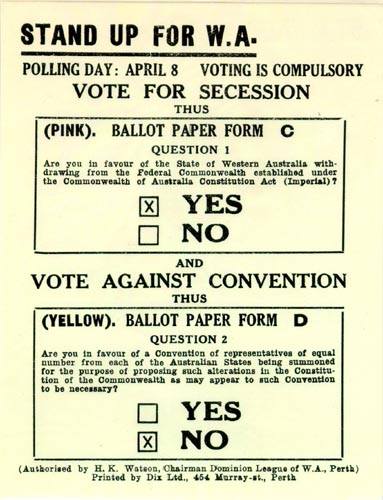
Western Australian secessionists, in common with Scottish nationalists, really do like to dictate the terms of their succession which always includes an open border and a generous financial settlement regarding division of federal government debts.
How arrogant. Why should parting be sweet? If you do not want us, why should we want you. If you want to find your own destiny, you can find it good and hard.
Applied welfare economics was never value free, but applied price theory is @TimothyTTaylor
11 Sep 2015 Leave a comment
in applied welfare economics, comparative institutional analysis, constitutional political economy, history of economic thought, liberalism, Murray Rothbard Tags: David Colander, Henry Hazlitt, Joan Robinson, methodology of economics
The first words uttered in my first lecture in applied welfare economics by Bob Rutherford were ‘this course starts with an explicit political position – that of liberalism’. I never forgot that.

Source: CONVERSABLE ECONOMIST: Crossing the Ravine from Economic Theory to Policy Advice.
This leads us to Robert and Zeckhauser’s taxonomy of disagreement:
Positive disagreements can be over questions of:
1. Scope: what elements of the world one is trying to understand?
2. Model: what mechanisms explain the behaviour of the world?
3. Estimate: what estimates of the model’s parameters are thought to obtain in particular contexts?
Values disagreements can be over questions of:
1. Standing: who counts?
2. Criteria: what counts?
3. Weights: how much different individuals and criteria count?
Any positive analysis tends to include elements of scope, model, and estimation, though often these elements intertwine; they frequently feature in debates in an implicit or undifferentiated manner. Likewise, normative analysis will also include elements of standing, criteria, and weights, whether or not these distinctions are recognised.
The origin of political disagreement is a broad church indeed in a liberal democracy. Those you disagree with are not evil, they just disagree with you. As Karl Popper observed:
There are many difficulties impeding the rapid spread of reasonableness. One of the main difficulties is that it always takes two to make a discussion reasonable. Each of the parties must be ready to learn from the other.


#JFK on @jeremycorbyn #toriesforcorbyn
10 Sep 2015 Leave a comment
in comparative institutional analysis, constitutional political economy, Marxist economics, Public Choice Tags: British politics, JFK, Leftover Left

Presidential election turnout by race
09 Sep 2015 Leave a comment
in constitutional political economy, politics - USA, Public Choice, rentseeking Tags: 2016 presidential election, civil rights, Democratic Party, racial discrimination, southern States, voting rights

Democracy in Africa
08 Sep 2015 Leave a comment
in constitutional political economy, development economics, economic history, growth disasters, growth miracles Tags: Africa, capitalism and freedom
Is sociology really irrelevant in policy debates?
03 Sep 2015 Leave a comment
in applied price theory, applied welfare economics, comparative institutional analysis, constitutional political economy, economics of bureaucracy, economics of media and culture, income redistribution, labour economics, occupational choice, Public Choice, rentseeking Tags: compensating differentials, evidence-based policy, media bias, offsetting behaviour, public intellectuals, sociology, The fatal conceit, The pretence to knowledge, unintended consequences
Is sociology really irrelevant in policy debates? @familyunequal does a better job with the #s blog.contexts.org/2015/01/25/soc… http://t.co/c4E25DTCmm—
(@SocImages) February 04, 2015
Expulsions of Jews across Europe during the Medieval & Early Modern periods
28 Aug 2015 Leave a comment
in constitutional political economy, economic history, income redistribution, law and economics, property rights, Public Choice, rentseeking Tags: anti-semitism, European history
Expulsions of Jews across Europe during the Medieval & Early Modern periods. http://t.co/4HKGlNCjou—
History Facts 247 (@historyfacts247) July 08, 2015
Bryan Caplan on why H.L. Mencken was right
22 Aug 2015 Leave a comment
in constitutional political economy, economics of information, Public Choice Tags: Bryan Caplan, H.L Mencken, rational ignorance, rational irrationality, voter demographics


@nzlabour @NZGreens There just isn’t no missing million out there hanging out for that hard-left clarion call @rsalmond
22 Aug 2015 1 Comment
in applied price theory, constitutional political economy, economics of information, politics - New Zealand, Public Choice Tags: British Labour Party, British politics, economics of advertising, Eric Crampton, expressive voting, false consciousness, Leftover Left, median voter theorem, New Zealand Greens, New Zealand Labour Party, rational ignorance, rational rationality
Rob Salmond has written a great blog this week on the ideological spectrum of New Zealand voters based on the New Zealand Election Study.

In the course of his blog he drove a tremendously big stake through the heart of the old left fantasy that if Labour or Greens goes left, a large block of voters not voting for them now or not voting at all (the missing million voters) will shake lose its false consciousness and follow you:
But “pulling the centre back towards the left” is massively, massively hard.
You win those people over by being relevant to them as they are, not by telling them they’re worldview needs a rethink. It is just basic psychology. Tell people they were right all along; they like you. Tell people they were wrong all along; they don’t.
And if you win a majority of centrists, you win. The New Zealand Election Study series records six MMP elections in New Zealand – the three where Labour did best among centrists were the three Labour won.
That’s another message from the academic study I quoted above – in Germany, Sweden, and the UK, the elections where the left did best among centrists were the elections where they took power. As their popularity among centrists declined, so did their seat share.
What is more disturbing for the old left fantasy of the missing million is voting for the Labour Party or Greens is correlated with ignorance rather than knowledge.
Furthermore, the more people know about economics, the less likely they are to vote for the left as Eric Crampton explains:
When they get to the polls, the ignorant are significantly more likely to support the Labour Party (4% increase in predicted probability for a standard deviation increase in ignorance) and significantly less likely to support the Green party (1% decrease in predicted probability) and United Future (0.5% decrease in predicted probability).
Understanding economics strongly predicted supporting National in 2005, which comes as little surprise: the National Party leader was former Governor of the Reserve Bank of New Zealand. A standard deviation increase in our “economic thinking” index correlates with a 5.7% increased probability of voting National, a 1.5% decreased probability of voting NZ First, and a slight decrease in the probability of voting United Future and Maori.
To make matters worse, Crampton found that joining political organisations does little to cure ignorance of politics or otherwise lead to a political awakening. Sometimes active political affiliation reduces ignorance, other times such organisational membership intensifies ignorance.
via Salmond on the centre | Kiwiblog and StephenFranks.co.nz » Blog Archive » Why the left wants everyone to vote.
Why did @jeremycorbyn never split from @UKLabour despite 30 years on the outer? #torysforcorbyn
21 Aug 2015 1 Comment
in constitutional political economy, politics - Australia, politics - New Zealand, politics - USA, Public Choice, rentseeking Tags: British general election, British politics, Leftover Left
If you think equality and fairness in Britain is important you should do this: labour.tw/1MH6f4M http://t.co/7gCDkX7fj5—
The Labour Party (@UKLabour) August 06, 2015
Jeremy Corbyn had 30 years to split from the Labour Party, which he voted against 25% of the time, establish his own party and receive the same reception presumably he would have got without needing to have to run for leader of the Labour Party.
Conservatism and nationalism destroy the Labour Party nickcohen.net/2015/06/02/con… http://t.co/ue0XzXTEFo—
Nick Cohen (@NickCohen4) June 02, 2015
The reasoning Corbyn never split from the Labour Party, and the reason why the left never splits from the Labour Party, is the left knows that it would get far fewer votes on its own rather than piggybacking on the right wing of that party.
The right split from the British Labour Party in the early 1980s to form the Social Democratic party. The right-wing split from the Australian Labor Party at least four times over its history.
The left is never split from the New Zealand Labour Party because it knows that it could never get anywhere even under proportional representation without the image of being part of the traditional Labour Party, centre-left, social democratic, not socialist. Jeremy Corbyn and the rest of the left of British Labour are practising mild mannered entryism. By stealing the brand of the Labour Party, the left obtains far more power than it ever could standing on its own two feet as true believers.
Our vision is of an economy that works for all, provides opportunity for all and invests in all. #jeremy4leader http://t.co/59Gk9AN7Xf—
JeremyCorbyn4Leader (@Corbyn4Leader) July 22, 2015
The working hypothesis of the far left everywhere is if the Labour Party were to adopt hard left policies is many more votes.
Fabulous scenes wherever we go, but this picture of the Opera House in Newcastle is quite something. #voteCorbyn http://t.co/GzB96CjB7d—
JeremyCorbyn4Leader (@Corbyn4Leader) August 18, 2015
Labour would win many more votes because the offer of a genuine socialist alternative would shake voters loose of their false consciousness.

The left of the Labour Party never went out on its own to test that hypothesis because they knew in their hearts be lucky to not to lose their deposits.

This is despite the strong rise in third parties in British politics despite first past the post.
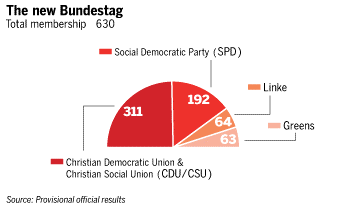
The remnants of the communist parties do well at elections in countries such as France, Germany (Linke or Left Party) and Japan and are in government in Greece.
- 53 communist and anti-capitalist parties have been elected worldwide to freely elected parliament in 39 countries.
- The Trots regularly get 4% in French presidential elections while the British SWP is still in the same league as the monster raving loony party.

The right wing of the Labour Party was willing to take its chances under first past the post voting in the House of Commons because it knew that a large part the electorate would vote for it in preference to the remnant of a left-wing run Labour Party.
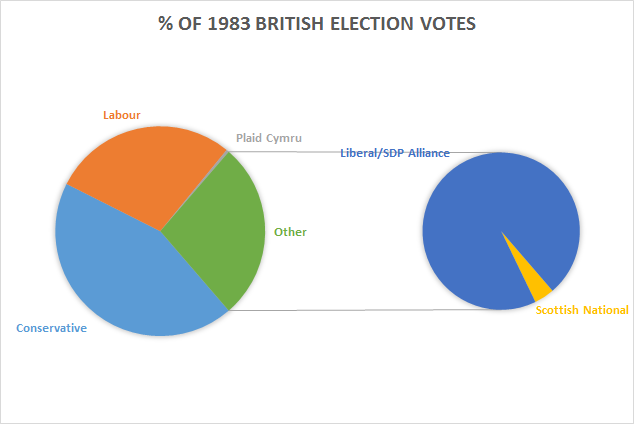
The combination of these splitters from the British Labour Party and the Liberal party won 25% of the vote, two percentage points behind the British Labour Party.
Henry Hazlett on why economics is so difficult
20 Aug 2015 Leave a comment
in applied price theory, applied welfare economics, comparative institutional analysis, constitutional political economy, economics of bureaucracy, income redistribution, Public Choice, rentseeking Tags: antiforeign bias, antimarket bias, bootleggers and baptists, green rent seeking, Henry Hazlett, makework bias, methodology of economics, philosophy of economics
 Utopia, you are standing in it!
Recent Comments