The reduction of Polio in Africa. http://t.co/JKL1Kfx2qr—
Max Roser (@MaxCRoser) June 29, 2015
The reduction of Polio in Africa
10 Jul 2015 Leave a comment
in development economics, growth disasters, growth miracles, health economics Tags: Africa, anti-vaccination movement, polio, quackery, vaccinations, vaccines
The Great Fact: the rise of the middle class in developing countries
09 Jul 2015 Leave a comment
China pulled 203m into the middle class from 2001-11; more than half the global gain of 385m pewrsr.ch/1LSs6Wz http://t.co/DiskvneykJ—
Rakesh Kochhar (@RakeshKochhar) July 08, 2015
Richer is greener: environmentalists are Environmental Kuznets Curve deniers
07 Jul 2015 Leave a comment
in applied price theory, applied welfare economics, development economics, economic growth, economic history, energy economics, environmental economics, growth disasters, growth miracles, health and safety, industrial organisation, international economics, labour economics, law and economics, liberalism, property rights, public economics Tags: healthier is wealthier, Japan, Kuznets environmental curve, richer is greener, richer is safer
The Kuznets environmental curve describes an empirical regularity between environmental quality and economic growth. Outdoor water, air and other pollution first worse and then improves as a country first experiences economic growth and development.

While many pollutants exhibit this pattern in the Kuznets environmental curve, peak pollution levels occur at different income levels for different pollutants, countries and time periods. John Tierney explains:
In dozens of studies, researchers identified Kuznets curves for a variety of environmental problems.
There are exceptions to the trend, especially in countries with inept governments and poor systems of property rights, but in general, richer is eventually greener.
As incomes go up, people often focus first on cleaning up their drinking water, and then later on air pollutants like sulphur dioxide.
As their wealth grows, people consume more energy, but they move to more efficient and cleaner sources — from wood to coal and oil, and then to natural gas and nuclear power, progressively emitting less carbon per unit of energy.
When I was living in Japan in the mid 1990s, they just completed a period of rapid operation of the Kuznets environmental curve. I was told by my professors at Graduate School that in the 1960s, cities and prefectures welcomed polluting industries because of the better paid jobs they offered. At that time, shipping companies used like to go to Tokyo because the pollution in Tokyo Bay was so bad that it would clean all the barnacles off their ships. That made them sail faster.

Japanese incomes and wages doubled over the course of the 1960s. The Japanese voter was now prepared to support stricter pollution standards and environmental controls.
Life expectancy is at an all time high: buff.ly/1ICraAi http://t.co/jgRqKy8LfQ—
HumanProgress.org (@humanprogress) June 28, 2015
In the early 1970s, the ruling LDP stole the long-standing environmental policies of their opponents in a big crack down on pollution because the country could now afforded them.
Poverty has plummeted in East Asia and the world. buff.ly/1NtIDyY http://t.co/SsY3sf3kyH—
HumanProgress.org (@humanprogress) July 01, 2015
Plenty of developing countries are democracies now. Their people could demand through the ballot box higher environmental standards and clean tap water but they don’t because of its cost to economic development.
These 4 nations are 50% of mankind. That's 3.5 billion people who are living longer. buff.ly/1Kle6mU #health http://t.co/949oqisMsL—
HumanProgress.org (@humanprogress) June 30, 2015
The environmental movement lives in a state of denial regarding the relationship between economic growth and environmental quality.
OECD Better Life Index correlates with GDP
But US lower than poorer countries
& NZL higher than richer countries http://t.co/yrTCnO1B0l—
Max Roser (@MaxCRoser) June 26, 2015
Matt Ridley on the Pope and The Great Fact
06 Jul 2015 Leave a comment
in applied price theory, applied welfare economics, development economics, economic history, economics of regulation, energy economics, entrepreneurship, environmental economics, financial economics, growth disasters, growth miracles, health economics, history of economic thought, human capital, industrial organisation, labour economics, liberalism, survivor principle Tags: doomsday prophecies, Matt Ridley doomsday prophets, Papal economics, The Great Enrichment, The Great Escape, The Great Fact
See which way the data points for yourself, like @mattwridley. buff.ly/1HsZxgx #health #progress http://t.co/B3KbUJOn05—
HumanProgress.org (@humanprogress) June 30, 2015
The Great Fact in Sudan
06 Jul 2015 Leave a comment
in development economics, growth disasters, growth miracles Tags: Sudan, The Great Escape, The Great Fact
Access to education and to the Internet are expanding and helping to improve lives: buff.ly/1NzHbKP #progress http://t.co/45AISWVKHQ—
HumanProgress.org (@humanprogress) July 02, 2015
@MaxCRoser only one line in this chart about India matters
05 Jul 2015 Leave a comment
in comparative institutional analysis, constitutional political economy, development economics, economic history, growth disasters, growth miracles, poverty and inequality, Public Choice Tags: capitalism and freedom, extreme poverty, global poverty, India, Leftover Left, The Great Escape, The Great Fact, top 1%
In #India poverty is falling very, very rapidly – while inequality is rising.
More at: bit.ly/1KLT8Lh http://t.co/xTxlW1i06o—
Max Roser (@MaxCRoser) June 29, 2015
Corruption index for south-east Asia
04 Jul 2015 Leave a comment
in development economics, growth disasters, growth miracles, rentseeking Tags: bribery and corruption, China, Indonesia, Philippines
Corruption in Indonesia: Jokowi’s arduous task in cleaning up the government econ.st/1FJ3sS0 http://t.co/1myuRbwoXK—
The Economist (@EconBizFin) June 11, 2015
Only one line in this chart matters
04 Jul 2015 Leave a comment
in applied welfare economics, development economics, economic history, growth disasters, growth miracles Tags: capitalism and freedom, child poverty, extreme poverty, global poverty, Malaysia, The Great Escape, The Great Fact
In #Malaysia inequality and poverty are falling.
More at: bit.ly/1KLUA02 http://t.co/aXEmuA0bnb—
Max Roser (@MaxCRoser) July 02, 2015

The rise of the South
03 Jul 2015 Leave a comment
in development economics, growth disasters, growth miracles Tags: China, India, The Great Fact, undeveloped countries
The GDP of the South doubled to 40% by 2012, w/ China —12% of global GDP: wrld.bg/N9CYe #RisingoftheSouth http://t.co/Yt2LiF9srr—
World Bank Pubs (@WBPubs) May 20, 2015
Extreme poverty is not the same thing as digital poverty
01 Jul 2015 Leave a comment
Percentage of people around the world who own smartphones, via @conradhackett. Note #China. http://t.co/wAOmIklVbW—
Legatum Institute (@LegatumInst) May 30, 2015
Fastest-growing economies and fastest-growing populations
28 Jun 2015 Leave a comment
in development economics, growth disasters, growth miracles, population economics Tags: ageing society, labour demographics
India at night in 1994 and 2010 – Estimating Poverty Using Nightlights
27 Jun 2015 Leave a comment
in development economics, econometerics, economic history, growth disasters, growth miracles Tags: India, measurement error, national accounts

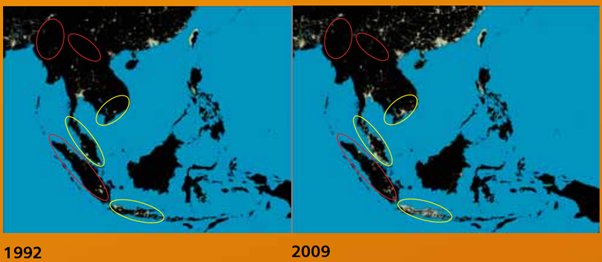
Maxim Pinkovskiy and Xavier Sala-i-Martin last year suggested that national accounting estimates of poverty should be adjusted for the evolution of satellite-recorded night-time lights. I agree from personal experience.
In India between 1994 and 2010, its survey income grew by 29% but its GDP per capita more than doubled during this time. We see that lights in India increase dramatically both in their intensity over the major cities as well as in their extent over previously dark areas of the country. This suggests that the GDP estimate is a more accurate assessment of economic development of India and the faster reduction of poverty than income surveys suggest.
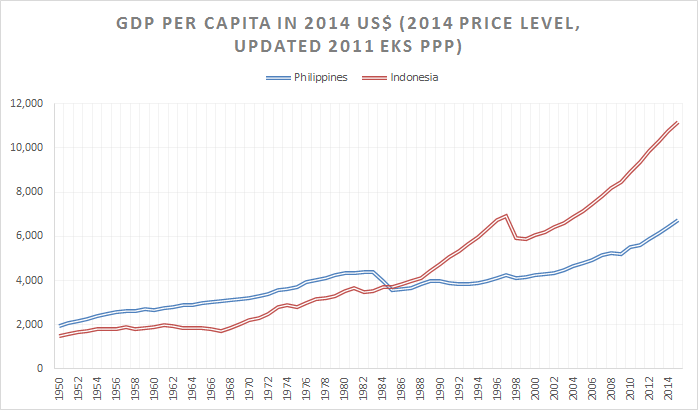
Source: The Conference Board. 2015. The Conference Board Total Economy Database™, May 2015, http://www.conference-board.org/data/economydatabase/
National accounting data on real GDP, PPP would suggest that Indonesia is a much wealthier country than the Philippines. The Philippines from about the late 1998, has had rapid economic growth, but so has Indonesia. I first visited the Philippines in 1997. I have never visited Indonesia.
When I first visited my parents-in-law in the Philippines in 1998, that part of Leyte had no sealed roads and no phones.
The next time I visited, the road was being sealed and mobile reception was better if you had an aerial on the roof.
After a five year gap in visiting, not only was mobile reception good, there was cable TV if you wanted it. When I visited in 2012, there was wireless internet if you had outside aerial.
Christmas before last, we hot spotted off my sister-in-law’s mobile. Neighbours have Skype if we want to say hello. I don’t know how that rapid change in economic fortunes is captured accurately in national accounting figures.
Is investor state dispute settlement a form of overseas development assistance?
24 Jun 2015 Leave a comment
in comparative institutional analysis, constitutional political economy, development economics, growth disasters, growth miracles, international economic law, international economics, law and economics, property rights, Public Choice, rentseeking, Richard Posner Tags: European Court of Justice, free trade agreements, International Court of Justice, international law, investor state dispute settlement, ODA, overseas development assistance, preferential trade agreements, regional trade agreements, WTO
Would objections to the Investor State Dispute Settlement provisions in the proposed Trans-Pacific Partnership wilt away if the adjudicating body was the International Court of Justice? The left-wing opponents of investor state dispute settlement genuflect at the very mention of the International Court of Justice and international law generally (unless it is international economic law).

Disputes over the provisions of European union treaties are adjudicated by the European Court of Justice. The judgements of that court brought by individuals against member states so annoy the British that it is a leading reason for many British wanting to leave the European Union and replace the Human Rights Act 1998 with a British Bill Of Rights policed by British courts rather than by the European Court of Justice and European human rights law.
It is routine for any treaty to have some provision for arbitration of disputes. This includes trade and investment treaties.
The World Trade Organisation treaty includes a dispute settlement provision with arbitrators based in Geneva. Some of the more than 400 cases heard have been motivated by discrimination against imports on the basis of a breached environmental protection policies of the importing country.

A number of countries want to ban imports that are produced in ways that upset them. Others want to include labour and environmental standards in trade agreements to impose developed country standards on developing countries in what is a new form of colonialism.
I have previously said that investor State Dispute Settlement provisions have no place in trade and investment treaties between democracies. I must now admit there are good reasons to have arbitration clauses in treaties between democracies.
The puzzle is why refer these trade and investment disputes to a little-known arbitration body adjunct to the World Bank rather than the far more prestigious International Court of Justice.
Perhaps the reason is both sides want an arbitrator who is not too strong and not too credible. It would look very bad if the International Court of Justice was to rule against you.
William Landes and Richard Posner contended that judicial independence maximises the value of legislative deals with interest groups by enhancing the durability of those deals.
Why no International Court of Commercial Law? When deciding what type in judiciary to enforce international trade bargains, the signatories may prefer a less credible adjudication and enforcement mechanism in case they want to opt out of it or chip around the decision.
The jurisdiction of the International Court of Justice is to settle, in accordance with international law, legal disputes submitted to it by special agreement and matters specifically provided for in treaties and conventions in force.
UN member states are the parties to any litigation but that doesn’t stop them raising cases on behalf of individuals. That said, organizations, private enterprises, and individuals cannot have their cases taken to the International Court, such as to appeal a national supreme court’s ruling. Only the states can bring the cases and become the defendants of the cases.
The International Court of Justice is different from the European Court of Justice because individuals cannot easily bring complaints before it. One of the causes of action before the European Court of Adjusters is under European competition law over member states providing financial aid to industries.
Democratic countries with high levels of economic and social integration, such as the European union, do find it in advantage to set up a European wide Court to adjudicate disputes over rights under European law.
Why then would a democracy sign up to an investment protection treaty with a developing country? One reason is overseas development assistance.
Developing countries with corrupt and incompetent courts, politicians and bureaucracies sign international treaties as a way of assuring foreign investors and trading partners of some degree of security of their property rights and their ability to enforce contracts with suppliers and buyers.
By folding these assurances into trade treaties, the developing country has a stronger incentive to honour its promises. There will be domestic constituencies wanting to retain reciprocal export market access who will lobby for the honouring of the promises of legal protection to investors and businesses in their home country.
New Zealand signing up to the Trans-Pacific Partnership is an example of this form of overseas development assistance. Exporters and investors from the developing country who export and invest in New Zealand have another reason to support more secure property rights and better enforcement of contracts in their home country as a way of securing their treaty rights to export and invest in New Zealand.
The Left of the political spectrum should be keen on this form of overseas development considering their general belief in greatly increasing the amount spent on overseas development assistance. Rather than pay cash to the development country, the payment is in kind as reciprocal legal promises.
Trade treaties that include investor state dispute settlement are forms of governance assistance to developing countries. The reciprocal exchange of promises about investor protection and the enforcement of contracts and property rights improves the quality of governance in the developing country.
The countries most likely to be subject to investor state dispute settlement are those with weaker governance. Even in the European Union, the member states most likely to be sued are former communist countries. The most common course of action was the cancellation of a licence or permit.

Investor state dispute settlement clauses are no different from any other international treaty include environmental and human rights treaties. All these treaties require countries to give up part of their sovereignty.

Democracies give up their sovereignty in investor state dispute settlement in the hope that developing country partners to the treaty will improve the development potential of their country through better governance and more secure property rights.
That is an overseas development aid objective the Left of the political spectrum should support, but it does not. The Left of the political spectrum is happy to use trade agreements to impose developed country labour and environmental standards on poor countries desperate for access to rich country markets, but is not willing to give up anything in return.
The Quantity and Quality of Japanese, Singaporean and Hong Kong Lives, 1965 to 1995
23 Jun 2015 Leave a comment
in applied welfare economics, development economics, economic history, Gary Becker, growth miracles Tags: Hong Kong The Great Escape, Japan, life expectancy is, Singapore, The Great Enrichment, The Great Fact
Figure 1: increase in real GDP and increase in real GDP plus life expectancy GDP increase equivalent, Japan, Singapore and Hong Kong, 1965 to 1995
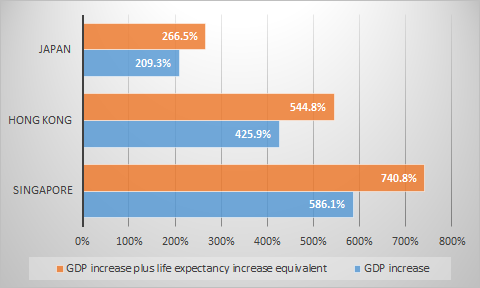
GDP per capita is usually used to proxy for the quality of life of individuals living in different countries. Becker and his co-authors computed a "full" growth rate that incorporates the gains in health and life expectancy.
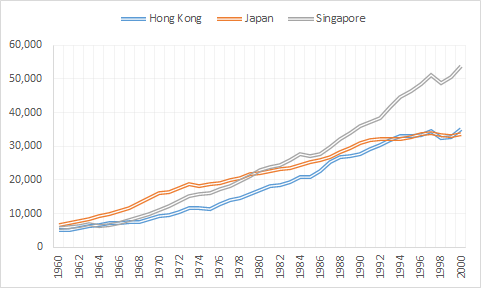
Figure 2 shows that Japan, Hong Kong and Singapore started from similar levels of real GDP per capita PPP in 1960.
Figure 2: GDP per capita in 2014 US$ (converted to 2014 price level with updated 2011 PPPs), Hong Kong, Japan and Singapore, 1960 – 2000
Source: The Conference Board. 2015. The Conference Board Total Economy Database™, May 2015, http://www.conference-board.org/data/economydatabase/
 Utopia, you are standing in it!
Recent Comments