This reading gap is the equal if 6-12 months extra school.for girls.

SOURCE: Organization for Economic Cooperation and Development (OECD), Program for International Student Assessment (PISA), 2015 Reading, Mathematics and Science Assessment.
Celebrating humanity's flourishing through the spread of capitalism and the rule of law
07 Dec 2016 Leave a comment
in economics of education, gender, human capital, labour economics, occupational choice Tags: lost boys, PISA, reverse gender gap
This reading gap is the equal if 6-12 months extra school.for girls.
SOURCE: Organization for Economic Cooperation and Development (OECD), Program for International Student Assessment (PISA), 2015 Reading, Mathematics and Science Assessment.
02 Dec 2016 Leave a comment
01 Dec 2016 Leave a comment
in applied price theory, discrimination, economic history, economics of education, gender, health economics, human capital, labour economics, labour supply, occupational choice Tags: contraception, gender gap, gender wage gap
11 Nov 2016 Leave a comment
in applied price theory, applied welfare economics, economics of education, human capital, labour economics, labour supply, poverty and inequality Tags: child poverty, family poverty
08 Nov 2016 Leave a comment
in discrimination, economics of education, gender, human capital, labour economics, minimum wage, occupational choice Tags: gender wage gap, reversing gender gap
Rendall and Rendall (2016) found that women prefer occupations where their skills depreciate slowest when taking time out from motherhood. Verbal and reading skills depreciate at a far slower rate than mathematical and scientific skills so this gives women yet another strong reason to avoid science, technology, engineering and maths (STEM) careers.
we show that college educated women avoid occupations requiring significant math skills due to the costly skill atrophy experienced during a career break. In contrast, verbal skills are very robust to career interruptions.
The results support the broadly observed female preference for occupations primarily requiring verbal skills – even though these occupations exhibit lower average wages. Thus, skill-specific atrophy during employment leave and the speed of skill repair upon returning to the labour market are shown to be important factors underpinning women’s occupational outcomes.
Not only do women have vastly superior verbal and reading skills, worth somewhere near 6 to 12 months extra schooling, these skills do not depreciate much during career breaks. Indeed, reading and verbal skills tend to naturally increase with age until your late 60s.
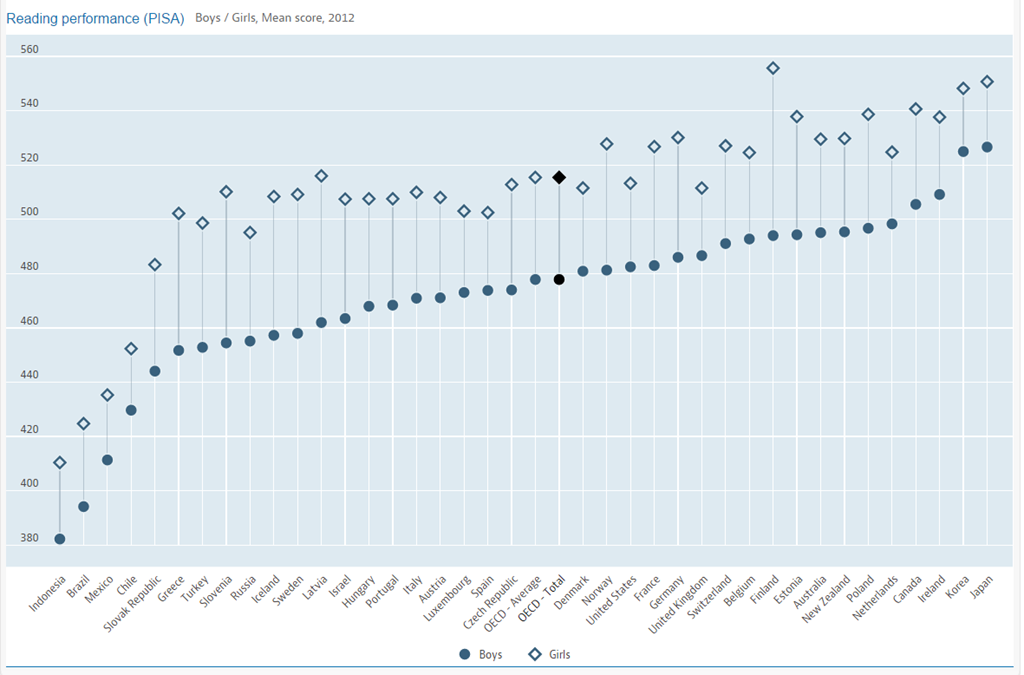
Source: Reading performance (PISA) – International student assessment (PISA) – OECD iLibrary.
Maths skills get rusty if not used while knowledge of computer languages and the like and of specific technologies can be quickly overtaken by events while on maternity leave. Rendall and Rendall (2016) again
… college educated females avoid math-heavy occupations, and pursue verbal-heavy occupations instead. This is due to the high skill atrophy associated with math skills, and the ability of verbal skills to act as “skill insurance” against gaps.
Additionally, for college educated individuals, math is the skill most vulnerable to loss during employment gaps, which also implies a slow rebuilding post-break. In contrast, non-college educated individuals experience a much smaller math skill loss.
Rendall and Rendall’s point about college educated women avoiding maths heavy occupations even if it costs them wages so as to maximise the lifetime income may explain the larger gender wage gap at the top of the income distribution than at the bottom.
At the bottom of the income distribution, skill atrophy do not really matter much. At the top, it do. Women make occupational choices where annual income may be lower but lifetime income may be higher because of the lower rates of skill depreciation when they are out having children.
03 Nov 2016 Leave a comment
in applied price theory, applied welfare economics, development economics, economic history, economics of education, labour economics Tags: affirmative action, racial discrimination, Thomas Sowell
01 Nov 2016 Leave a comment
in economics of education, labour economics, labour supply Tags: Baumol's disease
18 Oct 2016 Leave a comment
in economics of education, economics of media and culture, economics of regulation, environmental economics, health economics Tags: Anti-Science left
18 Oct 2016 Leave a comment
in economics of education, human capital, labour economics Tags: economics of languages
17 Oct 2016 Leave a comment
in economics of education, economics of media and culture, economics of regulation, environmental economics, global warming, health economics Tags: Anti-Science left
16 Oct 2016 Leave a comment
in economics of education Tags: political correctness
Source: Watch Leftist Students Say Science Is Racist and Should Be Abolished – Hit & Run : Reason.com.
04 Oct 2016 Leave a comment
02 Oct 2016 Leave a comment
in economics of education, occupational choice, politics - USA
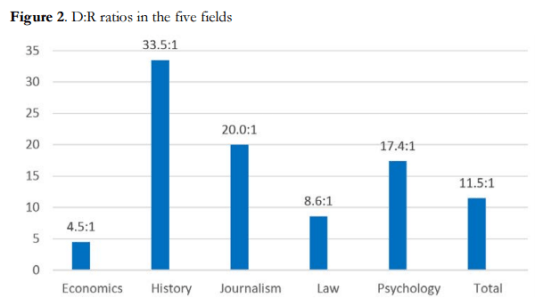
Source: Faculty Voter Registration in Economics, History, Journalism, Law, and Psychology · Econ Journal Watch : Voter registration, academia, ideology, political parties, professors via Anti-Dismal: Latest issue of Econ Journal Watch.
Celebrating humanity's flourishing through the spread of capitalism and the rule of law
Celebrating humanity's flourishing through the spread of capitalism and the rule of law
Celebrating humanity's flourishing through the spread of capitalism and the rule of law
Celebrating humanity's flourishing through the spread of capitalism and the rule of law
Celebrating humanity's flourishing through the spread of capitalism and the rule of law
A History of the Alt-Right
Econ Prof at George Mason University, Economic Historian, Québécois
Celebrating humanity's flourishing through the spread of capitalism and the rule of law
Scholarly commentary on law, economics, and more
Beatrice Cherrier's blog
Celebrating humanity's flourishing through the spread of capitalism and the rule of law
Celebrating humanity's flourishing through the spread of capitalism and the rule of law
Celebrating humanity's flourishing through the spread of capitalism and the rule of law
Why Evolution is True is a blog written by Jerry Coyne, centered on evolution and biology but also dealing with diverse topics like politics, culture, and cats.
Celebrating humanity's flourishing through the spread of capitalism and the rule of law
A rural perspective with a blue tint by Ele Ludemann
DPF's Kiwiblog - Fomenting Happy Mischief since 2003
Celebrating humanity's flourishing through the spread of capitalism and the rule of law
The world's most viewed site on global warming and climate change
Tim Harding's writings on rationality, informal logic and skepticism
A window into Doc Freiberger's library
Let's examine hard decisions!
Commentary on monetary policy in the spirit of R. G. Hawtrey
Thoughts on public policy and the media
Celebrating humanity's flourishing through the spread of capitalism and the rule of law
Politics and the economy
A blog (primarily) on Canadian and Commonwealth political history and institutions
Reading between the lines, and underneath the hype.
Economics, and such stuff as dreams are made on
"The British constitution has always been puzzling, and always will be." --Queen Elizabeth II
Celebrating humanity's flourishing through the spread of capitalism and the rule of law
Celebrating humanity's flourishing through the spread of capitalism and the rule of law
WORLD WAR II, MUSIC, HISTORY, HOLOCAUST
Undisciplined scholar, recovering academic
Celebrating humanity's flourishing through the spread of capitalism and the rule of law
Res ipsa loquitur - The thing itself speaks
In Hume’s spirit, I will attempt to serve as an ambassador from my world of economics, and help in “finding topics of conversation fit for the entertainment of rational creatures.”
Researching the House of Commons, 1832-1868
Articles and research from the History of Parliament Trust
Reflections on books and art
Posts on the History of Law, Crime, and Justice
Celebrating humanity's flourishing through the spread of capitalism and the rule of law
Exploring the Monarchs of Europe
Cutting edge science you can dice with
Small Steps Toward A Much Better World
“We do not believe any group of men adequate enough or wise enough to operate without scrutiny or without criticism. We know that the only way to avoid error is to detect it, that the only way to detect it is to be free to inquire. We know that in secrecy error undetected will flourish and subvert”. - J Robert Oppenheimer.


Recent Comments