As China grew freer economically, its poverty rate fell. buff.ly/1KohOxS http://t.co/OpaxOzNdNs—
HumanProgress.org (@humanprogress) June 29, 2015
Capitalism and The Great Fact in China
17 Jul 2015 Leave a comment
in applied price theory, applied welfare economics, comparative institutional analysis, development economics, economic history, economics of education, economics of regulation, entrepreneurship, environmental economics, growth disasters, growth miracles, history of economic thought, industrial organisation, Marxist economics, Public Choice Tags: capitalism and freedom, China, fall of communism, Leftover Left, transitional economies
Low performers in maths by gender, USA, UK, Japan, Canada, Australia and New Zealand
17 Jul 2015 Leave a comment
in discrimination, economics of education, gender, human capital, labour economics Tags: cognitive psychology, educational psychology, lost boys, PISA, Psychology, reversing gender gap
Figure 1: % of students achieving a proficiency level below 2 in maths by gender, USA, UK, New Zealand, Japan, Canada and Australia, 2012
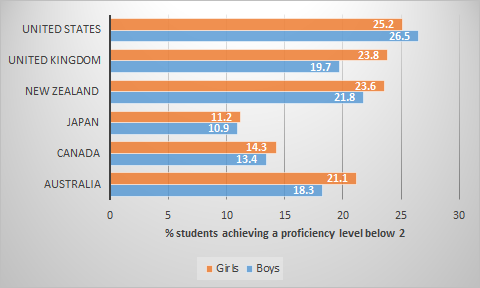
Source: OECD StatExtract.
What group has by far the lowest jobless rate?
17 Jul 2015 Leave a comment
in economics of education, human capital, job search and matching, labour economics, labour supply, occupational choice, unemployment Tags: College premium, compensating differentials, graduate premium, labour demographics
What group has by far the lowest jobless rate? College grads on.wsj.com/1Mtk8l9 http://t.co/27ft9qYjvz—
WSJ Central Banks (@WSJCentralBanks) June 05, 2015
Share of university degrees conferred to U.S. women since 1970
16 Jul 2015 Leave a comment
in economic history, economics of education, human capital, labour economics, occupational choice, politics - USA Tags: lost boys, reversing gender gap
Share of university degrees conferred to U.S. women since 1970 (via @MaxCRoser) http://t.co/FUGrM7WbJd—
Claire Lehmann (@clairlemon) July 09, 2015
Low performers in science by gender, USA, UK, Japan, Canada, Australia and New Zealand
16 Jul 2015 Leave a comment
in discrimination, economics of education, gender, labour economics, labour supply Tags: cognitive psychology, educational psychology, lost boys, PISA, Psychology, reversing gender gap
Figure 1: % of students achieving a proficiency level below 2 in science by gender, USA, UK, New Zealand, Japan, Canada and Australia, 2012

Source: OECD StatExtract.
And the rich got richer, who cares
16 Jul 2015 Leave a comment
in applied price theory, applied welfare economics, Austrian economics, comparative institutional analysis, constitutional political economy, development economics, economic history, economics of bureaucracy, economics of education, economics of regulation, economics of religion, energy economics, entrepreneurship, environmental economics, financial economics, growth disasters, growth miracles, income redistribution, industrial organisation, international economics, labour economics, labour supply, liberalism, poverty and inequality, Public Choice, rentseeking, survivor principle, transport economics, urban economics Tags: Deirdre McCloskey, entrepreneurial alertness, The Great Enrichment, The Great Escape, The Great Fact, top 1%
"The rich got richer, true. But…" —@DeirdreMcClosk buff.ly/1Imdv4o http://t.co/M3ERx3JTIn—
HumanProgress.org (@humanprogress) June 28, 2015
Low performers in reading by gender, USA, UK, Japan, Canada, Australia and New Zealand
15 Jul 2015 1 Comment
in discrimination, economics of education, gender, human capital, labour economics Tags: cognitive psychology, education, lost boys, PISA, Psychology, reversing gender gap
Figure 1: % of students achieving a proficiency level below 2 in reading by gender, USA, UK, New Zealand, Japan, Canada and Australia, 2012

Source: OECD StatExtract.
Gender gaps and reversing gender gaps in education
15 Jul 2015 Leave a comment
in discrimination, economics of education, gender, human capital, international economics Tags: gender gap, reversing gender gap
A perspective on the overweening conceit of youth
14 Jul 2015 Leave a comment
in applied welfare economics, behavioural economics, economics of crime, economics of education, labour economics, law and economics Tags: child development, cognitive psychology, economics of personality traits, political psychology
Does education pay in New Zealand?
14 Jul 2015 Leave a comment
in economics of education, human capital, labour economics, occupational choice, politics - Australia, politics - New Zealand, politics - USA Tags: College premium, graduate premium
New Zealand teachers’ unions are above average in their effectiveness
12 Jul 2015 Leave a comment
in economic history, economics of education, income redistribution, labour economics, Public Choice, rentseeking, unions Tags: public sector unions, teachers union, union power, union wage premium
Scientific Misbehavior in Economics and Publish or Perish
11 Jul 2015 Leave a comment
in economics of crime, economics of education, managerial economics, occupational choice, organisational economics, personnel economics Tags: academic fraud, promotion tournaments, rate races


The political bias of psychologists
05 Jul 2015 Leave a comment
in economics of bureaucracy, economics of education, economics of media and culture, politics - Australia, politics - New Zealand, politics - USA, Public Choice, rentseeking Tags: academic bias, bureaucratic bias, expressive voting, Leftover Left, media bias, occupational choice, political bias, rational ignorance, rational irrationality, social psychology, Twitter left
Why is it that the economics profession is the only profession questioned on the grounds of its political diversity?

1) Academic psychology once had considerable political diversity, but has lost nearly all of it in the last 50 years;
2) This lack of political diversity can undermine the validity of social psychological science via mechanisms such as the embedding of liberal values into research questions and methods, steering researchers away from important but politically unpalatable research topics, and producing conclusions that mischaracterize liberals and conservatives alike;
3) Increased political diversity would improve social psychological science by reducing the impact of bias mechanisms such as confirmation bias, and by empowering dissenting minorities to improve the quality of the majority’s thinking; and
4) The underrepresentation of non-liberals in social psychology is most likely due to a combination of self-selection, hostile climate, and discrimination.
via Psychology’s Political Diversity Problem | Psychology Today.
The evolution of global warming scepticism
05 Jul 2015 Leave a comment
in economics of education, environmental economics, global warming, rentseeking Tags: academic bias, climate alarmism, global warming, green rent seeking, publish or perish
Nobel-Winning Scientists are Getting Older
05 Jul 2015 Leave a comment
in economic history, economics of education, human capital, industrial organisation, personnel economics Tags: death of the Renaissance man, Nobel prizes, rising burden of knowledge
Why Nobel-Winning Scientists are Getting Older:
priceonomics.com/why-nobel-winn… http://t.co/rNxCUS0xG2—
Priceonomics (@priceonomics) April 10, 2015


Recent Comments