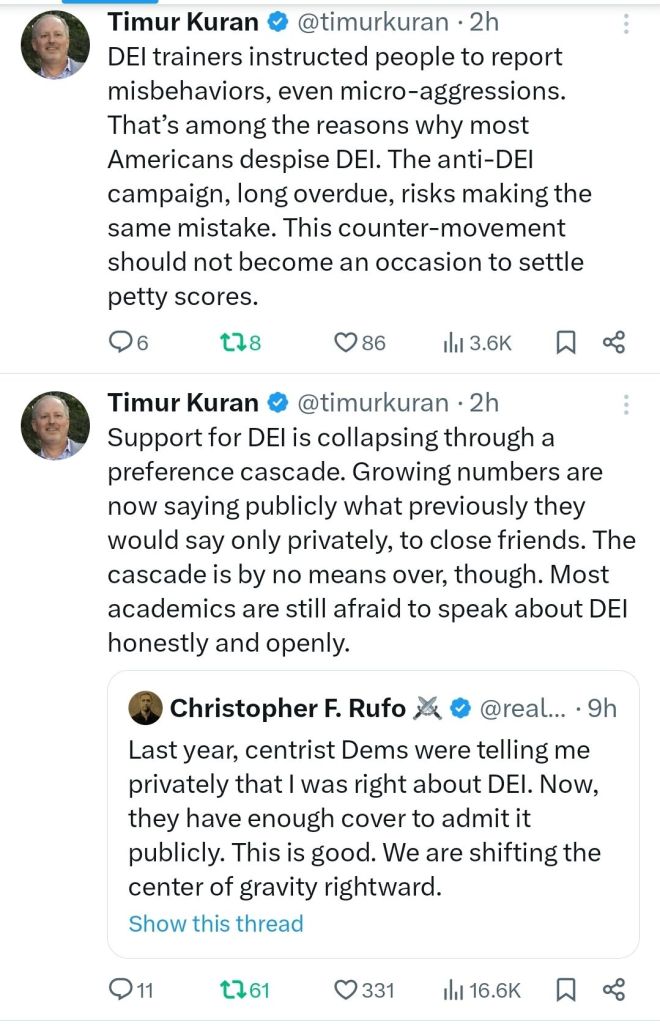
The DEI preference cascade
23 Jan 2025 Leave a comment
in applied price theory, behavioural economics, discrimination, economics of bureaucracy, economics of education, economics of information, economics of media and culture, economics of regulation, gender, labour economics, law and economics, liberalism, Marxist economics, politics - USA, property rights, Public Choice Tags: affirmative action, Age of Enlightenment, free speech, political correctness, racial discrimination, regressive left, sex discrimination

Economists Should Never Abandon Their Principles
14 Jan 2025 Leave a comment
in applied price theory, Austrian economics, comparative institutional analysis, economics of information, economics of regulation
TweetIn the Spring of 2023 I had the honor of delivering, at the Richmond Fed, the annual Sandridge Lecture to the Virginia Association of Economists. The text of that lecture – the title of which is “The Role of the Economic Scholar in Highly Politicized Society” – is available here. And pasted below are two…
Economists Should Never Abandon Their Principles
Will Australia’s Mandatory Climate Reporting make Greenwashing Illegal?
13 Jan 2025 Leave a comment
in economics of climate change, economics of information, economics of regulation, energy economics, entrepreneurship, environmental economics, environmentalism, financial economics, global warming, politics - Australia Tags: climate activists, climate alarmism

Legal penalties for greenwashing could force Aussie companies to declare their total lack of interest in climate action.
Will Australia’s Mandatory Climate Reporting make Greenwashing Illegal?
Meta dismantles misinformation industry
09 Jan 2025 Leave a comment
in economics of information, entrepreneurship, industrial organisation, law and economics, liberalism, politics - Australia, politics - New Zealand, politics - USA, property rights, Public Choice, survivor principle Tags: 2024 presidential election, free speech, political correctness, regressive left
Mark Zuckerberg announced: In recent years we’ve developed increasingly complex systems to manage content across our platforms, partly in response to societal and political pressure to moderate content. This approach has gone too far. As well-intentioned as many of these efforts have been, they have expanded over time to the point where we are making […]
Meta dismantles misinformation industry
Meta Culpa: Zuckerberg Joins Musk in the Global Fight for Free Speech
08 Jan 2025 Leave a comment
in economics of information, economics of regulation, entrepreneurship, law and economics, liberalism, politics - USA Tags: creative destruction, free speech, political correctness, regressive left

Below is my column in Fox.com on the potentially historic change in policy at Meta to restore free speech protections. As one of the longest and loudest critics of the company over its censorship history, it is admittedly hard to trust. However, an alliance of Mark Zuckerberg with Elon Musk could prove the most important […]
Meta Culpa: Zuckerberg Joins Musk in the Global Fight for Free Speech
Government Disinformation On EVs
05 Jan 2025 Leave a comment
in economics of information, energy economics, environmental economics, global warming, transport economics Tags: British politics, electric cars, hybrids

By Paul Homewood What I really wanted to comment on regarding the EV consultation was the gross disinformation below: https://www.gov.uk/government/news/industry-encouraged-to-shape-uk-transition-to-zero-emission-vehicles The Consultation Document is even more specific:
Government Disinformation On EVs
Some Simple Economics of the Google Antitrust Case
17 Dec 2024 1 Comment
in applied price theory, economics of information, entrepreneurship, industrial organisation, law and economics, politics - USA, Public Choice, survivor principle, theory of the firm Tags: competition law
The case is straightforward: Google pays firms like Apple billions of dollars to make its search engine the default. (N.B. I would rephrase this as Apple charges Google billions of dollars to make its search engine the default–a phrasing which matters if you want to understand what is really going on. But set that aside […]
Some Simple Economics of the Google Antitrust Case
The Missing Myths
04 Dec 2024 Leave a comment
in applied price theory, comparative institutional analysis, constitutional political economy, discrimination, economic history, economics of climate change, economics of information, economics of media and culture, economics of regulation, energy economics, entrepreneurship, environmental economics, environmentalism, financial economics, gender, global warming, health economics, human capital, income redistribution, labour economics, labour supply, law and economics, liberalism, libertarianism, Marxist economics, occupational choice, politics - USA, poverty and inequality, property rights, Public Choice, rentseeking Tags: Age of Enlightenment, crime and punishment, criminal deterrence, free speech, gender wage gap, law and order, political correctness, racial discrimination, regressive left, sex discrimination

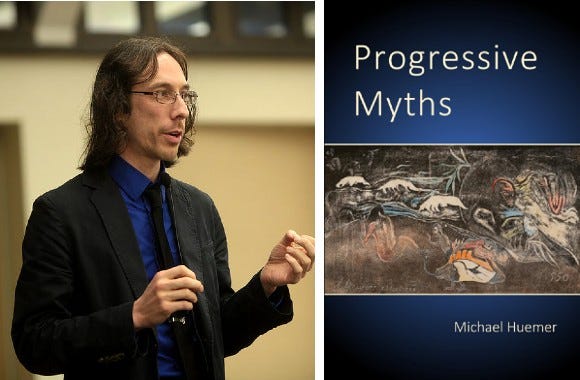
Michael Huemer’s Progressive Myths is the best book on wokeness. One of its many strengths is its focus on basic facts. As the author explains:I have selected beliefs that can be debunked fairly quickly and forcefully. Many other progressive beliefs require long argumentation and subjective judgment calls to assess. About these more difficult issues, I…
The Missing Myths
Massachusetts has occupational licensing for fortune tellers
30 Nov 2024 Leave a comment
in economics of information, economics of regulation, human capital, industrial organisation, labour economics, labour supply, law and economics, occupational choice, occupational regulation, politics - USA, property rights, Public Choice, rentseeking Tags: cranks
Here is the link, “Prohibits fraudulently taking money by “pretended fortune telling.”” Seen referenced somewhere on Twitter.
Massachusetts has occupational licensing for fortune tellers
Bob Ekelund Remembered
23 Nov 2024 Leave a comment
in applied price theory, comparative institutional analysis, economics of bureaucracy, economics of information, economics of regulation, entrepreneurship, health economics, history of economic thought, industrial organisation, law and economics, market efficiency, Milton Friedman, property rights, Public Choice, public economics, regulation, theory of the firm Tags: competition law, Product safety
TweetHere’s my just-published remembrance, in Public Choice, of my late teacher, dissertation advisor, co-author, and friend, Bob Ekelund. Three slices: The only textbook assigned for the course was Milton Friedman’s Price Theory. From some younger members of Auburn’s economics faculty, I heard a few cocktail-lubricated complaints that core theory courses in a modern economics Ph.D.…
Bob Ekelund Remembered
New MRU Video! Negative Externalities
31 Oct 2024 Leave a comment
in applied price theory, economics of information, environmental economics, law and economics, property rights, Ronald Coase
Here’s the latest video from Marginal Revolution University. It covers negative externalities–drawing, of course, from the most innovative and interesting principles of economics textbook, Modern Principles of Economics. MRU videos are free for anyone’s use anytime, anywhere and don’t forget there are also two new econ-practice games on negative externalities and positive externalities and a fun choose […]
New MRU Video! Negative Externalities
Against personal definitions
02 Oct 2024 Leave a comment
in economics of education, economics of information, economics of media and culture, law and economics, liberalism, Marxist economics, politics - Australia, politics - New Zealand, politics - USA, property rights Tags: economics of languages, free speech, political correctness, regressive left
An argument against the use of personal definitions of words can be framed around the concepts of communication efficacy, shared meaning, and societal cohesion. 1. Undermines Effective Communication The primary purpose of language is to facilitate clear communication between individuals. Personal definitions of words undermine this goal by distorting the shared meaning that allows people […]
Against personal definitions
The BBC once again won’t use the word “terrorists” for Hamas
28 Sep 2024 Leave a comment
in defence economics, economics of crime, economics of information, law and economics, laws of war, war and peace Tags: British politics, Gaza Strip, media bias, Middle-East politics, political correctness, regressive left, war against terror

This article just appeared in Spiked (click headline below to read), but you can see a similar piece in the Times of Israel. The upshot is that the BBC, which has long bridled at using the word “terrorists” for Hamas, is now bridling again when the Beeb itself shows a documentary about the Nova Music […]
The BBC once again won’t use the word “terrorists” for Hamas
The high cost of free insurance
24 Sep 2024 Leave a comment
in applied price theory, economics of bureaucracy, economics of information, economics of regulation, environmental economics, politics - New Zealand, Public Choice, public economics, urban economics Tags: unintended consequences
Eric Crampton writes – Government sometimes cannot stop itself from providing bailouts when risk-taking goes wrong. This kind of ‘free’ insurance policy leads to no end of bad outcomes.
The high cost of free insurance
“A Better Deterrence”: Hillary Clinton Calls for the Arrest of Americans Spreading Disinformation
18 Sep 2024 Leave a comment
in constitutional political economy, economics of information, economics of media and culture, law and economics, liberalism, Marxist economics, politics - USA, television Tags: 2024 presidential election, free speech, political correctness, regressive left
Hillary Clinton has long been one of the most anti-free speech figures in American politics, including calling upon European officials to force Elon Musk to censor American citizens under the infamous Digital Services Act (DSA). She is now suggesting the arrest of Americans who spread what she considers disinformation. It is a crushingly ironic moment…
“A Better Deterrence”: Hillary Clinton Calls for the Arrest of Americans Spreading Disinformation
Recent Comments