Conspiracy theories and science denial are two phenomena that often intersect, influencing public discourse and societal trust in authoritative knowledge sources. This essay explores their connection, elucidates the psychological and social mechanisms underpinning them, and provides examples to demonstrate how these two manifestations of skepticism reinforce each other, often with deleterious consequences. The Connection At […]
Conspiracy theories and science denial
Conspiracy theories and science denial
26 Feb 2025 Leave a comment
in economics of climate change, economics of education, economics of information, economics of media and culture, environmental economics, environmentalism, global warming, politics - Australia, politics - New Zealand, politics - USA Tags: conjecture and refutation, conspiracies theories, philosophy of science
Selfishly Speaking, Who Should Skip College?
20 Feb 2025 Leave a comment
in applied price theory, economics of education, economics of information, human capital, James Buchanan, labour economics, labour supply, occupational choice Tags: adverse selection, asymmetric information, College premium, signaling

The central thesis of my The Case Against Education is that actually-existing education is a terrible waste of taxpayer money. Since signaling, not building human capital, is the main function of education, the main effect of government subsidies is credential inflation. In economic jargon, my claim is that education has a low (indeed, negative) social…
Selfishly Speaking, Who Should Skip College?
Does the Gender Wage Gap Actually Reflect Taste Discrimination Against Women?
11 Feb 2025 Leave a comment
in applied price theory, discrimination, econometerics, economics of education, economics of information, economics of media and culture, gender, human capital, labour economics, labour supply Tags: gender wage gap
One explanation of the gender wage gap is taste discrimination, as in Becker (1957). We test for taste discrimination by constructing a novel measure of misogyny using Google Trends data on searches that include derogatory terms for women. We find—surprisingly, in our view—that misogyny is an economically meaningful and statistically significant predictor of the wage […]
Does the Gender Wage Gap Actually Reflect Taste Discrimination Against Women?
When politicians campaign on competition, be very worried
31 Jan 2025 Leave a comment
in applied price theory, applied welfare economics, Armen Alchian, Austrian economics, comparative institutional analysis, economics of information, economics of regulation, entrepreneurship, experimental economics, history of economic thought, law and economics, politics - New Zealand, property rights Tags: competition law
Targeting big existing businesses may be tempting to politicians, but ensuring market openness will do more good Eric Crampton writes – It’s fair to say that economists like competition. It’s also fair to say that when politicians start talking about competition, economists ought to get a little bit nervous.
When politicians campaign on competition, be very worried
Hayek on Decentralized Information in Markets
29 Jan 2025 Leave a comment
in applied price theory, Austrian economics, economics of information, F.A. Hayek
Friedrich von Hayek won the Sveriges Riksbank Prize in Economic Sciences in Memory of Alfred Nobel in 1974. For the 50th anniversary of the prize, the IEA published a short collection of essays called Hayek’s Nobel: 50 Years On, edited by Kristian Niemietz. It Includes Hayek’s speech upon acceptance of the Nobel Prize, “The Pretence…
Hayek on Decentralized Information in Markets
Book review: Hidden games
28 Jan 2025 Leave a comment
in applied price theory, behavioural economics, economics of information Tags: game theory

Game theory has a lot of real-world applications. I am never short of good examples to use when teaching game theory in my ECONS101 class. However, I can always use more examples. And so, I was really interested to read Hidden Games, by Moshe Hoffman and Erez Yoeli. The subtitle promises: “The surprising power of…
Book review: Hidden games
Interview with Eugene Fama: For Whom are Financial Markets Efficient?
28 Jan 2025 Leave a comment
in applied price theory, economics of information, entrepreneurship, financial economics Tags: efficient markets hypothesis, Internet
Joe Walker interviews Eugene Fama (Nobel ’13) with the title “For Whom is the Market Efficient?” (The Joe Walker podcast, December 31, 2024). Here are some bits and pieces of their exchange that caught my eye. Are financial markets efficient? WALKER: Gene, I was talking with a few friends who work in high finance in preparation…
Interview with Eugene Fama: For Whom are Financial Markets Efficient?
“No Consistent Patterns:” Scientists Find No Evidence that Closing Schools Materially Reduced Transmission
27 Jan 2025 Leave a comment
in economics of education, economics of information, health economics, liberalism, politics - USA Tags: economics of pandemics, free speech

For years, scientists and commentators who questioned COVID policies were censored, blacklisted, and canceled across the country. Many of these dissenting views have since been vindicated from the lab origins theory to the lack of efficacy of surgical masks to the opposition to the closure of schools. Now, a new study in the Journal of […]
“No Consistent Patterns:” Scientists Find No Evidence that Closing Schools Materially Reduced Transmission
A Wartime Natural Experiment About Copyright
26 Jan 2025 1 Comment
in applied price theory, comparative institutional analysis, defence economics, econometerics, economic history, economics of education, economics of information, economics of media and culture, economics of regulation, industrial organisation, law and economics, politics - USA, property rights, war and peace Tags: patents and copyrights, World War II
One of the hardest questions in copyright policy is: “What would have happened otherwise?” When Disney lobbies for longer copyright terms or academic publishers defend high subscription fees, we struggle to evaluate their claims because we can’t observe the counterfactual. What would happen to creativity and innovation if we shortened copyright terms or lowered prices? […]
A Wartime Natural Experiment About Copyright
Quotation of the Day…
25 Jan 2025 Leave a comment
in applied price theory, economics of information, industrial organisation, Milton Friedman
Tweet… is from page 224 of Milton & Rose Friedman’s great 1980 book, Free To Choose: What about the claim that consumers can be led by the nose by advertising? Our answer is that they can’t – as numerous expensive advertising fiascoes testify. One of the greatest duds of all time was the Edsel automobile,…
Quotation of the Day…
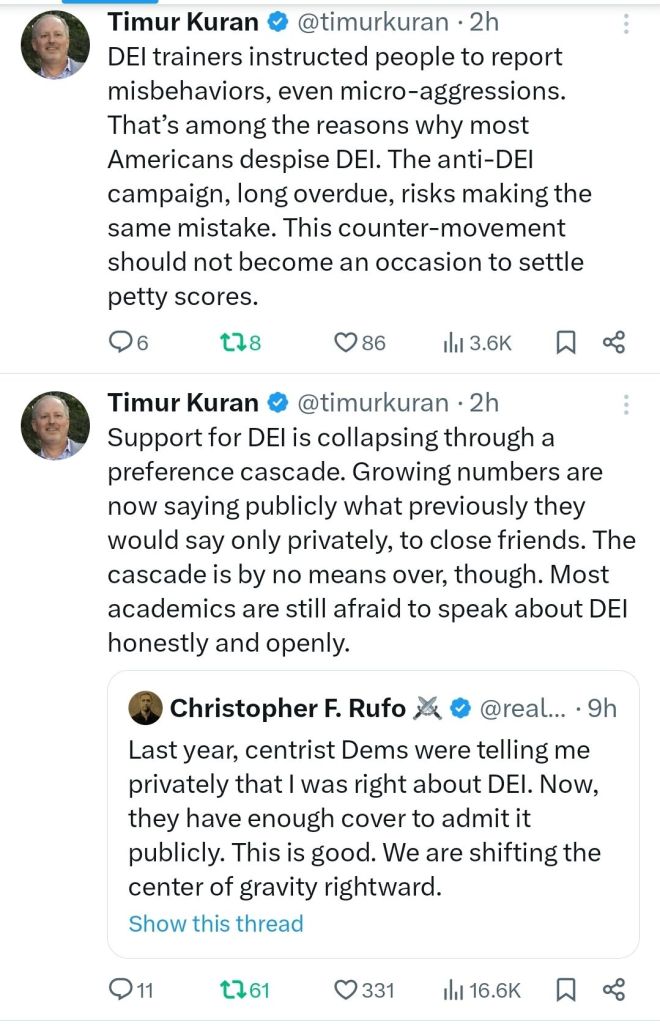
The DEI preference cascade
23 Jan 2025 Leave a comment
in applied price theory, behavioural economics, discrimination, economics of bureaucracy, economics of education, economics of information, economics of media and culture, economics of regulation, gender, labour economics, law and economics, liberalism, Marxist economics, politics - USA, property rights, Public Choice Tags: affirmative action, Age of Enlightenment, free speech, political correctness, racial discrimination, regressive left, sex discrimination
Economists Should Never Abandon Their Principles
14 Jan 2025 Leave a comment
in applied price theory, Austrian economics, comparative institutional analysis, economics of information, economics of regulation
TweetIn the Spring of 2023 I had the honor of delivering, at the Richmond Fed, the annual Sandridge Lecture to the Virginia Association of Economists. The text of that lecture – the title of which is “The Role of the Economic Scholar in Highly Politicized Society” – is available here. And pasted below are two…
Economists Should Never Abandon Their Principles
Will Australia’s Mandatory Climate Reporting make Greenwashing Illegal?
13 Jan 2025 Leave a comment
in economics of climate change, economics of information, economics of regulation, energy economics, entrepreneurship, environmental economics, environmentalism, financial economics, global warming, politics - Australia Tags: climate activists, climate alarmism

Legal penalties for greenwashing could force Aussie companies to declare their total lack of interest in climate action.
Will Australia’s Mandatory Climate Reporting make Greenwashing Illegal?
Meta dismantles misinformation industry
09 Jan 2025 Leave a comment
in economics of information, entrepreneurship, industrial organisation, law and economics, liberalism, politics - Australia, politics - New Zealand, politics - USA, property rights, Public Choice, survivor principle Tags: 2024 presidential election, free speech, political correctness, regressive left
Mark Zuckerberg announced: In recent years we’ve developed increasingly complex systems to manage content across our platforms, partly in response to societal and political pressure to moderate content. This approach has gone too far. As well-intentioned as many of these efforts have been, they have expanded over time to the point where we are making […]
Meta dismantles misinformation industry
Meta Culpa: Zuckerberg Joins Musk in the Global Fight for Free Speech
08 Jan 2025 Leave a comment
in economics of information, economics of regulation, entrepreneurship, law and economics, liberalism, politics - USA Tags: creative destruction, free speech, political correctness, regressive left

Below is my column in Fox.com on the potentially historic change in policy at Meta to restore free speech protections. As one of the longest and loudest critics of the company over its censorship history, it is admittedly hard to trust. However, an alliance of Mark Zuckerberg with Elon Musk could prove the most important […]
Meta Culpa: Zuckerberg Joins Musk in the Global Fight for Free Speech


Recent Comments