This is either real or excellent computer-generated images.
HT: Julian Weeks
Celebrating humanity's flourishing through the spread of capitalism and the rule of law
18 Sep 2015 Leave a comment
in economics of media and culture Tags: CGI
This is either real or excellent computer-generated images.
HT: Julian Weeks
17 Sep 2015 Leave a comment
in economic history, economics of media and culture, Public Choice Tags: British politics, expressive voting, London, London newspaper market, media bias, rational ignorance, rational rationality
16 Sep 2015 Leave a comment
in economics of media and culture, economics of regulation, energy economics, environmental economics Tags: atomic power, environmental alarmism, expressive voting, Green alarmism, nuclear energy, rational ignorance, rational irrationality
15 Sep 2015 Leave a comment
in economic history, economics of media and culture Tags: economics of language, network goods
The original definition of "egregious" was "remarkably good." Literally. http://t.co/r8lUkG7NAs—
Lisa Wade, PhD (@lisawade) April 16, 2015
15 Sep 2015 Leave a comment
in cats, economics of media and culture, entrepreneurship Tags: entrepreneurial alertness
The Software That Detects When a Cat Is Messing with Your Keyboard:
priceonomics.com/the-software-t… http://t.co/6dkU6e8ors—
Priceonomics (@priceonomics) September 09, 2015
14 Sep 2015 Leave a comment
in economics of media and culture Tags: cyber loafing
I discover how productive cyber loafing was when I was cut off from the Internet for 16 days at my desktop.

My usual way of working was completely interrupted. Instead of working in bursts and doing a bit of cyber loafing while recharging my batteries. I had nothing in particular to do when each spell of concentrated work came to an end. This is before you consider the fact that you integrate looking things up on the Internet while writing papers and researching blogs.

14 Sep 2015 Leave a comment
in cats, economics of media and culture Tags: cat doors
13 Sep 2015 Leave a comment
in economic history, economics of media and culture, entrepreneurship Tags: creative destruction, laptops
The difference that 25 years makes. http://t.co/amfutCoLT0—
Lost In History (@SadHappyAmazing) September 11, 2015
13 Sep 2015 Leave a comment
in economic history, economics of crime, economics of media and culture, health and safety, health economics, labour economics, law and economics, Music, occupational choice Tags: crime and punishment, homicide rates, law and order, suicide
What kills popular musicians? Depends on the genre http://t.co/BTDvdWOS4F—
paulkirby (@paul1kirby) September 11, 2015
12 Sep 2015 1 Comment
in comparative institutional analysis, constitutional political economy, economics of media and culture, liberalism, managerial economics, organisational economics Tags: Cass Sunstein, Daily Me, information cocoons, infotopia, John Stuart Mill, Karl Popper, New Zealand Greens, Twitter, Twitter left
One of the first things I noticed when feuding on Twitter with Green MPs was how polite they were. Twitter is not normally known for that characteristic and that is before considering the limitations of 144 characters. People who are good friends and work together will go to war over email without any space limitations for the making an email polite and friendly. Imagine how easy it is to misconstrue the meaning and motivations of tweets that can only be 144 characters.

The New Zealand Green MPs in their replies on Twitter make good points and ask penetrating questions that explain their position well and makes you think more deeply about your own. Knowledge grows through critical discussion, not by consensus and agreement.

Cass Sunstein made some astute observations in Republic.com 2.0 about how the blogosphere forms into information cocoons and echo chambers. People can avoid the news and opinions they don’t want to hear.
Sunstein has argued that there are limitless news and information options and, more significantly, there are limitless options for avoiding what you do not want to hear:
A common risk of debate is group polarisation. Members of the deliberating group move toward a more extreme position relative to their initial tendencies! How many blogs are populated by those that denounce those who disagree? This is the role of the mind guard in group-think.
Sunstein in Infotopia wrote about how people use the Internet to spend too much time talking to those that agree with them and not enough time looking to be challenged:
In an age of information overload, it is easy to fall back on our own prejudices and insulate ourselves with comforting opinions that reaffirm our core beliefs. Crowds quickly become mobs.
The justification for the Iraq war, the collapse of Enron, the explosion of the space shuttle Columbia–all of these resulted from decisions made by leaders and groups trapped in “information cocoons,” shielded from information at odds with their preconceptions. How can leaders and ordinary people challenge insular decision making and gain access to the sum of human knowledge?
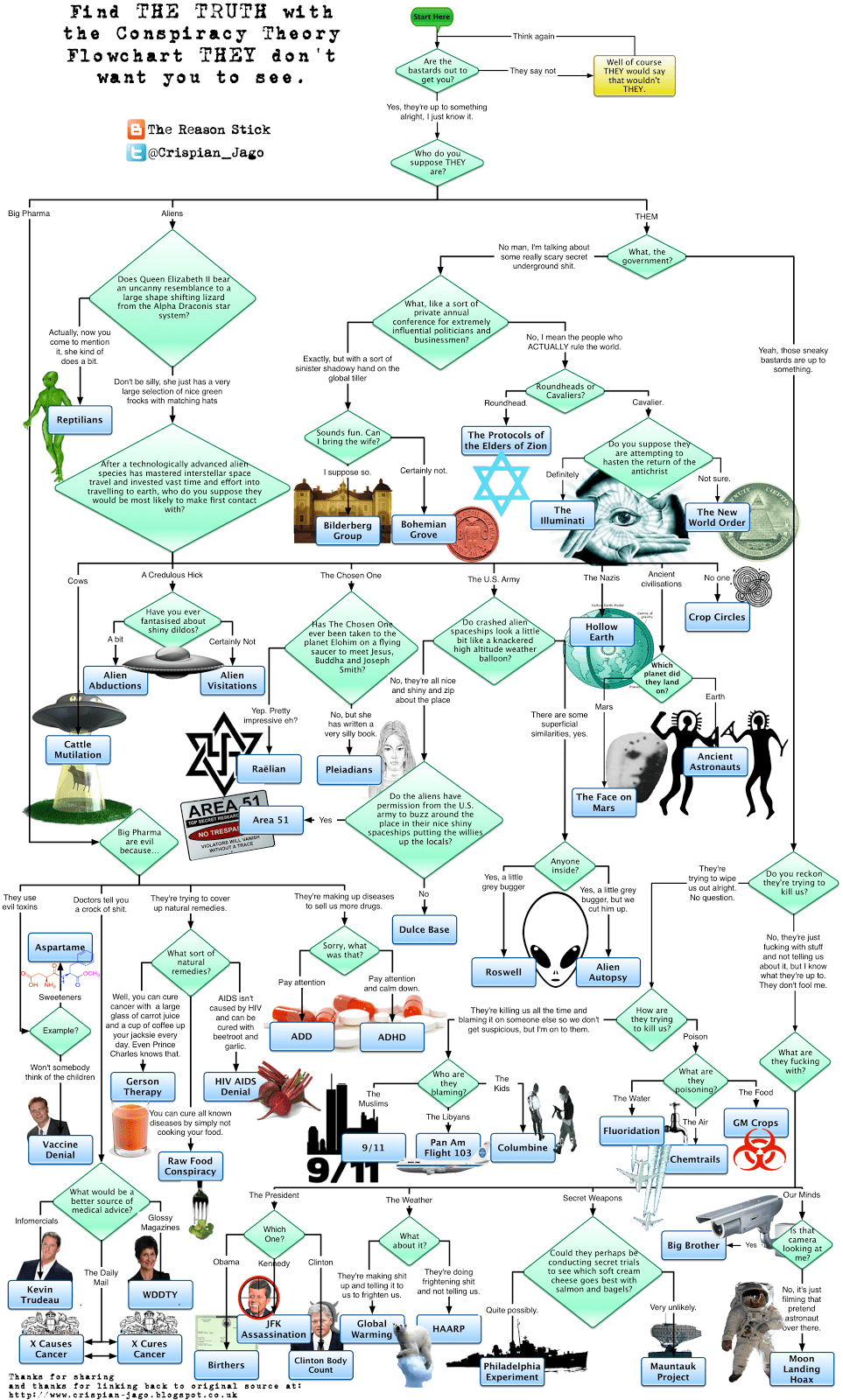
Conspiracy theories had enough momentum of their own before the information cocoons and echo chambers of the blogosphere gained ground.

J.S. Mill pointed out that critics who are totally wrong still add value because they keep you on your toes and sharpened both your argument and the communication of your message. If the righteous majority silences or ignores its opponents, it will never have to defend its belief and over time will forget the arguments for it.
As well as losing its grasp of the arguments for its belief, J.S. Mill adds that the majority will in due course even lose a sense of the real meaning and substance of its belief. What earlier may have been a vital belief will be reduced in time to a series of phrases retained by rote. The belief will be held as a dead dogma rather than as a living truth.
Beliefs held like this are extremely vulnerable to serious opposition when it is eventually encountered. They are more likely to collapse because their supporters do not know how to defend them or even what they really mean.

J.S. Mill’s scenarios involves both parties of opinion, majority and minority, having a portion of the truth but not the whole of it. He regards this as the most common of the three scenarios, and his argument here is very simple. To enlarge its grasp of the truth, the majority must encourage the minority to express its partially truthful view. Three scenarios – the majority is wrong, partly wrong, or totally right – exhaust for Mill the possible permutations on the distribution of truth, and he holds that in each case the search for truth is best served by allowing free discussion.

Mill thinks history repeatedly demonstrates this process at work and offered Christianity as an illustrative example. By suppressing opposition to it over the centuries Christians ironically weakened rather than strengthened Christian belief. Mill thinks this explains the decline of Christianity in the modern world. They forgot why they were Christians.
12 Sep 2015 Leave a comment
in economic history, economics of media and culture, entrepreneurship Tags: creative destruction
Pizza night? Enjoy this first. A @nytimes 1944 explanation of pizza to an unsuspecting America http://t.co/Q5vhCLaQT6—
paulkirby (@paul1kirby) September 11, 2015
11 Sep 2015 Leave a comment
in economics of media and culture Tags: British politics
11 Sep 2015 Leave a comment
in economic history, economics of media and culture, entrepreneurship, technological progress Tags: cell phones, creative destruction, living standards
11 Sep 2015 Leave a comment
in economics of media and culture Tags: cultural etiquette, travel
Celebrating humanity's flourishing through the spread of capitalism and the rule of law
Celebrating humanity's flourishing through the spread of capitalism and the rule of law
Celebrating humanity's flourishing through the spread of capitalism and the rule of law
Celebrating humanity's flourishing through the spread of capitalism and the rule of law
Celebrating humanity's flourishing through the spread of capitalism and the rule of law
Celebrating humanity's flourishing through the spread of capitalism and the rule of law
Celebrating humanity's flourishing through the spread of capitalism and the rule of law
Celebrating humanity's flourishing through the spread of capitalism and the rule of law
Celebrating humanity's flourishing through the spread of capitalism and the rule of law
Celebrating humanity's flourishing through the spread of capitalism and the rule of law
Celebrating humanity's flourishing through the spread of capitalism and the rule of law
Celebrating humanity's flourishing through the spread of capitalism and the rule of law
A History of the Alt-Right
Econ Prof at George Mason University, Economic Historian, Québécois
Celebrating humanity's flourishing through the spread of capitalism and the rule of law
Scholarly commentary on law, economics, and more
Beatrice Cherrier's blog
Celebrating humanity's flourishing through the spread of capitalism and the rule of law
Celebrating humanity's flourishing through the spread of capitalism and the rule of law
Celebrating humanity's flourishing through the spread of capitalism and the rule of law
Why Evolution is True is a blog written by Jerry Coyne, centered on evolution and biology but also dealing with diverse topics like politics, culture, and cats.
Celebrating humanity's flourishing through the spread of capitalism and the rule of law
A rural perspective with a blue tint by Ele Ludemann
DPF's Kiwiblog - Fomenting Happy Mischief since 2003
Celebrating humanity's flourishing through the spread of capitalism and the rule of law
The world's most viewed site on global warming and climate change
Tim Harding's writings on rationality, informal logic and skepticism
A window into Doc Freiberger's library
Let's examine hard decisions!
Commentary on monetary policy in the spirit of R. G. Hawtrey
Thoughts on public policy and the media
Celebrating humanity's flourishing through the spread of capitalism and the rule of law
Politics and the economy
A blog (primarily) on Canadian and Commonwealth political history and institutions
Reading between the lines, and underneath the hype.
Economics, and such stuff as dreams are made on
"The British constitution has always been puzzling, and always will be." --Queen Elizabeth II
Celebrating humanity's flourishing through the spread of capitalism and the rule of law
Celebrating humanity's flourishing through the spread of capitalism and the rule of law
WORLD WAR II, MUSIC, HISTORY, HOLOCAUST
Undisciplined scholar, recovering academic
Celebrating humanity's flourishing through the spread of capitalism and the rule of law
Res ipsa loquitur - The thing itself speaks
In Hume’s spirit, I will attempt to serve as an ambassador from my world of economics, and help in “finding topics of conversation fit for the entertainment of rational creatures.”
Researching the House of Commons, 1832-1868
Reflections on books and art


Recent Comments