December 5th 1933 – The night they ended Prohibition http://t.co/OCxvyNfVIR—
Old Pics Archive (@oldpicsarchive) April 11, 2015
Prohibition ended this day 1933
05 Dec 2015 Leave a comment
in economic history, economics of regulation, health economics, politics - USA Tags: alcohol prohibition, alcohol regulation, meddlesome preferences, nanny state, prohibition era
Cut drug lags with Free To Choose Medicine @annetterongotai @dbseymour @PeterDunneMP
03 Dec 2015 Leave a comment
in economics of regulation, health economics, politics - New Zealand, politics - USA, Sam Peltzman
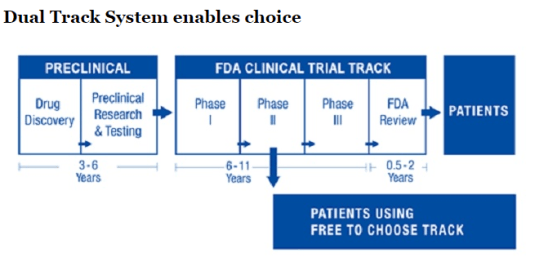
Bart Madden and Vernon Smith outlined a brilliant proposal charted above to shorten lags in the availability of life-saving medicine based on reforms in Japan:
Recently, Japanese legislation has implemented the core FTCM [Free to Choose Medicine] principles of allowing not-yet-approved drugs to be sold after safety and early efficacy has been demonstrated; in addition, observational data gathered for up to seven years from initial launch will be used to determine if formal drug approval is granted. In order to address the pressing needs of an aging population, Japanese politicians have initially focused on regenerative medicine (stem cells, etc.).
Source: Give The FDA Some Competition With Free To Choose Medicine – Forbes via A Dual-Track Drug Approval Process.
This process would release the relevant data behind the drug including its clinical trials on a web portal so that patients and their doctors can work out whether a new drug is suitable to them given their genetic markers. Madden and Smith explain the operation of the web portal for Free to Choose Medicine (FTCM) as follows:
Doctors would be empowered to use their medical knowledge and in-depth knowledge of their patients similar to how they decide on off-label use for approved drugs, i.e., for uses that the FDA has neither tested nor approved but, in the opinion of doctors, are likely to be beneficial to patients. To gain early access, patients would purchase the drug from developers and consent to doctor and developer immunity from lawsuits except in the case of gross negligence or willful misconduct.
Off label use of medicines arises because the current Food and Drug Administration (FDA) process for drug approval has several phases. Phase 1 tests for the safety of the drug. Later phases are about whether the drug has its predicted effects. That should not be a concern of the FDA or its superfluous New Zealand equivalent Medsafe.
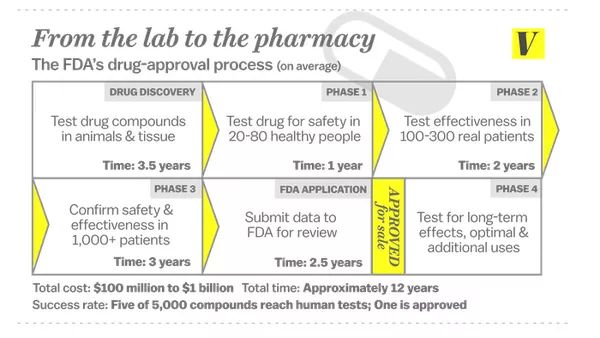
If a new drug isn’t better than the existing competition, that’s a problem for its investors for backing the wrong horse. It’s up to its investors and potential buyers to work out for themselves whether a new drug is more effective than the existing options. That’s a commercial decision, not a decision from regulators.
https://twitter.com/Carolynyjohnson/status/667696845615968257
Once a drug is approved by the FDA for particular uses, doctors and researchers often discover that a drug has other clinical applications.
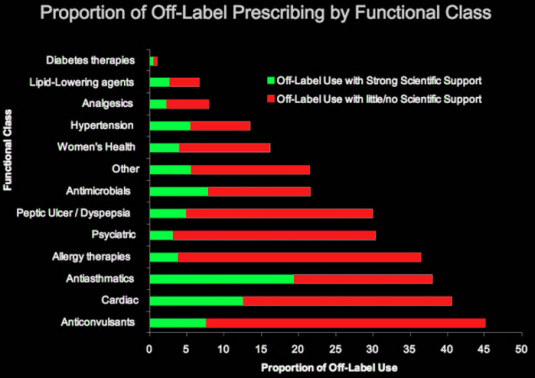
Source: Pharma Marketing Blog
Rather than go through another round of FDA approvals, doctors simply prescribe that drug despite the fact it is not approved by the FDA for that particular clinical use. This is what is called off label prescription.
A number of US states have passed hopelessly unconstitutional Right to Try legislation that authorises the prescription of new drugs not approved by the FDA.
The Free to Choose Medicine proposal is similar to Right to Try legislation. Free to Choose Medicine would allow doctors to make their own prescription choices for their patients as long as the new drug has been shown to be safe. That is, it has passed Phase 1 of the FDA drug approval process. Phase 1 is about drug safety.
In 1962, an amended law gave the FDA authority to judge if a new drug produced the results for which it had been developed. Formerly, the FDA monitored only drug safety. It previously had only sixty days to decide this. Drug trials can now take up to 10 years.
https://twitter.com/MaxCRoser/status/627581135355310080
Sam Peltzman showed in a famous paper in 1973 that the 1962 amendments to US Federal drug approval laws reduced the introduction of effective new drugs in the USA from an average of forty-three annually in the decade before the 1962 amendments to sixteen annually in the ten years afterwards. No increase in drug safety was identified.

Peltzman found that the unregulated market quickly weeded out ineffective drugs prior to the 1962 law change in the USA. The sales of ineffective new drugs declined rapidly within a few months of their introduction.
Doctors stop prescribing medicines that don’t work. Patients complain quickly about medicines that don’t work. What matters is they had the chance to try this drug.

If economists have a bitter drinking song, a battle cry that unites the warring schools of economic thought all, it would be “how many people has the FDA killed today”. Many drugs became available years after they were on the market outside the USA because of drug approval lags at the FDA. The dead are many. To quote David Friedman:
In 1981… the FDA published a press release confessing to mass murder. That was not, of course, the way in which the release was worded; it was simply an announcement that the FDA had approved the use of timolol, a ß-blocker, to prevent recurrences of heart attacks. At the time timolol was approved, ß-blockers had been widely used outside the U.S. for over ten years. It was estimated that the use of timolol would save from seven thousand to ten thousand lives a year in the U.S. So the FDA, by forbidding the use of ß-blockers before 1981, was responsible for something close to a hundred thousand unnecessary deaths.
Free to Choose Medicine is an excellent way to break the regulatory deadlock over drug lags. Free to Choose Medicine should be adopted in New Zealand. Any new drug that has passed the phase 1 drug safety part of regulatory approval processes in any one of the USA, UK, Australia, Canada or Germany should be lawful to prescribe in New Zealand. New drugs should not have to go through the superfluous processes of Medsafe.

The existing drug regulatory regime is based upon making the drug safe for the average patient. That has been swept aside by pharmaceutical innovation as Madden and Smith explain:
Today’s world of accelerating medical advancements is ushering in an age of personalized medicine in which patients’ unique genetic makeup and biomarkers will increasingly lead to customized therapies in which samples are inherently small. This calls for a fast-learning, adaptable FTCM environment for generating new data.
In sharp contrast, the status quo FDA environment provides a yes/no approval decision based on statistical tests for an average patient, i.e., a one-size-fits-all drug approval process. In a FTCM environment, big data analytics would be used to analyze TEDD [Tradeoff Evaluation Drug Database] in general and, in particular, to discover subpopulations of patients who do extremely well or poorly from using a FTCM drug.
The modern macroeconomics of the Global Financial Crisis
02 Dec 2015 Leave a comment
in applied price theory, budget deficits, business cycles, economic growth, economic history, economics of regulation, Euro crisis, fiscal policy, global financial crisis (GFC), great depression, great recession, macroeconomics, monetary economics Tags: adverse selection, bank panics, bank runs, banking crises, deposit insurance, economics central banks, financial crises, moral hazard, sovereign defaults
@NYTimeskrugman nails urban inequality @PhilTwyford @metiria
01 Dec 2015 Leave a comment
in economics of regulation, politics - New Zealand, urban economics

Source: Inequality and the City – The New York Times via Krugman: Deregulate Housing, David Henderson | EconLog | Library of Economics and Liberty.
Climate sceptics are so low that they must be smeared as libertarians
01 Dec 2015 3 Comments
in applied welfare economics, economics of regulation, environmental economics, global warming, politics - USA, Public Choice
When the Twitter Left brands an opponent as a libertarian, I assume it’s a secret handshake among true believers trying to identify each other. You need time management counselling in your calling as a political junkie if you knew what a libertarian was until a few years ago. The only reason to change was the election of Senator Ron Paul.
The Twitter Left likes to smear opponents as libertarians despite the fact that certainly outside the USA and even within the USA few know what the libertarian means even with the help of scare quotes.
Only political junkies have an inkling of what a neoliberal is so why smear someone such an even more obscure label such as libertarian? Libertarian must be lower than a neo-liberal and should be hated even more by the Twitter Left must be the implication despite its poor marketing outreach value. I’m still puzzled as to why use such an obscure political label.
Today in the New York Times, a guide was published giving its readers the short answers to the key questions global warming. The author argued that most attacks on the science of global warming come from libertarians and other political conservatives who don’t like the implications of fighting global warming for growth in the size of government.

Source: Short Answers to Hard Questions About Climate Change – The New York Times via Environmental Economics: Short Answers to Hard Questions About Climate Change – The New York Times.
It is true that people attempt to discredit the arguments behind positions. Let he who is without sin cast the first stone.
“How to discredit an unwelcome report:
… Stage Four: Discredit the person who produced the report. Explain (off the record) that
1. He is harbouring a grudge against the Department.
2. He is a publicity seeker.
3. He is trying to get a Knighthood/Chair/Vice Chancellorship.
4. He used to be a consultant to a multinational.
5. He wants to be a consultant to a multinational.”
Sir Humphrey, The Greasy Pole.
As a professional economist, I am used to special interests as well as the Twitter Left arguing that economics is “just a theory” and its methodology is unrealistic along with various other attempts to avoid engaging with the actual advice put forward.

It is also true that scepticism about climate science has a partisan divide. In the USA, for example, Democrats are far more worried about global warming then independents or Republicans. (Independents is their name for swinging voters. They are called independents because if they register as one, they can vote in the Republican or Democratic primaries in many states).

I have argued in the blogosphere since 2011 that let the science be settled, only the economics matters because the economic cost of global warming is small.
Global warming, although real, is not apt to be severe. It will lower the level of GDP by maybe 2%. The loss of one year’s income growth! Courtesy of David Friedman’s reading of the report, this is what the most recent report of the IPCC said:
With these recognized limitations, the incomplete estimates of global annual economic losses for additional temperature increases of ~2°C are between 0.2 and 2.0% of income (±1 standard deviation around the mean)
I have also argued that the climate alarmists scored a great tactical victory in keeping the debate about the reliability of the science. By successfully baiting that trap for opponents, the climate alarmists have avoided having to discuss the costs and benefits of global warming.
Richard Tol on the scientific consensus about human-caused global warming skepticalscience.com/graphics.php?g… http://t.co/OpdRtsY1tx—
John Cook (@skepticscience) March 24, 2015
So it is rather curious that climate sceptics are playing to the strength of the climate alarmists rather than their weaknesses. Those weaknesses are the economics of global warming and the public choice economics of international climate agreements.
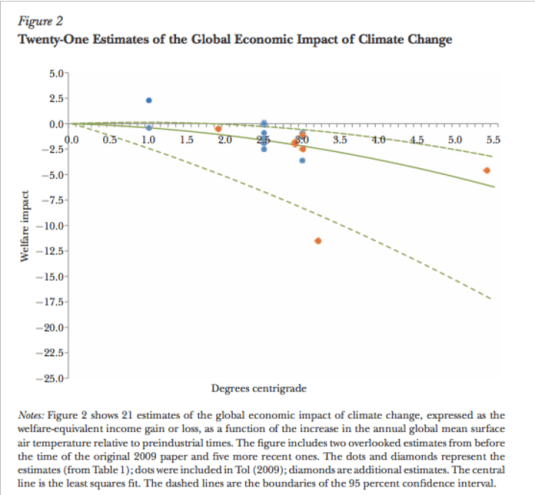
Source: Richard Tol.
Not only is the economic cost of global warming small, the chances of supplying an international public good such as a treaty to reduce carbon emissions is minimal.
The New York Times today in its Q&A guide did not quantify the costs and benefits of global warming. That makes their guide deeply misleading. This is because such estimates of the cost of global warming as a percentage of GDP are available from the IPCC. Which is worse? Being a libertarian or a misleading, low rent journalist?

Source: Short Answers to Hard Questions About Climate Change – The New York Times via Environmental Economics: Short Answers to Hard Questions About Climate Change – The New York Times.
What is even more bizarre in the guide today in the New York Times is the claim that politicians are finally taking climate change seriously. Anyone who claims that a climate change treaty will come out of Paris that is in any way binding is simply not paying attention to the last 5 years of politics and who controls the U.S. Congress. They cannot be taken seriously as a political commentator.
Obama gave up on a climate bill passed by the House of Representatives in 2010 despite the fact that he had the numbers in the Senate to break a filibuster. There were 5 Republican senators who would have voted for cap and trade in April 2010: Lindsey Graham, Susan Collins, Olympia Snowe, Scott Brown, and George LeMieux. There were 57 Democrat Senators. It takes 60 votes to break a filibuster.
Obama gave up because he didn’t want the additional political flak of passing a climate change bill in the aftermath of the political costs of passing Obamacare. President Obama could have fought harder to get the Bill the House passed through the Senate but he did not.
Concern about global warming fads away when it becomes a hip pocket issue. Rather than blaming vast right-wing conspiracies, using Google searches for “unemployment” and “global warming”, Kahn and Kotchen found that:
- Recessions increase concerns about unemployment at the expense of public interest in climate change;
- The decline in global-warming searches is larger in more Democratic leaning states; and
- An increase in a state’s unemployment rate decreases in the probability that Americans think global warming is happening, and reduces the certainty of those who think it is.
As Geoff Brennan has argued, CO2 reduction actions will be limited to modest unilateral reductions of a largely token character. There are many expressive voting concerns that politicians must balance to stay in office and the environment is but one of these. Once climate change policies start to actually become costly, expressive voting support for these policies will fall away, and it has.
Homeopathy explained
01 Dec 2015 Leave a comment
in economics of information, economics of media and culture, economics of regulation, health economics Tags: consumer fraud, cranks, homeopathy, quackery, Quacks
Political outlooks and risk perception
29 Nov 2015 1 Comment
in applied welfare economics, economics of regulation, health economics Tags: anti-vaccination movement, expressive voting, GMOs, gun control, political psychology, risk risk trade-offs
Marijuana regulation: there are many options
27 Nov 2015 Leave a comment
in applied price theory, economics of crime, economics of media and culture, economics of regulation, industrial organisation, law and economics Tags: marijuana decriminalisation

@Maori_Party sold their people out to the NIMBYs
23 Nov 2015 Leave a comment
in applied price theory, economics of regulation, politics - New Zealand, urban economics
The Māori Party face the least political risks from deregulating land supply because so few Māori own their own homes. Less than half the rate of European New Zealanders. Māori home ownership rates peaked in 1991.
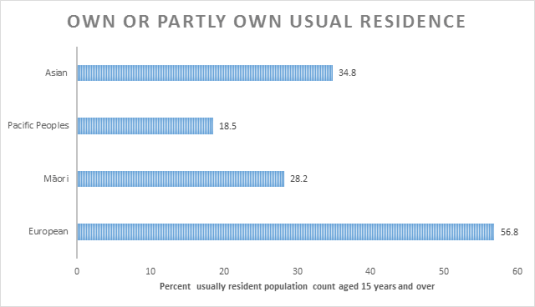
Source: 2013 Census QuickStats about housing.
Nonetheless, the Māori Party supplied the last two votes to vote down attempts to relax regulatory restrictions on the supply of land in New Zealand.
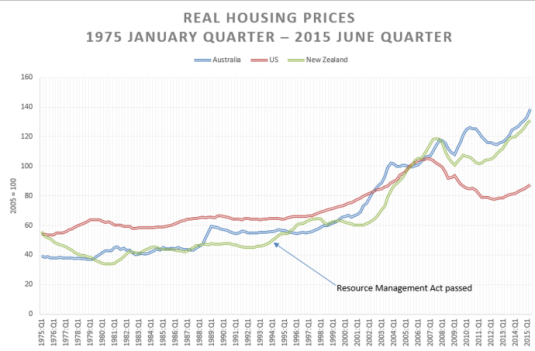
Source and notes: International House Price Database – Dallas Fed June 2015; nominal housing prices for each country is deflated by the personal consumption deflator for that country.
Their rationale for making land more expensive is a commitment to environmental principles. As the Māori Party coleader explained at the time:
We know there is considerable pressure and need for this Government to address the housing shortage, particularly in Auckland. However, one intent of the RMA, is to protect our environment for generations to come and this must remain paramount.
The 2014 policy manifesto of the party did not discuss housing supply or the need for reform of the RMA. It was mainly about social housing and the quality of rental house.
The chances of Māori increasing their homeownership rates rather than becoming leading members of Generation Rent requires a relaxation in restrictions in the RMA on the supply of land.
Auckland is up with London and New York in terms of housing unaffordability relative to median incomes. US cities with responsive land regulation don’t experience housing bubbles.
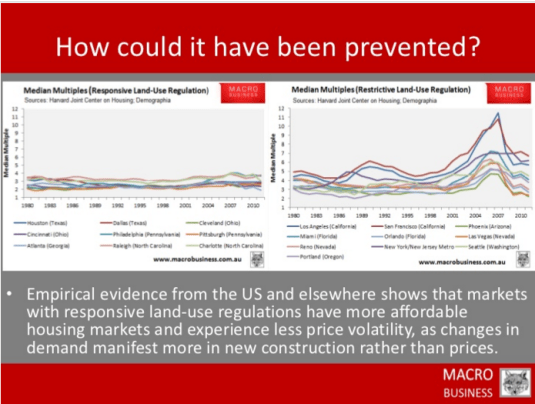
Glaeser and Gyourko summarised the findings of a number of studies on land supply and housing prices:
Recent research also indicates that house prices are more volatile, not just higher, in tightly regulated markets …. price bubbles are more likely to form in tightly regulated places, because the inelastic supply conditions that are created in part from strict local land-use regulation are an important factor in supporting ever larger price increases whenever demand is increasing. …. It is more difficult for house prices to become too disconnected from their fundamental production costs in lightly regulated markets because significant new supply quickly dampens prices, thereby busting any illusions market participants might have about the potential for ever larger price increases.
There has been a steady decline in housing affordability in New Zealand. The position is critical of the bottom 20% of the income ladder. Four in 10 now spend more than 30% of their disposable income on housing costs. Māori will be over-represented in this group but the party set-up to speak for them fails to do everything it can to make their housing cheaper.
Uber is creative destruction on steroids
23 Nov 2015 Leave a comment
in economics of regulation, entrepreneurship, industrial organisation, survivor principle Tags: creative destruction, entrepreneurial alertness, taxi regulation, Uber
Unlike @Subway @WalmartToday understands the #DHMO awareness campaign
19 Nov 2015 Leave a comment
in economics of media and culture, economics of regulation, environmental economics, health economics Tags: political satire, precautionary principle, Subway, Walmart

Banking crises are more common than you think
16 Nov 2015 Leave a comment
in currency unions, economic history, economics of regulation, Euro crisis, macroeconomics, monetary economics Tags: bank run, banking crises, banking panics, economics of banking, financial crises

@JohnQuiggin on “How New Zealand fell further behind” @FairnessNZ
15 Nov 2015 1 Comment
in applied welfare economics, economic growth, economic history, economics of regulation, fiscal policy, labour economics, politics - New Zealand Tags: Australia, John Quiggin, lost decades
Leading Australian academic economist John Quiggin has just published an article arguing that New Zealand should not be a policy role model for anything. To quote Quiggin:
For most of the twentieth century, the New Zealand and Australian economies performed almost identically. New Zealand took a somewhat larger hit when Britain entered the European Common Market in the 1970s, but that impact has long since washed out. The real divergence came in the 1980s. Since then, New Zealand’s income per person has fallen 35 per cent behind Australia’s
He used Reserve Bank of New Zealand data going back to 1990, which is common starting point for most Reserve Bank data.
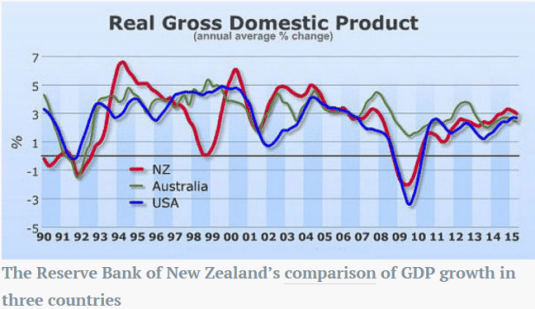
Source: John Quiggin “How New Zealand fell further behind”. Inside Story, 11 November 2015.
If he had taken that chart back to the 1970s and earlier using the Conference Board Total Database, Quiggin would have found that New Zealand economy diverged from Australia in the 1970s, not in the 1980s. His data from the Reserve Bank of New Zealand started at the low point in 1990 – at the end of that divergence that started in 1974. The New Zealand economy was depressed between 1974 and 1992. I label this Great Depression in New Zealand as New Zealand’s Lost Decades.
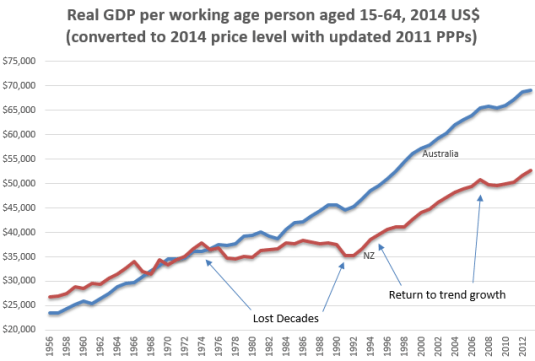
Source: Computed from OECD Stat Extract and The Conference Board. 2015. The Conference Board Total Economy Database™, May 2015, http://www.conference-board.org/data/economydatabase/
Real GDP PPP per working age New Zealander fell rapidly after 1974 (a 34% drop against trend) when that economy was a heavily regulated, highly taxed economy. This heavily regulated, highly taxed, economically stagnant New Zealand is the good old days in the eyes of the Twitter Left.
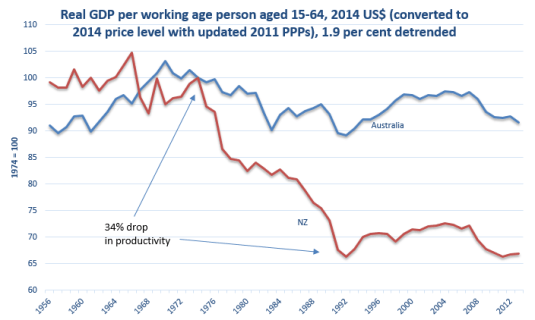
Source: Computed from OECD Stat Extract and The Conference Board. 2015. The Conference Board Total Economy Database™, May 2015, http://www.conference-board.org/data/economydatabase/
In the chart above, the base is 1974 which equals 100. A flat-line means annual growth equal to the trend rate of growth in the 20th century for the USA. A falling line means below trend growth; a rising line means above trend rate economic growth per working age Australian or New Zealander.
With the election of a National Party government in 1990 and a massive fiscal consolidation, New Zealand growth rate returned to the previous trend rate of 1.9% in 1992. Ruth Richardson’s horror budget of 1991 was so bad that the what became the Twitter Left called it the “Mother of All Budgets“.
What followed this massive fiscal consolidation where welfare benefits for cut severely was an economic boom that lasted until the GFC.
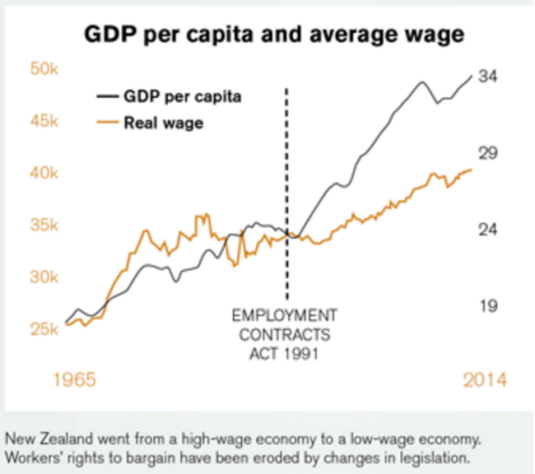
Source: Income Gap | New Zealand Council of Trade Unions – Te Kauae Kaimahi.
As shown in the chart conveniently compiled by the New Zealand Council of Trade Union, there was 20 years of real wage stagnation until the passage of the Employment Contracts Act in 1991.
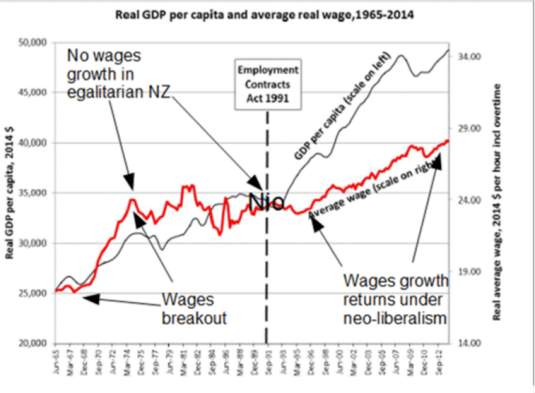
Source: Income Gap | New Zealand Council of Trade Unions – Te Kauae Kaimahi with annotations.
What followed the passage of that Act was sustained real wages growth for the first time in two decades and the end of growing inequality under the previously highly taxed, heavy regulated economy that was good old days New Zealand if the Twitter Left is to be believed.
To do this, to paint pre-1984 New Zealand, pre-neoliberal New Zealand as a fairly egalitarian paradise, Max Rashbrooke is an example of that is had to ignore two thirds of the population and the inequalities they suffered:
“New Zealand up until the 1980s was fairly egalitarian, apart from Maori and women, our increasing income gap started in the late 1980s and early 1990s,” says Rashbrooke. “These young club members are the first generation to grow up in a New Zealand really starkly divided by income.”
Racism and patriarchy can sit comfortably with a fairly egalitarian society if you are to believe the vision of the Twitter Left as to their good old days. John Quiggin refers to the period in Australia known as the Menzies Era as part of his golden age of the mixed economy. The Menzies Era was most of the 23 years of uninterrupted conservative party rule between 1949 and 1972. The actual Menzies Era was the period up to 1966 when Liberal Party Prime Minister Sir Robert Menzies retired
The reforms of the 1980s known as Rogernomics stopped the long-term stagnation in real wages that started in about 1974. The reforms of the early 1990s under a National Party government including a massive fiscal consolidation and the passing of the Employment Contracts Act was followed by the resumption of sustained growth in real wages with little interruption since.
New work by Chris Ball and John Creedy shows substantial *declines* in NZ inequality.
initiativeblog.com/2015/06/24/ine… http://t.co/f94fw4Bhae—
Eric Crampton (@EricCrampton) June 24, 2015
This boom after two decades of minimal real economic growth per working age New Zealander benefited everyone. The unemployment rate fell to a record low of 3.5% about 2005. Maori unemployment was at a 20-year low of 8% in 2008. Maori labour force participation rates increased from 45% in the late 1980s to about 62% by the eve of the Global Financial Crisis.
The increase in percentage terms of Maori and Pasifika real household income is much larger than for Pakeha since the economic reforms of the 1980s and 1990s. As Bryan Perry (2015, p. 67) explains when commenting on table D6 sourced by Closer Together Whakatata Mai:
From a longer-term perspective, all groups showed a strong rise from the low point in the mid 1990s through to 2010. In real terms, overall median household income rose 47% from 1994 to 2010: for Maori, the rise was even stronger at 68%, and for Pacific, 77%. These findings for longer- term trends are robust, even though some year on year changes may be less certain. For 2004 to 2010, the respective growth figures were 21%, 31% and 14%.
US, UK, Danish and Swedish tax revenues as % of GDP since 1966
13 Nov 2015 Leave a comment
in economic history, public economics, Sam Peltzman
You can’t find Reaganomics in the tax statistics below. Maggie Thatcher stopped a rapid growth in British tax revenues which caused the UK to become the sick man of Europe. She then unwound that growth in tax revenues as a percentage of British GDP. The election of the Blair government in 1997 stopped the rapid growth in tax revenues as a share of British GDP under that double secret socialist John Major. As Sam Peltzman previously noticed, the growth the government stopped in Denmark and Sweden in the mid-1980s.
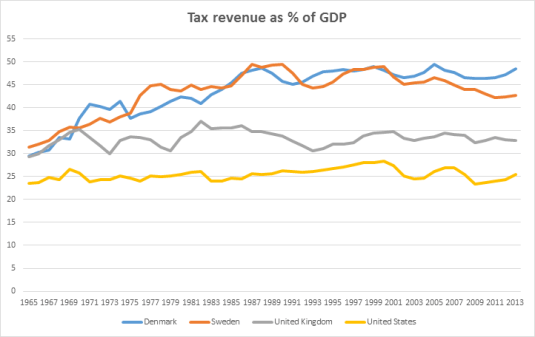
Data extracted on 12 Nov 2015 23:56 UTC (GMT) from OECD.Stat


Recent Comments