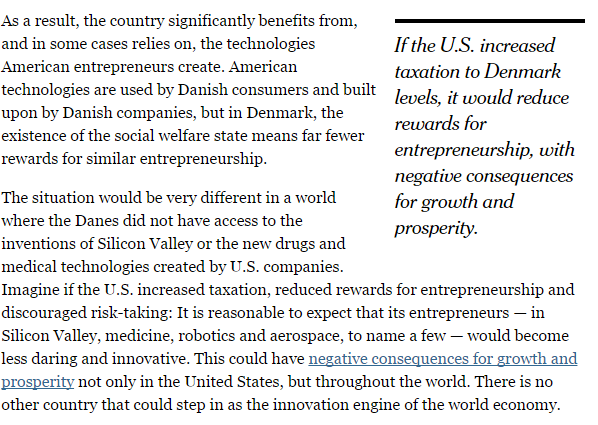
Source: Daron Acemoglu A Scandinavian U.S. Would Be a Problem for the Global Economy – NYTimes.com.
Celebrating humanity's flourishing through the spread of capitalism and the rule of law
12 Nov 2015 1 Comment
in applied price theory, applied welfare economics, comparative institutional analysis, constitutional political economy, economic history, economics of regulation, entrepreneurship, industrial organisation, politics - USA, public economics, survivor principle, taxation, technological progress Tags: creative destruction, Daron Acemoglu, Denmark, entrepreneurial alertness, Eurosclerosis, international technology diffusion, taxation and entrepreneurship, taxation and innovation, taxation and investment, taxation and labour supply, technology followers, welfare state
Source: Daron Acemoglu A Scandinavian U.S. Would Be a Problem for the Global Economy – NYTimes.com.
10 Nov 2015 Leave a comment
in business cycles, economic history, economics of regulation, Euro crisis, job search and matching, labour economics, labour supply, macroeconomics Tags: British economy, employment law, equilibrium unemployment rate, Eurosclerosis, France, Germany, Italy, labour market reforms, Margaret Thatcher, Thatchernomics, The British Disease
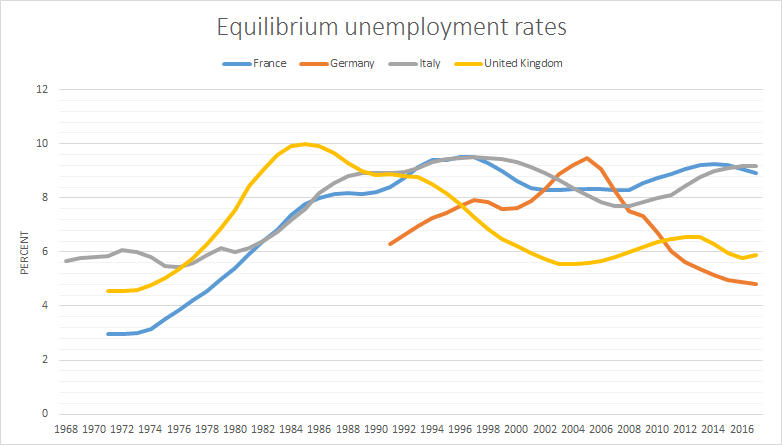
Unlike the USA, the German, Italian, British and French equilibrium unemployment rates all show fluctuations that reflect changes in their underlying economic circumstances and labour market reforms. The case of the British, the rise of the British disease and Thatchernomics. The case of German, its equilibrium unemployment rate rose after German unification and then fell after the labour market reforms of 2002 to 2005.
Source: OECD Economic Outlook November 2015 Data extracted on 10 Nov 2015 07:07 UTC (GMT) from OECD.Stat.
09 Nov 2015 Leave a comment
in economics of regulation, politics - New Zealand, Public Choice, rentseeking, urban economics
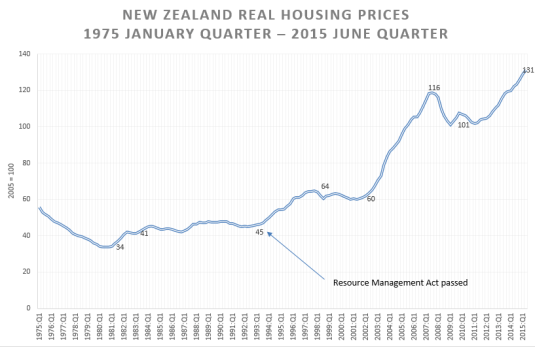
Buying a house became an investment in New Zealand coincidently with the passing of the Resource Management Act and all the restrictions on land supply it empowered. Prior to then buy a house was a good idea except if you want to make money because real housing prices in 1993 were the same as in the mid-70s.
Source and notes: Dallas Fed International Housing Database July 2015 – The author acknowledge use of the dataset described in Mack and Martínez-García (2011); real housing prices are nominal housing prices deflated by a personal consumption deflator.
Housing prices rose by 50% in the first few years after the passage of the Resource Management Act. Housing prices doubled again in the last five years of the last Labour Government in New Zealand. With the economic recovery, housing prices increased again by 30% in the last four years or so.
The housing prices charted in deflated above are nationwide figures originally from nationwide nominal data published by the Reserve Bank of New Zealand and Quotable Value. They do not show the even faster growth in housing prices in, example, Auckland, Wellington and Christchurch and stagnant housing prices in declining regions, cities and towns of New Zealand.
08 Nov 2015 Leave a comment
in applied price theory, economics of regulation, fiscal policy, politics - New Zealand, urban economics Tags: housing affordability, land supply, New Zealand Greens, New Zealand Labour Party, RMA
Labour yesterday announced an excellent policy on housing affordability. The reforms proposed by Labour stress increasing the supply of land and improvements to local government finances surrounding infrastructure investments for new housing:
Labour will free up density and height controls to allow more medium density housing and reform the use of urban growth boundaries so they don’t drive up section costs. This will curb land bankers and speculators.
Labour has struck at the heart of two major constraints on urban land supply New Zealand: restrictions on density and height of new developments, and much more importantly, the use of urban growth boundaries to drive up land prices. These proposed regulatory reforms could not be more welcome.
The other shoe of Labour’s housing affordability reform proposals is improving the incentives for local councils to support new housing developments:
The other new element is changing the way we fund infrastructure for new developments. Currently those costs are either subsidised by the ratepayer or passed by the developer onto the price tag of a new home. That makes houses much more expensive. It also means they are paid off through mortgages at expensive bank interest rates.
Our new policy will see infrastructure funded by local government bonds, paid off over the lifetime of the asset through a targeted rate on the properties in the new development. This will substantially reduce the cost of new housing.
The reforms proposed by Labour to local government financing will reduce the financial burden on existing ratepayers of the local government funded infrastructure necessary to support new land developments.
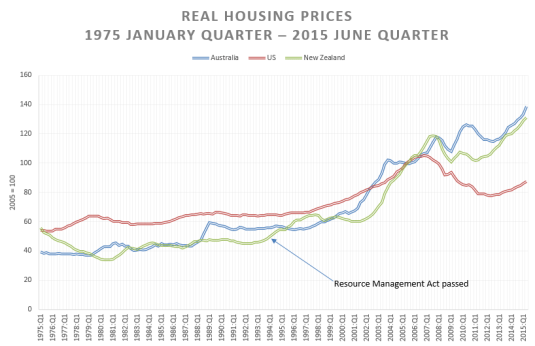
Source and notes: International House Price Database – Dallas Fed June 2015; nominal housing prices for each country is deflated by the personal consumption deflator for that country.
These Labour Party reforms are fantastic because the main party on the left-wing of New Zealand politics has faced up to restricted land supply as a key reason behind housing unaffordability. I wonder what the New Zealand Greens will think of these major new reforms.
Of course, nothing is perfect in the art of policy development. New Zealand Labour continue to want government to build 100,000 affordable houses and scapegoat foreigners for high housing prices.
A few more sensible economic and fiscal policy announcements such as those today by the New Zealand Labour Party and it will start looking like a credible alternative government.
06 Nov 2015 Leave a comment
in economic history, economics of regulation, health and safety
05 Nov 2015 Leave a comment
in economic history, economics of regulation, health economics Tags: economics of smoking
04 Nov 2015 Leave a comment
in economics of information, economics of regulation, health economics Tags: homeopathy, Quacks
https://twitter.com/NightingaleC/status/501737546125410305/photo/1
The decline of outpatient attendancies at the Glasgow Homeopathic Hospital: nightingale-collaboration.org/news/165-more-… #ten23 #homeopathy http://t.co/cFO4k2vIjt—
Nightingale Collab. (@NightingaleC) August 19, 2014
The rising costs of #homeopathy on the NHS: nightingale-collaboration.org/news/162-the-d… #ten23 (3/3) http://t.co/GjXkC14y3D—
Nightingale Collab. (@NightingaleC) August 19, 2014
The decline of #homeopathy on the NHS: #ten23 (2/3) http://t.co/0FcHBjtqI7—
Nightingale Collab. (@NightingaleC) August 19, 2014
The decline of #homeopathy on the NHS: #ten23 (1/3) http://t.co/BcHz8GQ7bG—
Nightingale Collab. (@NightingaleC) August 19, 2014
31 Oct 2015 Leave a comment
in economics of media and culture, economics of regulation, energy economics, environmental economics, health economics Tags: expressive voting, precautionary principle, rational ignorance, rational irrationality, risk risk trade-offs
31 Oct 2015 Leave a comment
in applied price theory, Austrian economics, comparative institutional analysis, constitutional political economy, defence economics, economics of bureaucracy, economics of regulation, industrial organisation, labour economics, Ludwig von Mises, Public Choice, survivor principle Tags: Nazi Germany
#TBT Ludwig von Mises' 1942 Letter to the Editor in the @nytimes on Nazi socialism. http://t.co/kv7TFekY8J—
Mises Institute (@mises) October 15, 2015
29 Oct 2015 Leave a comment
in economics of regulation, public economics
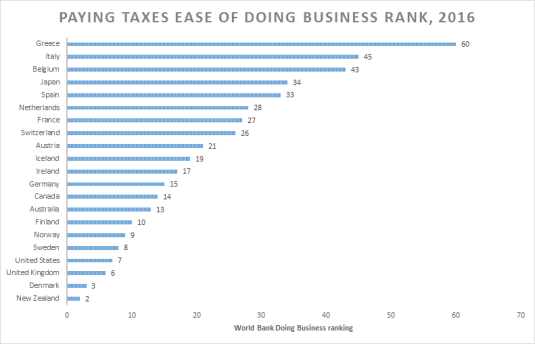
I’m surprised it is so difficult to pay taxes in Japan. I had a job there. Your employer fills out your income tax return for you. The individual taxpayer doesn’t have to do anything. I certainly found it more difficult to do tax returns in New Zealand and Australia as compared to Japan.
Source: Historical Data – Doing Business- World Bank Group.
People tell me that filling out a tax return in the USA is a nightmare. Filling out a federal tax return takes a day and tax agents must be hired by ordinary taxpayers. The USA is still ranked seventh by the World Bank in terms of ease of paying taxes.
All those American TV shows ranging from police dramas to comedies about the horrors of filling out tax returns and the dreaded IRS audit of ordinary taxpayers must have some truth in them. The pop culture about the IRS must have some accuracy to resonate with lives of the viewing audience.
Not to kick America when it’s down, I did not mention the need of many American taxpayers to fill out multiple state and city tax income tax returns. I haven’t mentioned multiple federal state and local business tax and sales tax returns either.
29 Oct 2015 1 Comment
in applied welfare economics, economics of regulation, health economics, politics - New Zealand Tags: drug lags, Drug safety
Medsafe denied New Zealanders access to four drugs approved in comparable regulatory jurisdictions in the last three years. Medsafe rejected two other drugs in the last three years but these drugs were not approved in comparable jurisdictions. Doxorubicin Liposomal, chemotherapy drug, is not as yet actually refused, its application is pending. Medsafe is not involved in the funding of medicines; this is the responsibility of PHARMAC.

Source: data released 29 October 2015 pursuant to an Official Information Act request to the Ministry of Health.
What’s the point of this regulatory arm of the Ministry of Health? Is it a waste of space? Should not New Zealand automatically register any drug approved in the USA, UK, Canada, Australia or Germany? What can medical trials in New Zealand find out were not already found out overseas? Medsafe targets processing applications for the approval of new drugs in New Zealand to be done within 200 days. That’s 200 days too many.
Barriers to entry – costs ($s) of bringing new drugs to the market have risen manyfold #econ3 http://t.co/MFHTFhTLrj—
Geoff Riley (@tutor2u_econ) November 30, 2014
It should be lawful under the Medicines Act 1981 to market any drug in New Zealand which any of Australia, UK, USA, Canada or Germany has approved for prescription to patients.
SEEN & UNSEEN/ How much illness & death could be averted by limiting the FDA to safety, leaving efficacy to markets? http://t.co/4QkUuCCMDN—
Robert Graboyes (@Robert_Graboyes) March 11, 2015
If economists have a bitter drinking song, a battle cry that unites the warring schools of economic thought all, it would be “how many people has the FDA killed today”. For example, drugs became available years after they were on the market outside the USA because of drug approval lags at the FDA. The dead are many. To quote David Friedman:
In 1981… the FDA published a press release confessing to mass murder. That was not, of course, the way in which the release was worded; it was simply an announcement that the FDA had approved the use of timolol, a ß-blocker, to prevent recurrences of heart attacks. At the time timolol was approved, ß-blockers had been widely used outside the U.S. for over ten years. It was estimated that the use of timolol would save from seven thousand to ten thousand lives a year in the U.S. So the FDA, by forbidding the use of ß-blockers before 1981, was responsible for something close to a hundred thousand unnecessary deaths.
In 1962, an amended law gave the FDA authority to judge if a new drug produced the results for which it had been developed. Formerly, the FDA monitored only drug safety. It previously had only sixty days to decide this. Drug trials can now take up to 10 years.
Sam Peltzman showed in a famous paper in 1973 that these 1962 amendments reduced the introduction of new drugs in the USA from an average of forty-three annually in the decade before the 1962 amendments to sixteen annually in the ten years afterwards. No increase in drug safety was identified.
Halving every 9 years.
New approved drugs per billion dollars spent on research & development
bit.ly/1StxuV9 http://t.co/Hvx6mQ0lBa—
Max Roser (@MaxCRoser) August 01, 2015
Medsafe is a cost with no benefits to the New Zealand public. Medsafe has around 60 staff operating out of two offices, with centralised administrative functions, product approval and standard setting at the head office in Wellington.

How much of this budget of several million for Medsafe could be redirected to funding more life-saving and life changing drugs for use in New Zealand? This is rather than wasted on duplicating clinical trials already completed overseas or at the minimum duplicating regulatory approval processes, paperwork already completed overseas but not requiring a duplicate clinical trial in New Zealand.
At a minimum, the net benefits of the entire drug approval framework over the past three years in New Zealand is riding out on rejecting for approval half a dozen drugs, four of which are approved as safe in other comparable jurisdictions. That’s a pretty thin reed on which to hang a large budget that could be used by PHARMAC to fund life-saving drugs.
There should be a post box at the Ministry of Health to receive the certifications from overseas drug regulation agencies. Anything more is a deadly waste of taxpayers’ money.
My next round of Official Information Act requests will ask whether the minister and associate ministers of health were briefed on refusals of new medicines approved in other jurisdictions. Next I will ask:
I have previously asked for information on drug approval lags. That was refused on the grounds I can look it up for myself on a rather complicated public database that requires knowledge of the names of medicines submitted for approval. Still mulling over what to do about that.
28 Oct 2015 Leave a comment
in economics of regulation, international economics, law and economics
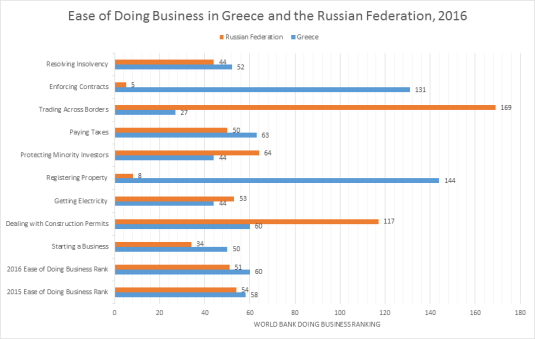
The only clear advantage Greece has on Russia as a place to do business is trading across borders because of European Union membership. Russia is a dog of a place to get things across borders. Greece has dropped two places overall ranking as a place to do business while Russia climbed 3 places in the World Bank 2016 Doing Business rankings as compared to their 2015 Doing Business rankings.
Source: Historical Data – Doing Business- World Bank Group.
In 2016, Russia has considerable strengths as compared to Greece in a number of other areas of doing business such as enforcing contracts, registering property and starting a business. Russia is even a slightly better place to pay taxes than Greece! Russia’s World Bank Doing Business ranking for trading across borders has not changed between 2015 and 2016.
28 Oct 2015 Leave a comment
in currency unions, economics of regulation, international economic law, international economics
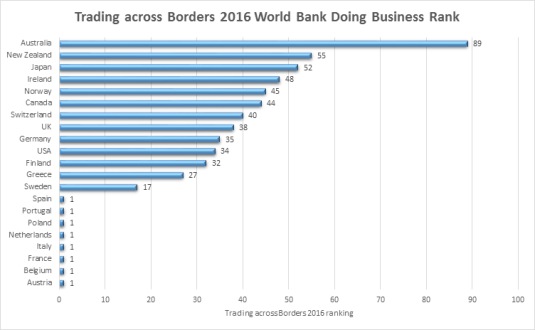
Australia is certainly a dog of a place when it comes to trading across borders and the same pretty much goes for New Zealand. Continental European Union members who are next to each other have a good run when it comes to trading across borders. Germans seem to manage to stuff that up nonetheless.
Source: Historical Data – Doing Business- World Bank Group.
Australia and New Zealand get a poor rating because of border charges for a processing of customs documents. In Continental Europe, where there are no border controls for land crossings between EU members, these border compliance costs obviously do not apply nor is there any waiting at border checkpoints.
28 Oct 2015 Leave a comment
in economics of regulation, law and economics
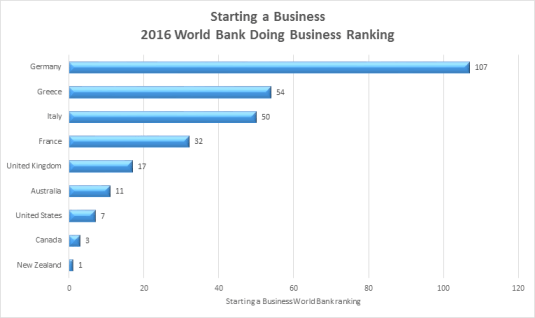
If you doing anything as badly as Greece, which Italy and certainly Germany have some explaining, it’s really difficult to start a business in your country. The British and French don’t have anything to crow about either.
26 Oct 2015 Leave a comment
in economics of crime, economics of regulation, health economics, politics - New Zealand, Public Choice
Preview of @NZQandA tomorrow https://t.co/svYBRTpUeR—
Peter Dunne (@PeterDunneMP) October 23, 2015
Associate Health Minister Peter Dunne was onto something when he pointed out that a number of those supporting the legalisation of medicinal cannabis oils are using it as a stalking horse to legalise the marijuana leaf.
After reading the wonderful investigation in Saturday’s Dominion Post, it’s quite clear that cannabis oil has nothing to do with marijuana liberalisation.
The Associate Health Minister pointed out on television yesterday that there is already one cannabis oil derivative product approved by Medisafe and available on prescription. It is open to any pharmaceutical company to submit any other cannabis oil and marijuana derivative medicine for approval. There will be a fair hearing.
Medical marijuana is already legal in New Zealand. Few cannabis oil and marijuana leaf derivatives have been approved under the Medicines Act because few have shown to be an effective medication.
Those campaigned for a marijuana law reform would do a lot of sick people a service by saying that the campaign from better access and government funding of cannabis oil and other marijuana derivatives is a separate issue from which they stand apart. They should be not trying to follow in medicinal cannabis deregulation to liberalise recreational use of marijuana.
The issues have nothing to do with each other. Those who want marijuana liberalisation should stand on their own political feet.
US deaths (2013)
Tobacco 437k
Alcohol 29k
Opoids 16k
Heroin 8k
Cocaine 5k
Marijuana 0vox.com/2014/5/19/5727… http://t.co/o8yMDf7oE0—
Conrad Hackett (@conradhackett) August 04, 2015
By infiltrating the medical marijuana lobby, their entryism slows any deregulation of the medicinal uses of cannabis oil and marijuana leaf because of slippery slope arguments.
A group of men and women gleefully demonstrate against Prohibition in 1932. http://t.co/686SwVHyC0—
Old Pics Archive (@oldpicsarchive) January 29, 2015
The marijuana decriminalisation lobby should be honest and say that it happens to be a coincidence that marijuana has other constituents that have medicinal uses. They want to decriminalise marijuana because they just want to get high.

Celebrating humanity's flourishing through the spread of capitalism and the rule of law
Celebrating humanity's flourishing through the spread of capitalism and the rule of law
Celebrating humanity's flourishing through the spread of capitalism and the rule of law
Celebrating humanity's flourishing through the spread of capitalism and the rule of law
Celebrating humanity's flourishing through the spread of capitalism and the rule of law
Celebrating humanity's flourishing through the spread of capitalism and the rule of law
Celebrating humanity's flourishing through the spread of capitalism and the rule of law
Celebrating humanity's flourishing through the spread of capitalism and the rule of law
A History of the Alt-Right
Econ Prof at George Mason University, Economic Historian, Québécois
Celebrating humanity's flourishing through the spread of capitalism and the rule of law
Scholarly commentary on law, economics, and more
Beatrice Cherrier's blog
Celebrating humanity's flourishing through the spread of capitalism and the rule of law
Celebrating humanity's flourishing through the spread of capitalism and the rule of law
Celebrating humanity's flourishing through the spread of capitalism and the rule of law
Why Evolution is True is a blog written by Jerry Coyne, centered on evolution and biology but also dealing with diverse topics like politics, culture, and cats.
Celebrating humanity's flourishing through the spread of capitalism and the rule of law
A rural perspective with a blue tint by Ele Ludemann
DPF's Kiwiblog - Fomenting Happy Mischief since 2003
Celebrating humanity's flourishing through the spread of capitalism and the rule of law
The world's most viewed site on global warming and climate change
Tim Harding's writings on rationality, informal logic and skepticism
A window into Doc Freiberger's library
Let's examine hard decisions!
Commentary on monetary policy in the spirit of R. G. Hawtrey
Thoughts on public policy and the media
Celebrating humanity's flourishing through the spread of capitalism and the rule of law
Politics and the economy
A blog (primarily) on Canadian and Commonwealth political history and institutions
Reading between the lines, and underneath the hype.
Economics, and such stuff as dreams are made on
"The British constitution has always been puzzling, and always will be." --Queen Elizabeth II
Celebrating humanity's flourishing through the spread of capitalism and the rule of law
Celebrating humanity's flourishing through the spread of capitalism and the rule of law
WORLD WAR II, MUSIC, HISTORY, HOLOCAUST
Undisciplined scholar, recovering academic
Celebrating humanity's flourishing through the spread of capitalism and the rule of law
Res ipsa loquitur - The thing itself speaks
In Hume’s spirit, I will attempt to serve as an ambassador from my world of economics, and help in “finding topics of conversation fit for the entertainment of rational creatures.”
Researching the House of Commons, 1832-1868
Reflections on books and art
Posts on the History of Law, Crime, and Justice
Celebrating humanity's flourishing through the spread of capitalism and the rule of law
Exploring the Monarchs of Europe
Cutting edge science you can dice with


Recent Comments