
How @MaxRashbrooke showed housing costs is the main driver of poverty when trying to argue rising inequality was not driven by housing costs
13 Oct 2015 Leave a comment
in applied welfare economics, economics of regulation, politics - New Zealand, poverty and inequality, Rawls and Nozick, rentseeking, urban economics
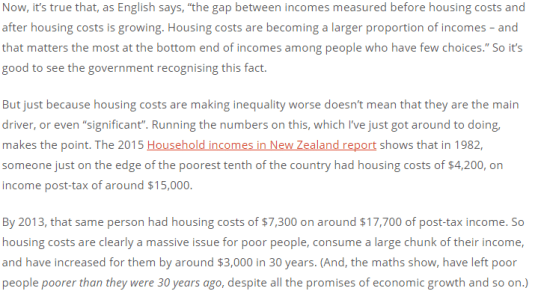
Rashbrooke then goes on to discuss how housing costs were not a main driver of the growing gap between the top 10% and the bottom 10% of the income distribution in New Zealand. My point is he is more concerned with the politics of envy than with building political support for action against poverty.
What children say about poverty #childpovertynz #itsnotchoice http://t.co/vYfxTn7aG7—
Child Poverty NZ (@povertymonitor) September 07, 2015
Rashbrooke showed that the main driver of poverty in New Zealand is rising housing costs. That is easy to redress but for the opposition of the left-wing parties to reforms to the Resource Management Act that will increase the supply of land and thereby drive down housing costs and rents.
Children's views on poverty #childpovertynz occ.org.nz/assets/Uploads… http://t.co/wZHJ19QcpN—
Child Poverty NZ (@povertymonitor) September 08, 2015
Housing costs gobbled up much of the rising incomes of the poor for many years now in New Zealand as Rashbrooke showed today. The New Zealand Labor Party and New Zealand Greens are doing nothing about it. The regulatory constraints on the supply of land could be gone by lunchtime if the self-proclaimed champions of the poor and social justice supported the reform of the RMA.
The proposals of the New Zealand Labour Party and Greens for the government to build more houses is pointless unless there is more land is supplied. If there is no increase in land supply, all the building of more houses by government does is build the same houses of private developers would have built on the same fixed supply of land. There must be an increase in the supply of land to drive housing costs down for the poor.

Will Auckland become like San Francisco?
10 Oct 2015 1 Comment
in economic history, economics of regulation, environmental economics, politics - New Zealand, politics - USA, urban economics Tags: Auckland, housing affordability, land supply, land use planning, RMA, San Francisco, zoning
https://twitter.com/JoshZumbrun/status/652517712070082561/photo/1
"Your neighborhood could be next." San Francisco-wide mailer in support of Prop I, the Mission housing moratorium. http://t.co/PtN38JTaUM—
Jed Kolko (@JedKolko) October 10, 2015
@sival84 @MarketUrbanism @SFyimby More for thought: Permits vs prices for top ten tech hubs trulia.com/blog/trends/pr… http://t.co/yRvjVWDova—
Ralph B. McLaughlin (@housingnomix) October 01, 2015
@NZGreens @GreenpeaceNZ why does @PAKnSAVE charge for plastic bags?
08 Oct 2015 Leave a comment
in applied price theory, economics of regulation, entrepreneurship, industrial organisation, managerial economics, organisational economics
The 40 PAKnSAVE supermarkets on the North Island charge for plastic bags which you pack for yourself. The 100 New World supermarkets owned by Foodstuffs on the North Island do not charge for plastic bags and the bags are packed for you. The reason is supply and demand that takes account of the full price of groceries including the time cost of shopping and the incomes of their respective customers.

My New World supermarket is just down the road for me – I can see it from my window as I type. The nearest PAKnSAVE is a short drive to a slightly rougher part of town. The PAKnSAVE supermarkets are warehouse style supermarkets rather than a shopping experience made as pleasant as possible and convenient to where you live. PAKnSAVE supermarkets are much larger supermarkets required to be a hub for a number of suburbs rather than one or two.
The type of people who shop at PAKnSAVE are people that the New Zealand Greens pretend to be concerned about. PAKnSAVE customers are lower income people sensitive to prices, willing to go to the trouble of recycling bags.
5p for a plastic bag?
I'm all for a nice little earner, but this is a bleedin' liberty!
#Minder http://t.co/BvfLnjsVy8—
Arthur Daley (@DaleyArfur) October 08, 2015
As you expect under capitalism and freedom, a supermarket chain emerged through market competition to service that more price sensitive niche. The New World supermarket caters more for people in a hurry rather than people on a budget. People on a budget go to PAKnSAVE.
Monday's Daily Mail front page:
Plastic bags chaos looms
#tomorrowspaperstoday #bbcpapers http://t.co/iHHLunYyow—
Nick Sutton (@suttonnick) October 04, 2015
The customers of New World supermarkets are nice members of the middle class who are much more likely to vote Green. They are busy people who do not have the time to keep their bags for next time, much less pack them for themselves. That is before we discuss how unhygienic the recycling of plastic bags is.
Typical of your middle-class Green disposed voter, they are cheapies in a small way as well. When my local supermarket started charging for plastic bags, they quickly dropped the idea because of hostile customer reactions.
The charges are nominal but the people on budgets particularly low income people struggling to with the budget, every cent counts. Naturally the New Zealand Greens are quite dismissive of the cost to shoppers of paying for bags because hardly any of their voters are on a budget.
Typical of the nanny state attitude of the New Zealand Greens, they are happy to compel people to pay for plastic bags and not compensate them for the loss even when they are on low incomes. Do the New Zealand Greens believe plastic bags should be free for low income families?
This same New Zealand Greens pretend to care about poor people who cannot afford to feed their children breakfast, but are happy to make the poor pay for plastic bags.
Let the market sorted it out. There are already supermarkets are charge for plastic bags. Most do not because their customer is uninterested in wasting time paying or bringing their own bags.

I well remember wanting to get time back on my deathbed as we waited behind some arrogant young Green who was packing his own bag after paying for his goods so he kept us waiting for a minute or two.
That is another reason why middle-class supermarkets pack your bags for you. They get you out of the supermarket and away from the lines at the checkouts faster if they pack the bags for you rather than let you do it in a more leisurely pace or perhaps after you have paid.

Again, this is a case about entrepreneurial alertness in the organisation of supermarkets. When your customers are time sensitive, the supermarket does things for them because the supermarket staff can do it faster than they do as they chat to each other and deal with their children.
Eroom’s Law in pharmaceutical R&D
06 Oct 2015 Leave a comment

@jamespeshaw nails the #TPPA policy trade-off @NZGreens
06 Oct 2015 1 Comment
in applied price theory, applied welfare economics, comparative institutional analysis, economics of regulation, international economic law, international economics, International law, law and economics, politics - Australia, politics - New Zealand, politics - USA, property rights Tags: conspiracy theories, David Friedman, foreign direct investment, free trade agreements, FTI, international investment law, Leftover Left, New Zealand Greens, preferential trading agreements, TPPA, Twitter left
About 1% more GDP but higher drug prices.
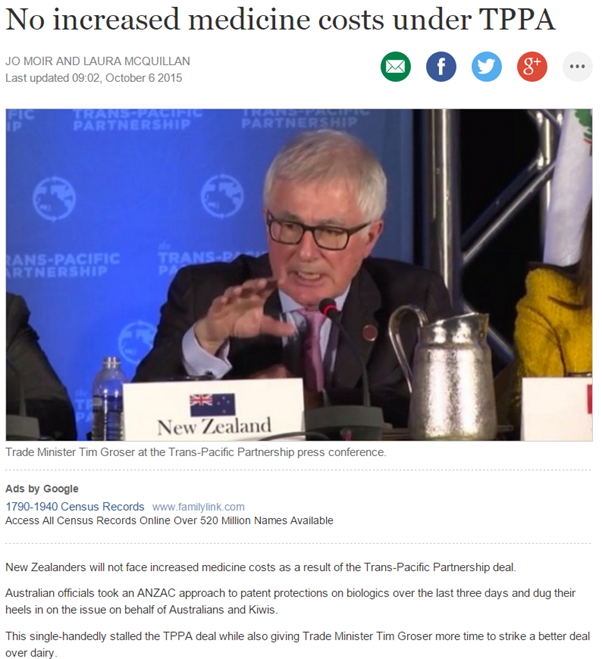
Source: No increased medicine costs under TPPA | Stuff.co.nz
.@MSF: Patients and treatment providers in developing countries the big losers of the #TPP bit.ly/TPPconcludes http://t.co/cbikANleyA—
MSF Access Campaign (@MSF_access) October 05, 2015
The next best arguments James Shaw made were xenophobia about foreign investment in land and some vast conspiracy theory regarding endangered dolphins.
When your next best argument is foreigners are coming to buy up all our land, you are playing from a weak populist hand. About half of million New Zealand born live in other countries.
About 80% of these live in Australia, the great majority as residents rather than as citizens. These New Zealanders living in Australia and elsewhere need protection under international agreements to ensure they are not the victim of populist outbreaks against the sale of land to foreigners.
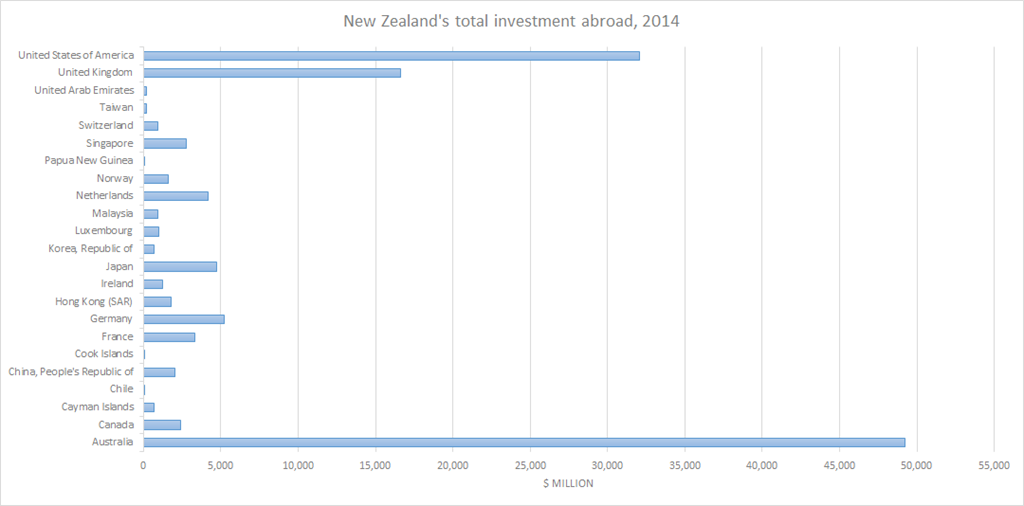
Source: Statistics New Zealand.
In addition, if a foreigner wants to pay over the odds for my house I am glad to separate a fool from his money.
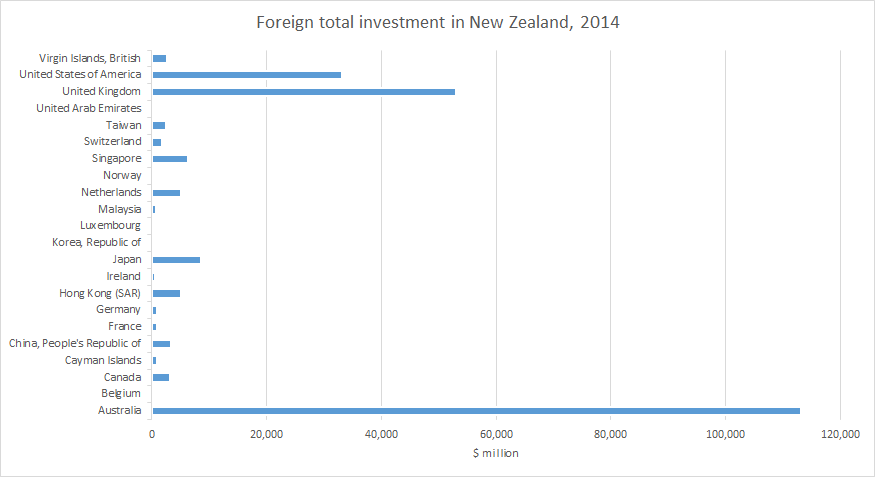
Source: Statistics New Zealand.
New Zealand has a strong interest in protecting the rights of its own expatriates as well as New Zealand foreign investors to buy land in other countries. As David Friedman explains:
Much more commonly, [economic imperialism] is used by Marxists to describe–and attack–foreign investment in “developing” (i.e., poor) nations. The implication of the term is that such investment is only a subtler equivalent of military imperialism–a way by which capitalists in rich and powerful countries control and exploit the inhabitants of poor and weak countries.
There is one interesting feature of such “economic imperialism” that seems to have escaped the notice of most of those who use the term. Developing countries are generally labour rich and capital poor; developed countries are, relatively, capital rich and labour poor. One result is that in developing countries, the return on labour is low and the return on capital is high–wages are low and profits high. That is why they are attractive to foreign investors.
To the extent that foreign investment occurs, it raises the amount of capital in the country, driving wages up and profits down. The effect is exactly analogous to the effect of free migration. If people move from labour-rich countries to labour-poor ones, they drive wages down and rents and profits up in the countries they go to, while having the opposite effect in the countries they come from.
If capital moves from capital-rich countries to capital-poor ones, it drives profits down and wages up in the countries it goes to and has the opposite effect in the countries it comes from. The people who attack “economic imperialism” generally regard themselves as champions of the poor and oppressed.
To the extent that they succeed in preventing foreign investment in poor countries, they are benefiting the capitalists of those countries by holding up profits and injuring the workers by holding down wages. It would be interesting to know how much of the clamour against foreign investment in such countries is due to Marxist ideologues who do not understand this and how much is financed by local capitalists who do.
@JosephEStiglitz talks sense on flaws of the #TPPA @ItsOurFutureNZ @greencatherine @RusselNorman
04 Oct 2015 1 Comment
in economics of regulation, international economic law, politics - New Zealand, politics - USA, rentseeking Tags: drug lags, free trade agreements, Leftover Left, preferential trading agreements, TPPA, Trade Blocs
Joe Stiglitz occasionally gets it right such as this week when he spoke about the downside of the Trans-Pacific Partnership Agreement. As he said:
The reality is that this is an agreement to manage its members’ trade and investment relations – and to do so on behalf of each country’s most powerful business lobbies.
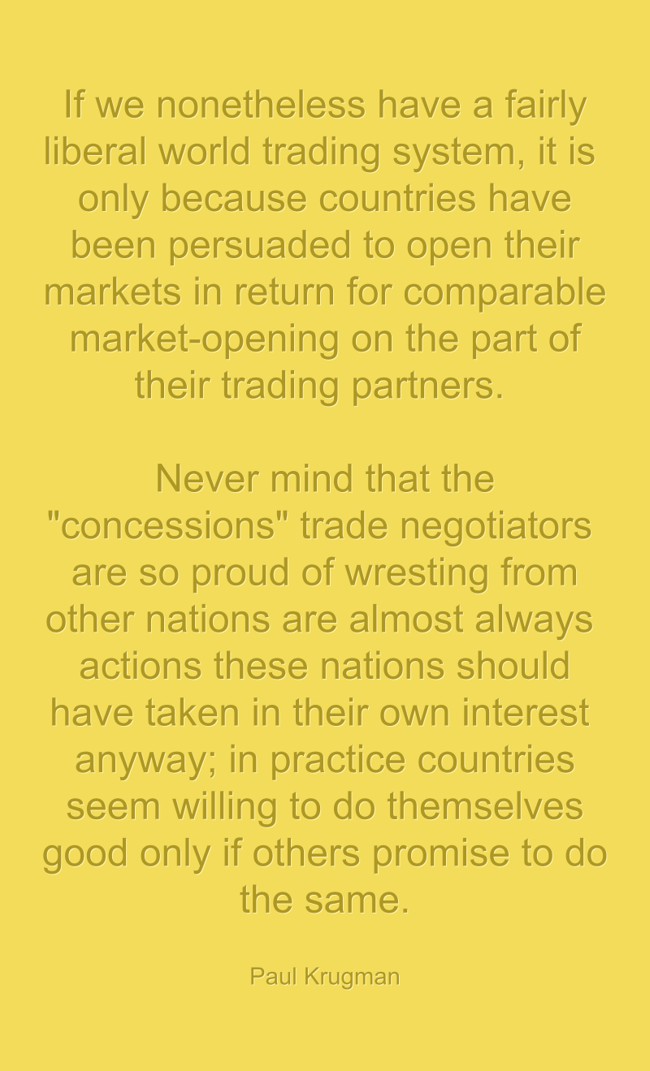
Make no mistake: It is evident from the main outstanding issues, over which negotiators are still haggling, that the TPP is not about “free” trade.
Because of all the haggling over the trade-offs where you do something stupid in return for the other side doing something sensible in terms of liberalisation or something equally stupid in additional regulation, the gains in the agreement can be quite small. Again as Joe Stiglitz explains:
New Zealand has threatened to walk away from the agreement over the way Canada and the US manage trade in dairy products. Australia is not happy with how the US and Mexico manage trade in sugar.
And the US is not happy with how Japan manages trade in rice. These industries are backed by significant voting blocs in their respective countries. And they represent just the tip of the iceberg in terms of how the TPP would advance an agenda that actually runs counter to free trade.
The case for intellectual property rights over drugs is complicated but no one seems to be suggesting that patents should be lengthened.
Far more can be gained in terms of drug availability through regulatory reforms that streamline the drug safety approval process which is currently costing many people their lives.
Barriers to entry – costs ($s) of bringing new drugs to the market have risen manyfold #econ3 http://t.co/MFHTFhTLrj—
Geoff Riley (@tutor2u_econ) November 30, 2014
Sam Peltzman showed in a famous paper in 1973 that the 1962 amendments to US Federal drug approval laws reduced the introduction of effective new drugs in the USA from an average of forty-three annually in the decade before the 1962 amendments to sixteen annually in the ten years afterwards. No increase in drug safety was identified.
The most bizarre part of drug approval processes is they go beyond the checking whether the new drug is safe. What is even more bizarre in New Zealand is the New Zealand drug safety agency duplicates safety processes already performed overseas. This is instead of automatically approving any drug or medical device approved in the USA, UK, Canada or Australia.
Drug safety regulators in the USA also check to see if the drug works – that the drug has its predicted effects. Drug safety is a health policy concern but whether the investors developed a useful drug is something between them and those interested in buying it. Drugs became available years after they were on the market outside the USA because of drug lags at the FDA. To quote David Friedman:
In 1981… the FDA published a press release confessing to mass murder. That was not, of course, the way in which the release was worded; it was simply an announcement that the FDA had approved the use of timolol, a ß-blocker, to prevent recurrences of heart attacks.
At the time timolol was approved, ß-blockers had been widely used outside the U.S. for over ten years. It was estimated that the use of timolol would save from seven thousand to ten thousand lives a year in the U.S.
So the FDA, by forbidding the use of ß-blockers before 1981, was responsible for something close to a hundred thousand unnecessary deaths.
It is a pity that the far left movement ranted against the TPP focused on conspiratorial theories about investor state dispute settlement rather than the risks of this trade deal to the cost of drugs to the health sector. Only late in the game did the far left start talking about drug availability and the costs of drugs to the health budget of the government if patent lives were extended under the TPPA.
@amplifyonly @TaurangaTPPA @actionstation @ActivistsNZ @Keyweekat @endarken #ExposeTPP @gregfullmoon http://t.co/JyG5wQ2MX7—
ItsOurFuture (@ItsOurFutureNZ) July 22, 2015
A campaign against the TPPA on the basis of its impact on drug availability because of longer patent terms running up against the limited budgets of pharmaceutical purchasing agencies would have appealed across the entire political spectrum. As Joe Stiglitz explains:
The TPP would manage trade in pharmaceuticals through a variety of seemingly arcane rule changes on issues such as “patent linkage,” “data exclusivity,” and “biologics.”
The upshot is that pharmaceutical companies would effectively be allowed to extend – sometimes almost indefinitely – their monopolies on patented medicines, keep cheaper generics off the market, and block “biosimilar” competitors from introducing new medicines for years. That is how the TPP will manage trade for the pharmaceutical industry if the US gets its way.
The health sector can only so much to buy drugs. If drug patents last longer, there is less money to go around because the generics become available later than otherwise.
The only person who is safe in a gun-free zone is the man with a gun
04 Oct 2015 Leave a comment
in applied price theory, economics of crime, economics of regulation Tags: expressive voting, game theory, gun control, gun free zones, offsetting behaviour, rational ignorance, rational rationality, unintended consequences
Homicide rates for young American males since 1980
04 Oct 2015 Leave a comment
in economic history, economics of crime, economics of regulation, law and economics, politics - USA
The explosion in the murder rate in the USA during the crack cocaine epidemic appears to mainly be confined to young black Americans and to a lesser extent Latino youth.

Source: Centres for Disease Control and Prevention.
Number of beers you can buy with your monthly minimum wage in Europe
29 Sep 2015 Leave a comment
in economics of regulation, labour economics, law and economics, minimum wage Tags: alcohol regulation, EU
Number of beers you can buy with your monthly minimum wage in Europe http://t.co/uvuunx5mkF—
Amazing Maps (@Amazing_Maps) June 21, 2015

RT @NZGreens @GreenpeaceNZ @KevinHague Allow Golden Rice Now
25 Sep 2015 Leave a comment
in development economics, economics of regulation, environmental economics, growth disasters, growth miracles, health economics Tags: child mortality, child poverty, economics of agriculture, extreme poverty, global hunger, global poverty, GMOs, golden rice, Greenpeace, infant mortality, Luddites, malnutrition, New Zealand Greens, unintended consequences
Good as Gold: Can Golden Rice and Other Biofortified Crops Prevent Malnutrition? ow.ly/QQ1VT #Harvard http://t.co/O3SwpGhsXD—
Golden Rice (@Golden_Rice) August 13, 2015
Drug Price Controls End Up Costing Patients Their Lives
24 Sep 2015 Leave a comment
in applied price theory, applied welfare economics, comparative institutional analysis, economics of regulation, entrepreneurship, health economics, industrial organisation, law and economics, politics - USA, property rights, survivor principle Tags: creative destruction, endogenous growth theory, innovation, intellectual property rights, patents and copyrights, pharmaceutical innovation, price controls
Our research shows that when prices fall, innovation falls even more. Patients would see their lives cut short by delayed or absent drugs.
Source: Drug Price Controls End Up Costing Patients Their Health – NYTimes.com
…cutting prices by 40 to 50 percent in the United States will lead to between 30 and 60 percent fewer R and D projects being undertaken in the early stage of developing a new drug. Relatively modest price changes, such as 5 or 10 percent, are estimated to have relatively little impact on the incentives for product development – perhaps a negative 5 percent.
Source: The Effect of Price Controls on Pharmaceutical Research


Recent Comments