https://twitter.com/roomfordebate/status/662290426083328000

Source: The Costs of Solar Energy to the Environment – Room for Debate – NYTimes.com.
Celebrating humanity's flourishing through the spread of capitalism and the rule of law
13 Nov 2015 Leave a comment
in energy economics, environmental economics, global warming Tags: Big Solar, expressive voting, renewable energy, solar energy, unintended consequences
https://twitter.com/roomfordebate/status/662290426083328000
Source: The Costs of Solar Energy to the Environment – Room for Debate – NYTimes.com.
07 Nov 2015 Leave a comment
in economic history, energy economics Tags: Oil prices
05 Nov 2015 1 Comment
in applied price theory, energy economics, environmental economics, politics - New Zealand, transport economics
https://twitter.com/RadioLIVENZ/status/662064658203840512
In the course of calling for generous subsidies to electric cars, Greens co-leader James Shaw and transport spokesman Julie Anne Genter destroy the case for further public investment in electric cars and charging stations.
The Greens’ spokesmen refer to the biggest drawback of electric cars. Right now, it takes hours to recharge an electric vehicle. With generous investment by the long-suffering taxpayer, this recharging period will still be reduced to a still unacceptable 30 minutes.
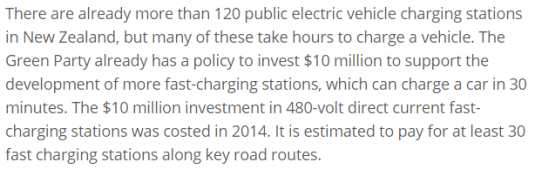
Source: Business Tax Breaks for Clean Transport Options | Green Party of Aotearoa New Zealand.
Recharging times for electric cars are much worse than I previously thought. They highlight how little progress has been made in solving that problem.
Tesla destroys the competition when it comes to how far its cars go on one charge buff.ly/1LphuLg http://t.co/UhIAECZIFp—
Business Insider (@businessinsider) October 17, 2015
Range anxiety is the biggest drawback of the electric car unless you’re willing to buy a very expensive Tesla. Even with a Tesla, because of the amount of time it takes to recharge even when a short is 30 minutes, the effective range is much less than the maximum range.
The motorist will have to build a larger buffer into their range of their batteries because of the time it takes to recharge. It takes a couple of minutes to fill my tank. Half an hour out of my day is still unsatisfactory, much less the current hopeless several hours.

Rather than fill up when you near empty, the green motorist will have to recharge when say a quarter empty or even half empty. The buffer must be larger than for a conventional car because the motorist does not necessarily always have time spare in the day to fill up.
With a conventional car, you can fill up at any time. With an electric car, you must plan in your week to ensure you have that half hours spare when you won’t need your car, can retrieve it from the recharging station with convenience and anticipate no urgent use of the car will arise.

Source: Business Tax Breaks for Clean Transport Options | Green Party of Aotearoa New Zealand.
In an quirk, the Greens want to increase electric car ownership by subsidising alternatives to car ownership for commuting purposes. People have fewer reasons to buy a car, much less an expensive sort of status symbol car, if they can commute for less because their employer gave them a free bus pass to take advantage of a fringe benefits tax concession.
Electric cars are a poor investment to begin with and what’s the point of shelling out all that cash if you don’t even drive it much? What more, electric buses are to be phased out in Wellington soon you will be commuting in a diesel bus to work courtesy of a free bus pass supported by the Greens.

04 Nov 2015 Leave a comment
https://twitter.com/NZReuben/status/661793755171655680
https://twitter.com/JimRose69872629/status/661802293549887488
The number of oil spills is decreasing.
More on oil spills: OurWorldInData.org/data/environme… http://t.co/mcXEodJzYc—
Max Roser (@MaxCRoser) June 14, 2015
04 Nov 2015 Leave a comment
in energy economics Tags: Big Solar, Big Wind, green rent seeking, solar power, wind power
03 Nov 2015 Leave a comment
in economic history, energy economics Tags: gas, nuclear power, Oil prices, renewable energy, solar power, wind power
02 Nov 2015 Leave a comment
in energy economics Tags: Middle-East politics, Oil prices
Oil price has halved to around $50 a barrel. How has this affected the producers? econ.st/1W99aED https://t.co/WxT3snysLj—
The Economist (@TheEconomist) October 26, 2015
02 Nov 2015 Leave a comment
in energy economics, environmental economics, global warming, politics - Australia, politics - New Zealand, politics - USA Tags: Big Solar, Big Wind, bootleggers and baptists, expressive voting, green rent seeking, rational irrationality, renewable energy, solar power, wind power
31 Oct 2015 Leave a comment
in energy economics, environmental economics
31 Oct 2015 Leave a comment
in economics of media and culture, economics of regulation, energy economics, environmental economics, health economics Tags: expressive voting, precautionary principle, rational ignorance, rational irrationality, risk risk trade-offs
28 Oct 2015 Leave a comment
in applied welfare economics, development economics, energy economics, environmental economics, growth disasters, growth miracles Tags: air pollution, energy poverty, indoor air pollution
25 Oct 2015 Leave a comment
in applied price theory, climate change, constitutional political economy, economics of climate change, economics of media and culture, economics of regulation, energy economics, environmental economics, environmentalism, politics - Australia, politics - New Zealand, politics - USA, Public Choice, transport economics, urban economics
1. My JPAM 2000 paper documents that suburbanites drive more and consume more electricity than urban residents.
2. My 2011 JUE paper documents that center city liberal resident NIMBY zoning regulation has deflected more development to the suburbs where people live a high carbon life (see paper #1 above) and then oppose carbon pricing.
3. My co-authored 2013 JPUBE paper documents that energy intensive manufacturing industries seek out cheap electricity price areas. Whether U.S carbon pricing and the resulting higher electricity prices would nudge them to move oversees remains an open question.
4. My co-authored 2012 EER paper documents that more educated people are more likely to have installed solar panels and to go off the grid and thus not pay higher electricity prices.
5. My 2013 EI paper documents that Congress Representatives oppose carbon mitigation regulation when they are conservative, their district is poorer and their district is high carbon. Nancy Pelosi and Tom Steyer are in liberal, rich, low carbon San Francisco. There, it is easy to comply with carbon regulation. They will pay few new costs for such low carbon regulation.
6. My co-authored 2015 JAERE paper documents that even in California and within counties that suburbanites vote against low carbon regulation relative to center city residents. Since we control for the fact that liberals live in center cities, this 3rd variable does not explain the urban form/voting correlation.
7. In my co-authored 2015 JUE paper we document that U.S protectionism through the Buy America Act has hindered the improvement of our bus fleet as a green technology.
Source: Environmental and Urban Economics: The Economics of Red State vs. Blue State Carbon Politics
24 Oct 2015 Leave a comment
in applied price theory, comparative institutional analysis, energy economics, environmental economics, global warming, Public Choice, rentseeking Tags: 2016 presidential election, climate alarmists, expressive voting, free riding, game theory, global warming, international public goods, rational ignorance, rational irrationality
15 Oct 2015 Leave a comment
in energy economics Tags: British economy, energy prices, North Sea, Norway, offshore drilling, Oil prices
12 Oct 2015 Leave a comment
in development economics, energy economics, entrepreneurship, environmental economics, environmentalism, growth disasters, growth miracles Tags: energy poverty, expressive voting, global poverty, green rent seeking, Leftover Left, Oxfam, rational ignorance, rational irrationality, stream poverty, The Great Escape
https://twitter.com/MichaelBTI/status/651503672002785281
Outrageous & Orwellian for @Oxfam to lobby to deny cheap energy to poorest people in world. #ElectrifyAfrica http://t.co/b2P09Gn7rP—
Mike Shellenberger (@MichaelBTI) October 06, 2015
Oxfam world HQ looks like such a pleasant place to work. Grid electricity. Effective security. Ample parking. http://t.co/lsxTf2DN6b—
Mike Shellenberger (@MichaelBTI) October 06, 2015
Here's @Oxfam's luxury office building in UK. Were its steel & glass components constructed with solar panels? http://t.co/642mm2zB4B—
Mike Shellenberger (@MichaelBTI) October 06, 2015
https://twitter.com/MichaelBTI/status/651458416569909248
https://twitter.com/VoxMaps/status/608411758022291456/photo/1?ref_src=twsrc%5Etfw
Celebrating humanity's flourishing through the spread of capitalism and the rule of law
Celebrating humanity's flourishing through the spread of capitalism and the rule of law
Celebrating humanity's flourishing through the spread of capitalism and the rule of law
Celebrating humanity's flourishing through the spread of capitalism and the rule of law
Celebrating humanity's flourishing through the spread of capitalism and the rule of law
Celebrating humanity's flourishing through the spread of capitalism and the rule of law
Celebrating humanity's flourishing through the spread of capitalism and the rule of law
Celebrating humanity's flourishing through the spread of capitalism and the rule of law
A History of the Alt-Right
Econ Prof at George Mason University, Economic Historian, Québécois
Celebrating humanity's flourishing through the spread of capitalism and the rule of law
Scholarly commentary on law, economics, and more
Beatrice Cherrier's blog
Celebrating humanity's flourishing through the spread of capitalism and the rule of law
Celebrating humanity's flourishing through the spread of capitalism and the rule of law
Celebrating humanity's flourishing through the spread of capitalism and the rule of law
Why Evolution is True is a blog written by Jerry Coyne, centered on evolution and biology but also dealing with diverse topics like politics, culture, and cats.
Celebrating humanity's flourishing through the spread of capitalism and the rule of law
A rural perspective with a blue tint by Ele Ludemann
DPF's Kiwiblog - Fomenting Happy Mischief since 2003
Celebrating humanity's flourishing through the spread of capitalism and the rule of law
The world's most viewed site on global warming and climate change
Tim Harding's writings on rationality, informal logic and skepticism
A window into Doc Freiberger's library
Let's examine hard decisions!
Commentary on monetary policy in the spirit of R. G. Hawtrey
Thoughts on public policy and the media
Celebrating humanity's flourishing through the spread of capitalism and the rule of law
Politics and the economy
A blog (primarily) on Canadian and Commonwealth political history and institutions
Reading between the lines, and underneath the hype.
Economics, and such stuff as dreams are made on
"The British constitution has always been puzzling, and always will be." --Queen Elizabeth II
Celebrating humanity's flourishing through the spread of capitalism and the rule of law
Celebrating humanity's flourishing through the spread of capitalism and the rule of law
WORLD WAR II, MUSIC, HISTORY, HOLOCAUST
Undisciplined scholar, recovering academic
Celebrating humanity's flourishing through the spread of capitalism and the rule of law
Res ipsa loquitur - The thing itself speaks
In Hume’s spirit, I will attempt to serve as an ambassador from my world of economics, and help in “finding topics of conversation fit for the entertainment of rational creatures.”
Researching the House of Commons, 1832-1868
Articles and research from the History of Parliament Trust
Reflections on books and art
Posts on the History of Law, Crime, and Justice
Celebrating humanity's flourishing through the spread of capitalism and the rule of law
Exploring the Monarchs of Europe


Recent Comments