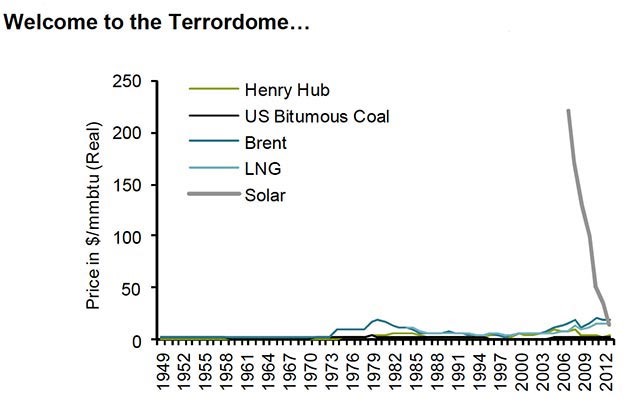
HT: Bloomberg.com
Celebrating humanity's flourishing through the spread of capitalism and the rule of law
10 Mar 2015 Leave a comment
in energy economics Tags: Oil prices, solar power
HT: Bloomberg.com
09 Mar 2015 Leave a comment
in applied price theory, economic history, energy economics Tags: electric cars
06 Mar 2015 Leave a comment
in development economics, economic history, energy economics, environmental economics, growth miracles Tags: air pollution, capitalism and freedom, The Great Escape
03 Mar 2015 Leave a comment
in energy economics, entrepreneurship, environmental economics, environmentalism, global warming Tags: carbon neutral economy, China, climate alarmism, global warming, solar energy
01 Mar 2015 Leave a comment
in energy economics, environmental economics, global warming Tags: climate alarmism, global climate treaty, global warming, international public goods, Japan
01 Mar 2015 Leave a comment
in energy economics Tags: European politics, Russia, Ukraine crisis

HT: cityam.com
01 Mar 2015 Leave a comment
in energy economics, environmental economics, global warming Tags: climate alarmism, Fossil Fuels, global warming
24 Feb 2015 Leave a comment
in energy economics, environmental economics, global warming Tags: wind welfare
22 Feb 2015 Leave a comment
in energy economics, environmental economics Tags: ethonol
20 Feb 2015 Leave a comment
in energy economics, environmental economics, global warming, rentseeking Tags: Big Green, Bjørn Lomborg, electric cars, green rent seeking
18 Feb 2015 Leave a comment
in energy economics, environmental economics, environmentalism, global warming
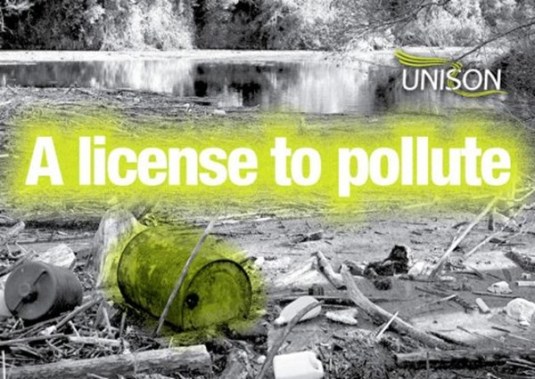
When I was a lad, the environmental movement was dead set against pollution taxes. Robert N. Stavins and Bradley W. Whitehead said in 1992:
…for many years, market-based incentives were characterized by environmentalists, not only as impractical, but also as “licenses to pollute.” Over time, environmental groups have frequently applied a different and more rigorous standard in measuring market-based systems against their command-and-control counterparts, possibly because of their belief that market-based systems legitimize pollution by purporting to sell the right to pollute. This old suspicion likely continues among many rank-and-file environmentalists.
How times have changed. Now the environmental movement of the biggest champions of carbon taxes as well as carbon trading. What gives? Anything more than cynical political opportunism? Concede nothing until the last moment when it is tactically opportune to sideline opposition.
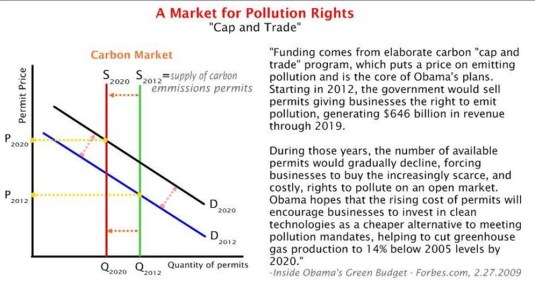
Initially, all environmental regulations were command and control regulations that specified quantities and the technologies to be mandated and gave no role to prices to ensure that the pollution reduction was done by those who could do it cheapest. Robert Crandall noticed the shift in position in his recent essay on pollution controls:
… environmentalists have increasingly realized that markets can work to allocate pollution reduction responsibilities efficiently among firms and across industries. Although the command-and-control approach is still the norm, environmental lobbyists and legislators have, on occasion, considered market-based approaches to pollution control. Most of the proposals for limiting global warming, for example, explicitly include market-based approaches for controlling carbon dioxide emissions.
The reason for the change in tactics by the environmental movement is quite straightforward. The deadweight cost of regulation and taxes that leads to increasing resistance from those subject to existing and proposed environmental regulations.
The rising deadweight cost of regulation due to technological change, and the dissipation of wealth through these rising costs progressively enfeebled environmental groups lobbying for more regulation. This allowed industry and consumers to win the initiative in resisting more environmental regulation. The cost of reducing carbon emissions is a classic example. Another is the United States acid rain allowance market.

In the case of carbon emissions, the additional political pressure that the winners had to exert to keep the same reduction in carbon emissions had to overcome rising pressure from the losers such as carbon intensive industries and they consist customers to escape their escalating losses of complying with any sort of further carbon emission regulation.
Eventually, the fight was no longer worthwhile relative to the alternatives. Taxed, regulated and subsidised groups can find common ground in wealth enhancing policies and an encompassing interest in mitigating any reduction in wealth from public policies (Becker 1983, 1985; Peltzman 1989).

In the case of global warming, both the environmental movement, and carbon intensive industries, and consumers find common ground in finding a cheaper way of reducing carbon emissions. That is done by agreeing to either carbon trading or carbon taxes. Coalitions of environmentalists and industry also form where carbon emission taxes or trading disadvantage the competition of some industries and some competitors within the same industry.

Carbon trading was a classic example of these dark coalitions. There’s a big difference in their cost to industry depending on whether carbon trading quotas are auctioned or given away to the incumbent firms for free or at a discount price.
17 Feb 2015 Leave a comment
in economics of bureaucracy, energy economics, environmental economics, environmentalism, financial economics, global warming, Public Choice, rentseeking Tags: efficient market hypothesis, fossil fuel disinvestment, Global disinvestment day, Green Party of New Zealand, index linked investing, privatisation, state ownership
The Green Party of New Zealand wants the New Zealand superannuation fund to sell its $676 million in fossil fuel investments. For those not in the know, this government investment fund is worth about $25 billion and is funded by present taxes to pay for the universal old age pension in New Zealand. Its current investment strategy seems to rely heavily on index linked funds that minimise management and trading costs.
The Government uses the Fund to save now in order to help pay for the future cost of providing universal superannuation.
In this way the Fund helps smooth the cost of superannuation between today’s taxpayers and future generations.
In common with the endowment funds of the American universities, that $676 million is about 2% of the total New Zealand superannuation portfolio of about NZ$25 billion.

Any portfolio manager risks considerable fees if she must monitor the entire portfolio because 2% is of dubious moral stature.

The main cost of divestiture is compliance costs to prevent fossil fuel investments drifting back into the portfolio through the routine day to day investments of other companies within their portfolios as these other firms expand into new businesses or diversified. The entire portfolio must be monitored for this risk.

American universities found that fossil fuels divestment rules out indexed linked funds as a class, along with their low management and trading fees. Ethical investors must move to actively managed investment funds which are perhaps a third more expensive in management fees.

If a move to a fossil fuel free portfolio rules out passive indexed linked funds, that is a major risk to future returns of the New Zealand superannuation fund. Would this fossil fuels disinvestment including selling the recently acquired Z petrol station network by the New Zealand superannuation fund?
Z Energy now owns and manages these businesses, which include:
- a 15.4 per cent stake in Refining NZ who runs New Zealand’s only oil refinery.
- a 25 per cent stake in Loyalty New Zealand who run Fly Buys
- over 200 service stations
- about 90 truck stops
- pipelines, terminals and bulk storage
As usual, in the course of argument for disinvestment by the government investment fund, the Green Party makes an excellent argument for the privatisation not only of state owned enterprises but of the New Zealand superannuation fund.
Rather than have one victory at a time, the Greens want the NZ superannuation fund to use the funds from the disinvestment to reinvest in pet projects of politicians. The green party co-leader said:
Money released from divestment can be reinvested in the rapidly growing renewable energy and energy efficiency sectors, helping to hasten the transition of our economy to a low-carbon future.
This makes government investment funds the playthings of politicians so they can never match the returns of a genuinely privately owned investment fund.
Celebrating humanity's flourishing through the spread of capitalism and the rule of law
Celebrating humanity's flourishing through the spread of capitalism and the rule of law
Celebrating humanity's flourishing through the spread of capitalism and the rule of law
Celebrating humanity's flourishing through the spread of capitalism and the rule of law
Celebrating humanity's flourishing through the spread of capitalism and the rule of law
Celebrating humanity's flourishing through the spread of capitalism and the rule of law
Celebrating humanity's flourishing through the spread of capitalism and the rule of law
Celebrating humanity's flourishing through the spread of capitalism and the rule of law
A History of the Alt-Right
Econ Prof at George Mason University, Economic Historian, Québécois
Celebrating humanity's flourishing through the spread of capitalism and the rule of law
Scholarly commentary on law, economics, and more
Beatrice Cherrier's blog
Celebrating humanity's flourishing through the spread of capitalism and the rule of law
Celebrating humanity's flourishing through the spread of capitalism and the rule of law
Celebrating humanity's flourishing through the spread of capitalism and the rule of law
Why Evolution is True is a blog written by Jerry Coyne, centered on evolution and biology but also dealing with diverse topics like politics, culture, and cats.
Celebrating humanity's flourishing through the spread of capitalism and the rule of law
A rural perspective with a blue tint by Ele Ludemann
DPF's Kiwiblog - Fomenting Happy Mischief since 2003
Celebrating humanity's flourishing through the spread of capitalism and the rule of law
The world's most viewed site on global warming and climate change
Tim Harding's writings on rationality, informal logic and skepticism
A window into Doc Freiberger's library
Let's examine hard decisions!
Commentary on monetary policy in the spirit of R. G. Hawtrey
Thoughts on public policy and the media
Celebrating humanity's flourishing through the spread of capitalism and the rule of law
Politics and the economy
A blog (primarily) on Canadian and Commonwealth political history and institutions
Reading between the lines, and underneath the hype.
Economics, and such stuff as dreams are made on
"The British constitution has always been puzzling, and always will be." --Queen Elizabeth II
Celebrating humanity's flourishing through the spread of capitalism and the rule of law
Celebrating humanity's flourishing through the spread of capitalism and the rule of law
WORLD WAR II, MUSIC, HISTORY, HOLOCAUST
Undisciplined scholar, recovering academic
Celebrating humanity's flourishing through the spread of capitalism and the rule of law
Res ipsa loquitur - The thing itself speaks
In Hume’s spirit, I will attempt to serve as an ambassador from my world of economics, and help in “finding topics of conversation fit for the entertainment of rational creatures.”
Researching the House of Commons, 1832-1868
Articles and research from the History of Parliament Trust
Reflections on books and art
Posts on the History of Law, Crime, and Justice
Celebrating humanity's flourishing through the spread of capitalism and the rule of law
Exploring the Monarchs of Europe



 HT:
HT: 

Recent Comments