The U.S. has built its first new oil refinery in 40 years
04 Dec 2014 Leave a comment
in economics of regulation, energy economics, environmental economics, resource economics Tags: green rent seeking, NIMBYs
M.A. Adelman on natural resource exhaustion
04 Dec 2014 1 Comment
in energy economics, entrepreneurship, environmental economics, resource economics Tags: entrepreneurship, M. A. Adelman, resource economics

On the unsustainability of wind power – noise pollution edition
03 Dec 2014 Leave a comment
in energy economics, environmental economics, global warming, law and economics Tags: noise pollution, wind power
M.A. Adelman on the use of knowledge in resource exploration and conservation
29 Nov 2014 Leave a comment

Too Many Battery Factories, Too Few Electric Cars | MIT Technology Review
29 Nov 2014 Leave a comment
in energy economics, environmental economics Tags: electric cars, expressive voting
A Mini adventure: London to Edinburgh in an electric car
28 Nov 2014 2 Comments
in energy economics, environmental economics, global warming Tags: climate alarmism, electric cars, expressive voting, global warming

The intrepid adventurer from the BBC drove the 778 kilometers from London to Edinburgh in an electric Mini, and had to stop eight times to recharge – often waiting six hours or more.
In total, he spent 80 hours waiting or driving, averaging just ten kilometers per hour – an unenviable pace even before the advent of the steam engine.
via BBC News – Mini adventure: how far can an electric car go?.
On the relative cost effectiveness of electric cars
28 Nov 2014 Leave a comment
in energy economics, environmental economics, global warming Tags: climate alarmism, expressive voting, global warming
Breaking Analysis: US-China Climate Deal to Avoid 640 Billion Tons of Carbon Pollution, if fully implemented!?
15 Nov 2014 Leave a comment
in energy economics, environmental economics, global warming Tags: climate alarmism, expressive voting, global warming
Why does the Left oppose higher petrol prices?
14 Nov 2014 Leave a comment
in election campaigns, energy economics, environmental economics, environmentalism, politics - Australia
“It is entirely possible to rapidly switch our energy systems to 100 percent renewables” – Naomi Klein
09 Nov 2014 Leave a comment
in energy economics, environmental economics, environmentalism, global warming Tags: carbon free economy, energy economics, expressive voting, green rent seeking, Leftover Left, Naomi Klein, Quacks, renewable energy
Jacobson and Delucchi think we can replace all coal, oil, natural gas, and nuclear power by 2030 with wind, solar, and hydropower while fueling a fleet of electric cars.
How? By deploying 3.8 million 5-megawatt wind turbines, 5,350 100-megawatt geothermal plants, 500,000 1-megawatt tidal turbines, 720,000 0.75-megawatt wave power generators, 1.7 billion 3-kilowatt rooftop solar panels, 40,000 300-megawatt solar panel farms, and 49,000 300-megawatt concentrated solar power plants.
| Annual global investment target | Current global stock |
| 250,000 wind turbines | 225,000 wind turbines |
| 113 million rooftop solar panel systems | 11.3 million |
Delucchi and Jacobson estimate a price tag of about $100 trillion for their program.
That entails spending about $6.6 trillion per year from now until 2030, more than 11 percent of the entire world’s 2013 output of $75 trillion.
Naomi Klein cited Jacobson and Delucchi to support her proposition that 100% renewable energy systems is possible.
Bjørn Lomborg says that the UN climate panel’s latest report tells a story that politicians prefer to ignore
09 Nov 2014 Leave a comment
in climate change, energy economics, environmental economics, global warming Tags: Bjørn Lomborg, climate alarmism, global warming, green rent seeking, IPCC
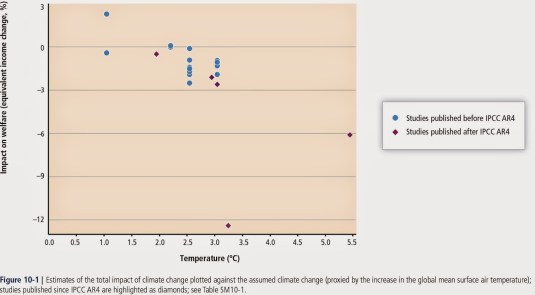
The second IPCC installment showed that the temperature rise that we are expected to see sometime around 2055-2080 will create a net cost of 0.2-2% of GDP – the equivalent of less than one year of recession…
Again, not surprisingly, politicians tried to have this finding deleted. British officials found the peer-reviewed estimate “completely meaningless,” and, along with Belgium, Norway, Japan, and the US, wanted it rewritten or stricken. One academic speculated that governments possibly felt “a little embarrassed” that their previous exaggerated claims would be undercut by the UN.
The third installment of the IPCC report showed that strong climate policies would be more expensive than claimed as well – costing upwards of 4% of GDP in 2030, 6% in 2050, and 11% by 2100.
And the real cost will likely be much higher, because these numbers assume smart policies, instantly enacted, with key technologies magically available.


Recent Comments