Media conspiracies versus cartel theory

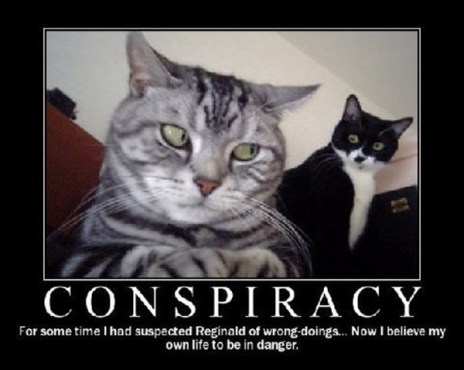
Media conspiracy theories suggest someone is in control; that dark, all-powerful cabals of men in cultish robes control the world. The truth is no one is in control. What about 57 channels, nothing on!

Newspapers, TV and cable, are not a monopoly. A monopoly is a single seller of as product with a legal right to bar new entry. It is an exclusive right to sell something.

At best, newspapers, TV and cable, are a large and unwieldy cartel under pressure from costs and new entry. The Internet makes electronic news competition global.

There are many different Australian news outlets and media types, three national networks, plus many cable news networks and 9 media owners. That is more than enough to destabilise any cartel.

Why is the mass media special? A supply-side model of media ownership suggesting that media outlets weigh the rewards of bias—political influence or personal pleasure—against the cost of bias—lost circulation from providing faulty news.

The mass media is a big business, and they increase readership and revenue by presenting factual and informative news.

The most likely to turn-off are women, and women vote to the Left more often than do men. The media is perhaps pandering to this centre-left marginal buyer.

A news cartel is like any other cartel. All cartels break-down and only some get back together.

Cartels contain seeds of their own destruction. Cartel members are reducing their output below their existing potential production capacity, and once the market price increases, each member of the cartel has the capacity to raise output relatively easily.

All cartels must decide how to allocate the reduction of output that follows the price increases across members with different costs structures and spare capacity.:

  • The tendency is for cartel members to cheat on their production quotas, increasing supply to meet market demand and lowering their price.
  • Most cartel agreements are unstable and at the slightest incentive they will quickly disband, and returning the market to competitive conditions.

One sign of a cartel that was developed by Aaron Director is periods of stable prices, despite cost fluctuations, followed by sudden price changes when the cartel collapses or decide to increase prices.

For a news cartel, this means toeing the line and then periods of truth, and then a sudden return to the party line when the cartel starts-up again.

The exercise of collective market power will not be stable unless sellers agree on prices and production shares; on how to divide the profits; on how to enforce the agreement; on how to deal with cheating; and on how to prevent new entry.

A cartel is in the unenviable position of having to satisfy everyone, for one dissatisfied producer can bring about the feared price competition and the disintegration of the cartel.

Thus a successful cartel must follow a policy of continual compromise. Little wonder that John. S McGee wrote that:

The history of cartels is the history of double crossing

Peter Drucker hated meetings too

Meetings are by definition a concession to a deficient organization.

For one either meets or one works. One can not do both at the same time…

There will always be more than enough meetings…Every meeting generates a host of little follow-up meetings—some formal, some informal, but both stretching out for hours.

Meetings, therefore, need to be purposefully directed.

An undirected meeting is not just a nuisance; it is a danger.

But above all, meetings have to be the exception rather than the rule.

An organization where everybody meets all the time is an organization in which no one gets anything done.

Wherever a time log shows the fatty degeneration of meetings—whenever, for instance people in an organization find themselves in meetings a quarter of their time or more—there is time-wasting malorganization.

Drucker also said:

The senior financial executive of a large organization knew perfectly well that the meetings in his office wasted a lot of time.

This man asked all of his direct subordinates to every meeting, whatever the topic.

As a result, the meetings were far too large.

And because every participant felt that he had to show interest, everybody asked at least one question—most of them irrelevant. As a result, the meetings stretched on endlessly.

But the senior executive had not known, until he asked, that his subordinates too considered the meetings a waste of their time.

Aware of the great importance everyone in the organization placed on status and on being "in the know", he feared that the uninvited men would feel slighted and left out.

Now, however, he satisfies the status needs of his subordinates in a different manner.

He sends out a printed form which reads:

"I have asked [Messrs Smith, Jones and Robinson] to meet with me [Wednesday at 3] in [the fourth floor conference room] to discuss [next year’s capital appropriations budget].

Please come if you think that you need the information or want to take part in the discussion.

But you will in any event receive right away a full summary of the discussion and of any decisions reached, together with a request for your comments".

Where formerly a dozen people came and stayed all afternoon, three men and a secretary to take the notes now get the matter over within an hour or so. And no one feels left out.

How much would an IPhone cost in 1991? | Techpolicy Daily

In the beginning, mobile phones were just a walkie-talkie. iPhones have the same capabilities of 13 distinct electronics gadgets worth more than $3,000 in a 1991.

An iPhone incorporates a computer, CD player, phone, and video camera, among other items.

In 1991, a gigabyte of hard disk storage cost around $10,000. Today, it costs around four cents.

Back in 1991, a gigabyte of flash memory, which is what the iPhone uses, would have cost something like $45,000, or more. (Today, it’s around 55 cents ($0.55).)

The mid-level iPhone 5S has 32 GB of flash memory. Thirty-two GB, multiplied by $45,000, equals $1.44 million.

The iPhone used 20,500 millions of instructions per second which in 1991 would have cost around $620,000.

In 1991, a mobile phone used the AMPS analog wireless network to deliver kilobit voice connections.

A 1.44 megabit T1 line from the telephone company cost around $1,000 per month.

Today’s LTE mobile network is delivering speeds in the 15 Mbps range.

Safe to say, the iPhone’s communication capacity is at least 10,000 times that of a 1991 mobile phone.

The 1991 cost of mobile communication was something like $100 per kilobit per second.

Fifteen thousand Kbps (15 Mbps), multiplied by $100, is $1.5 million.

Considering only memory, processing, and broadband communications power, duplicating the iPhone back in 1991 would have (very roughly) cost: $1.44 million + $620,000 + $1.5 million = $3.56 million.

This doesn’t even account for the MEMS motion detectors, the camera, the iOS operating system, the brilliant display, or the endless worlds of the Internet and apps to which the iPhone connects us.

via Techpolicy Daily and Cafe Hayek

Never had it so good, but people still complain

image

Image

Competition as a force for media accuracy or infotainment

Limiting the number of TV stations has unusual effects on media slant and muckraking.

Tyler Cowen argues that competition by itself is not a powerful force for media accuracy.

In the traditional conception of the demand for news, audiences read, watch, and listen to the news in order to get information. The quality of news is its accuracy.

But when there are many media outlets, competition results in a common slanting of news towards reader biases in the audience niche each network are serving. The market is very good are serving up what the customer wants.

Competition forces news outlets to cater to their customer’s niche preferences.

  • Realised profit is the criterion by which the market process selects survivors: those who realise positive profits survive; those who suffer losses disappear.
  • Positive profits accrue to those news outlets who are better than their competitors. These lesser rivals will exhaust their retained earnings and fail to attract further new investor support.

On topics where reader beliefs diverge on politically divisive issues, media outlets profit from segmenting the market and slanting reports to the biases of their niche audiences.

There is less bland truth-telling and more of the polemics that each market niche wants.

This means that left-wing and right-wing media outlets will hound the political enemies of their readers to cater to the preferences of their audience niche.

The clearest illustration of infotainment is the Lewinsky affair:

  • The left wing press presented information designed to excuse Clinton’s sins; and
  • The right wing press dug out details pointing to his culpability.

When there are only a few media outlets, the networks instead go for the median viewer/reader and offer more sedate and less scandal driven coverage.

More media competition increases the chances of the muckraking that brings down ministers and governments.

Those subservient press barons

Both political parties used television licensing and the threat of cable TV to manipulate Murdoch, Packer and the other press barons. They were victims of Fred McChesney’s concept of rent extraction:

  • Rent extraction is the politician’s pastime of threatening harmful legislation to extract political support and contributions from well-heeled private institutions.
  • Payments to politicians are often made not for political favours, but to avoid political disfavour, that is, as part of a system of political extortion or rent extraction.

Rent extraction is money for nothing – money paid in exchange for politicians’ inaction.

The politician is paid, not for rent creation, but for withholding legislative and regulatory action that would destroy existing private rents.

McChesney establishes the conditions under which of rent creation or extraction will occur. The relative attractiveness of the two strategies depends on the elasticities of demand and supply.

  • If demand is relatively inelastic, rent creation will occur; and
  • If supply is relatively inelastic, rent extraction will occur.

The existence of an organization or a large established firm lowers transaction costs for the politicians negotiating and collecting donations and support, making rent expropriation threats easier.

It is hard to extort rents from those with little in the way of organisation. A cost of being an established lobbying organisation or a large firm with high fixed costs is a greater potential for rent extraction.

The print and electronic media are ripe for rent extraction because of their immobile assets and heavy regulation.

Investors in heavily regulated capital intensive industries such as the mass media, digital and print, do not bite the hand the feeds them.

Little wonder that the media barons were honoured supplicants to whomever is in power in Canberra. They are soon Labor’s business mates whenever Labor was in power.

Threatening to allow cable TV was the big stick in every Australian government’s hand until the 1990s to extract support or at least subservience from the media.

Rupert Murdoch has unashamedly backed political winners, only to dump them when he was convinced that they were washed up or that his newspapers might be left stranded on the losing side of politics.

Murdoch’s see-sawing political stances are entirely pragmatic. He has always been prepared to back winners just before they win, and to shift allegiances on non-ideological grounds.

Top 10 Monty Python Movie Moments

Video

Why Does 1% of History Have 99% of the Wealth? | Learn Liberty – YouTube

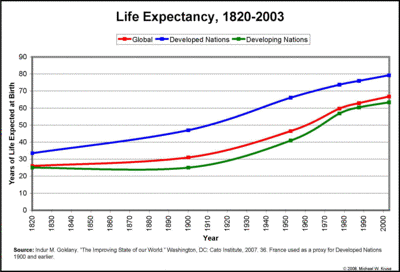
Throughout the history of the world, the average person on earth has been extremely poor: subsisting on the modern equivalent of $3 per day.


This was true until 1800, at which point average wages—and standards of living—began to rise dramatically.

Prof. Deirdre McCloskey explains how this tremendous increase in wealth came about.

In the past 30 years alone, the number of people in the world living on less than $3 per day has been halved.

The cause of the economic growth we have witnessed in the past 200 years may surprise you.

It’s not exploitation, or investment. Innovation—new ideas, new inventions, materials, machinery, organizational structures—has fueled this economic boom.

Prof. McCloskey explains how changes in Holland and England in the 1600s and 1700s opened the door for innovation to take off—starting the growth that continues to benefit us today.

via Why Does 1% of History Have 99% of the Wealth? | Learn Liberty – YouTube.

The Rawlsian social justice case for super-entrepreneurs and many more billionaires

The report SuperEntrepreneurs shows that:

  • SuperEntrepreneurs founded half the largest new firms created since the end of the Second World War
  • There is a strong correlation between high rates of SuperEntrepreneurship in a country and low tax rates
  • a low regulatory burden and high rates of philanthropy both correlate strongly with high rates of SuperEntrepreneurship
  • Active government and supranational programmes to encourage entrepreneurship – such as the EU’s Lisbon Strategy – have largely failed.
  • Yet governments can encourage entrepreneurialism by lowering taxes (particularly capital gains taxes which have a particularly high impact on entrepreneurialism while raising relatively insignificant revenues); by reducing regulations; and by vigorously enforcing property rights.
  • High rates of self-employment and innovative entrepreneurship are both important for the economy.
  • Yet policy makers should recognise that they are not synonymous and should not assume policies which encourage self-employment necessarily promote entrepreneurship.
  • Policy makers should use a definition of entrepreneurship which is based on innovation.

SuperEntrepreneurs examined about 1,000 self-made men and women who have earned at least $1 billion dollars and who appeared in Forbes magazine list of the world’s richest people between 1996 and 2010.

Hong Kong has the most, with around three SuperEntrepreneurs per million inhabitants, followed by Israel, the US, Switzerland and Singapore.

The US is roughly four times more super-entrepreneurial than Western Europe and three times more super-entrepreneurial than Japan.

Super-entrepreneurs tend to be well-educated – 84% have a university degree.

Many started their own company but there is no clear relationship between self-employment and successful entrepreneurship

Steven Kaplan and Joshua Rauh’s “It’s the Market: The Broad-Based Rise in the Return to Top TalentJournal of Economic Perspectives 2013 found that those in the Forbes 400 richest are less likely to have inherited their wealth or grown-up wealthy.

Today’s super-rich are self-made rich because they produce new and better products and services that people wanted and are willing to pay for.

John Rawls was alive to the importance of incentives in a just and prosperous society.

With his emphasis on fair distributions of income, Rawls’ initial appeal was to the Left. Left-wing thinkers then started to dislike his acceptance of capitalism and his tolerance of large discrepancies in income and wealth.

Rawls excluded envy when we are behind his veil of ignorance designed the social contract about how the society will be organised. He believed that principles of justice should not be affected by individual inclinations, which are mere accidents.

Rawls also argued that the liberties and political status of equal citizens encourage self-respect even when one is less well off than others; and background institutions (including a competitive economy) make it likely that excessive inequalities will not be the rule. He supposes that

the main psychological root of our liability to envy is a lack of self-confidence in our own worth combined with a sense of impotence

Then there is the old Russian joke that tells the story of a peasant with one cow who hates his neighbour because he has two. A sorcerer offers to grant the envious farmer a single wish any thing he wants: “Shoot my neighbour’s cow!” he demands.

via http://www.kiwiblog.co.nz/2014/04/entrepreneurship.html

Bill Gates “pre-reviewed” Piketty years ago

Bill Gates once said:

You take away the top 20 employees of Microsoft, we’ll just be an ordinary company. Top employees are what makes us.

File:Dts news bill gates wikipedia.JPG

via Gary Becker on Human Capital | Atanu Dey On India’s Development.

9 Wonderful French Expressions That Have No Good English Equivalent | Business Insider

Saloperie

The act of a jack-arse.

Mise en abyme

This is the word for when you’re standing between two mirrors and you see an infinite regression of yourself. It’s also commonly used to describe self-referential works in a novel or play.

Trouvaille

Something awesome that was discovered by chance or stumbled upon.

Décomplexé

Pure, sure of oneself, lacking neurotic hangups or socio-cultural pressures.

Droit a l’oubli

“Right to oblivion.” There are now guidelines, signed in 2010, applying to search engines that automatically cache pages on social media — basically, they’re not really allowed to. “We don’t hate what the Internet stands for — there’s a lot of material online that should be kept. But in certain cases, we’d prefer to have the ability to erase them,” Nathalie Kosciusko-Morizet, who put together the guidelines (and who just lost hte race for mayor in Paris), said upon signing the guidelines.

Diaboliser

To impugn with bad intentions — to suggest that someone or something is inherently bad. Often used in discussing politics.

Dépayser

To feel displaced from one’s native land or familiar routine.

Déontologie

An informal but widely set of rules for a profession. Also a philosophical concept denoting a set of actions taken out of duty, rather than consequence.

Laïcité

France’s aggressive form of separation between church and state. The country would never allow a voting booth to be placed in a church, for instance, even if it would be the most expedient means of holding an election in a small town.

via 9 Wonderful French Expressions That Have No Good English Equivalent | Business Insider.

Why I am not reviewing Thomas Piketty’s Capital in the Twenty-First Century – updated again

It’s 700 pages long and goes on about Marx. Some people were watching the other channel when the Berlin Wall fell.

thomas-piketty-economist-will-hutton

My 1 o’clock lecture at ANU in 1990 was next to a room rented out ironically from 12 to 1 to the Campus Trots and then to the Campus Christians for an hour of prayer to another saviour.

The Twitter summary of Piketty is this:

Karl Marx wasn’t wrong, just early. Pretty much. Sorry, capitalism. #inequalityforevah

The only Marxist I bother with is Jon Elster. He is a leading proponent of Analytical Marxism and one of the last polymaths. Brian Barry once wrote that to review one of Elster’s books one:

would either have to have taken off several years to master the many fields which fall within Elster’s purview or would be a consortium of at least twenty carefully-chosen experts.

All of Elster’s books and writings are worth reading, including

  • Ulysses and the Sirens (1979);
  • Sour Grapes: Studies in the Subversion of Rationality (1983);
  • Making Sense of Marx (1985); and
  • An Introduction to Karl Marx (1986).

As Jon Elster noted:

Marxian economics is, with a few exceptions, intellectually dead

and Marx’s labour theory of value is:

useless at best, harmful and misleading at its not infrequent worst.

To go on with my non-review, I will quote Tyler Cowen:

The crude seven-word version of Piketty’s argument is “rates of return on capital won’t diminish.”

Piketty’s reasons why rates of return on capital won’t diminish are fairly specific and restricted to only a small share of capital.

.. In any case this is pure speculation and Piketty’s entire argument depends upon it.

… Piketty converts the entrepreneur into the rentier.

To the extent capital reaps high returns, it is by assuming risk…

Yet the concept of risk hardly plays a role in the major arguments of this book.

Once you introduce risk, the long-run fate of capital returns again becomes far from certain.

In fact the entire book ought to be about risk but instead we get the rentier…

Overall, the main argument is based on two (false) claims.

First, that capital returns will be high and non-diminishing, relative to other factors.

Second, that this can happen without significant increases in real wages.

Piketty’s advocacy of a top marginal income tax rate of 80% and a an international treaty for a wealth tax are wildly impractical and destructive of economic growth and entrepreneurship. His advocacy of 60% marginal tax rates on incomes above $200,000 strike at the heart of the professional and managerial occupations that are the backbone of day-to-day capitalism. Piketty’s wealth tax would tax the homes and the retirement savings of the ordinary middle class:

  • wealth below 200,000 euros be taxed at a rate of 0.1 percent,
  • wealth between 200,000 and one million euros at 0.5 percent,
  • wealth between one million and five million euros at 1.0 percent, and
  • wealth above five million euros at 2.0 percent.

Piketty’s reason for these high top tax rates is not to bring in more revenue or to redistribute wealth to poor and the downtrodden but simply “to put an end to such incomes.” Harsanyi argues that:

Like many progressives, Piketty doesn’t really believe that most people deserve their wealth anyway, so confiscating it presents no real moral dilemma.

He also argues that we can measure a person’s productivity and the value of a worker (namely, low-skilled labourers) while arguing that other groups of workers (namely, the kind of people he doesn’t admire) are bequeathed undeserved, “arbitrary” salaries. What tangible benefit does a stockbroker or a kulak or an explanatory journalist offer society, after all?

This takes me back to Jon Elster who had this to say on socialism:

Optimism and wishful thinking have been features of socialist thought from its inception.

In Marx, for instance, two main premises appear to be that whatever is desirable is possible, and that whatever is desirable and possible is inevitable.

…It has become clear that classical socialism massively underestimated the importance of economic incentives.

Greg Mankiw is less harsh, but still to the point:

Like President Obama and others on the left, Piketty wants to spread the wealth around.

Another philosophical viewpoint is that it is the government’s job to enforce rules such as contracts and property rights and promote opportunity rather than to achieve a particular distribution of economic outcomes.

No amount of economic history will tell you that John Rawls (and Thomas Piketty) offers a better political philosophy than Robert Nozick (and Milton Friedman).

John Rawls was actually very much alive to the importance of incentives in a just and prosperous society.

Unequal incomes might turn out to be to the advantage of everyone. Work effort and entrepreneurial alertness respond to incentives; incentives channel people into the occupations and jobs where they produce more.

Rawls lent qualified support to the idea of a flat-rate consumption tax because these taxes:

impose a levy according to how much a person takes out of the common store of goods and not according to how much he contributes.

A simple way to have a progressive consumption tax is to exempt all savings from taxation.

With his emphasis on fair distributions of income, Rawls’ initial appeal was to the Left. Left-wing thinkers then started to dislike his acceptance of capitalism and his tolerance of large discrepancies in income and wealth.

It’s impossible to make the workers better off by taxing capital. The optimal rate of tax on income from capital is zero. This is why the Mirrlees Review of the UK taxation system argued for zero taxation of the returns to capital.

Robert Lucas estimated in 1990 that eliminating all taxes on income from capital would increase the U.S. capital stock by about 35% and consumption by 7%.

Hans Fehr, Sabine Jokisch, Ashwin Kambhampati, and Laurence J. Kotlikoff (2014) found that eliminating the corporate income tax completely would raise the U.S. capital stock (machines and buildings) by 23%, output by 8% and the real wages of unskilled and skilled workers each by 12%.

Book reviews serve the same purpose as film reviews. They are filters for our time. Do you agree?

I made a time management decision to not read a long book plenty of others reviewed and some even understood.

As for the growing income inequality, there is a long literature dating back 25-years arguing that skill-biased technological change is increasing the returns to investing in education as Gary Becker blogged in 2011:

Earnings inequality in the United States and many other countries has increased greatly since the late 1970s, due in large measure to globalization and technological progress that raised the productivity of more educated and more skilled individuals.

While the average American college graduate earned about a 40% premium over the average high school graduate in 1980, this premium increased to over 70% in 2000.

The good side of this higher education-based earnings inequality is that it induced more young men, and especially more young women, to go to and finish college.

The bad side is that many sufficiently able children could not take advantage of the greater returns from a college education because their parents did not prepare them to perform well in school, or they went to bad schools, or they lacked the financing to attend college.

As a result, the incomes of high school dropouts and of many high school graduates stagnated while incomes boomed for many persons who graduated college, and even more so for those with post graduate education.

There is nothing new under the sun.

Chart of the day: In 2013, America was more than twice as energy efficient compared to 1970 when Earth Day started | AEIdeas

gdp-600x430

Chart of the day: In 2013, America was more than twice as energy efficient compared to 1970 when Earth Day started | AEIdeas.

EARTH DAY: SPIRITUALLY UPLIFTING, INTELLECTUALLY DEBASED by Julian L. Simon

During the first great Earth Week in 1970 there was panic.

The public’s outlook for the planet was unrelievedly gloomy.

The doom saying environmentalists – of whom the dominant figure was Paul Ehrlich – raised the alarm: The oceans and the Great Lakes were dying; impending great famines would be seen on television starting in 1975; the death rate would  quickly increase due to pollution; and rising prices of increasingly-scarce raw materials would lead to a reversal in the past centuries’ progress in the standard of living.

… On average, people throughout the world  have been living longer and eating better than ever before.

Fewer people die of famine nowadays than in earlier centuries.

The real prices of food and of every other raw material are lower now than in earlier decades and centuries, indicating a trend of increased natural-resource availability rather than increased scarcity.

The major air and water pollutions in the advanced countries have been lessening rather than worsening.

Julian L. Simon

Via Julian Simon memorial site

HT: The Climate Counsel

Institutional Economics: Robert Shiller, Ex-Ante and Ex-Post

In his 2009 book with George Ackerlof, Robert Shiller, who shared a Nobel  Prize in economics for his work developing behavioural finance wrote:

there has been one way, at least in the past, in which almost everyone could become at least moderately rich

… Invest it for the long term in the stock market, where the rate of return after adjustment for inflation has been 7% per year’

Shiller’s ex-post observations on stock market returns in 2009 do not sit well with his ex-ante prediction in 1996:

long run investors should stay out of the market for the next decade.

via Institutional Economics: ‘Light Reading It’s Not’ – Forbes.

The joint advice of both the efficient market advocates such as Eugene Fama and the behavioural finance theorists on how to manage your retirement and other long-term savings are the same:

Buy and hold. Diversify. Put your money in index funds.

Pay attention to the one thing you can control–costs–and keep them as low as possible.

Index-linked or passive investment funds minimise their trading of shares and do not hire research departments so their costs and fees are far lower than investments funds that trade actively in the market trying to beat the market.

About 97% of these active funds fail to beat the market. The rest may just have been lucky.

  • The average actively managed investment must underperform the indexed investment when all costs are deducted.
  • The actively managed investments that beat the indexed investments this year fail to consistently beat the index in the future.

Investors can win higher returns by shouldering more risk and all that entails, and the reward for bearing risk vary over time and across assets.

Previous Older Entries Next Newer Entries

David Andolfatto

Celebrating humanity's flourishing through the spread of capitalism and the rule of law

Monetary Non-Neutrality

Celebrating humanity's flourishing through the spread of capitalism and the rule of law

Reason Magazine

Celebrating humanity's flourishing through the spread of capitalism and the rule of law

Coyote Blog

Celebrating humanity's flourishing through the spread of capitalism and the rule of law

Thoughts from the North

Celebrating humanity's flourishing through the spread of capitalism and the rule of law

Fardels Bear

A History of the Alt-Right

Vincent Geloso

Econ Prof at George Mason University, Economic Historian, Québécois

Bassett, Brash & Hide

Celebrating humanity's flourishing through the spread of capitalism and the rule of law

Truth on the Market

Scholarly commentary on law, economics, and more

The Undercover Historian

Beatrice Cherrier's blog

Matua Kahurangi

Celebrating humanity's flourishing through the spread of capitalism and the rule of law

Temple of Sociology

Celebrating humanity's flourishing through the spread of capitalism and the rule of law

Velvet Glove, Iron Fist

Celebrating humanity's flourishing through the spread of capitalism and the rule of law

Why Evolution Is True

Why Evolution is True is a blog written by Jerry Coyne, centered on evolution and biology but also dealing with diverse topics like politics, culture, and cats.

NoTricksZone

Celebrating humanity's flourishing through the spread of capitalism and the rule of law

Homepaddock

A rural perspective with a blue tint by Ele Ludemann

Kiwiblog

DPF's Kiwiblog - Fomenting Happy Mischief since 2003

The Dangerous Economist

Celebrating humanity's flourishing through the spread of capitalism and the rule of law

Watts Up With That?

The world's most viewed site on global warming and climate change

The Logical Place

Tim Harding's writings on rationality, informal logic and skepticism

Doc's Books

A window into Doc Freiberger's library

The Risk-Monger

Let's examine hard decisions!

Uneasy Money

Commentary on monetary policy in the spirit of R. G. Hawtrey

Barrie Saunders

Thoughts on public policy and the media

Liberty Scott

Celebrating humanity's flourishing through the spread of capitalism and the rule of law

Point of Order

Politics and the economy

James Bowden's Blog

A blog (primarily) on Canadian and Commonwealth political history and institutions

Science Matters

Reading between the lines, and underneath the hype.

Peter Winsley

Economics, and such stuff as dreams are made on

A Venerable Puzzle

"The British constitution has always been puzzling, and always will be." --Queen Elizabeth II

The Antiplanner

Celebrating humanity's flourishing through the spread of capitalism and the rule of law

Bet On It

Celebrating humanity's flourishing through the spread of capitalism and the rule of law

History of Sorts

WORLD WAR II, MUSIC, HISTORY, HOLOCAUST

Roger Pielke Jr.

Undisciplined scholar, recovering academic

Offsetting Behaviour

Celebrating humanity's flourishing through the spread of capitalism and the rule of law

JONATHAN TURLEY

Res ipsa loquitur - The thing itself speaks

Conversable Economist

In Hume’s spirit, I will attempt to serve as an ambassador from my world of economics, and help in “finding topics of conversation fit for the entertainment of rational creatures.”

The Victorian Commons

Researching the House of Commons, 1832-1868

The History of Parliament

Articles and research from the History of Parliament Trust

Books & Boots

Reflections on books and art

Legal History Miscellany

Posts on the History of Law, Crime, and Justice

Sex, Drugs and Economics

Celebrating humanity's flourishing through the spread of capitalism and the rule of law

European Royal History

Exploring the Monarchs of Europe

Tallbloke's Talkshop

Cutting edge science you can dice with

Marginal REVOLUTION

Small Steps Toward A Much Better World

NOT A LOT OF PEOPLE KNOW THAT

“We do not believe any group of men adequate enough or wise enough to operate without scrutiny or without criticism. We know that the only way to avoid error is to detect it, that the only way to detect it is to be free to inquire. We know that in secrecy error undetected will flourish and subvert”. - J Robert Oppenheimer.