
https://www.facebook.com/share/p/Y8JA1saUGwwCNr5Z/?mibextid=xfxF2i
Celebrating humanity's flourishing through the spread of capitalism and the rule of law
30 Jun 2024 Leave a comment
in economic history, entrepreneurship, industrial organisation, survivor principle
26 Jun 2024 Leave a comment
in applied price theory, entrepreneurship, history of economic thought, industrial organisation, law and economics, Ronald Coase Tags: competition law
Nobel Laureate Ronald Coase once quipped that he left antitrust because “When prices go up, its monopolization, when prices fall it’s predation, and when they stay the same it’s collusion.” As if to illustrate this idea, the FTC’s Chair is reversing herself to bring a case against Amazon. On one hand, booksellers argue that Amazon…
When life imitates comedy: FTC’s Amazon Flip Flop
04 Jun 2024 Leave a comment
in applied price theory, applied welfare economics, economic history, economics of education, entrepreneurship, human capital, labour economics, labour supply, occupational choice, politics - USA, poverty and inequality
02 Jun 2024 1 Comment
in energy economics, entrepreneurship, environmental economics, global warming Tags: electric cars

If true, the rest of the EV scene looks obsolete already. Will other countries find themselves rolling out the red carpet for Chinese cars as their own motor industries struggle to survive? – – – China has developed a revolutionary car battery that can charge in just 10 minutes and power a car for hundreds […]
China develops revolutionary electric car battery that can charge in 10 minutes
21 May 2024 Leave a comment
in applied price theory, comparative institutional analysis, development economics, economics of regulation, entrepreneurship, growth miracles, industrial organisation, managerial economics, organisational economics, public economics, survivor principle Tags: taxation and entrepreneurship, taxation and investment
QUESTION TO CLAUDE 3: The EU and China lag behind the US in economic dynamism, measured by start-up activity, number of unicorns, age of unicorns (younger indicates more rapid innovation), and in productivity growth. Can you document this and tell me why?ANSWER: Here is the data to document the economic dynamism gap between the US,…
Claude 3 on why the US leads China and the EU in economic dynamism
20 May 2024 Leave a comment
in applied price theory, comparative institutional analysis, economics of information, entrepreneurship, financial economics
By Nick Whitaker and J. Zachary Mazlish, this is the best piece on this question so far. Excerpt, noting I will not double indent: “Rather than regulation, our explanation for the absence of widespread prediction markets is a straightforward demand-side story: there is little natural demand for prediction market contracts, as we observe in practice. […]
Why prediction markets are not popular
19 May 2024 Leave a comment
in applied price theory, economic history, economics of education, entrepreneurship, human capital, income redistribution, industrial organisation, labour economics, labour supply, occupational choice, politics - USA, poverty and inequality, Public Choice Tags: taxation and entrepreneurship, taxation and investment

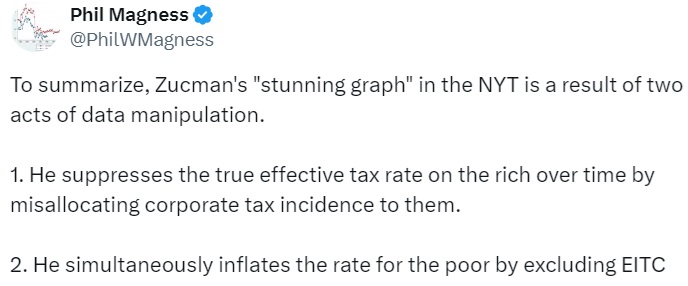
Like Thomas Piketty, Gabriel Zucman is a French economist who promotes economically destructive class-warfare tax policy. He’s also infamous for dodgy data manipulation, as Phil Magness explains in this Reason discussion. The interview lasts for 64 minutes, and I recommend the entire discussion. Yes, that’s a lot of time, but Phil has encyclopedic knowledge and […]
Debunking Bad Class Warfare and Debunking Nonsensical Class Warfare
17 May 2024 Leave a comment
in applied price theory, development economics, entrepreneurship, labour economics, labour supply, minimum wage
The New York Times (paywalled, but also available here) reported last month:At Sansan Chicken in Long Island City, Queens, the cashier beamed a wide smile and recommended the fried chicken sandwich.Or maybe she suggested the tonkatsu — it was hard to tell, because the internet connection from her home in the Philippines was spotty.Romy, who…
New York restaurants find a new way to respond to the minimum wage
15 May 2024 Leave a comment
in energy economics, entrepreneurship, environmental economics, financial economics, global warming, industrial organisation, survivor principle Tags: Germany, solar power

Germany’s costly and chaotic wind and solar transition has served up plenty of casualties. Large numbers of energy intensive manufacturers have already bailed out – chasing cheap power prices in places like the US and Singapore. Now, in a rather ironic twist, its solar panel manufacturing industry has all but thrown in the towel. Notwithstanding […]
Business Freeze: Germany’s Last Solar Panel Manufacturers Finally Crushed
07 May 2024 Leave a comment
in applied price theory, economic growth, economic history, entrepreneurship, human capital, income redistribution, industrial organisation, labour economics, labour supply, macroeconomics, Marxist economics, politics - USA, Public Choice, public economics Tags: taxation and entrepreneurship, taxation and investment, wealth tax
Everything you need to know about wealth taxation can be summarized in two sentences. The biggest problem with most tax systems is the pervasive tax bias against income that is saved and invested, which discourages the accumulation of capital that helps to finance future growth. Wealth taxes would dramatically increase the tax bias against saving […]
Dishonest Pimping for a Global Wealth-Tax Cartel
26 Apr 2024 Leave a comment
in applied price theory, comparative institutional analysis, constitutional political economy, development economics, economic history, economics of bureaucracy, entrepreneurship, growth disasters, history of economic thought, income redistribution, industrial organisation, law and economics, liberalism, Marxist economics, property rights, Public Choice Tags: economics of socialism

“to employ a hundred people is… exploitation, but to command the same number [is] honorable.” That’s an actual book by the way, explaining that although communism has failed in the past across different nations, races and cultures, it might work in the future where machines can create anything we want. Think Star Trek’s replicator technology. […]
Why Socialism Won’t Die
26 Apr 2024 Leave a comment
in applied price theory, entrepreneurship, industrial organisation, law and economics, managerial economics, organisational economics, politics - USA Tags: competition law, creative destruction
From former DOJ Economist Greg Werden: The governments case suggests that its exclusive deals with Apple and Mozilla to be the default search engine on their browsers “allowed Google to maintain its monopoly power [in “general search”] in violation of Section 2 of the Sherman Act.” However, the government’s brief also suggests that Google’s scale is very important,…
US v. Google: do complaints have to be internally consistent?
21 Apr 2024 Leave a comment
in applied price theory, economic growth, entrepreneurship, human capital, industrial organisation, labour economics, labour supply, macroeconomics, poverty and inequality Tags: artificial intelligence
That is the new Daron Acemoglu paper, and he is skeptical about its overall economic effects. Here is part of the abstract: Using existing estimates on exposure to AI and productivity improvements at the task level, these macroeconomic effects appear nontrivial but modest—no more than a 0.71% increase in total factor productivity over 10 years.…
“The Simple Macroeconomics of AI”
15 Apr 2024 1 Comment
in energy economics, entrepreneurship, environmental economics, financial economics, global warming, politics - USA Tags: climate alarmism

The climate cult thought the serious money was all in, forever. Til now, weather zealots could call on Wall Street to bankroll the climate industrial complex; there was no end to the amount of money available for harebrained, uneconomic wind and solar projects; no end to the unhinged war on hydrocarbons. These days, not so […]
Fun’s Over: America’s ‘Green’ Investors Ditch Climate Action Zealotry
14 Apr 2024 Leave a comment
in applied price theory, discrimination, economics of education, entrepreneurship, gender, human capital, labour economics, labour supply, occupational choice, poverty and inequality Tags: gender wage gap, sex discrimination
From “Diversity and Performance in Entrepreneurial Teams” (SSRN): Among the randomly-assigned teams [of MBA students], greater diversity along the intersection of gender and race/ethnicity significantly reduced performance. However, the negative effect of this diversity is alleviated … [when teams can choose their teammates]…teams with more female members perform substantially better when their faculty section leader was also…
Diverse MBA teams perform worse
Celebrating humanity's flourishing through the spread of capitalism and the rule of law
Scholarly commentary on law, economics, and more
Beatrice Cherrier's blog
Celebrating humanity's flourishing through the spread of capitalism and the rule of law
Celebrating humanity's flourishing through the spread of capitalism and the rule of law
Celebrating humanity's flourishing through the spread of capitalism and the rule of law
Why Evolution is True is a blog written by Jerry Coyne, centered on evolution and biology but also dealing with diverse topics like politics, culture, and cats.
Celebrating humanity's flourishing through the spread of capitalism and the rule of law
Celebrating humanity's flourishing through the spread of capitalism and the rule of law
A rural perspective with a blue tint by Ele Ludemann
DPF's Kiwiblog - Fomenting Happy Mischief since 2003
Celebrating humanity's flourishing through the spread of capitalism and the rule of law
The world's most viewed site on global warming and climate change
Tim Harding's writings on rationality, informal logic and skepticism
A window into Doc Freiberger's library
Let's examine hard decisions!
Commentary on monetary policy in the spirit of R. G. Hawtrey
Thoughts on public policy and the media
Celebrating humanity's flourishing through the spread of capitalism and the rule of law
Politics and the economy
A blog (primarily) on Canadian and Commonwealth political history and institutions
Reading between the lines, and underneath the hype.
Economics, and such stuff as dreams are made on
"The British constitution has always been puzzling, and always will be." --Queen Elizabeth II
Celebrating humanity's flourishing through the spread of capitalism and the rule of law
Celebrating humanity's flourishing through the spread of capitalism and the rule of law
WORLD WAR II, MUSIC, HISTORY, HOLOCAUST
Undisciplined scholar, recovering academic
Celebrating humanity's flourishing through the spread of capitalism and the rule of law
Res ipsa loquitur - The thing itself speaks
Celebrating humanity's flourishing through the spread of capitalism and the rule of law
Researching the House of Commons, 1832-1868
Articles and research from the History of Parliament Trust
Reflections on books and art
Posts on the History of Law, Crime, and Justice
Celebrating humanity's flourishing through the spread of capitalism and the rule of law
Exploring the Monarchs of Europe
Cutting edge science you can dice with
Small Steps Toward A Much Better World
“We do not believe any group of men adequate enough or wise enough to operate without scrutiny or without criticism. We know that the only way to avoid error is to detect it, that the only way to detect it is to be free to inquire. We know that in secrecy error undetected will flourish and subvert”. - J Robert Oppenheimer.
The truth about the great wind power fraud - we're not here to debate the wind industry, we're here to destroy it.
Celebrating humanity's flourishing through the spread of capitalism and the rule of law
Celebrating humanity's flourishing through the spread of capitalism and the rule of law
Economics, public policy, monetary policy, financial regulation, with a New Zealand perspective
Celebrating humanity's flourishing through the spread of capitalism and the rule of law
Restraining Government in America and Around the World
 Utopia, you are standing in it!
Recent Comments