Michael Reddell writes – There were good things in the Budget. There may be few/no votes in better macroeconomic statistics and, specifically, a monthly CPI but – years late (for which the current government can’t really be blamed) – it is finally going to happen.
Econ 101 is often dismissed as too simplistic. Yet recent events suggest that Econ 101 is underrated. Take the tariff debate: understanding that a tariff is a tax, that prices represent opportunity costs, that a bilateral trade deficit is largely meaningless, that a so-called trade “deficit” is equally a goods surplus or an investment surplus—these […]
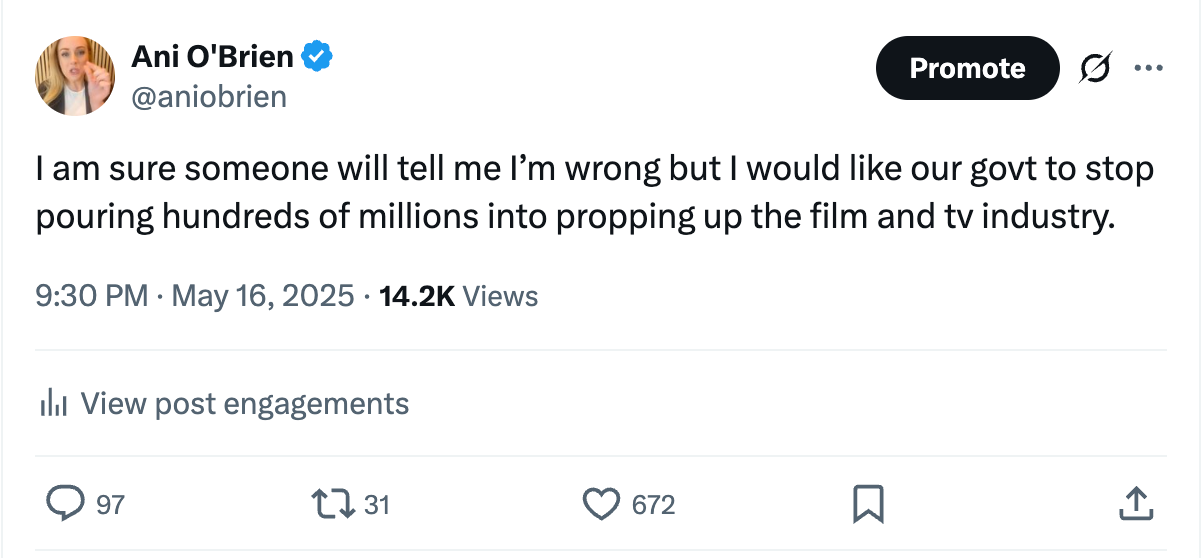
Ani O’Brien writes – On Friday night, having imbibed a few wines I strayed onto X to unwisely engage in some (slightly drunk) opinion sharing. I tweeted:
Numerous empirical studies show a relationship between a drug’s expected market size and the magnitude of research and development investments. Early studies focused on changes to market size resulting from the demographics of disease burden (Acemoglu and Linn 2004) and policy changes influencing market demand (Finkelstein 2004). These findings have largely been confirmed by more […]
I’m currently in Finland for meetings with various people and I learned that the country’s bloated public sector and expensive welfare state are imposing a very heavy cost on the economy. How heavy of a cost? According to IMF data, there’s been no growth in per-capita GDP over the past 18 years. Why is Finland […]
Berkshire Hathaway has realized a Sharpe ratio of 0.76, higher than any other stock or mutual fund with a history of more than 30 years, and Berkshire has a significant alpha to traditional risk factors. However, we find that the alpha becomes insignificant when controlling for exposures to Betting-Against-Beta and Quality-Minus-Junk factors. Further, we estimate […]
When interest rates go up, the price of bonds goes down. As Tyler and I discuss in Modern Principles, the inverse relationship between interest rates and prices holds for any asset that pays out over time. In particular, as Patrick McKenzie points out, when interest rates go up, the value of a loan goes down. […]
By Lauren Weber of The WSJ. Excerpts:”Most economists and other experts are skeptical that job creation will happen on a large scale because planning and building new factories is an incredibly complex and lengthy process. Businesses will be reluctant to do that unless they’re sure the investment is worth it over the long term. A fairly…
Vernon Smith reviews Joe Stiglitz’s book The Road to Freedom: Stiglitz did work in the abstract intellectual theoretical tradition of neoclassical economics showing how the standard results were changed by asymmetric or imperfect information. He is oblivious, however, to the experimental lab and field empirical research showing that agent knowledge of all such information is […]
Leasing companies have gambled that second hand values for EVs would be as strong as for conventional cars. It is a gamble that could cost them billions.
Myron Scholes was on top of the world in 1997, having won the Nobel Prize in economics that year for his work in financial economics, work that he had applied in the real world in a wildly successful hedge fund, Long Term Capital Management. But just one year later, LTCM was saved from collapse only […]
Why Evolution is True is a blog written by Jerry Coyne, centered on evolution and biology but also dealing with diverse topics like politics, culture, and cats.
“We do not believe any group of men adequate enough or wise enough to operate without scrutiny or without criticism. We know that the only way to avoid error is to detect it, that the only way to detect it is to be free to inquire. We know that in secrecy error undetected will flourish and subvert”. - J Robert Oppenheimer.



 Utopia, you are standing in it!
Recent Comments