https://twitter.com/MichaelBTI/status/673222286976008192
https://twitter.com/FODcdn/status/673225044454219776
https://twitter.com/MichaelBTI/status/672514378948718592
Celebrating humanity's flourishing through the spread of capitalism and the rule of law
06 Dec 2015 Leave a comment
in energy economics, environmental economics, global warming
https://twitter.com/MichaelBTI/status/673222286976008192
https://twitter.com/FODcdn/status/673225044454219776
https://twitter.com/MichaelBTI/status/672514378948718592
06 Dec 2015 1 Comment
in economics of regulation, energy economics, environmental economics, global warming Tags: Hotelling, offsetting behaviour, Oil prices, OPEC, The fatal conceit
Matthew Kahn wrote a fascinating blog post today on the impact of climate change, regulatory risks and fossil fuels disinvestment campaigns on investment portfolios.
At the end of that post, Kahn discussed the implications of a threatened carbon tax extraction rates of fossil fuels and the level of greenhouse gases:
Suppose that Exxon is aware that there will be a rising $100 carbon tax 50 years from now. Al Gore has claimed (in a 2014 WSJ piece) that this carbon pricing will lead to “stranded assets” and Exxon shareholders will suffer greatly.
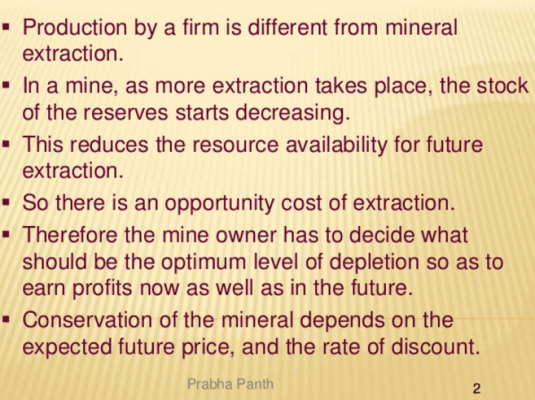
He needs to study his Hotelling no-arbitrage condition. Exxon will simply increase its extraction upfront to avoid this tax and the carbon emissions will occur earlier!
Regulatory uncertainty fostered by Greenpeace will have the same result of increasing extraction rates and carbon emissions with it because of the lower oil prices.
If Greenpeace looks like implementing any of its anti-growth, anti-poor, antidevelopment policies in a country, investors will respond by extracting as much as they can in anticipation of the regulatory crackdown.
Not long after I joined the Department of Finance from university, I remember attending a Treasury seminar that gave a property rights explanation of oil prices in the 1970s.
It was an alternative hypothesis to the OPEC cartel explanation. This was always a clumsy explanation because of the instability of cartels. Not only does OPEC not control the majority of production even in the 1970s, several members have been at war with each other and other OPEC member countries frequently in terrible financial straits with every incentive to cheat on their OPEC production quotas
Under the property rights hypothesis for oil prices, the oil companies anticipated nationalisation and pumped as much oil as they could before they were nationalised. This depressed prices prior to these nationalisations for as far back as the mid-50s. After these nationalisations, the oil companies became contractors who ran the oil fields on behalf of the national government who expropriated them.

After the nationalisation in the late 60s and early 70s, the radical change in property rights structure reduced extraction rates and with it increased oil prices in the international markets.
The oil price increases were a result of the change in control over production from the oil companies to the oil-producing countries. With these nationalisations there was a change from high rates of time preference to low rates on the part of the production decision-makers.

There was over-depletion because of insecure property rights. OPEC deserves credit for introducing long-overdue conservation policies to the benefit of generations of consumers then unborn.
The same logic applies to threats of a carbon tax. That risk encourages more depletion today so oil producers can sell at the untaxed rate. This will increase greenhouse gas emissions because oil prices will be depressed.
Policies that limit or reduce revenues in the future will induce the resource owners to bring their sales forward to the present. To quote Hans-Werner Sinn:
In my view, the Green Paradox is not simply a theoretical possibility. I believe it explains why fossil fuel prices have failed to rise since the 1980s, despite decreasing stocks of fossil fuels and the vigorous growth of the world economy.
The emergence of green policy movements around the world, rising public awareness of the climate problem, and increased calls for demand reducing policy measures, ranging from taxes and demand constraints to subsidies on green technologies, have alarmed resource owners.
In fact, while most of us perceived these developments as a breakthrough in the battle against global warming, resource owners viewed them as efforts that threatened to destroy their markets. Thus, in anticipation of the implementation of these policies, they accelerated their extraction of fossil fuels, bringing about decades of low energy prices.
05 Dec 2015 Leave a comment
in economic history, environmental economics, global warming Tags: climate alarmism, climate change adaptation, reclamation, The Netherlands
04 Dec 2015 Leave a comment
in economic history, energy economics, environmental economics, global warming Tags: climate alarmism, Fossil Fuels, global warming, nuclear power, renewable energy, solar energy, wind power
03 Dec 2015 Leave a comment
in applied price theory, economic growth, entrepreneurship, environmental economics, global warming, macroeconomics, Robert E. Lucas Tags: climate alarmists, endogenous growth theory, entrepreneurial alertness, exogenous growth theory, global warming, Matthew Kahn, neoclassical growth theory, offsetting, Robert Solow, unbalanced growth, unintended consequences
03 Dec 2015 Leave a comment
in energy economics, environmental economics, global warming, politics - USA Tags: climate alarmism, expressive voting, rational ignorance, rational rationality, voter demographics
02 Dec 2015 Leave a comment
in applied price theory, applied welfare economics, energy economics, environmental economics, global warming Tags: climate alarmism, Little ice age, younger dryas

01 Dec 2015 3 Comments
in applied welfare economics, economics of regulation, environmental economics, global warming, politics - USA, Public Choice
When the Twitter Left brands an opponent as a libertarian, I assume it’s a secret handshake among true believers trying to identify each other. You need time management counselling in your calling as a political junkie if you knew what a libertarian was until a few years ago. The only reason to change was the election of Senator Ron Paul.
The Twitter Left likes to smear opponents as libertarians despite the fact that certainly outside the USA and even within the USA few know what the libertarian means even with the help of scare quotes.
Only political junkies have an inkling of what a neoliberal is so why smear someone such an even more obscure label such as libertarian? Libertarian must be lower than a neo-liberal and should be hated even more by the Twitter Left must be the implication despite its poor marketing outreach value. I’m still puzzled as to why use such an obscure political label.
Today in the New York Times, a guide was published giving its readers the short answers to the key questions global warming. The author argued that most attacks on the science of global warming come from libertarians and other political conservatives who don’t like the implications of fighting global warming for growth in the size of government.

Source: Short Answers to Hard Questions About Climate Change – The New York Times via Environmental Economics: Short Answers to Hard Questions About Climate Change – The New York Times.
It is true that people attempt to discredit the arguments behind positions. Let he who is without sin cast the first stone.
“How to discredit an unwelcome report:
… Stage Four: Discredit the person who produced the report. Explain (off the record) that
1. He is harbouring a grudge against the Department.
2. He is a publicity seeker.
3. He is trying to get a Knighthood/Chair/Vice Chancellorship.
4. He used to be a consultant to a multinational.
5. He wants to be a consultant to a multinational.”
Sir Humphrey, The Greasy Pole.
As a professional economist, I am used to special interests as well as the Twitter Left arguing that economics is “just a theory” and its methodology is unrealistic along with various other attempts to avoid engaging with the actual advice put forward.
It is also true that scepticism about climate science has a partisan divide. In the USA, for example, Democrats are far more worried about global warming then independents or Republicans. (Independents is their name for swinging voters. They are called independents because if they register as one, they can vote in the Republican or Democratic primaries in many states).

I have argued in the blogosphere since 2011 that let the science be settled, only the economics matters because the economic cost of global warming is small.
Global warming, although real, is not apt to be severe. It will lower the level of GDP by maybe 2%. The loss of one year’s income growth! Courtesy of David Friedman’s reading of the report, this is what the most recent report of the IPCC said:
With these recognized limitations, the incomplete estimates of global annual economic losses for additional temperature increases of ~2°C are between 0.2 and 2.0% of income (±1 standard deviation around the mean)
I have also argued that the climate alarmists scored a great tactical victory in keeping the debate about the reliability of the science. By successfully baiting that trap for opponents, the climate alarmists have avoided having to discuss the costs and benefits of global warming.
Richard Tol on the scientific consensus about human-caused global warming skepticalscience.com/graphics.php?g… http://t.co/OpdRtsY1tx—
John Cook (@skepticscience) March 24, 2015
So it is rather curious that climate sceptics are playing to the strength of the climate alarmists rather than their weaknesses. Those weaknesses are the economics of global warming and the public choice economics of international climate agreements.
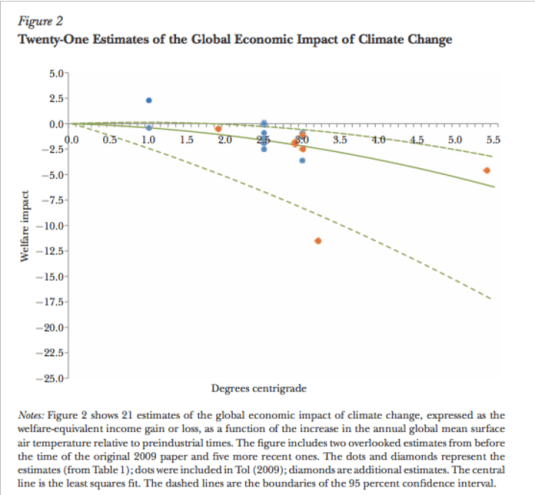
Source: Richard Tol.
Not only is the economic cost of global warming small, the chances of supplying an international public good such as a treaty to reduce carbon emissions is minimal.
The New York Times today in its Q&A guide did not quantify the costs and benefits of global warming. That makes their guide deeply misleading. This is because such estimates of the cost of global warming as a percentage of GDP are available from the IPCC. Which is worse? Being a libertarian or a misleading, low rent journalist?

Source: Short Answers to Hard Questions About Climate Change – The New York Times via Environmental Economics: Short Answers to Hard Questions About Climate Change – The New York Times.
What is even more bizarre in the guide today in the New York Times is the claim that politicians are finally taking climate change seriously. Anyone who claims that a climate change treaty will come out of Paris that is in any way binding is simply not paying attention to the last 5 years of politics and who controls the U.S. Congress. They cannot be taken seriously as a political commentator.
Obama gave up on a climate bill passed by the House of Representatives in 2010 despite the fact that he had the numbers in the Senate to break a filibuster. There were 5 Republican senators who would have voted for cap and trade in April 2010: Lindsey Graham, Susan Collins, Olympia Snowe, Scott Brown, and George LeMieux. There were 57 Democrat Senators. It takes 60 votes to break a filibuster.
Obama gave up because he didn’t want the additional political flak of passing a climate change bill in the aftermath of the political costs of passing Obamacare. President Obama could have fought harder to get the Bill the House passed through the Senate but he did not.
Concern about global warming fads away when it becomes a hip pocket issue. Rather than blaming vast right-wing conspiracies, using Google searches for “unemployment” and “global warming”, Kahn and Kotchen found that:
As Geoff Brennan has argued, CO2 reduction actions will be limited to modest unilateral reductions of a largely token character. There are many expressive voting concerns that politicians must balance to stay in office and the environment is but one of these. Once climate change policies start to actually become costly, expressive voting support for these policies will fall away, and it has.
23 Nov 2015 Leave a comment
in environmental economics, global warming, politics - New Zealand, Thomas Schelling
It is a stretch to say that New Zealand Greens have accepted that adaptation is the only proper response to the threat of global warming.
Nonetheless, their call for a plan for adaptation is an acceptance that more must be done than hoping for the best that a massively expensive international public good will be provided through a climate change treaty.

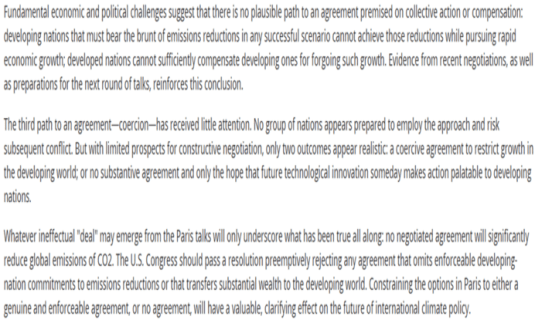
It is time for the environmental movement to face up to the fact that there never will be an international treaty to restrain carbon emissions.
The practical way to respond to global warming is healthier is wealthier, richer is safer. Faster economic growth creates more resources for resilience and adaptation to a changing environment.
Tom Schelling has been involved with the global warming debate since chairing a commission on the subject for President Carter in 1980.
Schelling is an economist who specialises in strategy so he focuses on climate change as a bargaining problem. Schelling drew in his experiences with the negotiation of the Marshall Plan and NATO.

International agreements rarely work if they talk in terms of results. They work better if signatories promise to supply specific inputs – to perform specific actions now. Individual NATO members did not promise to slow the Soviet invasion by 90 minutes if it happened after 1962. NATO members promised to raise and train troops, procure equipment and supplies, and deploy these assets geographically. All of these actions can be observed, estimated and compared quickly.
The Kyoto Protocol commitments were made not about actions but to results that were to be measured after more than a decade and several elections.
Climate treaties should promise to do certain actions now such as invest in R&D and develop carbon taxes that return the revenue as tax cuts. If the carbon tax revenue is fully refunded as tax cuts, less reliable countries, in particular, have an additional incentive to collect the carbon tax properly to keep their budget deficits under control.
As for the chances of a global treaty, Schelling has said:
The Chinese, Indonesians, or Bangladeshis are not going to divert resources from their own development to reduce the greenhouse effect, which is caused by the presence of carbon-based gases in the earth’s atmosphere. This is a prediction, but it is also sound advice. Their best defence against climate change and vulnerability to weather in general is their own development, reducing their reliance on agriculture and other such outdoor livelihoods. Furthermore, they have immediate environmental problems — air and water pollution, poor sanitation, disease — that demand earlier attention.
The costs of global warming to New Zealand are small. For developing countries, their best protection against global warming is rapid economic development through capitalism and freedom.
The latest report from the Intergovernmental Panel on Climate Change’s (IPCC) Working Group II has concluded that global warming of 2.5˚C would cost the equivalent to losing between 0.2-2.0% of annual income.

20 Nov 2015 Leave a comment
in environmental economics, global warming Tags: climate alarmism, expressive voting, political propaganda, rational ignorance, rational irrationality
17 Nov 2015 Leave a comment
in applied welfare economics, environmental economics, global warming
13 Nov 2015 Leave a comment
in energy economics, environmental economics, global warming Tags: Big Solar, expressive voting, renewable energy, solar energy, unintended consequences
https://twitter.com/roomfordebate/status/662290426083328000

Source: The Costs of Solar Energy to the Environment – Room for Debate – NYTimes.com.
Celebrating humanity's flourishing through the spread of capitalism and the rule of law
Celebrating humanity's flourishing through the spread of capitalism and the rule of law
Celebrating humanity's flourishing through the spread of capitalism and the rule of law
Celebrating humanity's flourishing through the spread of capitalism and the rule of law
Celebrating humanity's flourishing through the spread of capitalism and the rule of law
A History of the Alt-Right
Econ Prof at George Mason University, Economic Historian, Québécois
Celebrating humanity's flourishing through the spread of capitalism and the rule of law
Scholarly commentary on law, economics, and more
Beatrice Cherrier's blog
Celebrating humanity's flourishing through the spread of capitalism and the rule of law
Celebrating humanity's flourishing through the spread of capitalism and the rule of law
Celebrating humanity's flourishing through the spread of capitalism and the rule of law
Why Evolution is True is a blog written by Jerry Coyne, centered on evolution and biology but also dealing with diverse topics like politics, culture, and cats.
Celebrating humanity's flourishing through the spread of capitalism and the rule of law
A rural perspective with a blue tint by Ele Ludemann
DPF's Kiwiblog - Fomenting Happy Mischief since 2003
Celebrating humanity's flourishing through the spread of capitalism and the rule of law
The world's most viewed site on global warming and climate change
Tim Harding's writings on rationality, informal logic and skepticism
A window into Doc Freiberger's library
Let's examine hard decisions!
Commentary on monetary policy in the spirit of R. G. Hawtrey
Thoughts on public policy and the media
Celebrating humanity's flourishing through the spread of capitalism and the rule of law
Politics and the economy
A blog (primarily) on Canadian and Commonwealth political history and institutions
Reading between the lines, and underneath the hype.
Economics, and such stuff as dreams are made on
"The British constitution has always been puzzling, and always will be." --Queen Elizabeth II
Celebrating humanity's flourishing through the spread of capitalism and the rule of law
Celebrating humanity's flourishing through the spread of capitalism and the rule of law
WORLD WAR II, MUSIC, HISTORY, HOLOCAUST
Undisciplined scholar, recovering academic
Celebrating humanity's flourishing through the spread of capitalism and the rule of law
Res ipsa loquitur - The thing itself speaks
In Hume’s spirit, I will attempt to serve as an ambassador from my world of economics, and help in “finding topics of conversation fit for the entertainment of rational creatures.”
Researching the House of Commons, 1832-1868
Articles and research from the History of Parliament Trust
Reflections on books and art
Posts on the History of Law, Crime, and Justice
Celebrating humanity's flourishing through the spread of capitalism and the rule of law
Exploring the Monarchs of Europe
Cutting edge science you can dice with
Small Steps Toward A Much Better World
“We do not believe any group of men adequate enough or wise enough to operate without scrutiny or without criticism. We know that the only way to avoid error is to detect it, that the only way to detect it is to be free to inquire. We know that in secrecy error undetected will flourish and subvert”. - J Robert Oppenheimer.

 Utopia, you are standing in it!
Recent Comments