@NZGreens say something sensible on global warming @jamespeshaw @GreenpeaceNZ
23 Nov 2015 Leave a comment
in environmental economics, global warming, politics - New Zealand, Thomas Schelling
It is a stretch to say that New Zealand Greens have accepted that adaptation is the only proper response to the threat of global warming.
Nonetheless, their call for a plan for adaptation is an acceptance that more must be done than hoping for the best that a massively expensive international public good will be provided through a climate change treaty.

It is time for the environmental movement to face up to the fact that there never will be an international treaty to restrain carbon emissions.
The practical way to respond to global warming is healthier is wealthier, richer is safer. Faster economic growth creates more resources for resilience and adaptation to a changing environment.
Tom Schelling has been involved with the global warming debate since chairing a commission on the subject for President Carter in 1980.
Schelling is an economist who specialises in strategy so he focuses on climate change as a bargaining problem. Schelling drew in his experiences with the negotiation of the Marshall Plan and NATO.

International agreements rarely work if they talk in terms of results. They work better if signatories promise to supply specific inputs – to perform specific actions now. Individual NATO members did not promise to slow the Soviet invasion by 90 minutes if it happened after 1962. NATO members promised to raise and train troops, procure equipment and supplies, and deploy these assets geographically. All of these actions can be observed, estimated and compared quickly.
The Kyoto Protocol commitments were made not about actions but to results that were to be measured after more than a decade and several elections.
Climate treaties should promise to do certain actions now such as invest in R&D and develop carbon taxes that return the revenue as tax cuts. If the carbon tax revenue is fully refunded as tax cuts, less reliable countries, in particular, have an additional incentive to collect the carbon tax properly to keep their budget deficits under control.
As for the chances of a global treaty, Schelling has said:
The Chinese, Indonesians, or Bangladeshis are not going to divert resources from their own development to reduce the greenhouse effect, which is caused by the presence of carbon-based gases in the earth’s atmosphere. This is a prediction, but it is also sound advice. Their best defence against climate change and vulnerability to weather in general is their own development, reducing their reliance on agriculture and other such outdoor livelihoods. Furthermore, they have immediate environmental problems — air and water pollution, poor sanitation, disease — that demand earlier attention.
The costs of global warming to New Zealand are small. For developing countries, their best protection against global warming is rapid economic development through capitalism and freedom.
The latest report from the Intergovernmental Panel on Climate Change’s (IPCC) Working Group II has concluded that global warming of 2.5˚C would cost the equivalent to losing between 0.2-2.0% of annual income.

The inconvenient truths of @AlGore
20 Nov 2015 Leave a comment
in environmental economics, global warming Tags: climate alarmism, expressive voting, political propaganda, rational ignorance, rational irrationality
Payoff from Paris @COP21 @garethmorgannz @jamespeshaw @greenpeaceNZ @RusselNorman
17 Nov 2015 Leave a comment
in applied welfare economics, environmental economics, global warming
The costs of solar energy to the environment are underestimated
13 Nov 2015 Leave a comment
in energy economics, environmental economics, global warming Tags: Big Solar, expressive voting, renewable energy, solar energy, unintended consequences
https://twitter.com/roomfordebate/status/662290426083328000

Source: The Costs of Solar Energy to the Environment – Room for Debate – NYTimes.com.
Richard Tol on The road from Paris: whither climate policy?
03 Nov 2015 Leave a comment
in environmental economics, global warming Tags: climate alarmism, Richard Tol
The global warming models are still running too hot?
02 Nov 2015 Leave a comment
in environmental economics, global warming
@GreenpeaceNZ @RusselNorman Can We Rely on Wind and Solar Energy? @NZGreens
02 Nov 2015 Leave a comment
in energy economics, environmental economics, global warming, politics - Australia, politics - New Zealand, politics - USA Tags: Big Solar, Big Wind, bootleggers and baptists, expressive voting, green rent seeking, rational irrationality, renewable energy, solar power, wind power
@CarlyFiorina says it all on action to fight global warming @jamespeshaw @AndrewLittleMP @garethmorgannz
24 Oct 2015 Leave a comment
in applied price theory, comparative institutional analysis, energy economics, environmental economics, global warming, Public Choice, rentseeking Tags: 2016 presidential election, climate alarmists, expressive voting, free riding, game theory, global warming, international public goods, rational ignorance, rational irrationality
@GreenpeaceNZ @jamespeshaw The Futility and Farce of Global Climate Negotiations @RichardTol
18 Oct 2015 Leave a comment
in constitutional political economy, development economics, economics of bureaucracy, environmental economics, environmentalism, global warming, growth disasters, growth miracles, international economics, politics - Australia, politics - New Zealand, politics - USA, Public Choice, rentseeking Tags: bootleggers and baptists, climate alarmism, expressive voting, free-riders, global warming, green tariffs, international public goods, Leftover Left, New Zealand Greens, Twitter left
It is time for the environmental movement to face up to the fact that there never will be an international treaty to restrain carbon emissions. The practical way to respond to global warming is healthier is wealthier, richer is safer. Faster economic growth creates more resources for resilience and adaptation to a changing environment.
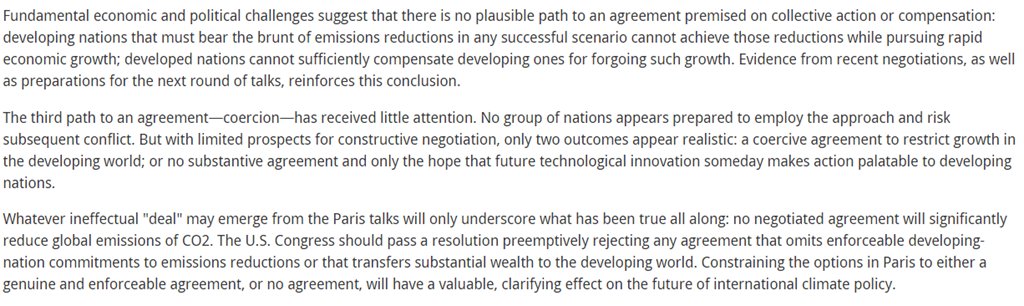
NEW REPORT: The Futility and Farce of Global Climate Negotiations bit.ly/1LvFFv3 http://t.co/TwbFUwaPlm—
Manhattan Institute (@ManhattanInst) October 17, 2015
India's target compared to its recent history http://t.co/pIvwhoSTpL—
Richard Tol (@RichardTol) October 02, 2015
Is the North Pole ice free as @algore predicted to happen by now
14 Oct 2015 Leave a comment
in environmental economics, environmentalism, global warming Tags: Al Gore, climate alarmism
@GreenpeaceNZ @savethearctic real reason @Shell stopped Arctic drilling @NZGreens
07 Oct 2015 Leave a comment
5 Ways People Power Helped Defeat Shell >> bit.ly/1L4KgAP #savethearctic http://t.co/e3Bn319yOe—
Greenpeace Canada (@GreenpeaceCA) October 06, 2015
Today in Energy: Sustained low oil prices could reduce exploration and production investment go.usa.gov/3twad http://t.co/zH8EpFc4Xx—
EIA (@EIAgov) September 24, 2015
CHART: Thanks to #fracking, US produced >89% of energy consumed this year (through June) for 1st time since 1984 http://t.co/8yEUac1pBA—
Mark J. Perry (@Mark_J_Perry) September 29, 2015
CHART: Thanks to #fracking, US petroleum imports this year through August (25.3%) are lowest in 44 years, since 1971 http://t.co/ThSbPTVDkH—
Mark J. Perry (@Mark_J_Perry) September 29, 2015
New EIA Data: US oil output fell to 9.1 bpd last week, down by 508,000 bpd from July peak ir.eia.gov/wpsr/overview.… http://t.co/VwAjeQ2dEN—
Mark J. Perry (@Mark_J_Perry) September 30, 2015
Energy Milestone: Thanks #fracking US Nat Gas Production Increased in July to New Record High eia.gov/dnav/ng/ng_pro… http://t.co/8KECE6ftxm—
Mark J. Perry (@Mark_J_Perry) September 30, 2015
Humanity keeps finding new reserves of energy: buff.ly/1LbOCcW #progress http://t.co/QhzgYkjWEi—
HumanProgress.org (@humanprogress) October 04, 2015
@RichardTol on energy pollution trade-offs
05 Oct 2015 Leave a comment
in energy economics, environmental economics, global warming Tags: air pollution, Richard Tol, trade-offs
BBC @RHarrabin on RE emissions pollution etc, good summary of complexity by @RichardTol
bbc.co.uk/news/science-e… http://t.co/xQNGzlpUSe—
Roddy Campbell (@Roddy_Campbell) September 29, 2015


Recent Comments