The Washington Post has announced layoffs affecting one-third of its workforce, including most of the sports and foreign news desks.…
The Washington Post Hit With Massive Layoffs As Guild Suggests the Need for New Owner
The Washington Post Hit With Massive Layoffs As Guild Suggests the Need for New Owner
08 Feb 2026 Leave a comment
in economics of media and culture, entrepreneurship, financial economics, industrial organisation, politics - USA, survivor principle Tags: creative destruction
The economics of currency values
25 Jan 2026 Leave a comment
in applied price theory, economic history, financial economics, international economics, macroeconomics, monetary economics Tags: Japan
That is the topic of my latest Free Press column, here is one excerpt: What else are currency values telling us today? The Japanese yen continues a very weak run, now coming in at about 158 to the U.S. dollar. I can recall when it was common for the yen to stand at about 100…
The economics of currency values
Yellen on Fiscal Dominance
17 Jan 2026 Leave a comment
in budget deficits, financial economics, fiscal policy, macroeconomics, monetary economics
“Fiscal dominance” refers to a situation where government debt grows so large that the nation’s central bank feels that it has little choice except to focus on making sure the government does not default–even if it means a surge of inflation. Janet Yellen described the issue and risks of fiscal dominance concisely in her comments…
Yellen on Fiscal Dominance
Trump’s Shameful Economic Illiteracy
11 Jan 2026 Leave a comment
in applied price theory, economics of regulation, financial economics, income redistribution, politics - USA, Public Choice, regulation, rentseeking

No, today’s column is not about Trump’s inane protectionism, which is definitely an example of economic illiteracy. It’s about another area where Trump is copying Joe Biden, channeling Elizabeth Warren, mind-melding with AOC, and acting like Bernie Sanders. Though it probably is indirectly connected with protectionism. “Affordability” has become a big issue, in part because […]
Trump’s Shameful Economic Illiteracy
Congressional leadership is corrupt
11 Dec 2025 Leave a comment
in applied price theory, econometerics, economic history, financial economics, politics - USA, Public Choice
Using transaction-level data on US congressional stock trades, we find that lawmakers who later ascend to leadership positions perform similarly to matched peers beforehand but outperform them by 47 percentage points annually after ascension. Leaders’ superior performance arises through two mechanisms. The political influence channel is reflected in higher returns when their party controls the…
Congressional leadership is corrupt
Japan’s Growing Burden of Government Means an Inevitable Fiscal Crisis
03 Dec 2025 Leave a comment
in budget deficits, economic growth, economic history, financial economics, fiscal policy, macroeconomics, population economics, public economics Tags: ageing society, Japan, population bust

I often get asked when the United States will suffer a Greek-style fiscal crisis. My answer is always “I don’t know,” though I freely admit we are heading in that direction. My lack of specificity isn’t merely because economists are lousy forecasters. I tell people it’s all about investor sentiment, and it’s hard to know […]
Japan’s Growing Burden of Government Means an Inevitable Fiscal Crisis
Should We Privatise More Government Businesses?
24 Nov 2025 Leave a comment
in applied price theory, comparative institutional analysis, financial economics, history of economic thought, industrial organisation, politics - New Zealand, privatisation
Pragmatic analysis says maybe we should, but we should also consider nationalisation. We should certainly consider better regulation. Brian Easton writes – An earlier column argued that we should make the government’s net worth – the value of its assets less its liabilities – more prominent in fiscal policy. Net worth is also fundamental when we are […]
Should We Privatise More Government Businesses?
Outstanding questions
13 Sep 2025 1 Comment
in economics of bureaucracy, financial economics, inflation targeting, macroeconomics, monetary economics, politics - New Zealand, Public Choice

A couple of nights ago, shortly after the Minister and Treasury finally released the suite of texts between Willis and Rennie, ZB featured interviewer Heather du Plessis-Allan talking to Herald journalist Jenee Tibshraeny (who has been over the Orr/Quigley/Willis saga issue from day one). There wasn’t anything concrete that was new in the conversation but […]
Outstanding questions
Some Links
07 Sep 2025 Leave a comment
in applied price theory, economic history, entrepreneurship, financial economics, macroeconomics Tags: China, Japan
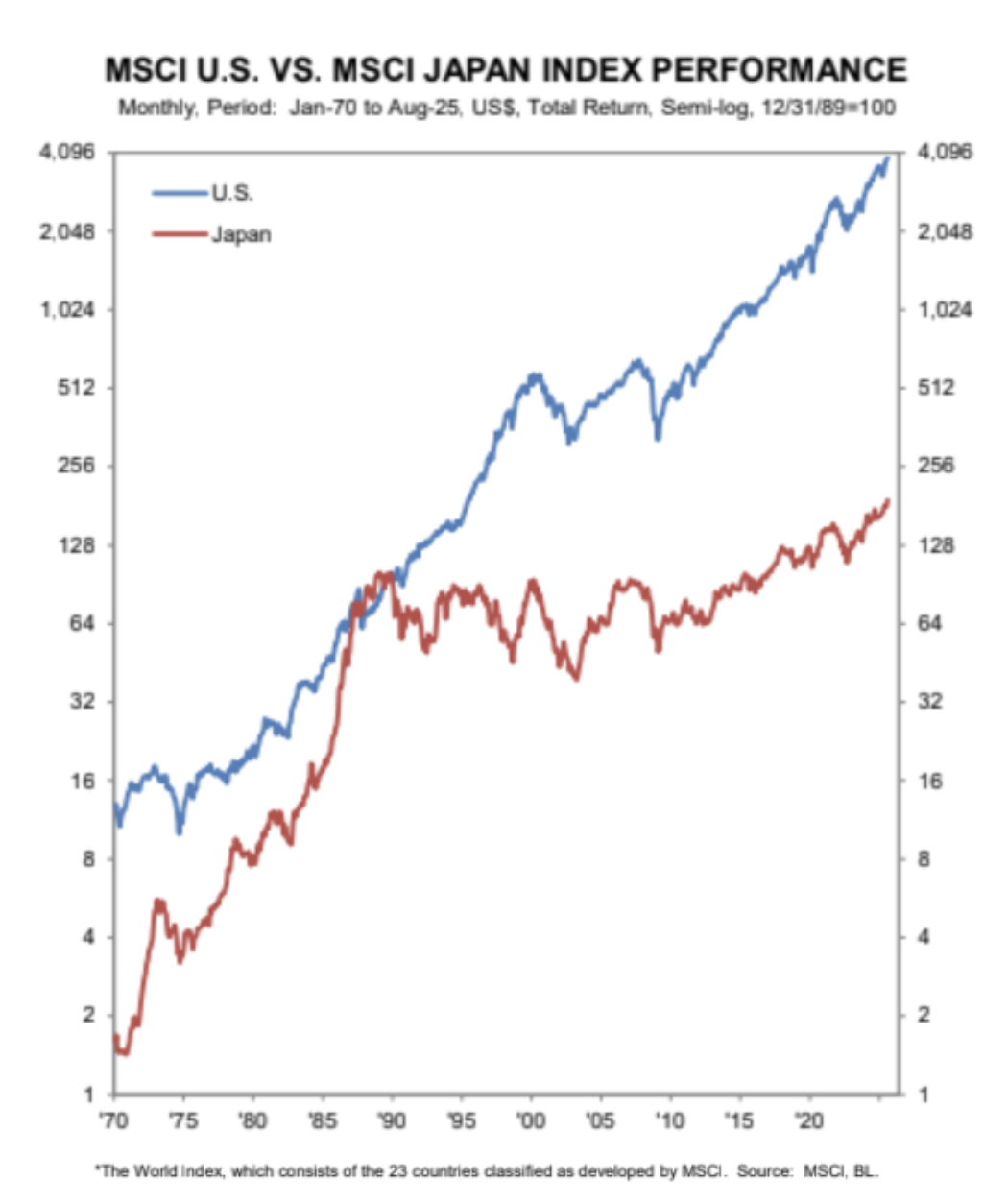
TweetThe folks at Unleash Prosperity share a chart that shows that Japanese industrial policy – which we Americans a few decades ago were warned by oh so very many pundits, professors, and politicians left, right, and center would propel Japan’s economy to great heights and leave America’s in the dust – was a curse to…
Some Links
Shorting Your Rivals: A Radical Antitrust Remedy
24 Jul 2025 Leave a comment
in applied price theory, economics of regulation, entrepreneurship, financial economics, industrial organisation Tags: competition law, competition law enforcement, mergers
Conventional antitrust enforcement tries to prevent harmful mergers by blocking them but empirical evidence shows that rival stock prices often rise when a merger is blocked—suggesting that many blocked mergers would have increased competition. In other words, we may be stopping the wrong mergers. In a clever proposal, Ayres, Hemphill, and Wickelgren (2024) argue that […]
Shorting Your Rivals: A Radical Antitrust Remedy
Markets in everything, bet on tariff repeal edition
23 Jul 2025 Leave a comment
in applied price theory, entrepreneurship, financial economics, international economics, politics - USA Tags: tarrifs
Cantor Fitzgerald, a financial services company led by the sons of US Commerce Secretary Howard Lutnick, has offered to buy the right to hundreds of millions of dollars in potential refunds from companies that have paid Trump’s tariffs. The offer means that the sons of the pro-tariff commerce secretary, Kyle and Brandon, have made a way for […]
Markets in everything, bet on tariff repeal edition
Markets are forward-looking
18 Jun 2025 1 Comment
in applied price theory, defence economics, econometerics, economic growth, economic history, financial economics, macroeconomics, market efficiency, politics - USA, war and peace Tags: efficient markets hypothesis, World War II
LPL Financial analyzed 25 major geopolitical episodes, dating back to Japan’s 1941 attack on Pearl Harbor. “Total drawdowns around these events have been fairly limited,” Jeff Buchbinder, LPL’s chief equity strategist, wrote in a research note on Monday. (Full recoveries often “take only a few weeks to a couple of months,” he added.) Deutsche Bank analysts […]
Markets are forward-looking
The 3.5 percent remittance tax
25 May 2025 1 Comment
in development economics, financial economics, Public Choice, public economics Tags: remittances
Trump has been talking about this. I am not sure what version of the idea we might end up with, but let’s consider the idea in its abstract form. Let’s also put aside money laundering issues, and talk about “simple remittances.” The United States has a partial monopsony power over Latino (and often other) migrants, […]
The 3.5 percent remittance tax
US Holders of Foreign Assets, Foreign Holders of US Assets, and Exorbitant Privilege
18 May 2025 Leave a comment
in financial economics, macroeconomics, monetary economics

US investors put money in assets of other countries, including “portfolio investment” which focuses on ownership of stocks and bonds without a management interest, and “foreign direct investment” which is owning enough of a foreign company to have a management interest. Conversely, foreign investors put money into US dollar assets in the US economy. Erin…
US Holders of Foreign Assets, Foreign Holders of US Assets, and Exorbitant Privilege
 Utopia, you are standing in it!
Recent Comments