TweetThis post by Oxford economist J. Zachary Mazlish is very good; I encourage you to read it. (HT David Levey) Nevertheless, there are two points that I think to be worth making in response to Mazlish’s post. I will here make one of these points. I’ll make the other of these points in a follow-up…
China Shock 2.0 vs. China Shock 1.0
China Shock 2.0 vs. China Shock 1.0
04 May 2026 Leave a comment
in applied price theory, development economics, econometerics, economic history, growth miracles, history of economic thought, industrial organisation, international economics, survivor principle Tags: China, free trade
Quotation of the Day…
03 May 2026 Leave a comment
in Adam Smith, applied price theory, history of economic thought
Tweet… is from page 47 of philosopher Christopher Freiman’s excellent contribution, titled “Utilitarianism,” to the 2016 collection edited by Aaron Ross Powell and Grant Babcock, Arguments for Liberty [original emphasis]: The great virtue of the market, from a utilitarian perspective, is that it leads us to promote the happiness of others without demanding that we…
Quotation of the Day…
Economics is Counter-Emotional, Not Counter-Intuitive
30 Apr 2026 Leave a comment
in applied price theory, comparative institutional analysis, constitutional political economy, economics of education, economics of information, history of economic thought, Public Choice
A few months ago, a high school econ student asked me to zoom with his class. I’m working against a tight deadline for Blockade, so I was inclined to decline. But the student’s list of questions was so ambitious that I decided to make the time. See for yourself:Here is the plan:- 5 minutes -WELCOME…
Economics is Counter-Emotional, Not Counter-Intuitive
How Reform Happens
30 Apr 2026 Leave a comment
in applied price theory, comparative institutional analysis, constitutional political economy, development economics, econometerics, economic history, economics of bureaucracy, growth disasters, growth miracles, history of economic thought, Public Choice
What determines whether and how regulations are reformed? We use a newly constructed data set of 3,590 successful and failed regulatory reforms in 189 countries, between 2005 and 2022, to address this question. We document that regulations have become more business friendly in some regulatory domains but not others. We also show that regulations are…
How Reform Happens
Quotation of the Day…
27 Apr 2026 Leave a comment
in applied price theory, economic history, entrepreneurship, history of economic thought, industrial organisation Tags: industry policy

Tweet… is from page 815 of Richard Nelson’s and Richard Langlois’s February 1983 Science paper titled “Industrial Innovation Policy: Lessons from American History”: A quick reading of the case studies is enough to dash any supposition that technological change is somehow a cleanly plannable activity. In fact, it is an activity characterized as much by…
Quotation of the Day…
What Does Dani Rodrik Think of Consumers?
27 Apr 2026 Leave a comment
in applied price theory, history of economic thought, international economics
TweetOn page 13 of their 2017 brief in support of “green industrial policy,” Tilman Altenburg and Dani Rodrik write: However, it should be noted that consumers do not respond perfectly to price signals. Even when new products exist that are better in many ways and cheaper, many consumers stick to the bad old alternatives because…
What Does Dani Rodrik Think of Consumers?
The Pernicious Trade Account
26 Apr 2026 Leave a comment
in applied price theory, economic history, financial economics, history of economic thought, international economics Tags: balance of trade
The trade accounts are among the most pernicious statistics ever collected. It’s long been remarked, for example, that merely by calling something a “deficit” it seems bad even though a current account deficit is matched by a financial account surplus. Put that issue aside, however, because the real problems are much deeper. The international accounts…
The Pernicious Trade Account
Quotation of the Day…
25 Apr 2026 Leave a comment
in applied price theory, history of economic thought, industrial organisation, international economics, labour economics, labour supply Tags: India

Tweet… is from page 150 of Columbia University economics professor Arvind Panagariya’s brilliant 2019 book, Free Trade and Prosperity: In India, Bihar is the poorest state and Kerala one of the richest. Going by the Gini coefficient, Bihar is among the states with the least inequality and Kerala among those with the highest inequality. If…
Quotation of the Day…
The President(s) Fought the Law and the Law Won
18 Apr 2026 Leave a comment
in applied price theory, economic history, history of economic thought, income redistribution, industrial organisation, international economics, labour economics, labour supply, politics - USA, poverty and inequality, Public Choice, rentseeking, survivor principle Tags: creative destruction, free trade, tarrifs
In our textbook, Modern Principles, Tyler and I emphasize that Congress and the President are subject to a higher law, the law of supply and demand. In an excellent column, Jason Furman gives a clear example of how difficult it is to fight the law of inelastic demand: …Today a given number of autoworkers can…
The President(s) Fought the Law and the Law Won
‘Market Power in Antitrust: Economic Analysis after Kodak,’ by Benjamin Klein
17 Apr 2026 Leave a comment
in applied price theory, economics of regulation, history of economic thought, industrial organisation, law and economics, politics - USA Tags: competition law
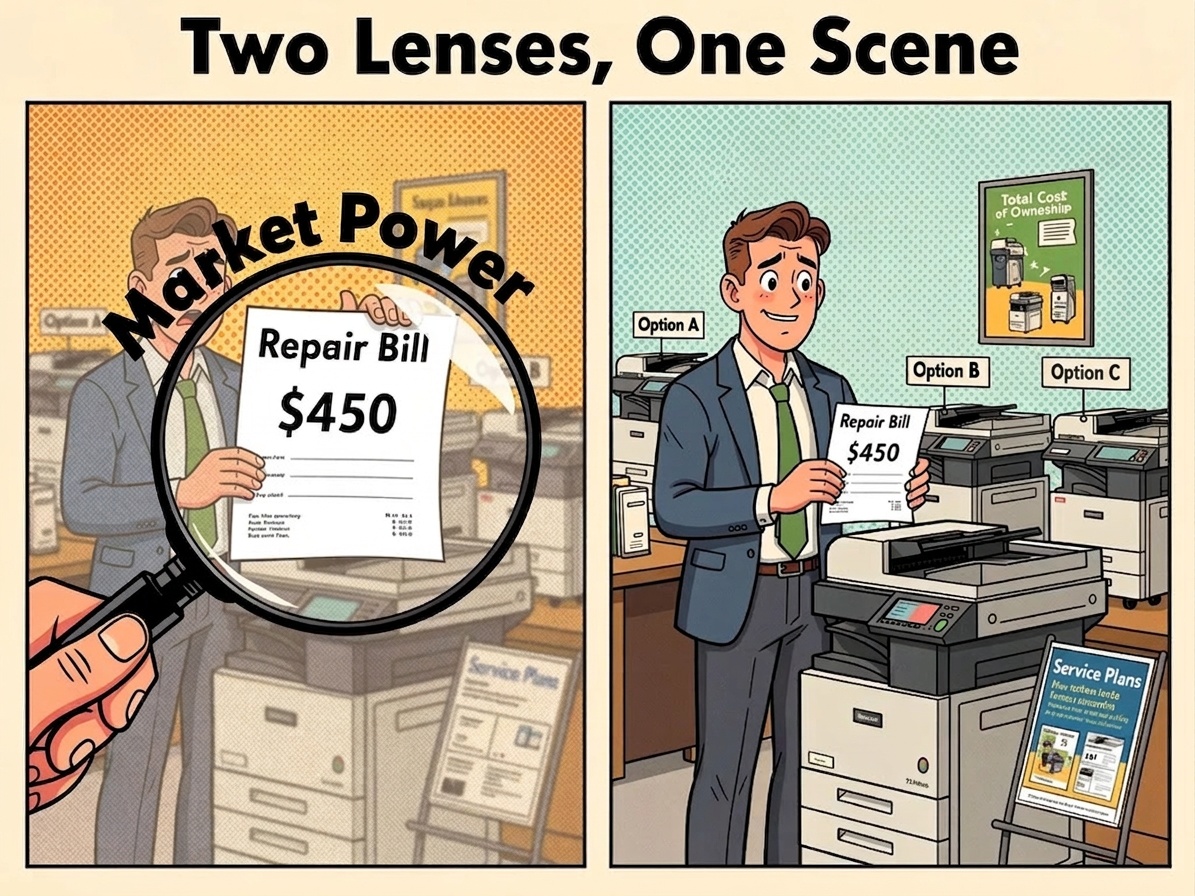
In 1992, the U.S. Supreme Court held in Eastman Kodak Co. v. Image Technical Services that a firm without market power in photocopiers might still possess market power in photocopier parts and service. The Court’s logic turned on opportunistic hold-up: Kodak could profit by trading short-run exploitation of locked-in customers for long-run losses in equipment…
‘Market Power in Antitrust: Economic Analysis after Kodak,’ by Benjamin Klein
Interview with Ellen McGrattan: Business Cycles and Intangible Capital
17 Apr 2026 Leave a comment
in business cycles, Edward Prescott, entrepreneurship, financial economics, global financial crisis (GFC), great recession, history of economic thought, human capital, labour economics, macroeconomics, monetary economics, occupational choice, Robert E. Lucas
Tim Sablik of the Richmond Fed interviews “Ellen McGrattan: On measuring what businesses do, developing effective tax policy, and searching for answers beyond the lamppost” (Econ Focus: Federal Reserve Bank of Richmond, First/Second Quarter 2026). Here are a few of the comments that caught my eye: How did McGrattan become interested in business cycles? In…
Interview with Ellen McGrattan: Business Cycles and Intangible Capital
Harnessing Mercantilist Idiocy for the Public Good
17 Apr 2026 Leave a comment
in applied price theory, history of economic thought, industrial organisation, international economics
TweetIdeally, every government would implement a policy of unilateral free trade. But governments, of course, by their nature testify that reality is very far from ideal. Here’s a letter to a long-time correspondent. Mr. B__: Thanks for your email in response to this blog post of mine in which I express support for the World…
Harnessing Mercantilist Idiocy for the Public Good
La Marxista: Mamdani Pledges to Open First City-Run Store with Projected $30 Million Initial Cost
15 Apr 2026 Leave a comment
in economics of bureaucracy, economics of regulation, history of economic thought, industrial organisation, law and economics, Marxist economics, politics - USA, property rights, Public Choice, survivor principle, urban economics Tags: New York City, state ownership

Mayor Zohran Mamdani used his “First 100 Days” speech this week to announce that he has kept his promise to…
La Marxista: Mamdani Pledges to Open First City-Run Store with Projected $30 Million Initial Cost
Bet On It Book Club: For a New Liberty, Chapter 9
11 Apr 2026 Leave a comment
in Austrian economics, business cycles, economic history, history of economic thought, macroeconomics, monetary economics, Murray Rothbard Tags: monetary policy
SummaryIn 1973, when the first edition of For a New Liberty was published, Keynesians were still sitting pretty. Five years later, the Keynesians had so much egg on their faces that Rothbard was inspired to add this entirely new chapter on “Inflation and the Business Cycle: The Collapse of the Keynesian Paradigm” to his revised…
Bet On It Book Club: For a New Liberty, Chapter 9
Oil and monetary policy
10 Apr 2026 Leave a comment
in applied price theory, defence economics, economic history, economics of bureaucracy, energy economics, financial economics, history of economic thought, labour economics, macroeconomics, monetary economics, politics - New Zealand, Public Choice, unemployment, war and peace Tags: 1973 oil crisis, monetary policy, oil shocks

I didn’t have too much problem with either the Reserve Bank Governor’s speech a couple of weeks ago on a framework for how monetary policy might deal with the oil shock, or with this week’s OCR review release from the Monetary Policy Committee. It was really all very orthodox stuff, much as any of the […]
Oil and monetary policy


Recent Comments