
Union density has taken a bit of a battering in US manufacturing and construction
05 Feb 2015 Leave a comment
Why do economic consulting firms exist?
02 Feb 2015 1 Comment
in applied price theory, economics of bureaucracy, economics of information, financial economics, law and economics, managerial economics, organisational economics, survivor principle Tags: advice giving industries, corporate law, Deirdre McCloskey, directors duties, economic consultants

Directors’ duties are the reason why the companies hire economic consultants. What consultants say isn’t important; the fact that simply the directors of a company sought advice is what matters. Same goes for the public sector: you must know what you’re doing, you took advice from outside experts.
Central to avoiding being sued if the company goes broke, or otherwise gets into a spot of bother, is the directors show that they acted responsibly.
Central to this is they can show they took advice from esteemed advisers: an accountant, a lawyer and an economist. If they did so, they must be responsible prudent directors because they took advice.

Deirdre McCloskey argued that the advising industry lives off 19th century case law on directors’ and trustees’ duties.
If you take advice – from an accountant, a lawyer or an economist – and the business or investment still fails, it can’t be your fault that you lost the widow’s and orphans’s inheritance.
You took advice. That is what that 19th-century court held with regard to what directors do and do not have to do given the fact that are not involved in the business on a day to day basis.
James Burk, a sociologist and former stockbroker… found that the advice giving industry sprang from legal decisions in the early 19th century.
The courts began to decide that the trustee of the pension fund or a child’s inheritance could be held liable for bad investing if they did not take advice. The effect would have been the same had the court decided that prudent man should consult a Ouija boards or the flight of birds…
America decided through its courts than an industry giving advice on the stock market should come into existence, whether or not it was worthless.
Therefore, it doesn’t matter what you say as a consultant economist to a company, the fact you’ve said something to them is more important to them than what you are saying. Seeking and receiving your advice excused them from being sued for breach of their directors duties for a couple of days.
Peak Facebook?
01 Feb 2015 Leave a comment
in economics of media and culture, industrial organisation, survivor principle Tags: competition as a discovery procedure, creative destruction, Facebook, Serial competition, The meaning of competition
Top 100 Companies Worldwide: the Geography of Large Corporations — Information is Beautiful Awards
28 Jan 2015 Leave a comment
in economic history, industrial organisation, survivor principle

via Top 100 Companies Worldwide: the Geography of Large Corporations — Information is Beautiful Awards.
I, Smartphone
28 Jan 2015 Leave a comment
in applied price theory, applied welfare economics, economics of media and culture, industrial organisation, survivor principle Tags: IPencil, Iphone
Based on Leonard Read’s famous essay “I, Pencil,” this short video beautifully illustrates the vast complexity that we carry in our pockets.
No one person could ever make a smartphone. It required the spontaneous cooperation of millions across all countries. The world could never be reinvented by a single mind, but rather requires the coordination of plans made possible only through private property and the price system.
HT: http://tucker.liberty.me/2015/01/27/15-great-lessons-on-commerce-and-entrepreneurship/#.VMfl-ZUvGGA.facebook
A cheat sheet of 19 different business models
28 Jan 2015 Leave a comment
in entrepreneurship, industrial organisation, managerial economics, organisational economics, survivor principle, theory of the firm Tags: entrepreneurial alertness, The meaning of competition


The Bechdel Test: whether women are in a movie as fully human characters, or as plot devices for the male characters
27 Jan 2015 Leave a comment
in discrimination, economics of media and culture, gender, industrial organisation, movies, occupational choice, survivor principle Tags: co-worker discrimination, consumer sovereignty, customer discrimination, employer discrimination, Hollywood economics, sex discrimination, The meaning of competition
/cdn0.vox-cdn.com/uploads/chorus_asset/file/3332436/hickey-bechdel-11.0.png)
Hollywood is a slave to the box office on the most cutthroat industry there is. Film producers and screenwriters will portray men and women in whatever roles and whatever extent sells tickets.
How women are represented in the movies is determined solely by the preferences of the audiences willing to buy tickets. It’s a buyers market out there. Film producers would do whatever it takes to finance films that sell tickets, as even Five Thirty-Eight realised:
“Movies that are female-driven do not travel,” said Krista Smith, West Coast editor of Vanity Fair, describing the broader sentiment in Hollywood. There are almost no women who have sales value in multiple international territories, maybe with the exception of Sandra Bullock, she said.
Times change, and film producers change with the times. Consumers are both sovereign and change their minds, and in the case of movie audiences, constantly demand novelty and surprises, as even Five Thirty-Eight picked up on:
Hollywood is the business of making money. Since our data demonstrates that films containing meaningful interactions between women do better at the box office than movies that don’t, it may be only a matter of time before the data of dollars and cents overcomes the rumours and prejudices defining the budgeting process of films for, by and about women.
This moral panic over gender wage gaps between millionaire actresses and actresses dare not say that for want of offending the audience that is actually the main driver of any gender gap in movies.

Hollywood activists complaining about the gender wage are to business minded to dare insult the audiences that pay their wages.
Why all this sucking up to the dead Saudi dictator?
24 Jan 2015 Leave a comment
in energy economics, industrial organisation, politics - Australia, politics - USA, resource economics Tags: autocracy, autocratic succession, cartel theory, creative destruction, David Friedman, M. A. Adelman, Middle-East politics, OPEC oil cartel
We are not living in the 70s, but nonetheless the death of the late unlamented Saudi dictator has flags at half-mast and other sycophantic behaviour that hasn’t been seen since the death of the last totalitarian dictator who was something of a player in geopolitics and American foreign policy.

We are not living in the 70s where the West in fear of the OPEC cartel and the behaviour of Saudi Arabia as the swing producer and purported cartel enforcer.
/cdn0.vox-cdn.com/uploads/chorus_asset/file/2908448/oil_price_jan6.0.png)
OPEC and Saudi Arabia are both shadows of the former selves in terms of dominance in the global oil markets. OPEC as a whole represents about one third of global oil production, which was down for a little over 50% in 1973.

Within OPEC, Saudi Arabia As oil reserves that aren’t much bigger than those of either Iran or Venezuela. All of these countries, including Saudi Arabia have large populations and few other ways to servicing needs than from the oil revenues.

Russia is in the same position of needing to pump out as much oil as it can while letting someone else do the hard lifting regarding keeping the price of the oil up by cutting back production. US oil production has been on the rise, and has lessened the need for imported crude oil.

The best place to be in any cartel is outside the cartel selling as much as you can at the cartel price. The next best option is to be a cartel member, pretending to be a loyal while selling under the counter bias, much as you can. Recent discounts given by the Kingdom to some customers have been interpreted as showing a determination to maintain market share. David Friedman explains:
One great weakness of a cartel is that it is better to be out than in. A firm that is not a member is free to produce all it likes and sell it at or just below the cartel’s price.
The only reason for a firm to stay in the cartel and restrict its output is the fear that if it does not, the cartel will be weakened or destroyed and prices will fall.
A large firm may well believe that if it leaves the cartel, the remaining firms will give up; the cartel will collapse and the price will fall back to its competitive level.
But a relatively small firm may decide that its production increase will not be enough to lower prices significantly; even if the cartel threatens to disband if the small firm refuses to keep its output down, it is unlikely to carry out the threat.
Maurice Adelman regards the oil glut as the chronic condition of the world oil market, given the continuous tendency to underestimate reserves and undiscovered oil.
There was a glut 70 years ago, 50 years ago in 1933, 15 years ago in 1970 …But that condition of everlasting glut is periodically broken by dangers of oil shortage.
All cartels break-down and only some get back together. Cartels contain seeds of their own destruction. Cartel members are reducing their output below their existing potential production capacity, and once the market price increases, each member of the cartel has the capacity to raise output relatively easily. Adelman explains:
Opinions vary as to what is the right price for maximum profit, and opec has often had to find its right price through trial and error…
Each opec member could reap a windfall by cheating and producing over quota because the cost of production is so far below the market price. But, if some cartel members were to defect, output would climb and the prices — and windfall profits — would fall.
OPEC members pay scant regard to their actual production quotas and their national production quotas are always increased when push comes to shove. As Bill Allen said:
Long-term survival of the cartel has two fundamental requirements: first, cheating by a member on the stipulated prices, outputs and markets must be detectable; second, detected cheating must be adequately punishable without leading to a break-up of the cartel.
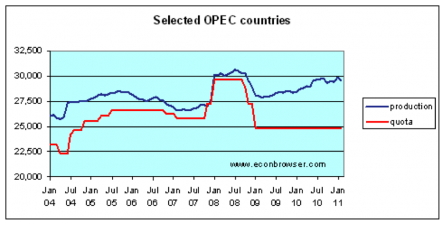

All cartels must decide how to allocate the reduction of output that follows the price increases across members with different costs structures and spare capacity.:
- The tendency is for cartel members to cheat on their production quotas, increasing supply to meet market demand and lowering their price.
- Most cartel agreements are unstable and at the slightest incentive they will quickly disband, and returning the market to competitive conditions.
The exercise of collective market power will not be stable unless sellers agree on prices and production shares; on how to divide the profits; on how to enforce the agreement; on how to deal with cheating; and on how to prevent new entry.

A cartel is in the unenviable position of having to satisfy everyone, for one dissatisfied producer can bring about the feared price competition and the disintegration of the cartel. Thus a successful cartel must follow a policy of continual compromise. Little wonder that John. S McGee wrote that:
The history of cartels is the history of double crossing.
Was it important to suck up to the Saudi dictator because of its role as swing producer in OPEC. In 1983, 1984, and 1986, for example, the Saudis produced only about 3.5 million barrels per day, despite their (then) production capacity of about 10 million barrels per day. Whatever else you can say about those production cutbacks to defend posted OPEC cartel price, they were a long time ago.

Saudi Arabia, Kuwait, and the United Arab Emirates have large reserves relative to the financial needs of their population but what they have is only a small share of global reserves and global production of oil and trivial share if you add global shale production.

With the exception of the wake of the 1979 Iranian upheaval, and market anticipation of a possible destruction of substantial reserves in the 1990–1991 and 2003 Gulf wars, real prices of crude oil fell from 1974 through 2003. Prices increased in 2004 onwards because of demand in Asia.

Bryan Caplan summarised the views of leading oil economist James Hamilton in 2008 as follows:
1. OPEC has almost no effect on world oil prices; most countries produce less than their quota, and when countries want to produce more, their quota goes up.
2. The price of oil follows a random walk. But the oil industry isn’t trying very hard to develop new sources because oil execs believe that the price of oil is mean-reverting (i.e., what goes up must come down). Why are the oil execs so wrong? Hamilton’s guess: They’re putting too much weight on their last big experience with high oil prices in the 70s and 80s.
No amount of cutting can support prices when supply outside OPEC is growing strongly and demand is weak in the wake of the global financial crisis and the slower recoveries both in the USA and Europe. Hamilton’s current view is that:
…of the observed 45% decline in the price of oil, 19 percentage points– more than 2/5– might be reflecting new indications of weakness in the global economy.
Whatever reason people are sucking up to the dead Saudi dictator, they have nothing to do with the global oil market.


Organic yield gap shrinking? Study actually shows it’s less sustainable than conventional agriculture
22 Jan 2015 Leave a comment
in applied price theory, applied welfare economics, health economics, industrial organisation, survivor principle Tags: activists, Anti-Science left, food snobs, Leftover Left, organic farming, Quacks

 Utopia, you are standing in it!
Recent Comments