
Celebrating humanity's flourishing through the spread of capitalism and the rule of law
30 Oct 2014 Leave a comment
in applied welfare economics, industrial organisation Tags: innovation, R&D, The fatal conceit, The pretence to knowledge
29 Oct 2014 Leave a comment
in applied price theory, applied welfare economics, economic growth, industrial organisation Tags: economic growth, innovation, R&D, The fatal conceit, The pretence to knowledge

28 Oct 2014 Leave a comment

22 Oct 2014 Leave a comment
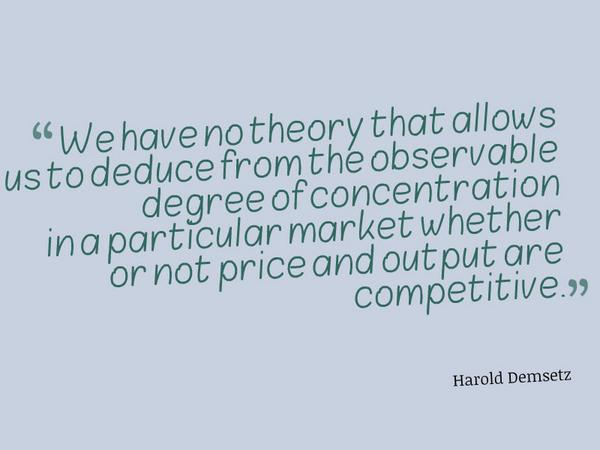
in industrial organisation Tags: Harold Demsetz
HT: Brian Albrecht
22 Oct 2014 Leave a comment

20 Oct 2014 Leave a comment
in applied price theory, entrepreneurship, F.A. Hayek, industrial organisation, survivor principle Tags: competition as a discovery procedure, FA Hayek, market process, profit and loss

HT: David Henderson
16 Oct 2014 Leave a comment
in applied price theory, applied welfare economics, comparative institutional analysis, constitutional political economy, discrimination, economic growth, entrepreneurship, gender, human capital, income redistribution, industrial organisation, labour economics, Marxist economics, Rawls and Nozick Tags: Daron Acemoglu, James Robinson, Piketty, poverty and inequality, The Great Enrichment
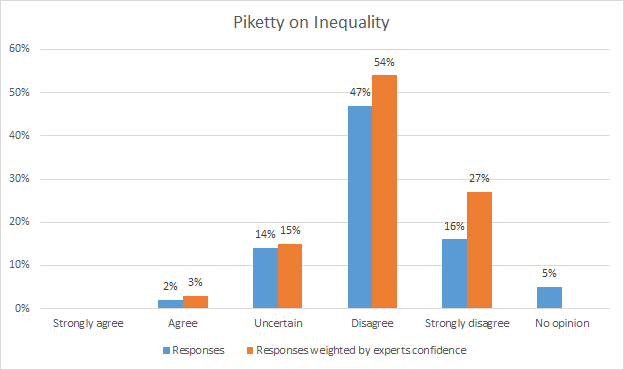
Question: The most powerful force pushing towards greater wealth inequality in the US since the 1970s is the gap between the after-tax return on capital and the economic growth rate?
Daron Acemoglu and James Robinson have a simple explanation for why Piketty is wrong:
But like Marx, Piketty goes wrong for a very simple reason. The quest for general laws of capitalism or any economic system is misguided because it is a-institutional.
It ignores that it is the institutions and the political equilibrium of a society that determine how technology evolves, how markets function, and how the gains from various different economic arrangements are distributed.
Despite his erudition, ambition, and creativity, Marx was ultimately led astray because of his disregard of institutions and politics. The same is true of Piketty.
15 Oct 2014 Leave a comment
in entrepreneurship, industrial organisation, law and economics Tags: browser wars, law and economics, Microsoft anti-trust trial, Richard McKenzie, Robert Bork, scourge of lower prices, William Shugart
You show your age when you remember that people used to pay $49 to download the Netscape Navigator browser.

Yes,people used to pay for browsers until nasty Microsoft came along in act of predatory entry started giving its Internet browser away from free in the hope of monopolising the market once Netscape went out of business when it would jack its price up again to recoup the intervening losses.
After the first browser war, the usage share of Netscape had fallen from over 90 percent in the mid-1990s to less than one percent by the end of 2006.
During the 1990s, Microsoft competitors — Netscape, IBM, Sun Microsystems, WordPerfect, Oracle, and others —pressed the Justice Department to sue Microsoft for tying Internet Explorer to Windows even though only one of them, Netscape, had a browser.
The demise of Netscape was a central premise of Microsoft’s antitrust trial, where the Court ruled that Microsoft’s bundling of Internet Explorer with the Windows operating system was a monopolistic and illegal business practice.
After losing on appeal , the Department of Justice announced in September 2001 that it was no longer seek to break up Microsoft and would instead seek a lesser antitrust penalty. Microsoft decided to draft a settlement proposal allowing PC manufacturers to adopt non-Microsoft software.
As William Shughart and Richard McKenzie observed:
Microsoft’s critics have advanced a number of economic theories to explain why the firm’s behaviour has violated the antitrust laws.
None of those critics has articulated why or how consumers have been harmed in the process.
Instead, the furious attacks on Microsoft have focused on the injuries supposedly suffered by rivals (on account of Microsoft’s pricing and product-development strategies) and by computer manufacturers and Internet service providers (on account of Microsoft’s “exclusionary contracts”).
Before former Judge Robert Bork became a lobbyist for Microsoft’s rivals, he said in The Antitrust Paradox:
Modern antitrust has so decayed that the policy is no longer intellectually respectable.
Some of it is not respectable as law; more of it is not respectable as economics; and … because it pretends to one objective while frequently accomplishing its opposite … a great deal of antitrust is not even respectable as politics.
A simple rule for a complex world: the moment that evidence is tended to a court about what happened to the competitors in a lawsuit under competition law, that court must dismiss the suit out of hand.
Too many lawsuits under competition law are designed to protect the consumer from the scourge of lower prices!
The best proof that a merger or other business practice is pro-consumer is the rival firms in that market are against it. Why would a firm be against a merger or other business practice that raises the prices of their business rivals?
HT: HistoricalPics
15 Oct 2014 Leave a comment
in applied price theory, comparative institutional analysis, George Stigler, industrial organisation, political change Tags: george stigler, The pretence to knowledge

HT: David Henderson
Celebrating humanity's flourishing through the spread of capitalism and the rule of law
Scholarly commentary on law, economics, and more
Beatrice Cherrier's blog
Celebrating humanity's flourishing through the spread of capitalism and the rule of law
Celebrating humanity's flourishing through the spread of capitalism and the rule of law
Celebrating humanity's flourishing through the spread of capitalism and the rule of law
Why Evolution is True is a blog written by Jerry Coyne, centered on evolution and biology but also dealing with diverse topics like politics, culture, and cats.
Celebrating humanity's flourishing through the spread of capitalism and the rule of law
Celebrating humanity's flourishing through the spread of capitalism and the rule of law
A rural perspective with a blue tint by Ele Ludemann
DPF's Kiwiblog - Fomenting Happy Mischief since 2003
Celebrating humanity's flourishing through the spread of capitalism and the rule of law
The world's most viewed site on global warming and climate change
Tim Harding's writings on rationality, informal logic and skepticism
A window into Doc Freiberger's library
Let's examine hard decisions!
Commentary on monetary policy in the spirit of R. G. Hawtrey
Thoughts on public policy and the media
Celebrating humanity's flourishing through the spread of capitalism and the rule of law
Politics and the economy
A blog (primarily) on Canadian and Commonwealth political history and institutions
Reading between the lines, and underneath the hype.
Economics, and such stuff as dreams are made on
"The British constitution has always been puzzling, and always will be." --Queen Elizabeth II
Celebrating humanity's flourishing through the spread of capitalism and the rule of law
Celebrating humanity's flourishing through the spread of capitalism and the rule of law
WORLD WAR II, MUSIC, HISTORY, HOLOCAUST
Undisciplined scholar, recovering academic
Celebrating humanity's flourishing through the spread of capitalism and the rule of law
Res ipsa loquitur - The thing itself speaks
In Hume’s spirit, I will attempt to serve as an ambassador from my world of economics, and help in “finding topics of conversation fit for the entertainment of rational creatures.”
Researching the House of Commons, 1832-1868
Articles and research from the History of Parliament Trust
Reflections on books and art
Posts on the History of Law, Crime, and Justice
Celebrating humanity's flourishing through the spread of capitalism and the rule of law
Exploring the Monarchs of Europe
Cutting edge science you can dice with
Small Steps Toward A Much Better World
“We do not believe any group of men adequate enough or wise enough to operate without scrutiny or without criticism. We know that the only way to avoid error is to detect it, that the only way to detect it is to be free to inquire. We know that in secrecy error undetected will flourish and subvert”. - J Robert Oppenheimer.
The truth about the great wind power fraud - we're not here to debate the wind industry, we're here to destroy it.
Celebrating humanity's flourishing through the spread of capitalism and the rule of law
Celebrating humanity's flourishing through the spread of capitalism and the rule of law
Economics, public policy, monetary policy, financial regulation, with a New Zealand perspective
Celebrating humanity's flourishing through the spread of capitalism and the rule of law
Restraining Government in America and Around the World



 Utopia, you are standing in it!
Recent Comments