
Who Routinely Trounces the U.S. Stock Market? Try 2 Out of 2,862 Funds – NYTimes.com
30 Jul 2014 Leave a comment
in entrepreneurship, financial economics, survivor principle Tags: active investing, efficient markets hypothesis, indexed linked investing, passive investing, stock picking

For the three years ended March 2014, 14.10% of large-cap funds, 16.32% of mid-cap funds and 25.00% of small-cap funds maintained a top-half ranking over three consecutive 12-month periods. Random expectations would suggest a rate of 25%.
After five years, two funds are still beating the market in each of the last five years.The rest of fallen by the wayside.
via Who Routinely Trounces the Stock Market? Try 2 Out of 2,862 Funds – NYTimes.com
George Stigler on do business owners maximise profits?
29 Jul 2014 Leave a comment
in applied price theory, Armen Alchian, entrepreneurship, George Stigler, survivor principle, theory of the firm Tags: george stigler, market selection, profit-maximisation

Entrepreneurs often do not know why they survived in competition. George Stigler in his autobiography told this wonderful story about how you could not get businessmen to admit in a survey that they maximise profits.
You go to their office and asked them: Do they maximise profits?
Their answer would be, of course, not. I am here to provide employment to my workers and put a small amount aside for the education of my children.
The surveyor would then ask them: if you do were to raise your prices, do you expect to increase your profits?
The businessman answers no.
The surveyor how would then ask them: if you were to cut your prices, do you expect to increase your profits?
The businessman answers no.
The survey would then ask: can you point to a time in the last 12-months where you substituted profit for some other objective?
At this point of time, you would be thrown out of their office as some sort of lunatic.


The separation of ownership from control
24 Jul 2014 3 Comments
in Armen Alchian, industrial organisation, Ronald Coase, survivor principle, theory of the firm Tags: Armlen Alchian, Eugene Fara, Harold Demsetz, Ronald Coase, separation of ownership and control, theory of the firm

Eugene Fama divides firms into two types: the managerial firm, and the entrepreneurial firm.
The owners of a managerial firm advance, withdraw, and redeploy capital, carry the residual investment risks of ownership and have the ultimate decision making rights over the fate of the firm (Klein 1999; Foss and Lien 2010; Fama 1980; Fama and Jensen 1983a, 1983b; Jensen and Meckling 1976).
Owners of a managerial firm, by definition, will delegate control to expert managerial employees appointed by boards of directors elected by the shareholders (Fama and Jensen 1983a, 1983b). The owners of a managerial firm will incur costs in observing with considerable imprecision the actual efforts, due diligence, true motives and entrepreneurial shrewdness of the managers and directors they hired (Jensen and Meckling 1976; Fama and Jensen 1983b).
Owners need to uncover whether a substandard performance is due to mismanagement, high costs, paying the employees too much or paying too little, excessive staff turnover, inferior products, or random factors beyond the control of their managers (Jensen and Meckling 1976; Fama and Jensen 1983b, 1985). Any paucity in knowledge slows the reactions of owners in correcting managerial errors including slip-ups in the recruitment and the retention of experienced older employees.
The entrepreneurial firms are owned and managed by the same people (Fama and Jensen 1983b). Mediocre personnel policies and sub-standard staff retention practices within entrepreneurial firms are disciplined by these errors in judgement by owner-managers feeding straight back into the returns on the capital that these owner-managers themselves invested. Owner-managers can learn quickly and can act faster in response the discovery of errors in judgement. The drawback of entrepreneurial firms is not every investor wants to be hands-on even if they had the skills and nor do they want to risk being undiversified.
Many of the shareholders in managerial firms have too small a stake to gain from monitoring managerial effort, employee performance, capital budgets, the control of costs and the stinginess or generosity of wage and employment policies (Manne 1965; Fama 1980; Fama and Jensen 1983a, 1983b; Williamson 1985; Jensen and Meckling 1976). This lack of interest by small and diversified investors does not undo the status of the firm as a competitive investment.

Large firms are run by managers hired by diversified owners because this outcome is the most profitable form of organisation to raise capital and then find the managerial talent to put this pool of capital to its most profitable uses (Fama and Jensen 1983a, 1983b, 1985; Demsetz and Lehn 1985; Alchian and Woodward 1987, 1988).
More active investors will hesitate to invest in large managerial firms whose governance structures tolerate excessive corporate waste and do not address managerial slack and error. Financial entrepreneurs will win risk-free profits from being alert and being first to buy or sell shares in the better or worse governed firms that come to their notice.
The risks to dividends and capital because of manifestations of corporate waste, reduced employee effort, and managerial slack and aggrandisement in large managerial firms are risks that are well known to investors (Jensen and Meckling 1976; Fama and Jenson 1983b). Corporate waste and managerial slack also increase the chances of a decline in sales and even business failure because of product market competition (Fama 1980; Fama and Jensen 1983b). Investors will expect an offsetting risk premium before they buy shares in more ill-governed managerial firms. This is because without this top-up on dividends, they can invest in plenty of other options that foretell a higher risk-adjusted rate of return.
The discovery of monitoring or incentive systems that induce managers to act in the best interest of shareholders are entrepreneurial opportunities for pure profit (Fama and Jensen 1983b, 1985; Alchian and Woodward 1987, 1988; Demsetz 1983, 1986; Demsetz and Lehn 1985; Demsetz and Villalonga 2001). Investors will not entrust their funds to who are virtual strangers unless they expect to profit from a specialisation and a division of labour between asset management and managerial talent and in capital supply and residual risk bearing (Fama 1980; Fama and Jensen 1983a, 1983b; Demsetz and Lehn 1985). There are other investment formats that offer more predictable, more certain rate of returns.

Competition from other firms will force the evolution of devices within the firms that survive for the efficient monitoring the performance of the entire team of employees and of individual members of those teams as well as managers (Fama 1980, Fama and Jensen 1983a, 1983b; Demsetz and Lehn 1985). These management controls must proxy as cost-effectively as they can having an owner-manager on the spot to balance the risks and rewards of innovating.
The reward for forming a well-disciplined managerial firm despite the drawbacks of diffuse ownership is the ability to raise large amounts in equity capital from investors seeking diversification and limited liability (Demsetz 1967; Jensen and Meckling 1976; Fama 1980; Fama and Jensen 1983b; Demsetz and Lehn 1985).Portfolio investors may know little about each other and only so much about the firm because diversification and limited liability makes this knowledge less important (Demsetz 1967; Jensen and Meckling 1976; Alchian and Woodward 1987, 1988).
It is still unwise to still suppose that portfolio investors will keep relinquishing control over part of their capital to virtual strangers who do not manage the resources entrusted to them in the best interests of the shareholders (Demsetz 1967; Williamson 1985; Fama 1980, 1983b; Alchian and Woodward 1987, 1988).
Managerial firms who are not alert enough to develop cost effective solutions to incentive conflicts and misalignments will not grow to displace rival forms of corporate organisation and methods of raising equity capital and loans, allocating legal liability, diversifying risk, organising production, replacing less able management teams, and monitoring and rewarding employees (Fama and Jensen 1983a, 1983b; Fama 1980; Alchian 1950).
Entrepreneurs win profits from creating corporate governance structures that can credibly assure current and future investors that their interests are protected and their shares are likely to prosper (Fama 1980; Fama and Jensen 1983a, 1983b, 1985; Demsetz 1986; Demsetz and Lehn 1985). Corporate governance is the set of control devices that are developed in response to conflicts of interest in a firm (Fama and Jensen 1983b).

Aaron Director and the default answer to why hard to understand business practices exist is ‘monopoly’ and the default policy response is ‘call the cops’
21 Jul 2014 Leave a comment
in industrial organisation, survivor principle Tags: Aaron Director

There are the myriad of ways in which real world business practices behave differently from the caricaturing in textbooks. Those differences sometimes arouses suspicious responses from economists.
Visions of market power and deadweight loss triangles dance their heads, and some of the suspect practices have been constrained by anti-trust policy. Director rejected this kind of intellectual laziness, and he sought, sometimes successfully, to inoculate those around him against it.
Director approached all business practices with the methodology that entailed asking very basic questions and answering them in a rigorous logic that it appealed ultimately to facts.
The style was verbal – some combination of Socratic dialogue and Adam Smith. This style had the disadvantage of producing few closed-form solutions. But it had the advantage of permitting analysis of the kind of problems that eluded simple solutions.
Indeed I believe that one reason for Director’s lasting influence he was able to show that simple judgements about business practices often cannot withstand rigorous scrutiny.
Sam Peltzman
Spans of control and the cost of entrepreneurial time
20 Jul 2014 Leave a comment
in applied price theory, Armen Alchian, industrial organisation, Ronald Coase, theory of the firm Tags: markets and hierarchies, Oliver Williamson, Robert Lucas, Ronald Coase, span of control, theory of the firm, Walter Oi

One constraint on the growth of any firm is entrepreneurs have a limited span of control (Coase 1937; Williamson 1967, Lucas 1978; Oi 1983a, 1983b). A span of control is the number of subordinates that an individual supervisor has to control and lead either directly or through a hierarchical managerial chain (Fox 2009).
There are only so many tasks that even the most able entrepreneurs can carry out in one day. Over-stretched spans of control motivate entrepreneurs to hire professional managers and delegate to them a wide range of decision-making rights over the firms they own (Williamson 1975; Foss, Foss and Klein 2008).
Entrepreneurs and the professional managers they hired to assist them must divide their respective time between monitoring employees, identifying new business opportunities, forecasting buyer demand and running the other aspects of their business (Lucas, 1978; Oi 1983, 1983b, 1988; Foss, Foss, and Klein 2008). The larger is the firm, the more employees there are for the entrepreneur to direct, monitor and reward. These costs of directing and monitoring employees will increase with the size of the firm and larger firms will encounter information problems not present in smaller firms (Alchian and Demsetz 1972; Stigler 1962).

The cost of entrepreneurial time spent monitoring employees will increase with the size of the firm (Lucas 1978; Oi 1983b). The time of the more talented entrepreneurs is more valuable because they had the superior managerial skills and entrepreneurial alertness to make their firms large in the first place and remain deft enough to survive in competition. Time spent on the supervision of employees is time that is spent away from other uses of the talents that got these more able entrepreneurs to the top and keeps them there (Williamson 1967; Lucas 1978; Oi 1983b, 1988, 1990; Idson and Oi 1999; Black et al 1999).
Firms in the same industry tend to exhibit systematic differences in their organization of production and the structure of their workforces because entrepreneurial ability is the specific and scarce production input that limits the size of a firm (Lucas, 1978; Oi 1983b). The less able entrepreneurs tend to run the smaller firms while the more able entrepreneurs tend to lead both the currently large firms and the smaller firms that are growing at the expense of market rivals (Lucas 1978, Oi 1983b; Stigler 1958; Alchian 1950).


The perennial gale of creative destruction at work: those all-powerful television networks
14 Jul 2014 Leave a comment
in economics of media and culture, entrepreneurship, industrial organisation, survivor principle Tags: creative destruction, media bias, Schumpeter, television networks


Sure, there’s a temptation to fix prices, but it isn’t as strong as the urge to put one over on your competitors
12 Jul 2014 Leave a comment
in applied price theory, industrial organisation Tags: Bill Allen, cartels

The desire to collude and thereby to raise prices must be distinguished from the ability to do so.
Not only is it difficult for rival companies to agree on the production cuts each must make in order to force up price, but it is difficult to prevent each company from undercutting the others in order to increase its sales. It is unlikely that, without–and sometimes even with–government support, firms will long curb their rivalry–even in industries with high levels of concentration…
It is not easy to organize a cartel, melding highly autonomous organizations into a monopolistic facsimile. There are markets to divide, prices to set, and production quotas to assign.
Successful operation is even harder than initial organization. Members must remain persuaded that they enjoy net benefits from collusion compared to acting as independent agents.
The more profitable the collusive efforts, the greater the incentive for outsiders to seek admission or to organize their own club or individually to compete.
The more numerous the participants and the more lucrative the tightening of the screws on consumers, the greater the temptation for individual members to cheat–and the greater the fear of each that some other member will cheat.
Long-term survival of the cartel has two fundamental requirements: first, cheating by a member on the stipulated prices, outputs and markets must be detectable; second, detected cheating must be adequately punishable without leading to a break-up of the cartel.
Bill Allen
What Sam Walton do to make his family rich?
10 Jul 2014 2 Comments
in applied price theory, applied welfare economics, entrepreneurship, industrial organisation, market efficiency, survivor principle, technological progress Tags: entrepreneurship, innovation, Walmart

HT: antidismal.blogspot via cafehayek
At least 20% of New Zealand workers are subject to occupational regulation
08 Jul 2014 Leave a comment
in applied price theory, applied welfare economics, comparative institutional analysis, David Friedman, economics of information, economics of regulation, entrepreneurship, industrial organisation, labour economics, law and economics, managerial economics, market efficiency, Milton Friedman, personnel economics, politics - New Zealand, Ronald Coase Tags: adverse selection, asymmetric information, blackboard economics, moral hazard, occupational regulation, screening, signalling
There are at least 98 regulated occupations in New Zealand covering about 20% of the workforce. In 2011, this amounts to 440,371 workers. The skills that are regulated range across all skill sets and many occupations:
- 49% of regulation is in the form of a licence;
- 18% of regulated work is in the form of licensing of tasks;
- 31% of regulated workers require a certificate; and
- 4% of regulated workers require registration.
There are 32 different governing Acts that regulated occupations in New Zealand with 55% of the workers subject to occupational regulation are employed in just five occupations:
- 98,000 teachers;
- 48,500 nurses;
- 42,730 bar managers;
- 32,733 chartered accountants; and
- 22,749 electricians.
The Health Practitioners Competency Assurance Act 2003 regulates 22 occupations and a total of 89,807 workers. The next best is the 10 occupations regulated by the Health and Safety in Employment Act 2002 which regulates an unknown number of occupations. The Civil Aviation Act 1990 regulates eight occupations and 19,095 workers, the Building Act 2004 regulates seven occupations and 21,101 workers and the Maritime Transport Act 1994 regulates six occupations and 20,500 workers. 12 of the regulated occupations are regulated under laws passed since 2007.
The purpose of occupational regulation is to protect buyers from quacks and lemons – to overcome asymmetric information about the quality of the provider of the service.
Adverse selection occurs when the seller knows more than the buyer about the true quality of the product or service on offer. This can make it difficult for the two people to do business together. Buyers cannot tell the good from the bad products on offer so many they do not buy to all and withdraw from the market.
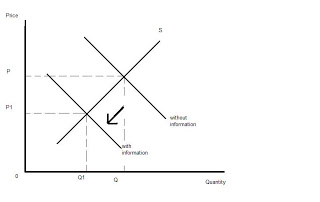
Goods and services divide into inspection, experience and credence goods.
- Inspection goods are goods or services was quality can be determined before purchase price inspecting them;
- Experience goods are goods whose quality is determined after purchase in the course of consuming them; and
- Credence goods are goods whose quality may never be known for sure as to whether the good or service actually worked – was that car repair or medical procedure really necessary?
The problem of adverse selection over experience and credence goods present many potentially profitable but as yet unconsummated wealth-creating transactions because of the uncertainty about quality and reliability.
Buyers are reluctant to buy if they are unsure of quality, but if such assurances can be given in a credible manner, a significant increase in demand is possible.
Any entrepreneur who finds ways of providing credible assurances of the quality of this service or work stands to profit handsomely. Brand names and warranties are examples of market generated institutions that overcome these information gaps through screening and signalling.
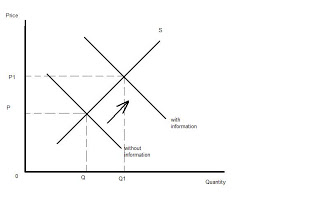
Screening is the less informed party’s effort, usually the buyer, to learn the information that the more informed party has. Successful screens have the characteristic that it is unprofitable for bad types of sellers to mimic the behaviour of good types.
Signalling is an informed party’s effort, usually the seller, to communicate information to the less informed party.
The main issue with quacks in the labour market is whether there are a large cost of less than average quality service, and is there a sub-market who will buy less than average quality products in the presence of competing sellers competing on the basis of quality assurance. This demand for assurance creates opportunities for entrepreneurs to profit by providing assurance.
David Friedman wrote a paper about contract enforcement in cyberspace where the buyer and seller is in different countries so conventional mechanisms such as the courts are futile in cases where the quality of the good is not as promised or there is a failure to deliver at all:
Public enforcement of contracts between parties in different countries is more costly and uncertain than public enforcement within a single jurisdiction.
Furthermore, in a world where geographical lines are invisible, parties to publicly enforced contracts will frequently not know what law those contracts are likely to fall under. Hence public enforcement, while still possible for future online contracts, will be less workable than for the realspace contracts of the past.
A second and perhaps more serious problem may arise in the future as a result of technological developments that already exist and are now going into common use. These technologies, of which the most fundamental is public key encryption, make possible an online world where many people do business anonymously, with reputations attached to their cyberspace, not their realspace, identities
Online auction and sales sites address adverse selection with authentication and escrow services, insurance, and on-line reputations through the rating of sellers by buyers.
E-commerce is flourishing despite been supposedly plagued by adverse selection and weak contract enforcement against overseas venders.
In the labour market, screening and signalling take the form of probationary periods, promotion ladders, promotion tournaments, incentive pay and the back loading of pay in the form of pension investing and other prizes and bonds for good performance over a long period.
In the case of the labour force, there are good arguments that a major reason for investments in education is as a to signal quality, reliability, diligence as well as investment in a credential that is of no value the case of misconduct or incompetence. Lower quality workers will find it very difficult if not impossible to fake quality and reliability in this way – through investing in higher education.
In the case of teacher registration, for example, does a teacher registration system screen out any more low quality candidates for recruitment than do proper reference checks and a police check for a criminal record.
Mostly disciplinary investigations and deregistrations under the auspices of occupational regulation is for gross misconduct and criminal convictions rather than just shading of quality.
Much of personnel and organisational economics is about the screening and sorting of applicants, recruits and workers by quality and the assurance of performance.
Alert entrepreneurs have every incentive to find more profitable ways to manage the quality of their workforce and sort their recruitment pools.
Baron and Kreps (1999) developed the recruitment taxonomy made up of stars, guardians and foot-soldiers.
Stars hold jobs with limited downside risk but high performance is very good for the firm – the costs of hiring errors for stars such as an R&D worker are small: mostly their salary. Foot-soldiers are employees with narrow ranges of good and bad possible outcomes.
Guardians have jobs where bad performance can be a calamity but good job performance is only slightly better than an average performance.
Airline pilots and safety, compliance, finance and controller jobs are all examples of guardian jobs where risk is all downside. Bad performance of these jobs can bring the company down. Dual control is common in guardian jobs.
The employer’s focus when recruiting and supervising guardians is low job performance and not associating rewards and promotions with risky behaviours. Employers will closely screen applicants for guardian jobs, impose long apprenticeships and may limit recruiting to port-of-entry jobs.
The private sector has ample experience in handling risk in recruitment for guardian jobs. Firms and entrepreneurs are subject to a hard budget constraints that apply immediately if they hire quacks and duds.
Blackboard economics says that governments may be able to improve on market performance but as Coase warned that actually implement regulatory changes in real life is another matter:
The policy under consideration is one which is implemented on the blackboard.
All the information needed is assumed to be available and the teacher plays all the parts. He fixes prices, imposes taxes, and distributes subsidies (on the blackboard) to promote the general welfare.
But there is no counterpart to the teacher within the real economic system
Occupational regulation comes with the real risk of the regulation turning into an anti-competitive barrier to entry as Milton Friedman (1962) warned:
The most obvious social cost is that any one of these measures, whether it be registration, certification, or licensure, almost inevitably becomes a tool in the hands of a special producer group to obtain a monopoly position at the expense of the rest of the public.
There is no way to avoid this result. One can devise one or another set of procedural controls designed to avert this outcome, but none is likely to overcome the problem that arises out of the greater concentration of producer than of consumer interest.
The people who are most concerned with any such arrangement, who will press most for its enforcement and be most concerned with its administration, will be the people in the particular occupation or trade involved.
They will inevitably press for the extension of registration to certification and of certification to licensure. Once licensure is attained, the people who might develop an interest in undermining the regulations are kept from exerting their influence. They don’t get a license, must therefore go into other occupations, and will lose interest.
The result is invariably control over entry by members of the occupation itself and hence the establishment of a monopoly position.
Friedman’s PhD was published in 1945 as Income from Independent Professional Practice. With co-author Simon Kuznets, he argued that licensing procedures limited entry into the medical profession allowing doctors to charge higher fees than if competition were more open.
Data Source: Martin Jenkins 2012, Review of Occupational Regulation, released by the Ministry of Business, Innovation and Employment under the Official Information Act.


Recent Comments