Dr. Israel M. Kirzner — “Economics and Entrepreneurship”
19 Aug 2026 Leave a comment
in applied price theory, Austrian economics, economic history, economics of regulation, entrepreneurship, history of economic thought, industrial organisation, law and economics, Public Choice, regulation, rentseeking Tags: competition law
The Cost of Going to Space
18 Aug 2026 Leave a comment
in applied price theory, econometerics, economic history, entrepreneurship, industrial organisation Tags: space
Terzi & Nicoli have a fascinating new paper analyzing over 4,400 orbital launches since 1960 to estimate “Wright’s Law.” This law states that a new technology’s unit costs fall in proportion to cumulative experience. Essentially, it is an expression of learning-by-doing. They show:… that the average cost of sending a kilogram to orbit has dropped…
The Cost of Going to Space
Alex Tabarrok: Britain’s equal pay madness
16 Aug 2026 Leave a comment
in applied price theory, Austrian economics, discrimination, economics of education, gender, health and safety, human capital, industrial organisation, labour economics, labour supply, occupational choice, poverty and inequality Tags: affirmative action, gender wage gap, pay equity, sex discrimination
Incentive Misalignment in Communism: the case of Vietnam
15 Aug 2026 1 Comment
in applied price theory, development economics, economic history, growth disasters, history of economic thought, industrial organisation, labour economics, labour supply, Marxist economics Tags: economics of central planning, Vietnam
Rainer Zitelmann writes in How Capitalism Beat Communism in Vietnam in Reason Magazine, The state collectives did not reward members for the amount of rice they produced, but instead counted how many days they had worked. 183 more words
Incentive Misalignment in Communism: the case of Vietnam
The Crime of Winning: How Europe’s DMA Punishes Google for Competing
09 Aug 2026 Leave a comment
in applied price theory, economics of regulation, entrepreneurship, industrial organisation Tags: competition law

Brussels has found a new way to punish success. Today, the European Commission fined Google €890 million under the Digital Markets Act (DMA) for two familiar business practices—featuring its own products and charging for customers its platform helps attract. The Commission imposed €460 million for “self-preferencing,” or giving Google’s services prominent placement in search results,…
The Crime of Winning: How Europe’s DMA Punishes Google for Competing
A Pac-Man Defense Against Predatory Pricing?
08 Aug 2026 Leave a comment
in applied price theory, economic history, history of economic thought, industrial organisation Tags: competition law
After the story of how Southwest Airlines broke an attempt at predatory pricing with booze, I learned of the Dow vs. Die Deutsche Bromkonvention episode. See here for an interesting narrative of events. To summarize, at the turn of the twentieth century, the German chemical industry was dominant and the various producers there had a comfortable cartel selling bromine…
A Pac-Man Defense Against Predatory Pricing?
Farmers can’t avoid high synthetic nitrogen fertiliser prices by switching to organic fertiliser
04 Aug 2026 Leave a comment
in applied price theory, energy economics, industrial organisation
The New Zealand Herald reported yesterday:New Zealand farmers face hefty increases in the price of fertiliser this spring as a result of the escalating US-Iran conflict and the war in Ukraine.The Middle East plays a big role in the global fertiliser market because of its supply of natural gas and mineral resources.Russia is also a…
Farmers can’t avoid high synthetic nitrogen fertiliser prices by switching to organic fertiliser
‘Market Power in Antitrust: Economic Analysis after Kodak,’ by Benjamin Klein
01 Aug 2026 Leave a comment
in applied price theory, economics of regulation, entrepreneurship, industrial organisation Tags: competition law
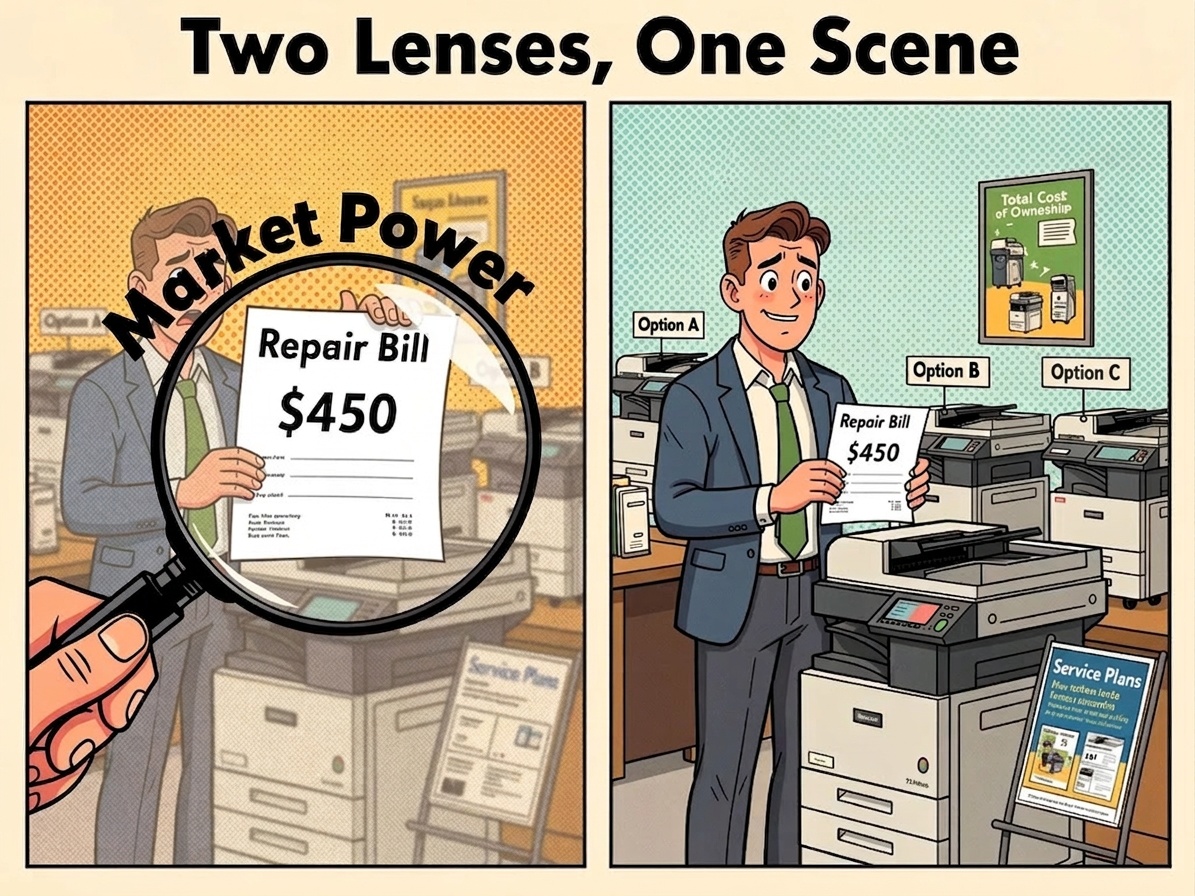
In 1992, the U.S. Supreme Court held in Eastman Kodak Co. v. Image Technical Services that a firm without market power in photocopiers might still possess market power in photocopier parts and service. The Court’s logic turned on opportunistic hold-up: Kodak could profit by trading short-run exploitation of locked-in customers for long-run losses in equipment…
‘Market Power in Antitrust: Economic Analysis after Kodak,’ by Benjamin Klein
The economic effects of GLP-1s
30 Jul 2026 Leave a comment
in applied price theory, entrepreneurship, industrial organisation, labour economics, labour supply, survivor principle
We estimate the causal impacts of GLP-1 treatment on labor market outcomes using linked Danish administrative data and a matched stacked difference-in-differences design. We compare patients who initiate GLP-1 treatment during the first two years of Semaglutide availability to observably similar patients who initiate four years later. We find that GLP-1 treatment reduces long-term sickness…
The economic effects of GLP-1s
The Predictable Folly of Government Grocery Stores
30 Jul 2026 1 Comment
in income redistribution, industrial organisation, politics - USA, Public Choice, survivor principle
I don’t like government running post offices, retirement systems, or air traffic control, so you won’t be surprised to learn that today’s column explains why it’s a dumb idea to have government grocery stores. We’ll start with this video from the Foundation for Economic Education. My knee-jerk instinct on this issue is to go to […]
The Predictable Folly of Government Grocery Stores
Some Links
17 Jul 2026 Leave a comment
in applied price theory, Austrian economics, entrepreneurship, history of economic thought, industrial organisation
TweetMarian Tupy disabuses American socialists of their economically ignorant belief that successful entrepreneurs steal their wealth from workers and consumers. Two slices: Early economists, such as James Mill and David Ricardo, theorized that the physical labor exerted to create a good is the real measure of its value. Karl Marx took the concept to its…
Some Links
The Great Enrichment continues
17 Jul 2026 Leave a comment
in economic history, entrepreneurship, industrial organisation Tags: creative destruction, The Great Enrichment

Does Costco Follow The Efficiency Wage Theory?
13 Jul 2026 1 Comment
in applied price theory, entrepreneurship, industrial organisation, labour economics, labour supply, managerial economics, organisational economics, personnel economics
See He Earns $33 an Hour as a Costco Cashier, Now He’s a Millionaire: Long-tenured workers like cashier Tony Barzar are reliable, experienced and able to speed shoppers through a checkout line-Costco is willing to pay to keep them around by Sarah Nassauer of The WSJ. I explain The Efficiency Wage Theory below after article excerpts:”Costco has…
Does Costco Follow The Efficiency Wage Theory?
The Troubled History of Government Equity in Technology
07 Jul 2026 1 Comment
in applied price theory, economic history, economics of regulation, entrepreneurship, industrial organisation, privatisation, Public Choice, rentseeking, survivor principle Tags: creative destruction, Germany
Even though Germany privatized Deutsche Telekom in 1996, the federal government retained a substantial ownership stake. This partial state ownership status, which remains to this day, presents a textbook example of how this type of arrangement distorts incentives and delays the competitive dynamism necessary for technological progress. Through the late 1990s and into the 2000s, Deutsche Telekom…
The Troubled History of Government Equity in Technology


Recent Comments