Econ Duel: Will Machines Take Our Jobs?
02 Nov 2016 Leave a comment
in applied price theory, economic history, entrepreneurship, industrial organisation, survivor principle Tags: creative destruction
A good summary of competition law
26 Oct 2016 Leave a comment
in industrial organisation, law and economics, survivor principle Tags: cartels, competition law, monopoly pricing, predatory pricing

Source: CONVERSABLE ECONOMIST: When Antitrust Runs Amok: Bulletin Board Material via Anti-Dismal: When antitrust runs amok: bulletin board material
ALL Obsolete Industries Deserve The Taxi Bailout!
25 Oct 2016 Leave a comment
in economic history, industrial organisation, survivor principle Tags: creative destruction
South Korea and Industrial Policy
23 Oct 2016 Leave a comment
in applied price theory, development economics, economic history, economics of bureaucracy, entrepreneurship, growth miracles, industrial organisation, Public Choice, rentseeking, survivor principle Tags: industry policy. South Korea, picking winners

The rise of a working rich in Australia
12 Oct 2016 Leave a comment
in economic history, human capital, industrial organisation, labour economics, labour supply, politics - Australia, poverty and inequality, survivor principle Tags: superstar wages, superstars, top 1%, top incomes
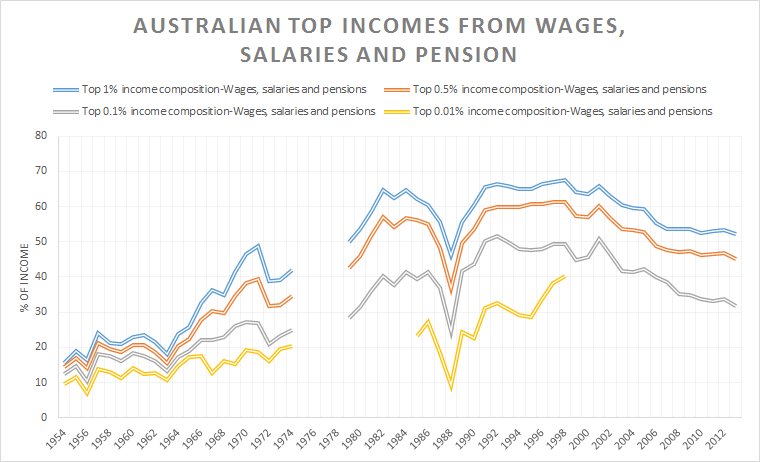
Source: The World Wealth and Income Database.
26th anniversary of Julian Simon @PaulREhrlich bet @GreenpeaceNZ @GreenpeaceUSA
11 Oct 2016 Leave a comment
in applied price theory, economic history, energy economics, entrepreneurship, industrial organisation, resource economics, survivor principle Tags: commodity prices, doomsday prophecies, endogenous growth theory, entrepreneurial alertness, Julian Simon, Paul Ehrlich
A 2011 blog post of mine on "the bet" rogerpielkejr.blogspot.com/2011/10/cornuc…
Attached a bigger bin of commodities & bet dates in red http://t.co/SC6HeuRwys—
Roger Pielke Jr. (@RogerPielkeJr) April 29, 2015
Lazy Australian top 0.1% only increased their income under @AustralianLabour
09 Oct 2016 Leave a comment
in economic history, industrial organisation, politics - Australia, poverty and inequality, survivor principle Tags: antimarket bias, entrepreneurial alertness, superstar wages, superstars, top 1%, top incomes
Australia’s top income earners are a lazy lot. The top 0.1% only ever had a rising income share under a Labor government in the 1980s. Even the top 1% had a pretty lean time until the 1990s.

Source: The World Wealth and Income Database.
When did creative destruction in newspapers begin?
27 Sep 2016 Leave a comment
in economic history, industrial organisation, survivor principle
#Uber and creative destruction in The Knowledge
21 Sep 2016 Leave a comment
in economics of regulation, entrepreneurship, industrial organisation, survivor principle Tags: creative destruction, entrepreneurial alertness, taxi regulation, Uber
I used Uber for the first time over the weekend. My car was towed away and a friend had the app on his phone. We used it to go to the tow away yard to pay the $275 release fee.
One of the things I noticed was the the driver could immediately use his GPS because it was pre-programmed by the booking.
When you book a regular cab, they do not know where you are going until they arrive. This is to stop drivers avoiding picking up short trips. It also means that they must know where they are going rather than waste time programming the GPS. Prior to the GPS, they simply had to know where everything was.

The Knowledge, knowledge of London streets necessary to qualify for a black cab License is so difficult that neurologists study the brains of black cabdrivers to see how they are different from others in memory capacity.
Uber destroyed the Knowledge in a wave of creative destruction by linking the app booking request to GPSs. No diver needs to know where anything because the destination and pickup points are both pre-programmed into their GPS.
How expensive are charter schools?
09 Sep 2016 Leave a comment
in economics of bureaucracy, economics of education, industrial organisation, Public Choice, rentseeking, survivor principle Tags: charter schools, expressive voting, New Zealand Greens, New Zealand Labour Party, rational rationality, teachers unions

Creative destruction in print media revenue and employment
26 Aug 2016 Leave a comment
in economic history, economics of media and culture, industrial organisation, survivor principle

.@NZGreens do not understand business: minimum wage for contractors version
25 Aug 2016 Leave a comment
in applied price theory, applied welfare economics, economics of regulation, industrial organisation, labour economics, politics - New Zealand, poverty and inequality, survivor principle Tags: expressive voting, market process, New Zealand Greens, price signals, rational irrationality, The meaning of competition
The Greens are most upset that a Labour party private members bill to specify a minimum wage for contractors was voted down by one vote in parliament yesterday.
If you earn than the minimum wage as a contractor, that is a signal wrapped in an incentive. Your poor hourly earnings is a signal to you that maybe you should get out of that contracting business and go back to being an employee where you will be paid at least the minimum wage.
Many small businesses make no profits at all in the first year or so as they build the business. The founders of the business get by on savings, which they anticipated when they drew up their business plan. No one expects a business to make an immediate profit or always be profitable.
Contractors are entrepreneurs chancing their arm. They need crisp signals about whether they are succeeding, failing or could succeed if they try harder or do something different. A minimum wage for contractors masks those important market signals of success and failure.
If your dream of owning your own business is not even paying the minimum wage, maybe it is time to get out of the contracting business.
Creative destruction in print media
22 Aug 2016 Leave a comment
in economics of media and culture, industrial organisation, survivor principle Tags: creative destruction, legacy media

Anti-competitive mergers make little sense to me
04 Aug 2016 Leave a comment
in applied price theory, industrial organisation, survivor principle Tags: competition and monopoly, competition law, mergers and takeovers
There are two main arguments against mergers and acquisitions. The first of these is that they are paper shuffling with little in the way of cost advantages. The second is they allow the combined firm to raise its prices because it faces less competition.
I find these arguments to be in direct contradiction. Anti-competitive mergers must be high risk venture if there is little in the way of cost savings. Two previously efficient firm sizes are disturbed permanently in the hope of some ability to raise prices in the future without provoking too much new entry or expansion from the competitive fringe.
It is far better just to keep on colluding or just compete rather than risk permanently damaging the efficient operation of both firms.
 Utopia, you are standing in it!

Recent Comments