I heard a story some years back about a court case that involved following a blizzard of cross-border financial payments. Apparently, even the lawyers were having a hard time tracking, and the jury was completely at sea. But the lawyers and the judge all knew that only one thing actually mattered in the trial. Would…
Last year, as part of a series on the additional reforms Milei needs to enact in Argentina, I shared this video on reducing protectionism. Since the video was only one-minute long, there was no chance to provide details. But at the conference in Buenos Aires this week, Professor Jorge Streb shared some fascinating details on […]
By ChatGPT-5.2 If Iran’s oil exports alone stopped, the world would feel it, but it would probably be a serious price shock rather than an immediate global supply collapse. Iran has recently been exporting roughly 1.1–1.5 million barrels a day, close to its 2025 average of about 1.69 million barrels a day, with China buying more than 80% of those shipped […]
See Why the Oil Shock Probably Won’t Derail the Economy. And One Way It Might: The U.S. is a net petroleum exporter and productivity is improving, but the bigger risk is stubborn inflation by Greg Ip of The WSJ. Stagflation combines the words stagnation and inflation. If oil prices rise, supply shifts to the left because the…
The Telegraph has written a guide for vapers travelling to parts of the world that are even more hostile to e-cigarettes. I am quoted in it. Christopher Snowdon, head of lifestyle economics at the Institute of Economic Affairs and editor of the Nanny State Index, which ranks countries by how much they interfere with people’s lifestyle…
We study the macroeconomic effects of tariff policy using U.S. historical data from 1840–2024. We construct a narrative series of plausibly exogenous tariff changes – based on major legislative actions, multilateral negotiations, and temporary surcharges – and use it as an instrument to identify a structural tariff shock. Tariff increases are contractionary: imports fall sharply,…
In Part I and Part II of this series, we looked at research showing that Americans are bearing the burden of Trump’s trade taxes. Those findings are a useful antidote to Trump’s silly and illiterate claim that foreign companies are swallowing the added cost. In both of those columns, however, I pointed out that I’m […]
The recent Supreme Court decision that President Trump did not have arbitrary and unbounded powers he has claimed to impose or retrace tariffs came as no surprise, for a variety reasons laid out in earlier posts here, here, and here. But here I want to focus on a different claim: that the reason for tariffs…
In Part I of this series, we reviewed some new research from the New York Federal Reserve. That study showed that Americans bear about 90 percent of the burden of Trump’s Liberation Day trade taxes. Though I added my own two cents because I don’t actually care that much about who bears the burden of […]
New Zealand was the first Western developed country to sign a free trade agreement with China, and it came into force in 2008. At the time, the New Zealand government estimated an increase in exports to China of between NZ$225 million and NZ$350 million (between US$180 million and US$280 million), and Ministry of Foreign Affairs…
One of the predictions made by economists when President Trump announce the start of his freewheeling tariff policies in April 2025 was that the costs of the tariffs would ultimately be passed through to consumers, leading to overall higher inflation. Well, President Trump has been tossing out tariff threats, keeping some and withdrawing others. However,…
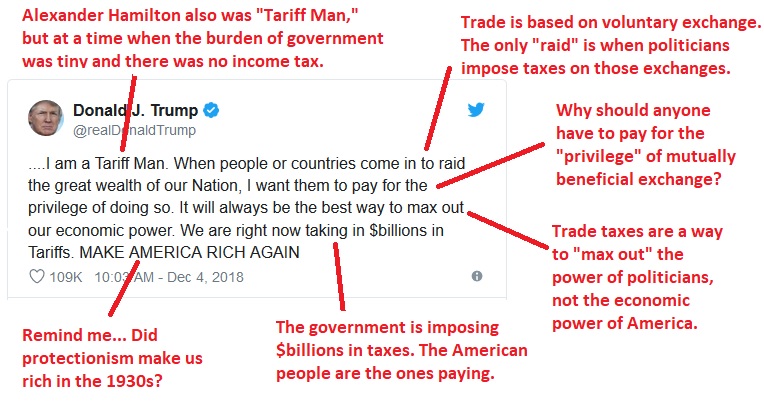
Donald Trump, who describes himself as “Tariff Man,” recently wrote a column in defense of his protectionist trade policy for the Wall Street Journal. After reading the column, my first thought was that Trump was trying to show he is more economically illiterate than Joe Biden (a big challenge, as seen here and here). And […]
TweetPhil Magness’s new essay on the origins of the vague and derogatory term “neoliberalism” is superb. A slice: While most versions of the neoliberal label still come from the academic left today, the term has come back into favor within a certain, curious strand of the right. Conservative writers such as Patrick Deneen, Adrian Vermeule,…
That is the topic of my latest Free Press column, here is one excerpt: What else are currency values telling us today? The Japanese yen continues a very weak run, now coming in at about 158 to the U.S. dollar. I can recall when it was common for the yen to stand at about 100…
Why Evolution is True is a blog written by Jerry Coyne, centered on evolution and biology but also dealing with diverse topics like politics, culture, and cats.
“We do not believe any group of men adequate enough or wise enough to operate without scrutiny or without criticism. We know that the only way to avoid error is to detect it, that the only way to detect it is to be free to inquire. We know that in secrecy error undetected will flourish and subvert”. - J Robert Oppenheimer.




 Utopia, you are standing in it!
Recent Comments