I don’t often claim to be ahead of the curve, but I’m going to pat myself on the back in today’s column about Swedish economic policy. More than 16 years ago, I started writing about Sweden’s shift from statism to markets. More than 14 years ago, I praised Swedish policy makers for significantly reducing the […]
TweetHere’s a letter to a new correspondent. Mr. H__: Thanks for your email. You write, in response to this post of mine, that I am “too quick at second guessing the president and his administration on its determination of the trade behaviors of other countries.” You say that I “owe the administration the benefit of…
A Constitutional Trojan Horse: advancing change through political stealth Trade Minister Hon Todd McClay has announced that the New Zealand-India free trade agreement has been signed and that the formal parliamentary treaty scrutiny process is now under way. The full text of the agreement is now public and has been referred to Parliament’s Foreign Affairs, Defence and Trade Committee […]
TweetThis post by Oxford economist J. Zachary Mazlish is very good; I encourage you to read it. (HT David Levey) Nevertheless, there are two points that I think to be worth making in response to Mazlish’s post. I will here make one of these points. I’ll make the other of these points in a follow-up…
Tweet… is from this recent post at Marginal Revolution by my colleague Alex Tabarrok: The trade accounts are among the most pernicious statistics ever collected. The post Bonus Quotation of the Day… appeared first on Cafe Hayek.
TweetOn page 13 of their 2017 brief in support of “green industrial policy,” Tilman Altenburg and Dani Rodrik write: However, it should be noted that consumers do not respond perfectly to price signals. Even when new products exist that are better in many ways and cheaper, many consumers stick to the bad old alternatives because…
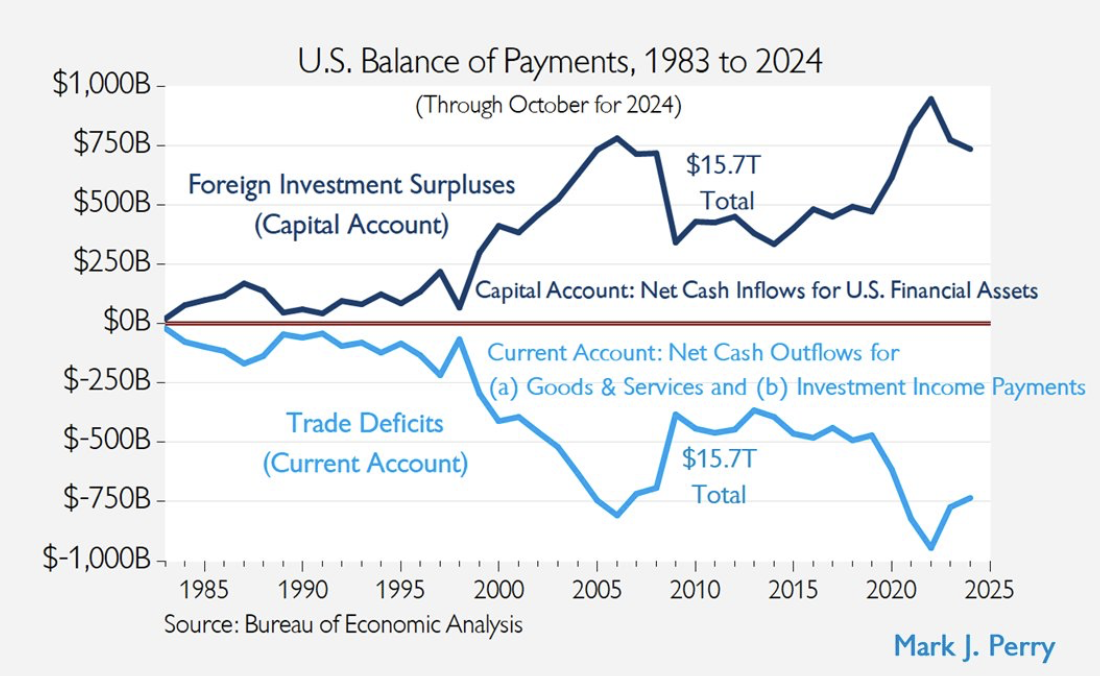
The trade accounts are among the most pernicious statistics ever collected. It’s long been remarked, for example, that merely by calling something a “deficit” it seems bad even though a current account deficit is matched by a financial account surplus. Put that issue aside, however, because the real problems are much deeper. The international accounts…
Tweet… is from page 150 of Columbia University economics professor Arvind Panagariya’s brilliant 2019 book, Free Trade and Prosperity: In India, Bihar is the poorest state and Kerala one of the richest. Going by the Gini coefficient, Bihar is among the states with the least inequality and Kerala among those with the highest inequality. If…
By Inti Pacheco of The WSJ. Excerpts:”Behind the jump: Extreme weather, including droughts in Brazil and Vietnam, had hit coffee crops. And even before any tariff increases, hedge-fund bets anticipating the levies were pushing commodity prices higher.” (droughts cause supply to shift to the left which raises price)”Then in July, President Trump slapped an additional 40%…
WSJ: “Iran insiders are rumbling about the looming economic catastrophe if Washington does not grant sanctions relief that would unlock prospects for economic recovery,” said Burcu Ozcelik, senior research fellow with the London-based Royal United Services Institute think tank. “Without the prospect of economic recovery, regime survival beyond the short term will face sustained structural…
In our textbook, Modern Principles, Tyler and I emphasize that Congress and the President are subject to a higher law, the law of supply and demand. In an excellent column, Jason Furman gives a clear example of how difficult it is to fight the law of inelastic demand: …Today a given number of autoworkers can…
TweetIdeally, every government would implement a policy of unilateral free trade. But governments, of course, by their nature testify that reality is very far from ideal. Here’s a letter to a long-time correspondent. Mr. B__: Thanks for your email in response to this blog post of mine in which I express support for the World…
I heard a story some years back about a court case that involved following a blizzard of cross-border financial payments. Apparently, even the lawyers were having a hard time tracking, and the jury was completely at sea. But the lawyers and the judge all knew that only one thing actually mattered in the trial. Would…
Last year, as part of a series on the additional reforms Milei needs to enact in Argentina, I shared this video on reducing protectionism. Since the video was only one-minute long, there was no chance to provide details. But at the conference in Buenos Aires this week, Professor Jorge Streb shared some fascinating details on […]
Why Evolution is True is a blog written by Jerry Coyne, centered on evolution and biology but also dealing with diverse topics like politics, culture, and cats.
In Hume’s spirit, I will attempt to serve as an ambassador from my world of economics, and help in “finding topics of conversation fit for the entertainment of rational creatures.”




Recent Comments