On this day 1919, Britain elected its first ever female Member of Parliament. Nancy Astor. pic.twitter.com/ezg4738HWv
— Paul Kirby (@paul1kirby) November 28, 2015
Gender wage gaps and the role of unconscious bias
28 Nov 2015 9 Comments
in discrimination, entrepreneurship, gender, labour economics, occupational choice, politics - New Zealand, survivor principle Tags: compensating differentials, employer discrimination, entrepreneurial alertness, gender wage gap, market selection, The meaning of competition
Geoff Simmons’ Friday Whiteboard podcast last night on the 12% gender wage gap was a good summary of the proximate drivers such as occupational segregation and part-time work. I have a few quibbles with his stress on unconscious bias as the driver of the gender wage gap.
The first of these quibbles is the gender wage gap is tiny at the bottom and even the middle of the labour market but is so high and so stable for so long at the top-end. Why does unconscious bias increase with the wages on offer? Better paid professional women have far more options to look around for the best paid job and turned down inferior officers.
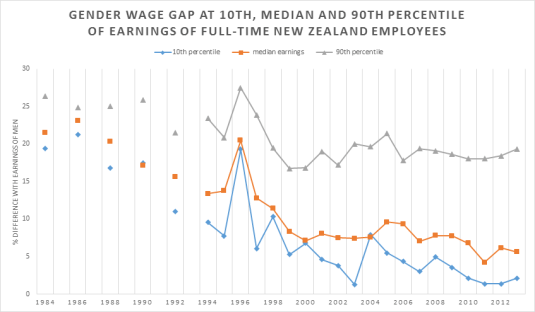
Source: OECD Employment Database.
My second quibble is the New Zealand gender wage gap is trivial for women under the age of 45 but suddenly there is a burst of unconscious bias until they retire. This is odd because mature age workers have had plenty of time to accumulate human capital, search around for the best job offer and will have a job and therefore can turn down inferior offers. These women are not new starters on the unemployment benefit desperate for employment.
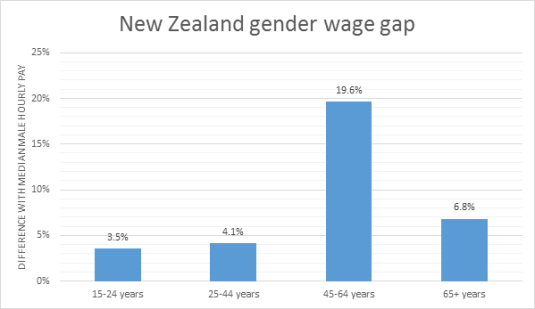
Source: New Zealand Income Survey 2014 via Human Rights Commission: Tracking Equality at Work.
My final quibble is the gender wage gap for part-time workers is reversed. No one takes this higher pay per hour as evidence that there is no unconscious bias against women who work part-time. If the gender pay gap was in the opposite direction, of course, that pay gap would be conclusive evidence of unconscious bias against women in part-time jobs. But as the gap is as it is in favour of women not against them, the usual adjustments for skills, age and experience become convenient truths.
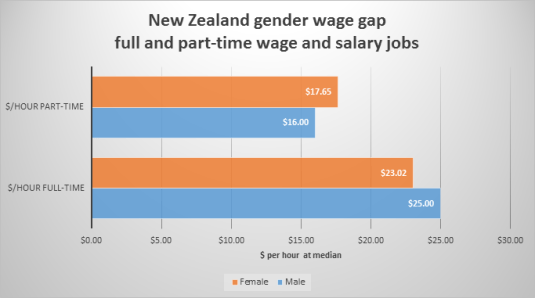
Source: Statistics New Zealand, New Zealand Income Survey, June quarter 2015.
Is what’s left of the unconscious bias hypothesis that we chauvinistic men, bastards all, have an unconscious bias against women who work full-time, who are over the age of 45 or earn a lot of money making us jealous?
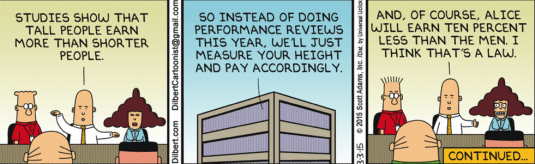
The unconscious bias hypothesis for the residual in the gender wage gap has come to the fore because earlier hypotheses of deliberate discrimination against women fell by the wayside as explanations for the gender wage gap.
Complicating things is the unconscious bias hypothesis must explain why the unconscious bias is so much stronger at the top end of the labour market against women who have plenty of options to fight back including found in their own companies to hire women underpaid elsewhere.
As is well known, sex and race discrimination by employers as a profit opportunity for other less prejudiced employers including unconsciously prejudiced employers to hire the undervalued workers.
The process whereby the market bids up the wages of women undervalued by unconsciously biased employers can be itself be thoroughly unconscious as Armen Alchian explained in 1950. Alchian pointed out the evolutionary struggle for survival in the face of market competition ensured that only the profit maximising firms survived:
- Realised profits, not maximum profits, are the marks of success and viability in any market. It does not matter through what process of reasoning or motivation that business success is achieved.
- Realised profit is the criterion by which the market process selects survivors.
- Positive profits accrue to those who are better than their competitors, even if the participants are ignorant, intelligent, skilful, etc. These lesser rivals will exhaust their retained earnings and fail to attract further investor support.
- As in a race, the prize goes to the relatively fastest ‘even if all the competitors loaf.’
- The firms which quickly imitate more successful firms increase their chances of survival. The firms that fail to adapt, or do so slowly, risk a greater likelihood of failure.
- The relatively fastest in this evolutionary process of learning, adaptation and imitation will, in fact, be the profit maximisers and market selection will lead to the survival only of these profit maximising firms.
These surviving firms may not know why they are successful, but they have survived and will keep surviving until overtaken by a better rival. All business needs to know is a practice is successful. The reason for its success is less important.
In the case of unconscious bias against women, those employers who are less unconsciously biased than the rest will grow at the expense of less enlightened albeit unconsciously less enlightened rivals. Undervaluing workers for any reason is a business opportunity. The market processes will reduce this undervaluation. All that is required is that some employers be less unconsciously biased than others.

One method of organising production will supplant another when it can supply at a lower price (Marshall 1920, Stigler 1958). Gary Becker (1962) argued that firms cannot survive for long in the market with inferior product and production methods regardless of what their motives are. They will not cover their costs.
The more efficient sized firms are the firm sizes that are currently expanding their market shares in the face of competition; the less efficient sized firms are those that are currently losing market share (Stigler 1958; Alchian 1950; Demsetz 1973, 1976). Business vitality and capacity for growth and innovation are only weakly related to cost conditions and often depends on many factors that are subtle and difficult to observe (Stigler 1958, 1987). In the case of unconsciously biased employers, they are less likely to survive.

What is even more peculiar is this unconscious bias exists at the end of the market where there is the greatest incentive to invest in ascertaining the quality of recruits if Edward Lazear’s pioneering work on the personnel economics of hiring standards is to believed:
Screening is more profitable when the stakes are higher: The purpose of screening is to avoid the unprofitable candidates. Therefore, the greater the downside risk from hiring the wrong person, the more value there is to screening. Similarly, the longer that a new candidate can be expected to stay with the employer, the more valuable will be the screen. Firms that intend to hire employees for the long term thus tend to invest more in careful screening before committing to a new hire.
The higher the wage of recruit, the more important they are to the success of the firm. That gives the entrepreneur more reasons to sort and screen from better quality recruits. The higher paid is the recruit, the greater the returns to the applicant from signalling their quality:
Signalling is helpful when employers do not have enough information about job applicants to assess their potential accurately enough. It is useful when differences in talent among potential employees matter a lot to productivity. When differences in talent do not make much difference to productivity, signalling will not be very useful.
These ideas suggest when we should expect to see employment practices consistent with signalling. First, signalling should be more important in jobs where skills are most important. Such jobs tend to be those that are at high levels of the hierarchy, in research and development, and in knowledge work. They also correspond well to professional service firms, such as consulting, accounting, law firms, and investment banks. In such professions, even small differences in talent can lead to large differences in effectiveness on the job, so sorting for talent is very important. For this reason, such firms tend to screen very carefully at recruiting, and usually have promotion systems that correspond well to our probation story above, at least in the first few years on the job.
The presence of more unconscious bias at the top of the labour market than at the middle and the bottom doesn’t have as many legs as suggested by Geoff Simmons in his Friday podcast. The higher is the wage, the greater is investment by both sides to the recruitment equation in an unbiased consideration of the job application. This runs against the notion that the gender gap at the top end of the labour market is due to unconscious bias.

A far better explanation is compensating differentials. Women at the top are trading off wages from work-life balance and more time with their children. They can do so because they are well-paid.
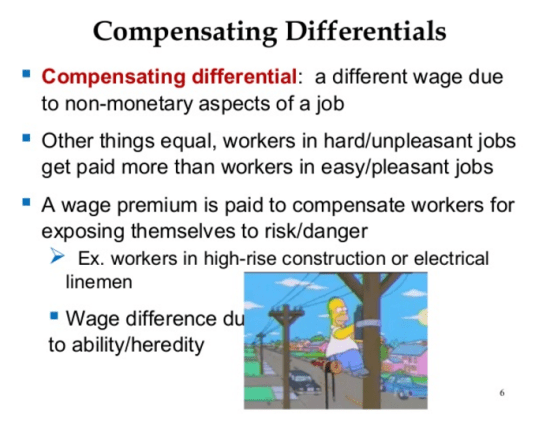
Whatever the hypothesis about compensating differentials is, that hypothesis has nothing to do with unconscious bias by employers. Alison Booth and Jan van Ours were almost annoyed to find that British women are actually quite satisfied with part-time work:
Women present a puzzle. Hours satisfaction and job satisfaction indicate that women prefer part-time jobs irrespective of whether these are small or large but their life satisfaction is virtually unaffected by hours of work.
I will close with a quote from Amy Wax on the impractical nature of doing anything about unconscious bias:
Demonstrating racial bias is no easy matter because there is often no straightforward way to detect discrimination of any kind, let alone discrimination that is hidden from those doing the deciding. As anyone who has ever tried a job-discrimination case knows, showing that an organization is systematically skewed against members of one group requires a benchmark for how each worker would be treated if race or sex never entered the equation. This in turn depends on defining the standards actually used to judge performance, a task that often requires meticulous data collection and abstruse statistical analysis.
Assuming everyone is biased makes the job easy: The problem of demonstrating actual discrimination goes away and claims of discrimination become irrefutable. Anything short of straight group representation — equal outcomes rather than equal opportunity — is “proof” that the process is unfair.
Advocates want to have it both ways. On the one hand, any steps taken against discrimination are by definition insufficient, because good intentions and traditional checks on workplace prejudice can never eliminate unconscious bias. On the other, researchers and “diversity experts” purport to know what’s needed and do not hesitate to recommend more expensive and strenuous measures to purge pervasive racism. There is no more evidence that such efforts dispel supposed unconscious racism than that such racism affects decisions in the first place.
White Brits are the ethnic group least likely to go to university
24 Nov 2015 Leave a comment
in discrimination, economics of education, human capital, labour economics Tags: British economy, College premium, graduate premium, tertiary attainment, university premium
@economicpolicy gathers more evidence of a waning gender pay gap @joshbivens_DC @eliselgould
22 Nov 2015 Leave a comment
in applied price theory, discrimination, economic history, gender, human capital, labour economics, labour supply, minimum wage, occupational choice, poverty and inequality Tags: asymmetric marriage premium, Claudia Goldin, compensating differentials, economics of fertility, gender wage gap, marriage and divorce, power couples
As part of a large paper calling for massive government intervention, the Economic Policy Institute, impeccably left-wing, massed a considerable amount of evidence about the withering away of the gender wage gap and anomalies in what is left of that gap. None of these anomalies bolster the case for more regulation of the labour market.
The first of their charts showed the large reduction in the gender wage gap in the USA. Women’s wages have been increasing consistently over the last 40 years or so. The second of their tweeted charts shows that women of all races consistently outperformed men in wages growth, often by a large margin.
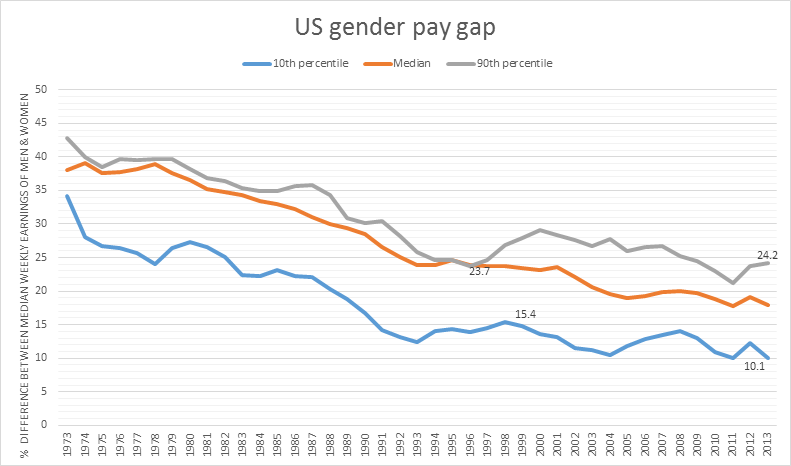
Their most interesting chart is about how the gender gap is not only highest among top earners, their pay gap has not fallen at all in the last 40 years. If anything, that gender wage gap is rising at the top end of the labour market albeit slowly. Progress in closing the gender gap been pretty consistent at the lower pay levels. That progress is certainly better than no progress at all.
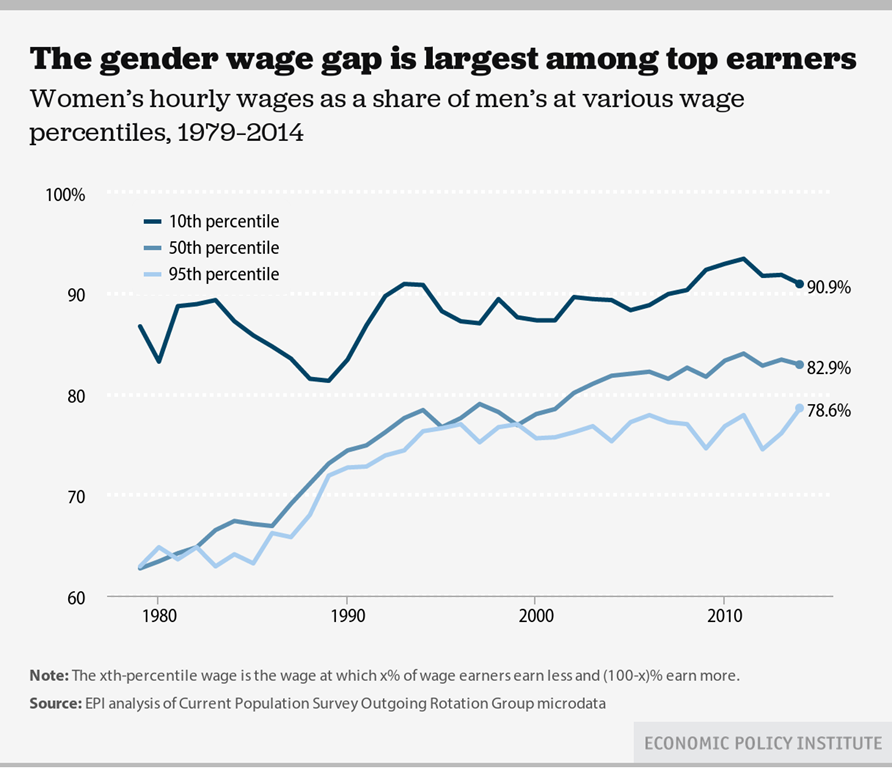
The Economic Policy Institute didn’t enquire in any detail into why women with the most options in the labour market had made the least progress in closing the gender wage gap.
None of their solutions such as more collective-bargaining and a higher minimum wage will help the top end of the job market.
There is an anomaly in the Economic Policy Institute’s reasoning. The women who would suffer least from a purported inequality of bargaining power inherent in the capitalist system and have plenty of human capital have had least success in closing the gender pay gap. These women can shop around for better job offers and start their own businesses. Many do because they are professionals where self-employment and professional partnerships are common.
The better discussions of the gender wage gap emphasise choice. Women choosing at the top end of the labour market to balance career and family and choosing the occupation and education where the net advantages of doing that are the greatest. As the Economic Policy Institute itself notes:
In 2014, the gap was smallest at the 10th percentile, where women earned 90.9 percent of men’s wages. The minimum wage is partially responsible for this greater equality among the lowest earners, as it results in greater wage uniformity at the bottom of the distribution.
The gap is highest at the top of the distribution, with 95th percentile women earning 78.6 percent as much as their male counterparts. Economist Claudia Goldin (2014) postulates that the gap is larger for women in high-wage professions because they are penalized for not working long, inflexible hours that often come with many professional jobs, due in large part to the arrival of children and long-standing social expectations about the division of household labour between men and women.
What the Economic Policy Institute does not explain is why these long-standing social expectations about the division of household labour should be strongest among well-paid women with plenty of options.
Among these options of high-powered women in well-paid jobs is the ability to buy every labour-saving appliance, hire a nanny and ample childcare and acquire everything else on the list of demands of the Economic Policy Institute on closing the gender pay gap. Something doesn’t add up?
Of course, the Economic Policy Institute discusses the unadjusted gender wage rather than the adjusted gender wage. When you study the gender wage gap after making adjustments for demographic and other obvious factors, it is clear that this pay gap is driven by the choices women make between career and family.
Claudia Goldin did a great study of Harvard MBAs using online surveys of their careers. This is the very group that according to the Economic Policy Institute have made the least progress in bringing down patriarchy in the labour market. Specifically, the overturning of traditional expectations about the marital division of labour in childcare and parenthood.
https://twitter.com/alyssalynn7/status/669219008747610113
Goldin found that three proximate factors accounted for the large and rising gender gap in earnings among MBA graduates as their careers unfold:
- differences in training prior to MBA graduation,
- differences in career interruptions, and
- differences in weekly hours.
The greater career discontinuity and shorter work hours for female MBAs are largely associated with motherhood. There are some careers that severely penalise any time at all out of the workforce or working less than punishingly long and rigid hours.
A 2014 Harvard Business School study found that 28 percent of recent female alumni took off more than six months to care for children; only 2 percent of men did.

Claudia Goldin found one counterfactual that cancels out the gender wage gap amongst MBA professionals: hubby earns less! Female MBAs who have a partner who earn less than them earn as much as the average MBA professional on an hourly basis but work a few less hours per week.
The gender wage gap is persisted in high-paying jobs because career women have so many options. Studies of top earning professionals show that they make quite deliberate choices between family and career. The better explanation of why so many women are in a particular occupation is job sorting: that particular job has flexible hours and the skills do not depreciate as fast for workers who take time off, working part-time or returning from time out of the workforce.
Low job turnover workers will be employed by firms that invest more in training and job specific human capital:
- Higher job turnover workers, such as women with children, will tend to move into jobs that have less investment in specialised human capital, and where their human capital depreciates at a slower pace.
- Women, including low paid women, select careers in jobs that match best in terms of work life balance and allows them to enter and leave the workforce with minimum penalty and loss of skills through depreciation and obsolescence.
This is the choice hypothesis of the gender wage gap. Women choose to educate for occupations where human capital depreciates at a slower pace.
The gender wage gap for professionals can be explained by the marriage market combined with assortative mating:
- Graduates are likely to marry each other and form power couples; and
- There tends to be an age gap between men and women in long-term relationships and marriages of two years.
This two-year age gap means that the husband has two additional years of work experience and career advancement. This is likely to translate into higher pay and more immediate promotional prospects.
An interesting and informed look at the pay gap between men and women economist.com/blogs/freeexch… https://t.co/0nxtC9ILWo—
Charles Read (@EconCharlesRead) November 06, 2015
Maximising household income would imply that the member of the household with a higher income, and greater immediate promotional prospects stay in the workforce. This is entirely consistent with the choice hypothesis and equalising differentials as the explanation for the gender wage gap. As Solomon Polachek explains:
At least in the past, getting married and having children meant one thing for men and another thing for women. Because women typically bear the brunt of child-rearing, married men with children work more over their lives than married women. This division of labour is exacerbated by the extent to which married women are, on average, younger and less educated than their husbands.
This pattern of earnings behaviour and human capital and career investment will persist until women start pairing off with men who are the same age or younger than them. That is, more women will have to start marrying down in both income and social maturity.

New Zealand gender wage gap for full-time workers and for part-time workers, 2015
10 Nov 2015 Leave a comment
in discrimination, gender, labour economics, labour supply, occupational choice, politics - New Zealand Tags: gender wage gap, part-time work, reversing gender gap
The unadjusted gender wage gap is regarded as a reliable measure of sex discrimination in these day, apparently, because the adjusted wage gap is too small to maintain the rage. In the data below, the gender wage gap is in favour of women. That is an unreliable unadjusted gender wage because many part-time male workers are teenagers. Many part-time female workers are professionals.
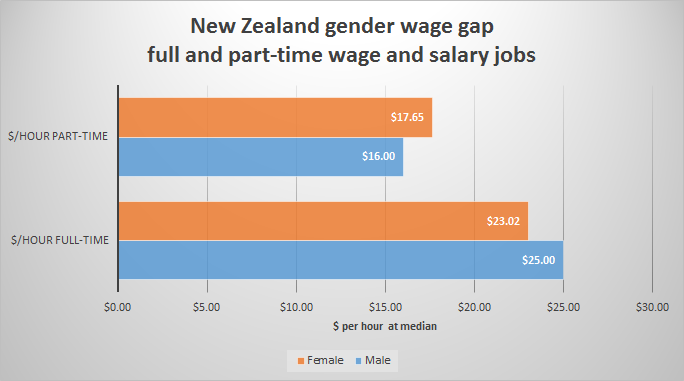
Source: Statistics New Zealand, New Zealand Income Survey, June quarter 2015
@NZGreens is the gender pay gap 6.6%, 11.8% or 14%?
10 Nov 2015 Leave a comment
in discrimination, gender, human capital, labour economics, occupational choice, politics - New Zealand Tags: compensating differentials, gender wage gap, Leftover Left, New Zealand Greens, Twitter left
Source: Statistics New Zealand: New Zealand Income Survey.
@greencatherine Unadjusted NZ gender pay gap is 6%, the best in world. http://t.co/2fYuVbJg9E—
Jim Rose (@JimRose69872629) March 19, 2015

Source: Gender pay gap | Ministry for Women.
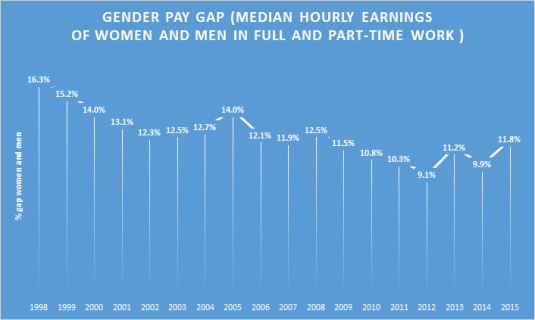
The unadjusted gender pay gap has been in a long-term decline for generations. The unadjusted gender wage gap in 2015 is 11.8% as shown in the above chart and in the second New Zealand Green’s Facebook link above but not first of their Facebook links above where it is claimed to be 14%.

To sex-up their numbers, the Labour Party and Greens used the gap between the average wages of men and women. This was rather than the median wage to make their gender wage gap comparisons despite the pious commitment of the Greens to use median wage in their gender wage gap calculations in the recent past.
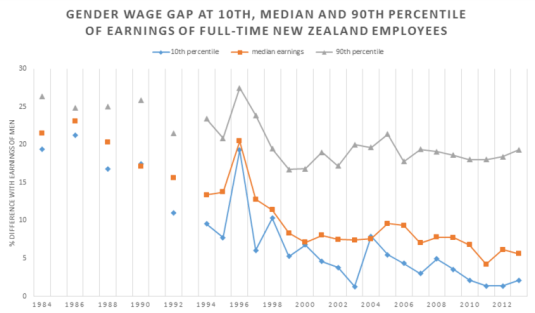
The unadjusted gender pay gap has all but disappeared at the bottom of the labour market as the chart below shows. The gender wage gap remains stubbornly high at the high end of the wage market at 20% because of compensating differentials. Professional women are balancing families and careers in choosing the occupations that best suits each individual woman.
Adjusted gender wage gap now trivial in USA
08 Nov 2015 Leave a comment
in discrimination, gender, labour economics Tags: gender wage gap
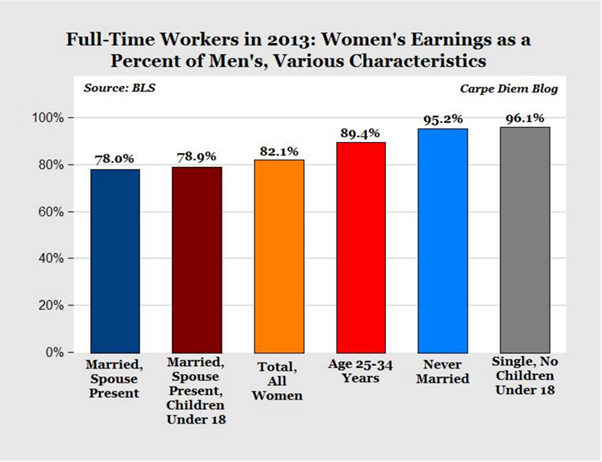
When the adjusted gender wage gap is less than 5% across all job titles, it rounds down to zero. It is not rational to expect statistical analysis to explain all 100% of the gender wage but it does for single people. The gender pay gap, what is left of it, is the cost of having children to careers.
Source: There really is no gender pay gap « Adam Smith Institute
Most of the gender pay gap explained by age, marriage, hours worked
05 Nov 2015 Leave a comment
in discrimination, economics of love and marriage, gender, human capital, labour economics, labour supply, occupational choice, politics - USA Tags: asymmetric marriage premium, compensating differentials, female labour force participation, gender wage gap, marital labour supply
HT: Lorenzo Michael Warby.
The demise of the Green Book and the decline of racism in America
04 Nov 2015 1 Comment
in applied price theory, constitutional political economy, discrimination, entrepreneurship, industrial organisation, liberalism, politics - USA, Public Choice, rentseeking
The Green Book was an indispensable survival guide to black Americans traveling in America in the Jim Crow Era if they wish to “sidestep humiliation (or worse) on the journeys”. As Richard Epstein noted when reflecting on the 50th anniversary of the 1964 Civil Rights Bill:
Title II was passed when memories were still fresh of the many indignities that had been inflicted on African American citizens on a routine basis. It took little imagination to understand that something was deeply wrong with a nation in which it was difficult, if not impossible, for African American citizens to secure food, transportation, and lodging when traveling from place to place in large sections of the country. In some instances, no such facilities were available, and in other cases they were only available on limited and unequal terms.
The Green Guide lists the types of businesses by name and address in the southern states that were known to welcome black patrons.

The Green Book spoke in code about how to avoid “embarrassing situations”. This was code for “the violence and discrimination inflicted by bigots”. The diffusion of the car into the black middle class was a godsend to escape racism.
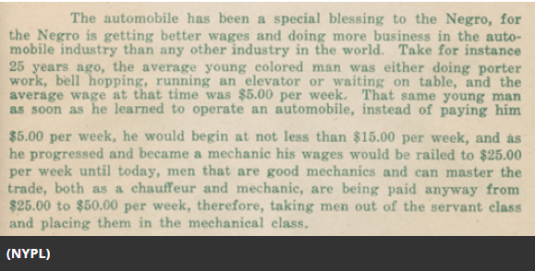
The founding publisher was a US postal worker who with typical entrepreneurial flair initially published the Green Book from his apartment in Virginia starting in the late 1930s. To find businesses that welcomed black patrons, Victor Green tapped into his network of fellow mailmen. His book covered the entire 50 states, parts of Canada and even extended to Europe in later editions.
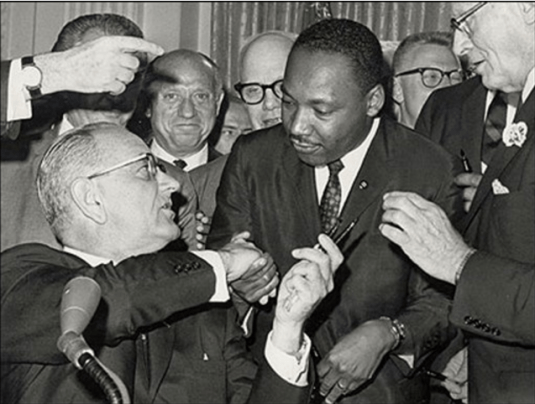
The Green Book stopped publishing a mere two years after the passage of a major civil rights bill in 1964 and the voting rights bill of 1965. These two bills strengthened voter rights and outlawed discrimination by businesses and employers.

By 1966, just two years after the passage of the civil rights bill, the market collapsed for information on businesses that welcomed black patrons in America. This was because so many businesses now welcome black patronage in every part of the southern states and elsewhere in America that a special booklet no longer had buyers. At the height of its popularity, the Green Book sold 15,000 copies per year.

Yes, there were law reforms but the closing of the Green Book is a sign of surprisingly rapid social change given the dogged resistance of the Democratic Party led southern states to all previous attempts at racial integration.
As an example of this tenacious resistance to civil rights legislation, Texas divided itself into 252 counties and delegated considerable responsibility to them. Local sheriffs in southern states would campaign on slogans such as “the man who can take care of situations that may arise”.
Control of the police and local courts was central to the enforcement of racial segregation in the southern states of America. This was backed up by the monopoly that the Democratic Party had over local and state offices.
To register to vote in Texas, for example, a black voter had to register with the local voter registration board in one of the 252 counties. Assuming you could find a member – they came in late, took long lunches and went home early – they would fail the applicant on the literacy test or some other criteria.
Can you pass a literacy test given to Black voters in the 1960's http://t.co/mtOIr7XE50—
History In Pictures (@historyepics) August 28, 2015
The aggrieved black would be voter would then have to take is local voter registration board all the way to the Supreme Court to overturn that decision. The members of the local voter registration board would refuse to follow the orders of the US District Court orders. The criminal contempt citation would be appealed all the way to the Supreme Court.
Once the criminal contempt citation is upheld by the Supreme Court, the voter registration board resigned so the litigation would have to start all over again against the new board members. This was because the state of Texas could not be named as a co-defendant under the 1957 civil rights law – the first past 100 years by Congress.
Such was the hostile legal environment, the lawlessness, the FBI had an eight part go to strategy in case a local sheriff arrested FBI agents in southern states when they are enforcing civil rights law. Black civil rights leaders in the USA were keen gun owners and owned a lot of them for home defence and they used them.
Plenty of school busing orders by courts were appealed for years and years and were resisted at every turn in both northern and southern states. One or two states closed their entire school systems and threatened to transfer the assets to private hands to prevent racial integration.
James Heckman was one of the first economist to note the rapid social change in the southern states of America over the course of the 60s. Heckman spent two years as a teenager in the late 1950s in racist Southern States of America and returned in 1963 and in 1970. His parents were received a delegation of neighbours upon their arrival to explain Southern ways.
Civil disobedience at its best, 1950s http://t.co/WzszCj1zBf—
Historical Pics (@VeryOldPics) September 20, 2015
There was organised segregation in 1963 when Heckman visited again as a college student. His 1963 visit with a college roommate from Nigeria was monitored by the local sheriff. In Birmingham, they stayed at the black YMCA. The people at the YMCA were frightened to death because Heckman and his Nigerian friend were breaking the local Jim Crow laws. Shops closed in New Orleans to avoid serving them.
In 1970, Heckman re-visited New Orleans as an academic, going back to the same places as in 1963. They were completely integrated, totally changed. This rapid social change fascinated him.
The Civil Rights Act of 1964 broke the control of segregationists over their political and legal institutions. The racial segregation collapsed because it could no longer rely on Jim Crow laws and the private violence and boycotts through the White Citizens Councils which police turned a blind eye too when they were not actively involved.
Unlike the Ku Klux Klan, the White Citizens’ Councils met openly and was seen as “pursuing the agenda of the Klan with the demeanour of the Rotary Club” by “unleashing a wave of economic reprisals against anyone, Black or white, seen as a threat to the status quo”. In Mississippi, the State Sovereignty Commission funded the Citizens’ Councils.

The 1957 and, particular, the 1964 civil rights laws overthrew racial segregation because more Black Americans could vote in the Southern States in state and local elections. Politicians soon courted those votes and there was a political realignment and a social revolution. The lawlessness that back-up most of segregation quickly came to an end because its victims could now vote. Richard Epstein explains:
With Jim Crow in the South this set of insidious practices was not accomplished by explicit laws mandating racial segregation. Rather, those inflexible social and economic patterns were supported by four interlocking strategies. First, illicit control of the electoral franchise, which in turn translated into control of the police and the courts. Second, corrupt use over the infrastructure translated into an ability to deny water and electrical hook-ups to firms that did not toe the segregationist line. Third, private violence to which southern police forces turned a blind eye when they did not actively support it. Fourth, social ostracism to those who spoke up against the system. Sensible people either left, stayed away or remained silent.
LBJ was behind the first civil rights bill of the 20th century. This was the 1957 civil rights bill. LBJ’s astute understanding of public choice processes was central to how he crafted the 1957 bill.
Then Senator Johnson could see that his fellow Southern Democrats would not live with racial integration at the social level. But he knew from his dealings with the Southern Democrats that in their heart of hearts that they could not ultimately deny that people have a right to vote. LBJ knew that if Black Americans in the Southern States could secure the right to vote, all the other rights they sought would soon follow and would be protected by law. He was right.
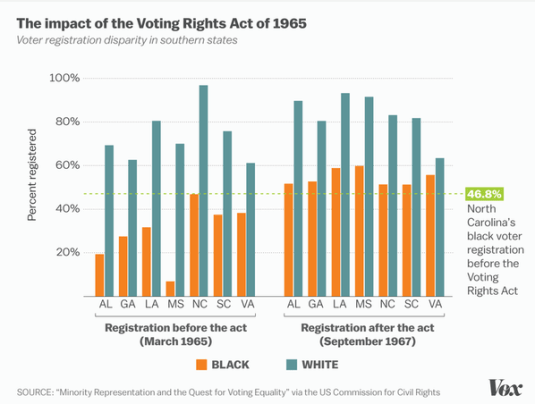
The Voting Right Act had a huge impact on many southern states. For example, black voter registration rates in Mississippi increased from a mere 6.7 percent in 1965 to 59.8 percent in 1967, according to the US Commission for Civil Rights. For a state that’s historically around 40 percent black, this represented a massive shift in politics — a change that much of the predominantly white leadership at the time feared but would have to accept due to the Voting Rights Act.
Timur Kuran in “Sparks and Prairie Fires: A Theory of Unanticipated Political Revolutions,” suggested that political revolutions and large shifts in political and social opinion will catch us by surprise again and again because of people’s readiness to conceal their true political preferences proclivities under perceived social pressure.
Kuran begins with a simple, even mundane point: social pressures can make people say that they want and believe something that they really don’t want or believe… The result of social pressures is to produce what Kuran calls “preference falsification,” a phenomenon that occurs when you make an inaccurate public statement about your actual preferences (or beliefs). Falsified preferences might be described more simply, of course, as lies; but they are a distinctive, and distinctly interesting, kind of lies, with particular social implications… People joined organizations they abhorred, followed orders they considered nonsensical, cheered speakers they despised and ostracized dissidents they greatly admired.
Those ready to oppose racism or who were lukewarm about it, kept their opposition private until a coincidence of factors gave them the courage to bring their views into the open. In switching sides, they encouraged other hidden opponents to switch. Fear changes sides. Genuine supporters of the old older falsify their publically professed preferences, pretending that they support the new order. These are late-switchers. Do not trust them. These opportunists will just as easily switch back.
Plenty of people have had personal experiences of this in the 1980s and the 1990s when there was rapid change in social and political attitudes about racism, sexism and gay rights. A few people had to stand up for what was right and a surprisingly large number quickly joined their side.
Once Blacks in the southern states started voting for the local sheriff and judges and for state-wide officials, the local legal infrastructure helped the market work rather than frustrated it. As Richard Epstein noted when writing a freedom of association but his remarks equally apply to the market process:
The practice of freedom of association cannot survive in a society that has corrupt electoral institutions, corrupt provision of public services, corrupt use of public force, and unrestrained use of private violence. The hard question in these settings is to ask exactly what legal changes should be made. In one sense, the thought that some non-discrimination principle could gain hold through legislation seems laughable. Indeed, it was only because federal legislation could work, with much huffing and puffing, to override state legislation that the local monopoly was broken… The competitive market works well when supported by well-ordered public institutions.
The rapid demise of the Green Book is a testament to the shallowness of racism in America apart from a hard-core full of hatred of whatever comes along. Certainly, the collapse in the market for a specialised information on businesses willing to accept black patch and suggests that many southern businesses opened their doors to black customers once it was physically safe to do so. The Civil Rights Bill of 1964 bought an end to lawlessness in the South principally because black people could now vote. Epstein again:
At its best, and in its original form, the Civil Rights Act of 1964 sought to break the control of the local segregationist forces over their political institutions. First on the list was Title I, which attacked exclusion from voting.
Is the living wage a form of indirect sex discrimination?
03 Nov 2015 Leave a comment
in applied price theory, discrimination, gender, labour economics, Marxist economics, minimum wage, politics - New Zealand Tags: expressive voting, living wage, offsetting behaviour, rational irrationality, The fatal conceit, unintended consequences
The living wage will certainly be to the profit of incumbent workers at the time of the wage increase but that is provided that their employer stays in business. The introduction of a living wage will result in indirect sex discrimination because of the higher job turnover rates of women. Women also have shorter average job tenures than men in any particular job.
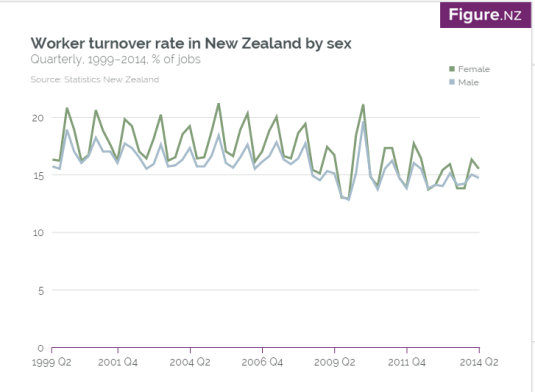
Source: Worker turnover rate in New Zealand by sex – Figure.NZ.
Any benefit premised on not quitting jobs discriminates against women because of their higher job quit rates. More women than men will have to quit living wage jobs because of motherhood and other changes in their personal circumstances. Isn’t that discrimination?
One in six workers change their jobs every year. That job turnover rate is higher among the workers with less human capital simply because both sides of the job match have less reasons to continue. A job quit or job layoff for a less skilled worker does not result as much of a loss of job specific and firm specific human capital than would be the case if the worker was more skilled with more firm-specific human capital.
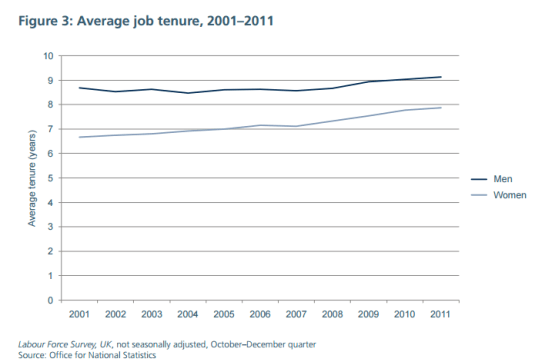
One of the iconic empirical facts of the labour market is job turnover rates are higher and job layoff rates are higher for less skilled workers. As workers acquire more job specific human capital, they are more reluctant to quit and their employer hesitate before laying them off. This is because of the firm specific human capital which both invested would have to be written off.
Women quit jobs more often than men, work part-time or switch between part-time and full-time work more often than men and enter and re-enter to the workforce because of motherhood and maternity leave. Women also tend to invest in more generalised, more mobile human capital. Women anticipate a more intermittent labour force participation and more spells of part-time work. As such, women have less reasons to invest in specific human capital if they anticipate leaving because of motherhood and either changing jobs more often are working part-time. If you are changing jobs more often, such as women do, investing in more general human capital and less in specific capital increases options when searching for vacancies.
Any benefit of the living wage will erode faster for women because they quit jobs at a higher rate than men. Is this indirect sex discrimination? This higher job turnover rate is driven by human capital investment strategies and career plans. The living wage, which privileges the incumbent workers at the time the living wage increases implemented, discriminates against female workers because they change jobs more often or are likely to quit sooner after the living wage was initially implemented.

The particular form of indirect sex discrimination at hand arises from the Golden Handcuffs effect of the living wage. Closer Together Whakatata Mai – reducing inequalities explain the Golden Handcuffs effect this way:
You may have noticed in the article it is actually the SAME people being paid the living wage (“all of them have stayed on as staff”). This is how labour markets can work if employers make different choices. If you look at the Living Wage employers – they haven’t hired a whole new set of people – they have invested in the people they already have. The world has not ended and many more people are happy and businesses and organisations are doing just fine.
Even the proponents of the living wage admit that a living wage increase will segment the labour market and create insiders and outsiders with the insiders paid more than what used to be called the reserve army in the unemployed by the same crowd of activists. A reduction in job turnover will increase unemployment durations because there are fewer vacancies posted every period.
Hopefully all the existing employees of the living wage employer are capable of the requisite up skilling they need to match their new productivity targets. Not everyone did well at school. One of the reasons workers on low wages are on those low wages because they perhaps didn’t do as well at school as activists who appointed themselves to speak for them. A harsh reality of life is 50% of the population have below-average IQs.
This up skilling answer to the cost to employers of a living wage increase is a variation of the standard policy response in a labour market crisis. That standard labour market policy response in crisis is send them on a course. Sending them on a course as a response to a crisis makes you look like you care and by the time they graduate the problem will probably have fixed itself. Most problems do. I found this bureaucratic response to labour market crises to repeat itself over and over again while working in the bureaucracy.
The reason was sending them on a course was so popular with geeks as yourself sitting at your desk as a policy analysis, minister or political activist all did well at university. You assume others will do well through further education and training including those who have neither the ability or aptitude to succeed in education. People don’t go on from high school to higher education for a range of reasons that include a lack of motivation to study or a simple lack of ability no matter how hard they try.

The living wage hypothesis about reduced turnover, up-skilling and greater motivation is a small example of the American company that decided to pay a minimum wage of $70,000 a year. Those workers who cannot earn as much of this elsewhere would never quit. Some of his better employers quit because they resented being paid the same as less productive employees. Hopefully, the minority shareholder suing his brother who is the CEO for offering that above market wage doesn’t end up bankrupting the company. As such, the incumbent workers’ fortunes are unusually closely tied to their existing employer if they are paying above the going rate in their industry and occupation.
I suppose you could hold on like grim death but women tend to have more reasons to move on than men if only because of pregnancy and motherhood. These golden handcuffs are of less value to them than to men. Younger workers are also less advantaged because many young New Zealanders take a overseas working holiday of several years, if not more. If they have a living wage job now that have to give up that advantage.
Workers who lack the labour productivity to earn a wage equivalent of the living wage elsewhere will never quit a living wage job, and will have a much reduced incentive to up-skill or seek promotion. There will be less internal reward for undertaking additional training or job responsibilities among low skilled is because the living wage will mean they will not get a wage rise. That wage rise is gobbled up by the living wage increase if you’re already a low-paid worker.
Naturally, as vacancies arise, recruits will be drawn from a much higher quality recruitment attracted by the higher wage at the living wage employer. The less skilled workers who don’t currently work for the living wage employer will miss out completely.
@EconomicPolicy showed gender pay equality when arguing the opposite @CHSommers @Mark_J_Perry
02 Nov 2015 2 Comments
in applied price theory, applied welfare economics, discrimination, gender, human capital, labour economics, labour supply, occupational choice, politics - USA Tags: asymmetric marriage premium, compensating differentials, gender wage gap, marital division of labour, power couples, top 1%, top incomes, Twitter left, union power, union wage premium
The Economic Policy Institute were good enough to dig out unit record data on the unadjusted US gender wage gap by percentiles. In attempting to show there was a persistent gender pay gap, the impeccably left-wing Economic Policy Institute showed that the unadjusted gender pay gap has all but disappeared in the USA.
There is next to no gender wage gap even in unadjusted terms towards the bottom of the labour market. This is despite all the protestations of the Left of an inherent inequality of bargaining power between the bosses and workers.
The low paid are supposed to be powerless unless unionised. Declining unionisation is a leading explanation on the Left of the rising income shares of the top 10%, top 1% in the top 0.1%.

If that inherent inequality of bargaining power trundled out at every opportunity by the Twitter Left explains anything in the labour market, this inequality of bargaining power should be operating with greatest strength at the bottom of the labour market.
Clearly the inherent inequality of bargaining power between the bosses and workers is not doing its job regarding the gender wage gap. The gender wage gap in the USA increases as you move up the income ladder rather than the other way around.
The explanation of the Economic Policy Institute for greater gender pay equality at the bottom is the minimum wage and male wage stagnation:
It is interesting to note that the wage gap between genders is smaller at the 10th percentile than at the 95th. At the 10th percentile, women earn 91 percent of men’s wages while women make only 79 percent of men’s wages at the 95th percentile.
The minimum wage is partially responsible for this greater equality among the lowest earners—it sets a wage floor that applies to everyone, which means that people near the bottom of the distribution are likely to make more equal wages. Also, low-wage workers are disproportionately women, which means that the minimum wage particularly bolsters women’s wages.
…Although women have seen modest wage gains in the last several decades, the main reason the gender wage gap has slowly narrowed is that the vast majority of men’s wages have stagnated or declined.
It is a bit rich for the Economic Policy Institute to praise the minimum wage as a force for increasing incomes after spending so much of its time saying how the minimum wage has fallen way behind wages growth in general.
The gender gap lingers at the top of the labour market despite the quite substantial wage gains for women as compared to men over the past 15 years. The Economic Policy Institute dismissed the substantial gains as modest despite their own documenting of them.
It is even richer for the Economic Policy Institute to start extending the male wage stagnation hypothesis to the top 20% and top 10%.
The top of the income distribution has not been known previously known as victims of wage stagnation.
The gender wage gap remains stubbornly high at the top end of the US labour market at 20% for the last few decades. The gender wage is so large and has stayed large at the top half of the labour market for the past few decades because of compensating differentials. Women on higher incomes are balancing families and careers in choosing the occupations that best suits each individual woman, their talents and educational choices.
Source: OECD Employment Database.
Studies of top earning professionals show that they make quite deliberate choices between family and career. The better explanation of why so many women are in a particular occupation is job sorting: that particular job has flexible hours and the skills do not depreciate as fast for workers who take time off, working part-time or returning from time out of the workforce. Low job turnover workers will be employed by firms that invest more in training and job specific human capital.
- Higher job turnover workers, such as women with children, will tend to move into jobs that have less investment in specialised human capital, and where their human capital depreciates at a slower pace.
- Women, including low paid women, select careers in jobs that match best in terms of work life balance and allows them to enter and leave the workforce with minimum penalty and loss of skills through depreciation and obsolescence.
This is the choice hypothesis of the gender wage gap. Women choose to educate for occupations where human capital depreciates at a slower pace. This gender wage gap for professionals can be explained by the marriage market combined with assortative mating:
- Graduates are likely to marry each other and form power couples; and
- There tends to be an age gap between men and women in long-term relationships and marriages of two years.
This two-year age gap means that the husband has two additional years of work experience and career advancement. This is likely to translate into higher pay and more immediate promotional prospects. Maximising household income would imply that the member of the household with a higher income, and greater immediate promotional prospects stay in the workforce.
This is consistent with the choice hypothesis and equalising differentials as the explanation for the gender wage gap. As Solomon Polachek explains:
At least in the past, getting married and having children meant one thing for men and another thing for women. Because women typically bear the brunt of child-rearing, married men with children work more over their lives than married women. This division of labour is exacerbated by the extent to which married women are, on average, younger and less educated than their husbands.
This pattern of earnings behaviour and human capital and career investment will persist until women start pairing off with men who are the same age or younger than them.
In low-paying jobs, there is little in the way of trade-offs other than full-time or part-time work. Low-paid jobs do not involve choosing majors at university, choosing careers, industries and employers that call for long hours and uninterrupted careers or not so long hours, fewer human capital and promotional penalties for time off and more work-life balance. The choice hypothesis is the far better explanation for the persistence of the unadjusted gender wage gap in the USA as Polachek explains:
The gender wage gap for never marrieds is a mere 2.8%, compared with over 20% for marrieds. The gender wage gap for young workers is less than 5%, but about 25% for 55–64-year-old men and women.
If gender discrimination were the issue, one would need to explain why businesses pay single men and single women comparable salaries. The same applies to young men and young women. One would need to explain why businesses discriminate against older women, but not against younger women. If corporations discriminate by gender, why are these employers paying any groups of men and women roughly equal pay?
Why is there no discrimination against young single women, but large amounts of discrimination against older married women? … Each type of possible discrimination is inconsistent with negligible wage differences among single and younger employees compared with the large gap among married men and women (especially those with children, and even more so for those who space children widely apart)
The main drivers of the gender wage gap are unknown to employers such as whether the would-be recruit or employer is married, their partner is present, how many children they have, how many of these children are under 12, and how many years are there between the births of their children.
Graduate premium by subject major
28 Oct 2015 Leave a comment
in discrimination, economics of education, gender, human capital, labour economics, occupational choice Tags: College premium, graduate premium, skill premium
Skill premium: The payoff of a university education depends on what you study – not where. econ.st/1H9cDfZ http://t.co/ZAqqvrecBm—
Max Roser (@MaxCRoser) June 16, 2015
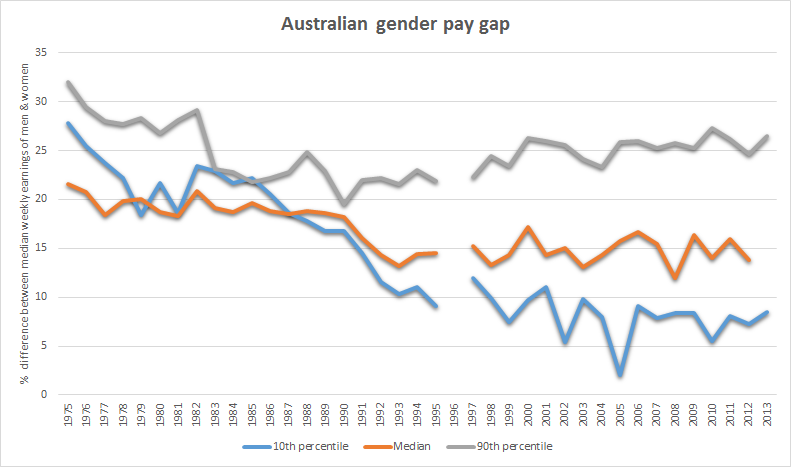
No gender equality down under – Australian gender pay gap at 10th, 50th and 90th percentile since 1975
27 Oct 2015 Leave a comment
in discrimination, economic history, gender, human capital, labour economics, occupational choice, politics - Australia Tags: Australia, gender wage gap
A rising majority of university students around the world are women
26 Oct 2015 Leave a comment
in development economics, discrimination, economic history, economics of education, gender, growth disasters, growth miracles, human capital, labour economics Tags: College premium, compensating differentials, education premium, graduate premium, marriage and divorce, reversing gender gap
A rising majority of university students around the world are women (HT @cblatts) http://t.co/6loTmSgrk9—
William Easterly (@bill_easterly) June 15, 2015
Tertiary educational attainment by age and gender, USA, UK, Canada and Australia, 2013
25 Oct 2015 Leave a comment
in discrimination, economics of education, gender, human capital, labour economics, occupational choice, politics - Australia, politics - USA Tags: Australia, British economy, Canada, reversing gender gap
There are marked differences in progress in tertiary educational attainment between countries and across the generations. For example, while a few more American women have tertiary degrees as compared to their mothers, there’s been no change for American men for a generation.

Source: Indicators of Gender Equality in Education – OECD.
Canada is firing ahead in both tertiary educational attainment and reversing the gender gap in education for good. Two thirds of prime age Canadian women have a tertiary degree as compared to half of their mothers.
The number of British women with tertiary degrees is also much higher than their mothers. British men are trying their best to keep up.


Recent Comments