Measures of racism across the world
08 May 2015 Leave a comment
in discrimination, politics - USA Tags: racial discrimination, racism, voter demographics
There are big differences in part-time employment rates across countries
06 May 2015 Leave a comment
in discrimination, gender, labour economics, labour supply, occupational choice Tags: gender wage gap, part-time employment, reversing gender gap
Gender & #jobs: pretty clear who's working only part-time. Follow @OECDlive & #gender tomorrow bit.ly/1BCpQOH http://t.co/arzboo6udl—
(@OECD) March 03, 2015
Labour stays silent over gender segregation at party rally
05 May 2015 Leave a comment
in discrimination, election campaigns, gender Tags: British general election, Left-wing hypocrisy, sex discrimination, UK politics
Labour stays silent over gender segregation at party rally specc.ie/1QcJHJf via @spectator http://t.co/Qs2FZV9Z7e—
Steerpike (@MrSteerpike) May 03, 2015
Up to a thousand expected at the great Labour Rally tomorrow at 4.00 being organised by @ansar_ali_khan http://t.co/Paec01bT8c—
Jack Dromey (@JackDromeyMP) May 01, 2015
Women are winning the human capital race | Kevin M. Murphy and Robert H. Topel
04 May 2015 Leave a comment
in applied welfare economics, discrimination, economics of education, gender, human capital, labour economics, labour supply, occupational choice Tags: gender wage gap, reversing gender gap

Why have women outpaced men? There’s little cognitive difference between the sexes, and males do better on standardized tests.
But Murphy, Becker, and Hubbard argue that women tend to have better “non-cognitive skills” than men do. Those personal skills and character traits such as persistence, self-control, and conscientiousness may help women excel academically and stay in school until they graduate.
The academic achievement gap actually starts before college: 25 percent more females than males took high-school advanced-placement tests in 2010, the Cleveland Fed economists find.
“There is a substantial gap between the measured high school performance of males and females,” Topel and Murphy write in a 2014 study, noting that female graduating high school seniors have, as a group, higher grade point averages than their male counterparts. “This high school gender gap in academic performance persists in the population that continues on to college.”
via Women are winning the human capital race | The University of Chicago Booth School of Business.
What is assortative mating?
02 May 2015 Leave a comment
in discrimination, economics of education, economics of love and marriage, gender, human capital, labour economics, labour supply, law and economics, occupational choice Tags: assortative mating
#Dailychart: Sex and money: How women's equality increases wealth inequality. econ.st/1kCYG1R http://t.co/dfrYJs4vBs—
The Economist (@ECONdailycharts) February 13, 2014
The wage stagnation that dare not speak its name
30 Apr 2015 Leave a comment
in discrimination, gender, labour economics, occupational choice Tags: gender analysis, gender wage gap, media bias, reversing gender gap, wage stagnation

The gender wage gap reverses at below 40 hours a week
30 Apr 2015 Leave a comment
in discrimination, gender, human capital, labour economics, labour supply Tags: gender wage gap

The value of a stay at home mum
29 Apr 2015 Leave a comment
in discrimination, gender, labour economics, labour supply Tags: family demographics, household production, marital division of labour
Why is the rapid closing of the gender wage gap in New Zealand not celebrated more?
27 Apr 2015 1 Comment
in discrimination, gender, human capital, labour economics, labour supply, occupational choice, politics - New Zealand Tags: activists, do gooders, gender wage gap, Left-wing hypocrisy, Leftover Left
With the rapid closure in the raw female male wage gap in New Zealand over the last 15 or so years, the lack of celebration of this achievement among equal pay activists is puzzling.
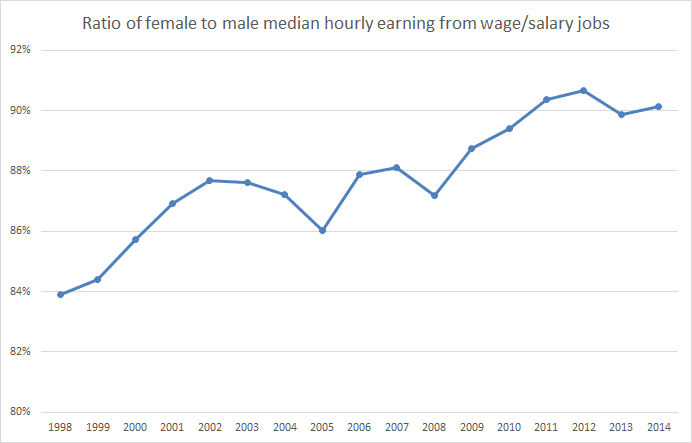
Source: Statistics New Zealand, New Zealand Social indicators, Median hourly earnings.
The economic and educational psychology case against making Te reo Māori compulsory in NZ schools
23 Apr 2015 1 Comment
in discrimination, economics of education, human capital, labour economics, politics - USA, poverty and inequality Tags: do gooders, economics of languages, Maori economic development, network economics, Te reo Māori
The Race Relations Commissioner Dame Susan Davoy has called for Te Reo Māori to be compulsory in New Zealand schools. She said being bilingual would be “a real added advantage” to young Kiwis and more people knowing Te reo Māori would help race relations.
Learning another language is not a priority for the Pākehā children or Māori mokupuna when you consider the poor literacy rates among Māori, Pasifika and Pākehā. The priority for children in an English speaking country is to master English. Too many children leave school with inadequate reading and writing skills.
Figure 1: Prose literacy by ethnicity, 2011
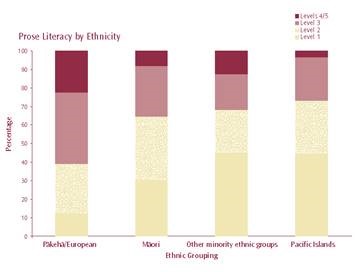
Source: Literacy skills of young adult New Zealanders | Education Counts.
Lower levels of literacy and numerously are much higher among Māori and Pasifika children. Pākehā consistently having a larger proportion in the higher levels of prose literacy.
Figure 2: Prose literacy rates by ethnicity, 1996 and 2006
Source: Indicator 9: Literacy rates — Office of the Auditor-General New Zealand.
60%of Pākehā are above the minimum level of competence to meet the prose literacy requirements of a knowledge society. This contrasts with the majority of Māori and Pasifika who are below the minimum level of competence.
Furthermore, requiring children who do not have an aptitude for language or school in general to learn a language will reinforce in those who are not doing well that they are not very smart. This will give them more reasons to hate school and leave as soon as possible and never go back.
The key to helping children who do not have an aptitude to succeed greatly at school is to find the subjects where they do do well so they can get a good start to life. If students are not good at academic subjects, requiring them to do more academic studies such as study language is fool-hardy.
Taking resources, and more importantly, students learning time away from basic literacy skills will do little for a Māori economic development and race relations. This is because this taking resources and student learning time away from literacy and basic education will slow the closing of income gaps between Māori and others.
Language is a network good. It pays to join the largest network so you can communicate and do business with more people. The wage premium for immigrants learning English in English-speaking’s countries is about 15%.

Learning Te reo Māori will not help children in their other subjects. The psychology of the transfer of learning was founded 100 years ago to explore the hypothesis that learning Latin gave the student muscle to learn other subjects, both other languages and generally learn faster.
Educational psychologists found that Latin does not help much in studying other languages and other subjects. No significant differences were found in deductive and inductive reasoning or text comprehension among students with 4 years of Latin, 2 years of Latin or no Latin at all.
Median income by race in America
23 Apr 2015 Leave a comment
in discrimination, income redistribution, labour economics, poverty and inequality Tags: racial discrimination, wage gaps

The reversed college gender gap
23 Apr 2015 Leave a comment
in discrimination, economics of education, gender, human capital, labour economics, labour supply, occupational choice Tags: gender wage gap reversed gender gap
CHART: The Huge College Degree Gender Gap: Since 1982, Women Have Earned ~10M MORE US College Degrees Than Men! http://t.co/83JhRfwCLE—
Mark J. Perry (@Mark_J_Perry) March 11, 2015

The comparative institutional analysis of stereotypes
21 Apr 2015 Leave a comment
in applied price theory, discrimination, economics of bureaucracy, entrepreneurship, gender, industrial organisation, labour economics, Public Choice, survivor principle Tags: labour market discrimination, markets selection, signaling and screening, stereotypes, The meaning of competition
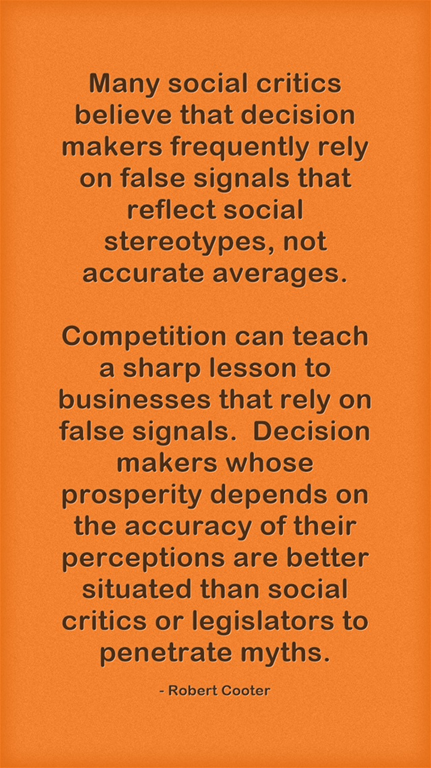
A long-standing anomaly about racial discrimination in the labour market
19 Apr 2015 Leave a comment
in discrimination, human capital, labour economics, labour supply, occupational choice Tags: co-worker discrimination, customer discrimination, employer discrimination, labour market discrimination, racial discrimination
CHART: Asians Make 15% More Than Whites, Is That Because of 'Asian Privilege' or Discrimination Against Whites? http://t.co/9YnkDDrcbO—
Mark J. Perry (@Mark_J_Perry) March 19, 2015


Recent Comments