
Claudia Goldin’s pollution theory of sex discrimination
10 Dec 2014 Leave a comment
in discrimination, gender, human capital, labour economics, labour supply, occupational choice Tags: Claudia Goldin, co-worker discrimination, credentialisation, employer discrimination, occupational segregation, sex discrimination, signalling
Claudia Goldin argues that it is difficult to rationalise sex segregation and wage discrimination on the basis of men’s taste for women in the same way as discrimination based on race or ethnicity. Goldin developed a pollution theory of discrimination in which new female hires may reduce the prestige of a previously all-male occupation.
When work took more brawn than brain, the distributions of skills and natural talents of men and women were further apart. Women were not as physically strong as men. This counted for more both before the Industrial Revolution and at the height of the Industrial Revolution when most factory work involved a considerable amount of brawn.
As machines substituted for strength, as brain replaced brawn and as educational attainment increased, the distributions of attributes, skills and natural talents narrowed by sex.
Because there is asymmetric information regarding the value of the characteristic of an individual woman, a new female hire may reduce the prestige of a previously all-male occupation.
Prestige is conferred by some portion of society and is based on the level of a productivity-related characteristic (e.g., strength, skill, education, ability) that originally defines the minimum needed to enter a particular occupation. People had to have a minimum amount of the socially prestigious strength or skill before they are hired.
Male fire fighters or police officers, to take two examples, may perceive their occupational status to depend on the sex composition of their police station or firehouse. These occupations are socially prestigious because of the strength and courage of police and fire-fighters. Men in an all-male occupation might be hostile to allowing a woman to enter their occupation even if the woman meets the qualifications for entry.
A reason for this hostility of the existing male members of the occupation is the rest of society may be slow to learn of the qualifications of these female newcomers. Their entry against this background of ignorance in the wider society may downgrade the occupation as still carrying prestigious characteristics such as physical strength. As Goldin explains:
Because they feel that the entry of women into their occupations would pollute their prestige or status in that occupation. Very simply, some external group is the arbiter of prestige and status.
Let’s take an example of firemen, and let’s say we begin not that long ago when there were no women who were firemen—which is why they’re called firemen.
And to become a fireman you have to take a test, lifting a very heavy hose and running up many flights of stairs. And every night, the firemen get off from work and go to the local bar.
Everyone slaps them on the back and says what great brawny guys they are and what a great occupation they are in, and everybody knows that to be a fireman requires certain brawny traits and lots of courage.
But nobody knows when there’s a technological shock to this occupation. And in this case it might be that fire hoses become really light or the local fire department changes the test. There are information asymmetries. But they do note that for this “brawny” characteristic, the median woman is much lower.
So if we observe a woman entering the occupation and we don’t know how to judge women, we’re going to assume that her skills are those of the median woman. Or it may be that we can observe something having to do with her muscles and that may up it a little bit.
But chances are we’re going to assume that some technological shock has happened to this occupation. And so her entry into the occupation is going to pollute it.
Then when they go to the bar, people will say, “oh you’ve got a woman in the firehouse; now fire fighting has become women’s work.” That’s where the pollution comes in.
Union rules also played a role in preventing the entry of women into some occupations
Many occupations have changed sex over time e.g., librarians, bank tellers, teachers, telephone operators, and sales positions. New occupations and industries are less like to be segregated on the basis of sex because they have not developed a social image regarding the prestige of workers.
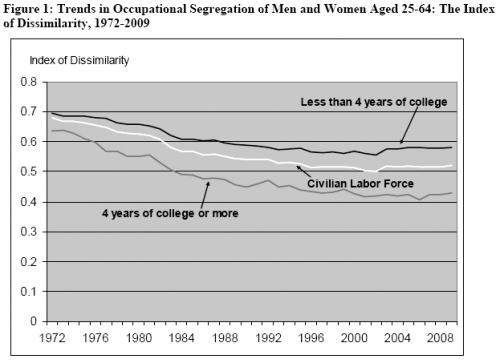
Occupational segregation came to an end because credentialisation, which spreads information about individual women’s productivities and shatters old stereotypes, can help expunge this pollution of the prestige of specific occupations and jobs both within the industry and in wider society .
The visibility successful women today and in the past may help shatter old stereotypes and increase knowledge about the true distribution of female attributes in this prestigious occupation.

Goldin found that when typists were primarily men, it was claimed that typing required physical stamina so woman need not apply.
But later, when the occupational sex segregation reversed, when typing became a female occupation, it was said that typing required a woman’s dexterity, which men did not have! When I was at school, only women were taught to type.
How Some Women Benefit From Marrying a Man Who Makes Less Money – The Atlantic
09 Dec 2014 Leave a comment
in discrimination, gender, labour economics Tags: asymmetric marriage premiumClick add, gender wage gap, power couples, sex discrimination

The large and growing gap is not due to timid female MBAs.
Some of it is attributed to different skills, jobs before the MBA, and that male business students typically take more finance classes and women more marketing classes.
But a majority of the difference is due to women taking time out of the labor force and then working less after having children.
Women without children usually don’t take time off, and most of their earnings disparity with men can be explained by differences in their skills.
It’s notable that the earnings of some women did not fall very much after they had children and any drop in income did not persist after a few years.
But these women often had a “lower” earning spouse (income under $100,000). A large and sustained drop in income is highly correlated with having children and a high-earning husband.
via How Some Women Benefit From Marrying a Man Who Makes Less Money – The Atlantic.
White Names vs. Black Names: Roland Fryer
08 Dec 2014 Leave a comment
in discrimination, economics of media and culture, human capital, labour economics, poverty and inequality


The Top Five Feminist Myths of All Time
30 Nov 2014 Leave a comment
in discrimination, gender, labour economics, liberalism Tags: feminist myths, gender wage gap
In the good old days, everyone agreed on the employment effects of minimum wage laws, even their supporters
28 Nov 2014 Leave a comment

#Shirtgate: Feminist heckles heard from outer space
27 Nov 2014 Leave a comment
in discrimination, gender, liberalism Tags: identity politics, witchhunts
Environmental and Urban Economics: Do Demographers Really Predict Future Population Trends Without Incorporating Women’s Economic Incentives?
26 Nov 2014 Leave a comment
in discrimination, economics of love and marriage, gender, health economics, human capital, labour economics
To my amazement, this work does not discuss how women’s potential earnings in the labor market correlates with fertility decisions.
At least in the Demography paper linked to above, the word “incentives” does not appear in the paper and nobody makes a choice based on the costs and benefits of fertility.
Without incorporating such factors, how can a statistical model yield a credible prediction?
61% of Dutch women work part-time!
26 Nov 2014 Leave a comment
in discrimination, gender, labour economics, labour supply Tags: labour economics gender employment gap, part-time work

A Dutch friend mentioned that Social Security eligibility in the Netherlands is based on paying Social Security tax on your earnings. If she was out of the Netherlands for more than two years, she lost her Social Security coverage.
This is just speculation: Dutch women work part time to pay Social Security tax and thereby remain eligible for various Social Security benefits.
Research by Jan van Ours, an excellent labour economist, shows that Dutch women are happy with their part-time work and only about 4% want to increase their hours of work to full-time.
Women graduates increasingly put their partner’s career first after they graduate | Daily Mail Online
19 Nov 2014 Leave a comment
in discrimination, economics of love and marriage, gender, human capital, labour economics, labour supply, occupational choice Tags: asymmetric marriage premium, Claudia Goldin, gender wage gap, motherhood penalty, power couples


Women are increasingly putting their husband’s career before their own, a controversial new study of Harvard Business School graduates has found.
It canvassed over 25,000 male and female students, and found 40 percent of Gen X and boomer women said their spouses’ careers took priority over theirs.
The researchers also said only about 20 percent of them had planned on their careers taking a back seat when they graduated.
This gender gap found by Robin Ely, Colleen Ammerman and Pamela Stone can be better explained by the marriage market combined with assortative mating.
1. Harvard business graduates are likely to marry each other and form power couples.
2. There tends to be an age gap between men and women in long-term relationships and marriages of say two years.
This two year age gap means that the husband as two additional years of work experience and career advancement. This is highly likely to translate into higher pay and more immediate promotional prospects.
Maximising household income would imply that the member of the household with a higher income, and greater immediate promotional prospects stay in the workforce.
It is entirely possible that women to anticipate this situation both in their subject choices and career ambitions.
Claudia Goldin found that the wage gap between male and female Harvard graduates disappears in the presence of one confounding factor.
That confounding factor is obvious: the male in the relationship earns less. When this is so, Goldin found that the female in the relationship earns pretty much as do similar male Harvard graduates, except for the fact that they work less hours per week:
We identify three proximate factors that can explain the large and rising gender gap in earnings: a modest male advantage in training prior to MBA graduation combined with rising labour market returns to such training with post-MBA experience; gender differences in career interruptions combined with large earnings losses associated with any career interruption (of six or more months); and growing gender differences in weekly hours worked with years since MBA.
Differential changes by sex in labour market activity in the period surrounding a first birth play a key role in this process. The presence of children is associated with less accumulated job experience, more career interruptions, shorter work hours, and substantial earnings declines for female but not for male MBAs.
The one exception is that an adverse impact of children on employment and earnings is not found for female MBAs with lower-earning husbands.
This sociological evidence reported in the Daily Mail is entirely consistent with the choice hypothesis and equalising differentials as the explanation for the gender wage gap. As Solomon Polachek explains:
At least in the past, getting married and having children meant one thing for men and another thing for women. Because women typically bear the brunt of child-rearing, married men with children work more over their lives than married women.
This division of labour is exacerbated by the extent to which married women are, on average, younger and less educated than their husbands.
This pattern of earnings behaviour and human capital and career investment will persist until women start pairing off with men who are the same age or younger than them.
The link between paid parental leave generosity and a larger gender pay gap-updated
09 Nov 2014 4 Comments
in discrimination, economics, gender, human capital, labour economics, labour supply, occupational choice Tags: gender pay gap, labour economics, occupation choice, sex discrimination

But it also turns out that some countries that offer more liberal parental leave policies have higher pay gaps among men and women ages 30 to 34, according to analyses of 16 countries conducted by the Organization for Economic Cooperation and Development.
OECD theorizes that this link may be driven by the fact that women are more likely than men to actually use their parental leave, and that time out of the workforce is associated with lower wages.
It is rather obvious if you pay women not to work, they will accumulate less job experience and miss out on promotional and other career advancement opportunities in their prime of their career.

As this OECD paper in 2012 found with regard to paid parental leave and gender gaps in employment and earnings:
…the provision and gradual lengthening of paid leave have contributed to a widening in the gender pay gap of full-time employees.
This may reflect the fact that women experience slower career and earnings progression on returning from leave to full-time employment than men, much fewer of whom take leave.
In sum, the development of parental leave policies in most countries appears to have had a positive, albeit marginal, role in the rise of female employment, although women pay a price in the form of reduced earnings progression.
Claudia Golden found that in some high-powered professions, any career interruption at all, can greatly reduce lifetime earnings.

via The link between parental leave and the gender pay gap | Pew Research Center.
Happy Birthday Marie Curie!
08 Nov 2014 Leave a comment
in discrimination, gender Tags: gender, Marie Curie, sex discrimination, The Great Fact
That Catcalling Video and Why “Research Methods” is such an Exciting Topic (Really!) — The Message — Medium
07 Nov 2014 1 Comment
in discrimination, economics of media and culture, gender, labour economics Tags: research design, sex discrimination, sexual harassment
The filmmakers claim to have shot this video while walking the streets of Manhattan for 10 hours, but over half of the shots in the video are actually taken from just one street, namely 125th St. in Harlem.


Recent Comments