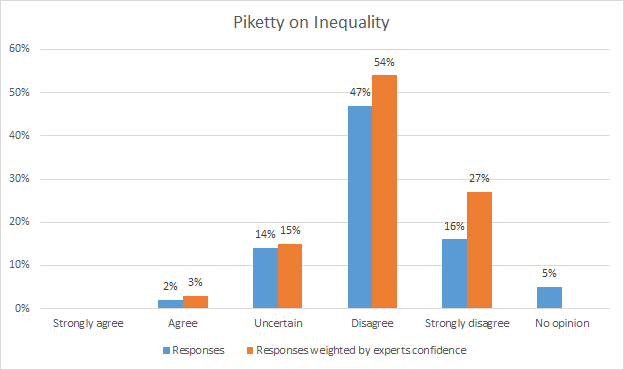
Piketty on inequality: views of the IGM economic experts
16 Oct 2014 Leave a comment
in applied price theory, applied welfare economics, comparative institutional analysis, constitutional political economy, discrimination, economic growth, entrepreneurship, gender, human capital, income redistribution, industrial organisation, labour economics, Marxist economics, Rawls and Nozick Tags: Daron Acemoglu, James Robinson, Piketty, poverty and inequality, The Great Enrichment
Question: The most powerful force pushing towards greater wealth inequality in the US since the 1970s is the gap between the after-tax return on capital and the economic growth rate?
Daron Acemoglu and James Robinson have a simple explanation for why Piketty is wrong:
But like Marx, Piketty goes wrong for a very simple reason. The quest for general laws of capitalism or any economic system is misguided because it is a-institutional.
It ignores that it is the institutions and the political equilibrium of a society that determine how technology evolves, how markets function, and how the gains from various different economic arrangements are distributed.
Despite his erudition, ambition, and creativity, Marx was ultimately led astray because of his disregard of institutions and politics. The same is true of Piketty.
The reverse gender gap in part-time employment
04 Oct 2014 Leave a comment
in discrimination, gender, human capital, labour economics, occupational choice Tags: compensating differentials, gender wage gap, part-time work, reversing gender gap

HT: economix
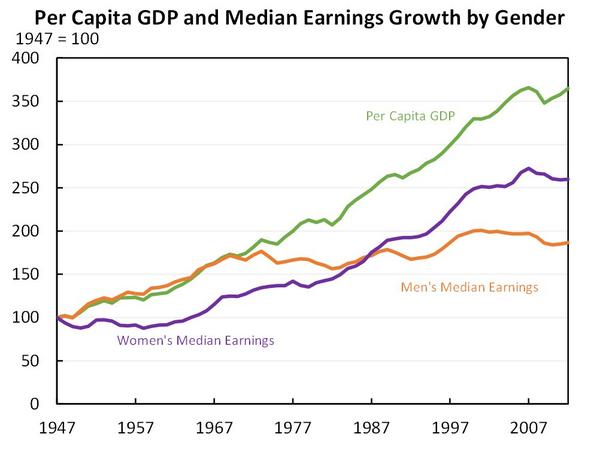
Much-needed gender analysis of median earnings growth since 1947
06 Sep 2014 Leave a comment
in discrimination, gender, human capital, labour economics Tags: gender analysis, median earnings growth by gender, myths and reality

Source: Council of Economic Advisors.
Are men just getting their comeuppance for decades of discrimination against women?
Much is made of the stagnation of median earnings over the last few decades. There is no such stagnation for women
The West Wing – Ainsley Hayes on the ERA
13 Aug 2014 Leave a comment
in discrimination, gender, labour economics, liberalism, TV shows Tags: affirmative action, do gooders, equality before the law, labour market discrimination, The fatal conceit, West Wing
The politics of ethnicity-based research in New Zealand
30 Jul 2014 Leave a comment
in applied price theory, discrimination, human capital, income redistribution, labour economics, labour supply, politics - New Zealand, population economics, Public Choice, rentseeking Tags: employment discrimination, inequality, Maori economic development, poverty, Simon Chapple, The Great Enrichment, The Great Fact
When Simon Chapple in 2000 wrote “Māori Socio-Economic Disparity”, which showed that disadvantage in New Zealand is more closely tied to age, marital status, education, skills, and geographic location than it is to ethnicity, broadly conceived, such as Māori ethnicity:
- He was summoned before the Māori Affairs Committee of parliament to defend his paper! His chief executive at the Ministry of Social Policy went along with him to defend what he wrote while employed as a senior analyst at the Department of Labour. Staff at his new ministry launched a petition to have Simon fired.
- The head of the Māori Affairs Ministry accused Simon of breaching the public service code of conduct.
Chapple also found that there are important differences in socio economic development by Māori self-identity. Those who identified only as Māori did worse than those that are identified as Māori and another ethnicity. Identifying only as Māori also correlated with living in rural New Zealand.
In terms of employment discrimination, employers would not know whether a Māori job applicant identified as only as Māori or also with another ethnicity, so discrimination is not a good explanation of Māori disadvantage because of this counterfactual. A major driver of Māori disadvantage, which is identifying on the Census form solely as Maori, is simply unknown to discriminating employers as a basis for discrimination in hiring and promotion.
There were editorials in the Dominion Post, which I cannot find online, and in the New Zealand Herald. The latter said:
The Government is being prodded to recognise that Maori deprivation has more to do with socio-economic factors than ethnicity.
This was the conclusion of a report by the Labour Department’s senior research analyst, Simon Chapple. Helen Clark might well have had that finding partly in mind when she referred to a lot of water having gone under the bridge since the Government first formulated legislation.
Mr Chapple said, in essence, that place of residence, age, education and skills had more to do with poverty than race. In areas such as South Auckland, Northland and the central North Island, there were poor Maori, but there were also poor Pākehā and poor Pasifika.
The Minister attacked him and the paper as well for contradicting the Minister’s claim during the election campaign that everything got worse for Maori in the 1990s.
Real equivalised median household income rose 47% from 1994 to 2010; for Māori, this rise was 68%; for Pasifika, 77% (Perry July 2014)
See Karen Baehler’s Ethnicity-based research and politics: snapshots from the United States and New Zealand for more information and a comparison with the similar response to Daniel Patrick Moynihan’s The Negro Family: A Case for National Action in 1965.
About a quarter of Negro families are headed by women. The divorce rate is about 2 1/2 times what it is [compared with whites],” Moynihan said. “The number of fatherless children keeps growing. And all these things keep getting worse, not better, over recent years.”
Moynihan, now retired from the United States Senate, was a senior official in LBJ’s Labor Department in 1965. He wrote his report on a typewriter over a few weeks and had the publications office in the basement of the Labor Department print 100 of them, marked “For Official Use Only.”
- He warned about the breakdown of the African-American family where deprivation and disorganisation had formed their own vicious circle.
- Many civil rights leaders had labelled Moynihan’s report a subtle form of racism because of its unflattering portrayal of the black family (Wilson 1987).
- These accusations of racism helped make the breakdown of the family a taboo subject in social policy in the USA
see The Moynihan Report Revisited: Lessons and Reflections after Four Decades for a review by the best and the brightest in American economics and sociology on Daniel Patrick Moynihan’s prophetic warnings. Holzer says, for example:
Moynihan was extremely insightful and even prescient in arguing that the employment situation of young black men was a “crisis . . . that would only grow worse.”
He understood that these trends involve both limits on labour market opportunities that these young men face as well as skill deficits of and behavioural responses by the young men themselves.
More children are growing-up without a working father living in the home and glean the awareness that work is a central expectation of adult life (Wilson 1987, 1996).
Single-parent households increased from 13 per cent of all Māori households in 1981 to 24.4 per cent in the 2006 Census. In the 2006 Census, 70 per cent of Māori single parent households were on a low income compared to 15 per cent of other Māori one family households (Kiro, Randow and Sporle 2010).
Most of the skill gaps that are present at the age of 18 – skill gaps which substantially explain gaps in adult earnings and employment in all groups – are also present at the age of five (Cunha and Heckman 2007). There is much evidence to show that disadvantaged children have lower levels of soft skills (non-cognitive skills): motivation, persistence, self-discipline, the ability to work with others, the ability to defer gratification and plan ahead, etc. (Heckman 2008). Most of the skills that are acquired at school build on these soft skills that are moulded and reinforced within whānau.
When I started working on labour economics in 2007 I found that the labour economics of Māori was very narrowly written and stayed well clear of the minefield that Simon braved about how ethnicity does not matter that much to Māori social disadvantage.
The desired ratio of older and younger workers
18 Jul 2014 Leave a comment
in discrimination, human capital, labour economics, labour supply Tags: older workers
The large accumulation of firm and industry-specific human capital of older employees can be more in demand in some jobs than others (Lazear 1998).
The pace of technological change in a particular industry influences the role of different ratios of older and younger employees to the most profitable way to develop human capital within a given firm (Lazear 1998).
Recruitment, on-the-job training, and learning by doing are alternative methods of acquiring and accumulating human capital. The relative profitability of each method of developing and renewing human capital will depend upon whether internal or external sources are the cheaper suppliers of new human capital to the firm.
When technological change is rapid, knowledge of the new technology is often embodied in the formal education and recent job experiences of new entrants into the workforce and younger up-and-coming workers (Lazear 1998).
In industries with more rapid technological progress, the departure of older workers is less of a capital loss to employers. Employers may have fewer incentives to accommodate phased retirements if human capital rich replacements are available. These younger recruits may be embodied with the latest knowledge of new technologies through their formal education and schooling and their previous job experiences.
The amount of skills learnt on the job relative to formal education is important to the desired ratios of older and younger employees.
When on-the-job skills are important to the success of the firm, there is a great need for teachers to pass on these skills. Older experienced employees will be greatly valued as repositories of firm-specific human capital and as teachers to new employees (Lazear 1998).
When formal education acquitted outside the workplace is the more important way in which employees learn their skills, it will be less important for employers to invest in accommodations that retain older employees as teachers.
The extent to which the firm’s operations and customers are more idiosyncratic is important to the ratio of ratio of older and younger employees that is best for human capital accumulation (Lazear 1998).
Again, senior workers are more likely to have this special knowledge and act as teachers to recruits when the firm’s operations and customers are more idiosyncratic relative to other firms (Lazear 1998). Employers will be more reluctant to see older employees quit if they act as teachers to recruits in the ways of the firm.
An employer has less concerned if older employees plans to leave if the firm’s preferred ratio of younger to older employee is not harmed. In some cases, older employees are valued as teachers and repositories of knowledge. In other cases, staff turnover can be an opportunity to inject fresh blood (Lazear 1998). It is all in the operational particulars of each firm, the importance of on-the-job training versus formal education, and the pace of technological change in the industry.


Recent Comments