


Female voting demographics and the growth of government
13 Jul 2014 1 Comment
in applied price theory, gender, income redistribution, Public Choice Tags: John Lott, The growth in government, voter demographics

The gender gap in voting dates back 2 generations or more and may now be in double digits.
A large share of all social spending is for the care of dependents – everything from children to non-working mothers and old age pensioners. Women support this spending because they benefit more from the social insurance it offers. Women both earn less and are more likely to be out of the workforce caring for children. Women also change their voting patterns more often than men as they marry and divorce or as they become single mothers.
John Lott pondered on why the government started growing precisely when it did. The federal government, aside from periods of wartime, consumed 2 to 3% of GDP up until World War I. In the 1920s, non-military federal spending began steadily climbing. FDR’s New Deal continued an earlier trend.
Lott explains the growth of government with women’s suffrage. For decades, polls have shown that women as a group vote differently than men. Without the women’s vote, Republicans would have swept every U.S. presidential race but one between 1968 and 2004.
A major gender gap issue is smaller government and lower taxes, which is a much higher priority for men. Women were more opposed to the 1996 federal welfare reforms, which mandated time limits for receiving welfare and imposed work requirements on welfare recipients.
Women are also supporters of Medicare, Social Security and educational expenditures more than men. Studies show that women are generally more risk-averse than men so they support government programs to ensure against certain risks in life.
- Women’s average incomes are also slightly lower and less likely to vary so single women prefer more progressive income taxes.
- Once women marry, they bear a greater share of taxes through their husbands’ relatively higher incomes so their support for high taxes declines.
Marriage also provides an economic explanation for why men and women prefer different policies.
Single women who believe they may marry as well as married women who most fear divorce, look for protection against possible divorce: a more progressive tax system and other government transfers of wealth from rich to poor.
Lott considers that A good way to analyse the direct effect of women’s suffrage on the growth of government is to study how each of the 48 state governments expanded after women obtained the right to vote.
- Women’s suffrage was first granted in western states seeking women migrants: Wyoming (1869), Utah (1870), Colorado (1893) and Idaho (1896).
- Women could vote in 29 states before women’s suffrage was achieved nationwide in 1920 with the adoption of the 19th Amendment to the Constitution.
The impact of granting of women’s suffrage was startling: state governments started expanding the first year after women voted and continued growing until real per capita spending more than doubled. The increase in government spending and revenue started immediately after women started voting.
There were 19 states that had not passed women’s suffrage before the approval of the 19th Amendment, nine approved the amendment, while the other 12 had suffrage imposed on them.
If some unknown third factor caused a desire for larger government and women’s suffrage, government should have only grown in states that voluntarily adopted suffrage. After approving women’s suffrage, government grew at a similar pace in both groups of states.
As more women voted and eventually voted in similar numbers as men, the size of state and federal governments expanded as women became an increasingly important part of the electorate. It took up to 30 years for women’s voting participation rate to equal that of men.
Lott also found that women’s political views on average vary more than those of men:
- Young single women are about 50 per cent more likely to vote Democratic.
- For married women, this gap is only one-third as large.
- Married women with children become more conservative still.
- Women with children who are divorced are suddenly about 75 per cent more likely to vote for Democrats than single men.
Not surprisingly, political parties pitch their platforms to women because they are more likely to change their vote over identifiable issues that are within the scope for government to change or influence
Walter Williams Asks: “How Much Can Discrimination Explain?”
04 Jul 2014 Leave a comment
via Cafe Hayek
The reversing gender gap in education
03 Jul 2014 Leave a comment
in economics of education, gender, human capital, labour economics, occupational choice Tags: reversing gender gap
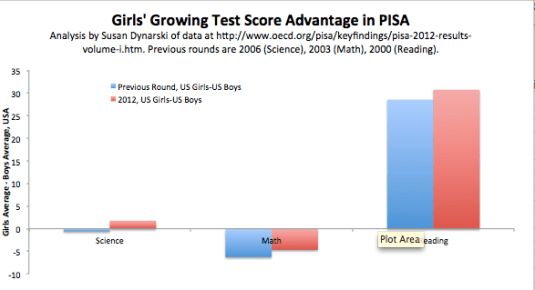
The difference in reading and verbal skills between girls and boys at the age of 15 is equal to 6-months extra schooling. Six months schooling explains a lot of the wage gaps with a long ethnic, racial and previously on gender lines.
Not surprisingly, fewer women do science and engineering degrees because their superior reading and verbal skills qualify them for medicine and other sciences that take advantage of these talents.
Gender and education: Have American boys been left behind? – Christina Hoff Sommers
10 Jun 2014 Leave a comment
in gender, human capital, labour economics Tags: Christina Hoff Sommers, gender gap, lost boys, reverse gender gap
Minimum wage was introduced to reduce the employment of women
10 May 2014 1 Comment
in gender, history of economic thought, labour economics Tags: minimum wage, progressive era
The minimum wage is a rare policy bird. Its employment effects change at the whim of its latest proponents.
Minimum wages were initially introduced in the USA shortly after 1900 solely for women and children. The express aim was to price women out of jobs and raise men’s wages by enough so that they could provide for their families.
These days, some argue that minimum wages actually increase employment. Times change, and the slopes of supply and demand curves must change with them.
Tim Leonard in Protecting Family and Race The Progressive Case for Regulating Women’s Work showed that these women-only minimum wages were justified by political progressive including women on grounds that they would:
(1) Protect the biologically weaker sex from the hazards of market work;
(2) Protect working women from the temptation of prostitution;
(3) Protect male heads of household from the economic competition of women; and
(4) Ensure that women could better carry out their eugenic duties as “mothers of the race.”

The above photo from the Minnesota Post has the following caption:
Fuelled by the Progressive Era, Minnesota becomes one of the first dozen states to pass a law establishing work standards for women and children and established a Minimum Wage Commission.
Women-only minimum wage laws were held unconstitutional by the Supreme Court in 1923 but were upheld by a Progressive-dominated Supreme Court in 1937. In the 1930s depression, single-sex, state minimum-wage laws were revived and flourished.
Xenophobia, race prejudice, and sexism should come as no surprise to any student of left-wing politics. Progressive politics in the first half of the 20th century was infested with racism:
- The support of the Australian Labor Party (ALP), and in the USA, the Democratic Party, for vicious, state-sponsored racism is well known.
- The ALP supported the passing of the White Australia policy with glee in 1901 by the newly formed Federal Parliament.
As Tim Leonard has shown, in days gone by, budding progressives not only revelled in exposes of capitalistic barons and attacks on laissez-faire economics by muckraking journalists, they also poured over racist tracts that drew on the latest anthropology, biology, psychology, sociology, eugenics, and medical science. Social Democrat Party Sweden practised eugenics until the 1960s.


Recent Comments