The very last part of the clip is hilariously funny.
Progressive Feminism Exposed
02 Nov 2014 Leave a comment
in applied welfare economics, discrimination, gender, human capital, occupational choice, politics - USA Tags: gender wage gap, myths and fallacies
Why the Gender Pay Gap is a Myth
29 Oct 2014 Leave a comment
in discrimination, gender, health and safety, human capital, labour economics, labour supply, occupational choice Tags: employment discrimination, gender wage gap, labour economics, sex discrimination
Men are far more likely to choose careers that are more dangerous, so they naturally pay more under the principle of compensating differences. Top 10 most dangerous jobs: Fishers, loggers, aircraft pilots, farmers and ranchers, roofers, iron and steel workers, refuse and recyclable material collectors, industrial machinery installation and repair, truck drivers, construction labourers. They are male-dominated jobs.
Men are far more likely to enter higher-paying fields and occupations (by choice). Men are far more likely to take work in uncomfortable, isolated, and undesirable locations that pay more. Men work longer hours than women do. The average fulltime working man works 6 hours per week or 15 percent longer than the average fulltime working woman.

Women tend to work in fields dominated by women because these fields best satisfy women’s’ dual careers as workers and household managers. This can include less stressful work environments (noise, strenuous activity, etc.), more flexible policies regarding time off, and a number of other factors.

Men work longer hours than women do. The average fulltime working man works 6 hours per week or 15 percent longer than the average fulltime working woman. Even within the same career category, men are more likely to pursue high-stress and higher-paid areas of specialisation.

Despite all of the above, unmarried women who’ve never had a child actually earn more than unmarried men. In 2008, single, childless women between ages 22 and 30 were earning more than their male counterparts in most U.S. cities, with incomes that were 8% greater on average.
Women business owners make less than half of what male business owners make, which, since they have no boss, means it’s independent of discrimination. The reason for the disparity is money is the primary motivator for 76% of men versus only 29% of women. Women place a higher premium on shorter work weeks, proximity to home, fulfillment, autonomy, and safety.
Women lean toward jobs with fewer risks, more comfortable conditions, regular hours, more personal fulfillment and greater flexibility. Many women are willing to trade higher pay for other desirable job characteristics.
Men often take on jobs that involve physical labour, outdoor work, overnight shifts and dangerous conditions (which is why men suffer the overwhelming majority of injuries and deaths at the workplace). They choose to put up with unpleasant factors because they can earn more.
An Analysis of Reasons for the Disparity in Wages Between Men and Women for the U.S. Department of Labor in 2009 concluded that:
This study leads to the unambiguous conclusion that the differences in the compensation of men and women are the result of a multitude of factors and that the raw wage gap should not be used as the basis to justify corrective action.
Indeed, there may be nothing to correct. The differences in raw wages may be almost entirely the result of the individual choices being made by both male and female workers.
Coalition Celebrating Equal Pay Case Outcome
29 Oct 2014 Leave a comment
in applied price theory, applied welfare economics, economics of regulation, gender, income redistribution, minimum wage, politics - New Zealand, rentseeking Tags: gender wage gap, living wage, minimum wage, pay equity
I wonder who will pay for this? Caregiver wages are funded out of a fixed budget allocated by the government.
A higher wage will change the type of worker that the caregiving sector will seek to recruit, as happened after increases in the teenage went minimum wage.
When the teenage minimum wage went up in New Zealand, employment of 17 and 18-year-olds fell, while the employment of 18 to 19-year-olds increased because the latter were more mature and reliable than the younger contemporaries.

Media release: Pay Equity Challenge Coalition
28 October 2014
Coalition Celebrating Equal Pay Case Outcome
“The Court of Appeal’s decision declining the employers’ appeal in the Kristine Bartlett case is a huge victory for women workers” said Pay Equity Coalition Challenge spokesperson Angela McLeod.
“The Courts’ decision that equal pay may be determined across industries in female-dominated occupations revitalises the Equal Pay Act 1972 and will be a major factor in closing New Zealand’s stubborn 14 percent gender pay gap”.
The judgement by the Court of Appeal upholding the Employment Court decision again validates the work of caregivers and that they are underpaid, she said.
“We commend the Service and Food Workers Union Nga Ringa Tota in taking this case and exposing the underpayment and undervaluation of aged care workers. And the decision is a victory for all the women’s organisations who have never given up fighting for equal pay,”…
View original post 92 more words


Piketty on inequality: views of the IGM economic experts
16 Oct 2014 Leave a comment
in applied price theory, applied welfare economics, comparative institutional analysis, constitutional political economy, discrimination, economic growth, entrepreneurship, gender, human capital, income redistribution, industrial organisation, labour economics, Marxist economics, Rawls and Nozick Tags: Daron Acemoglu, James Robinson, Piketty, poverty and inequality, The Great Enrichment
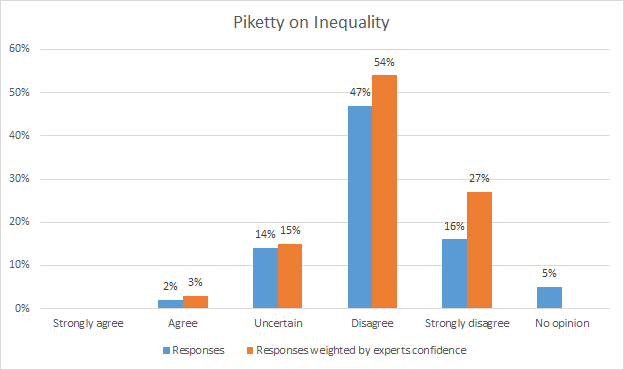
Question: The most powerful force pushing towards greater wealth inequality in the US since the 1970s is the gap between the after-tax return on capital and the economic growth rate?
Daron Acemoglu and James Robinson have a simple explanation for why Piketty is wrong:
But like Marx, Piketty goes wrong for a very simple reason. The quest for general laws of capitalism or any economic system is misguided because it is a-institutional.
It ignores that it is the institutions and the political equilibrium of a society that determine how technology evolves, how markets function, and how the gains from various different economic arrangements are distributed.
Despite his erudition, ambition, and creativity, Marx was ultimately led astray because of his disregard of institutions and politics. The same is true of Piketty.
The reverse gender gap in part-time employment
04 Oct 2014 Leave a comment
in discrimination, gender, human capital, labour economics, occupational choice Tags: compensating differentials, gender wage gap, part-time work, reversing gender gap

HT: economix
Much-needed gender analysis of median earnings growth since 1947
06 Sep 2014 Leave a comment
in discrimination, gender, human capital, labour economics Tags: gender analysis, median earnings growth by gender, myths and reality
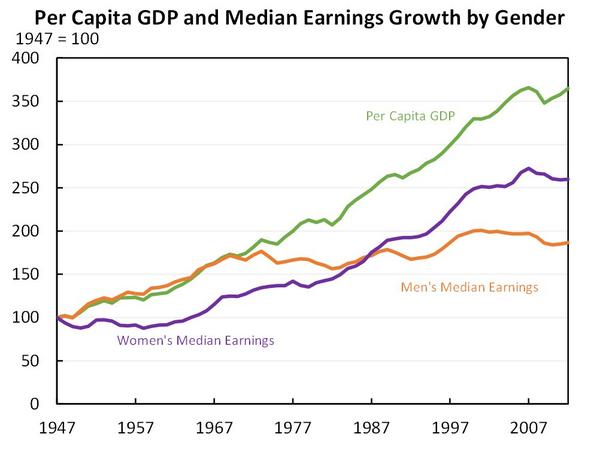
Source: Council of Economic Advisors.
Are men just getting their comeuppance for decades of discrimination against women?
Much is made of the stagnation of median earnings over the last few decades. There is no such stagnation for women
The West Wing – Ainsley Hayes on the ERA
13 Aug 2014 Leave a comment
in discrimination, gender, labour economics, liberalism, TV shows Tags: affirmative action, do gooders, equality before the law, labour market discrimination, The fatal conceit, West Wing


Recent Comments