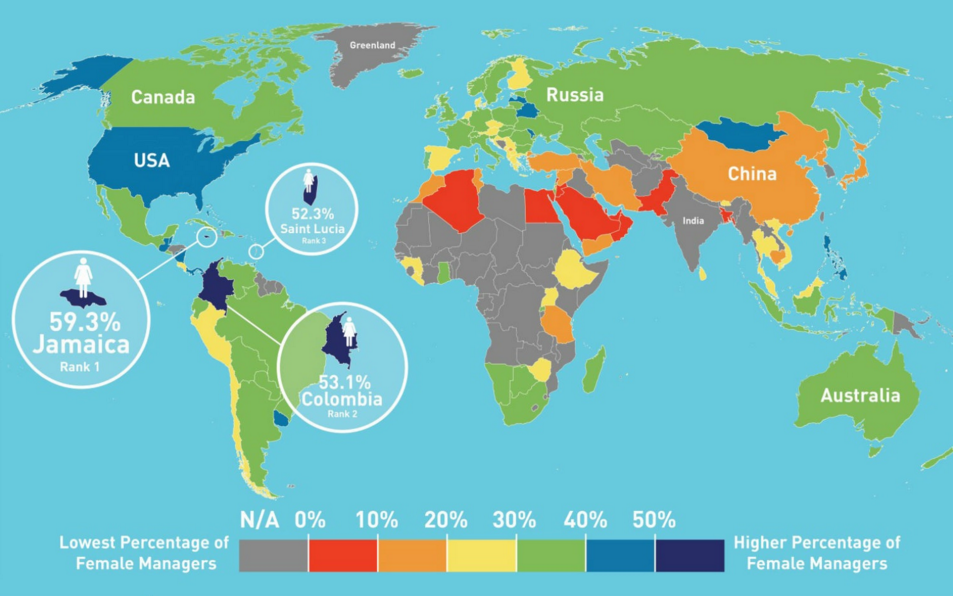
Source: 19 thought-provoking maps that will change how you see the world
Celebrating humanity's flourishing through the spread of capitalism and the rule of law
06 May 2016 Leave a comment
in discrimination, gender, labour economics, labour supply, occupational choice Tags: gender wage gap, reversing gender gap
29 Apr 2016 Leave a comment
in applied price theory, development economics, economics, gender, growth disasters, growth miracles, labour economics, labour supply Tags: fair trade
28 Apr 2016 Leave a comment
in discrimination, economics of education, economics of media and culture, gender Tags: gender politics, political correctness, safe spaces
28 Apr 2016 1 Comment
in discrimination, gender, human capital, labour economics, labour supply, occupational choice Tags: asymmetric information, asymmetric marriage premium, British economy, employer discrimination, family wage gap, gender wage gap, marriage and divorce, marriage bar, motherhood penalty
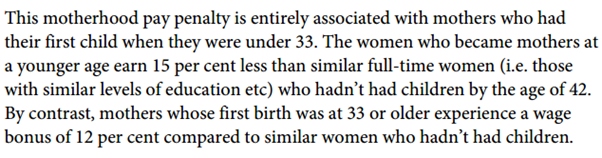
Source: Trades Union Congress – The Motherhood Pay Penalty.
The British Trades Union Congress (TUC) has released the preliminary findings of research into the 1970 Birth Cohort Study. The union research into the gender wage gap finds that
The overall gender pay gap of 34 per cent for this cohort of full-time workers who were born in 1970. This gap is largely due to the impact of parenthood on earnings – the women earning less and the men earning more after having children.
Mothers in the 1970 Birth Cohort Study who are in full-time work earn 11 per cent less than full-time women without children at age 42. When factors such as education, region and occupational social class are taken into account, this motherhood pay penalty in full-work falls to 7 per cent.
This finding by the union research into the 1970 birth cohort is no surprise. For 40 years at least now it has been known that having children and and spacing those children over a longer period carries a career penalty for women.
Recent work finds that the motherhood penalty is larger for those women pursuing careers where long hours or rigid hours is required and if they wish to combine careers and motherhood. Much of that research is led by Claudia Goldin.
It is difficult for employers to discriminate against women if the gender wage gap is not only driven by motherhood but also by having their first child past the age of 33. Male chauvinistic employers simply do not have the necessary information about whether women are mothers and and whether they had their first child before or after the age of 33.
For employer discrimination to drive the gender wage gap, these male chauvinist employers must know:
This information on the age of first motherhood is essential for employer discrimination to be driving the gender wage gap. This information about the age of first motherhood must be in the hands of the employer so that they do not shortlist and do not promote women who are mothers before age 33.
Of 534 occupations tracked by BLS, ONLY 7 pay women more than men ampr.gs/1oJzOrh http://t.co/XRunQkiav8—
American Progress (@amprog) January 29, 2015
It would be handy to know why why these male chauvinistic employers have such strong prejudices against women who are mothers before the age of 33 but have few prejudices against women who are mothers after age 33.
Another piece of useful information is how do male chauvinist employers get their hands on the partnership status of mothers when they had their first child. As the Trades Union Congress found
There is a bonus of 12 per cent for being in a couple when women had their first child.
If the gender wage gap is due to employer discrimination rather than the choices by women about motherhood, there seems to be a 12% wage bonus for single mothers who can successfully lie to male chauvinist employers about whether they are in a stable relationship when they had their first child.
Keeping up appearances for the sake of the children has a whole new meaning if there is 12% wage bonus in it if male chauvinist employers can be fooled. There is a wage bonus of several times that if mothers can keep their children secret from their discriminating employer.
When there is a marriage bar in the Australian Public Service, there were instances where women kept their children or marriages secret to avoid being sacked. One woman had four children before she decided to make an honest man of the father. She lost her job.
28 Apr 2016 Leave a comment
in discrimination, gender, human capital, labour economics, labour supply, occupational choice Tags: asymmetric information, asymmetric marriage premium, British economy, employer discrimination, family wage gap, gender wage gap, marriage and divorce, marriage bar, motherhood penalty
Source: Trades Union Congress – The Motherhood Pay Penalty.
The British Trades Union Congress (TUC) has released the preliminary findings of research into the 1970 Birth Cohort Study. The union research into the gender wage gap finds that
The overall gender pay gap of 34 per cent for this cohort of full-time workers who were born in 1970. This gap is largely due to the impact of parenthood on earnings – the women earning less and the men earning more after having children.
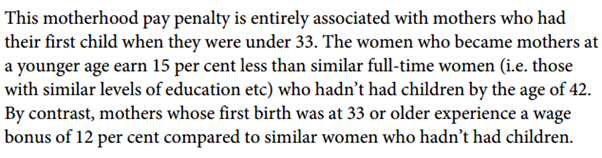
Mothers in the 1970 Birth Cohort Study who are in full-time work earn 11 per cent less than full-time women without children at age 42. When factors such as education, region and occupation are taken into account, this motherhood pay penalty in full-work falls to 7 per cent.
This finding by the union research into the 1970 birth cohort is no surprise. For 40 years at least now it has been known that having children and and spacing those children over a longer period carries a career penalty for women.
More recent work has emphasised the motherhood penalty is larger for those women pursuing careers where long hours or rigid hours is required and if they wish to combine careers and motherhood. Much of that research is led by Claudia Goldin.
It is difficult for employers to discriminate against women if the gender wage gap is not only driven by motherhood but also by having their first child past the age of 33. Male chauvinistic employers simply do not have the necessary information about whether women are mothers and and whether they had their first child before or after the age of 33.
For employer discrimination to drive the gender wage gap, rather than women’s choices about balancing career and motherhood, these male chauvinist employers must know:
This information on the age of first motherhood is essential for employer discrimination to be driving the gender wage gap. This information about the age of first motherhood must be in the hands of the employer so that they do not shortlist, do not promote and do not hire women who are mothers before the age of 33.
Of 534 occupations tracked by BLS, ONLY 7 pay women more than men ampr.gs/1oJzOrh http://t.co/XRunQkiav8—
American Progress (@amprog) January 29, 2015
It would be handy to know why why these male chauvinistic employers have such strong prejudices against women who are mothers before the age of 33 but have no prejudices against women who are mothers after the age of 33. It would
Another piece of you useful information is how do male chauvinist employers get their hands on the partnership status of mothers when they had their first child. As the Trades Union Congress found
There is a bonus of 12 per cent for being in a couple when women had their first child.
Why are the prejudices of male chauvinist employers dampened when the mother is married or in a stable relationship when they had their first child? Why are these male chauvinist employers so prejudiced against in mothers?
There seems to be a 12% wage bonus for single mothers who can successfully lie to male chauvinist employers about whether they are in a stable relationship back when they had the first child.
Keeping up appearances for the sake of the children has a whole new meaning if there is a 12% wage bonus in it if male chauvinist employers can be fooled. There is a wage bonus of several times that if mothers can keep their children secret from their discriminating employer.
When there is a marriage bar in the Australian Public Service, there were instances where women kept their children or marriages secret to avoid being sacked. One woman had four children before she decided to make an honest man of the father. She lost her job.
27 Apr 2016 Leave a comment
in discrimination, economics, gender, human capital, labour economics, labour supply Tags: gender gap
23 Apr 2016 Leave a comment
in economic history, economics of education, economics of media and culture, gender, human capital, labour economics, labour supply, occupational choice Tags: gender gap, gender wage gap, reversing gender gap
14 Apr 2016 Leave a comment
#EqualPayDay This coupon graphically represents the statistical fairly tale that is being spread today http://t.co/xwQXCrWE4d—
Mark J. Perry (@Mark_J_Perry) April 14, 2015
13 Apr 2016 Leave a comment
in discrimination, economic history, gender, human capital, labour economics, labour supply, politics - Australia, politics - New Zealand, politics - USA, poverty and inequality Tags: Australia, British economy, gender wage gap
13 Apr 2016 Leave a comment
in applied price theory, applied welfare economics, discrimination, gender, labour economics Tags: gender wage gap
Source: Farmer Hayek: Equal Pay Day
10 Apr 2016 Leave a comment
in discrimination, economics of love and marriage, economics of media and culture, gender, labour economics, law and economics, politics - Australia, politics - New Zealand, politics - USA, television Tags: feminism
04 Apr 2016 Leave a comment
in discrimination, economics, gender, labour economics Tags: gender gap
01 Apr 2016 Leave a comment
in discrimination, gender, labour economics, sports economics Tags: customer discrimination, employer discrimination, gender wage gap, television ratings, women's sports
If women soccer players are discriminated against, their employers must be making a lot of extra profits of their toil. If women soccer players are paid less than their marginal revenue product, the organisers of their tournaments and those that broadcasted them must be doing very well indeed.
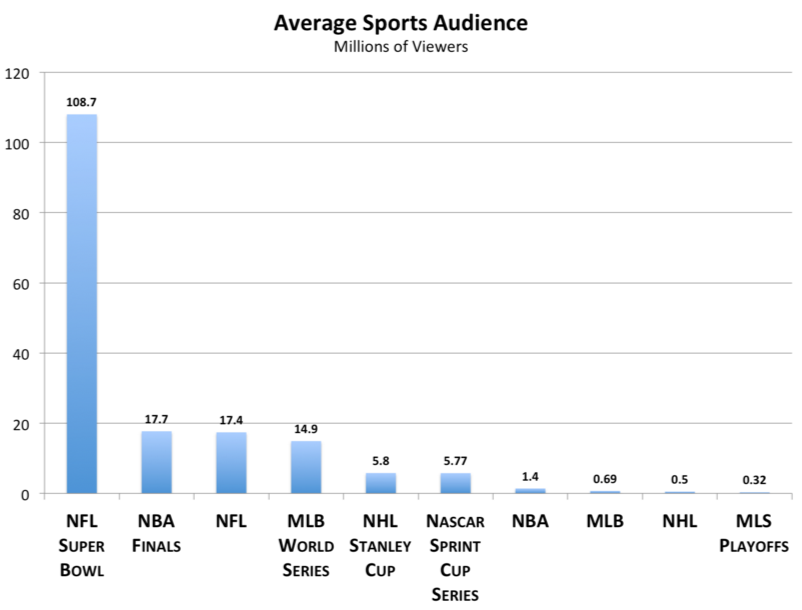
The reality is pay in sports these days is determined by revenue from television rights. Players can top that up with sponsorship deals.
Do television commercials for men’s and women’s soccer tournaments sell for the same price? If so, do women receive a smaller percentage of that revenue stream? That is a good test of the hypothesis that they are discriminated against.
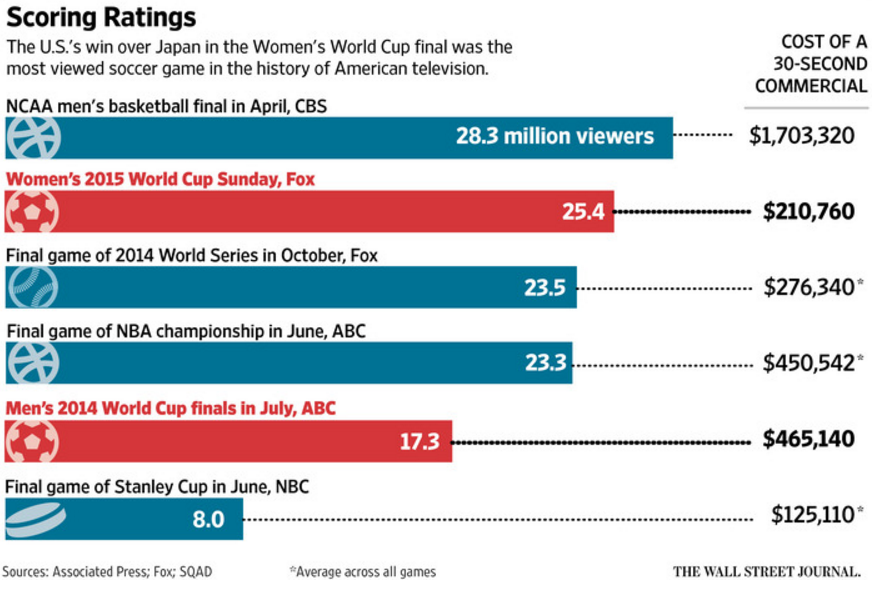
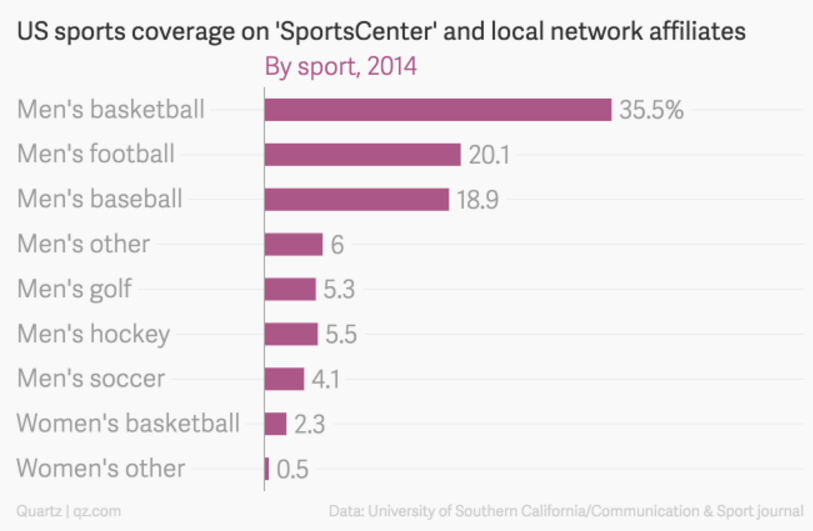
Despite the novelty of the US getting into the women’s World Cup, a 30 second commercial was sold for much much less. There may have been a ratings bonanza, but there was no accompanying revenue bonanza that could feed through to the pay of players from more generous television rights for future tournaments.
Women’s soccer is paid less because of the viewing preferences of audiences. Any sport that attracts high ratings will attract generous television rights. The money feeds through to the players.

This is a classic case of customer discrimination. Markets are very good at implementing customer discrimination, in this case giving viewers the sports they want to see.
A classic early example of that was the introduction of foreign and minority players. Part of sport is that could be me out there kicking the goal. In consequence, viewers had a lot of trouble identifying with people who are not like them. Mankiw explains:
Studies of sports teams suggest that racial discrimination is, in fact, common and that much of the blame lies with customers.
One study, published in the Journal of Labor Economics in 1988, examined the salaries of basketball players. It found that black players earned 20 percent less than white players of comparable ability. The study also found that attendance at basketball games was larger for teams with a greater proportion of white players.
One interpretation of these facts is that, at least at the time of the study, customer discrimination made black players less profitable than white players for team owners. In the presence of such customer discrimination, a discriminatory wage gap can persist, even if team owners care only about profit.
That barrier was quickly overcome when viewers discovered that these foreign players and minorities players were very good and helped the team win more. The preference for their team winning overcame the preference for the team winning with people who look like them.
The current successive US women’s soccer should not be overrated in terms of its implications for higher pay. The Women’s United Soccer Association (WUSA) was formed in 2000 after success in the 1999 FIFA Women’s World Cup. It lasted just three seasons before folding with losses of $100 million.
Women’s soccer in the USA did have one year broadcast deals with Fox sport and ESPN in 2014 and 2013. Although no TV deal is set for the 2015 season, the NWSL recently announced that all games will be broadcast on YouTube Live for free.
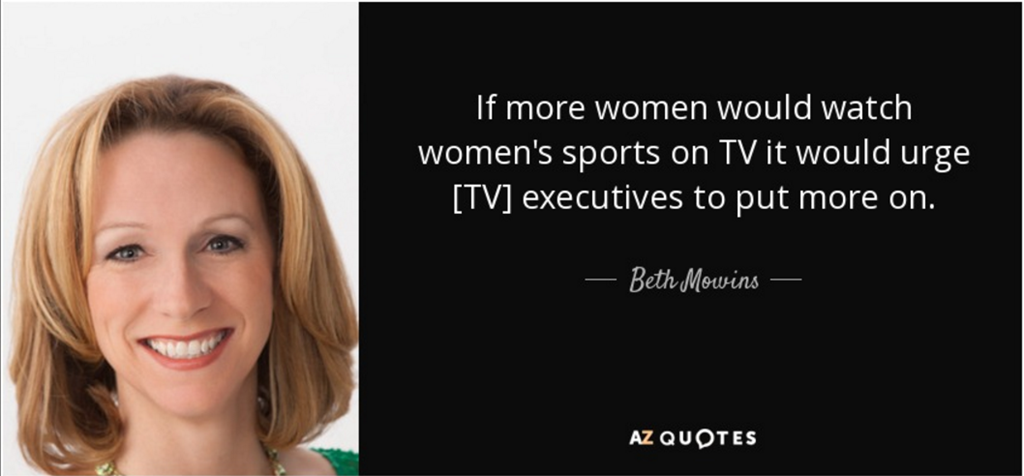
The women’s sports that are best paid without exception are the women’s sports with the most valuable television rights. Closing the gap between men’s and women’s sport is exclusively in the hands of viewer.
The sponsors of women’s sports are not hiding bags of money out the back which they could have paid for women out of secret television deals worth as the same as for men’s sports.
Celebrating humanity's flourishing through the spread of capitalism and the rule of law
Celebrating humanity's flourishing through the spread of capitalism and the rule of law
Celebrating humanity's flourishing through the spread of capitalism and the rule of law
Celebrating humanity's flourishing through the spread of capitalism and the rule of law
Celebrating humanity's flourishing through the spread of capitalism and the rule of law
Celebrating humanity's flourishing through the spread of capitalism and the rule of law
Celebrating humanity's flourishing through the spread of capitalism and the rule of law
Celebrating humanity's flourishing through the spread of capitalism and the rule of law
A History of the Alt-Right
Econ Prof at George Mason University, Economic Historian, Québécois
Celebrating humanity's flourishing through the spread of capitalism and the rule of law
Scholarly commentary on law, economics, and more
Beatrice Cherrier's blog
Celebrating humanity's flourishing through the spread of capitalism and the rule of law
Celebrating humanity's flourishing through the spread of capitalism and the rule of law
Celebrating humanity's flourishing through the spread of capitalism and the rule of law
Why Evolution is True is a blog written by Jerry Coyne, centered on evolution and biology but also dealing with diverse topics like politics, culture, and cats.
Celebrating humanity's flourishing through the spread of capitalism and the rule of law
A rural perspective with a blue tint by Ele Ludemann
DPF's Kiwiblog - Fomenting Happy Mischief since 2003
Celebrating humanity's flourishing through the spread of capitalism and the rule of law
The world's most viewed site on global warming and climate change
Tim Harding's writings on rationality, informal logic and skepticism
A window into Doc Freiberger's library
Let's examine hard decisions!
Commentary on monetary policy in the spirit of R. G. Hawtrey
Thoughts on public policy and the media
Celebrating humanity's flourishing through the spread of capitalism and the rule of law
Politics and the economy
A blog (primarily) on Canadian and Commonwealth political history and institutions
Reading between the lines, and underneath the hype.
Economics, and such stuff as dreams are made on
"The British constitution has always been puzzling, and always will be." --Queen Elizabeth II
Celebrating humanity's flourishing through the spread of capitalism and the rule of law
Celebrating humanity's flourishing through the spread of capitalism and the rule of law
WORLD WAR II, MUSIC, HISTORY, HOLOCAUST
Undisciplined scholar, recovering academic
Celebrating humanity's flourishing through the spread of capitalism and the rule of law
Res ipsa loquitur - The thing itself speaks
In Hume’s spirit, I will attempt to serve as an ambassador from my world of economics, and help in “finding topics of conversation fit for the entertainment of rational creatures.”
Researching the House of Commons, 1832-1868
Articles and research from the History of Parliament Trust
Reflections on books and art
Posts on the History of Law, Crime, and Justice
Celebrating humanity's flourishing through the spread of capitalism and the rule of law
Exploring the Monarchs of Europe


Recent Comments