US Teen Pregnancy, Birth and Abortion Rates since 1972 http://t.co/mwR1U6WJg8—
Max Roser (@MaxCRoser) August 06, 2015
US Teen Pregnancy, Birth and Abortion Rates
16 Aug 2015 Leave a comment
in economic history, gender, labour economics, labour supply, politics - USA, population economics, welfare reform Tags: abortion, economics of fertility, marriage and divorce, single mothers, single parents, teen pregnancy
Gender politics on college campuses
14 Aug 2015 Leave a comment
in discrimination, economics of education, gender, labour economics Tags: fainting couch feminism, male privilege, meddlesome preferences, micro-aggressions, nanny state, safe spaces, trigger warnings
The man-cession illustrated
13 Aug 2015 Leave a comment
in business cycles, discrimination, gender, human capital, job search and matching, labour economics, labour supply, macroeconomics, occupational choice Tags: female labour force participation, male labour force participation, recessions and recoveries
CHART: The Great Recession Had a Disproportionately Negative Effect on Men That Continues Today @CHSommers @AsheSchow http://t.co/wnfdUOUn0a—
Mark J. Perry (@Mark_J_Perry) August 08, 2015
Is there a gender gap in the Dunning-Kruger effect?
10 Aug 2015 Leave a comment
in applied price theory, economics of education, economics of media and culture, gender, human capital, labour economics, personnel economics Tags: cognitive psychology, Dunning-Kruger effect, economics of personality traits, reversing gender gap
Great scientists know what they don't know. 1st step to learning. Female economists winning. blogs.lse.ac.uk/impactofsocial… http://t.co/xcfCvMNU3U—
S Dynarski (@dynarski) July 03, 2015
Any progress ever on the gender wage gap in France, Germany, Sweden and Norway since 1980?
05 Aug 2015 Leave a comment
in discrimination, economic history, gender, labour economics, law and economics Tags: France, gender wage gap, Germany, Leftover Left, Norway, Sweden, Twitter left
Our friends on the Left go on about how wonderful place Sweden is despite its gender gap being stuck for 35 years. Not much better in Norway and in Germany and France for that matter.
Figure 1: gender wage, % of median male wage, full-time employees, France, Germany, Sweden and Norway, 1980 – 2012

Source: Earnings and wages – Gender wage gap – OECD Data.
The gender wage gap in figure 1 is unadjusted and defined as the difference between median earnings of men and women relative to median earnings of men. Data refer to full-time employees.
Gender wage gap, USA, UK, Australia and New Zealand since 1970
04 Aug 2015 1 Comment
in discrimination, gender, labour economics, politics - Australia, politics - New Zealand, politics - USA Tags: Australia, British economy, gender wage gap
New Zealand does much better than most on the gender wage gap for full-time workers.
Figure 1: gender wage, % of median male wage, full-time employees, USA, UK, Australia and New Zealand, 1970 – 2012
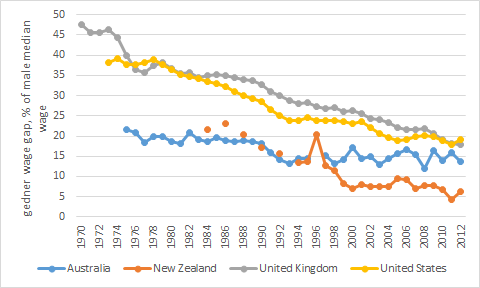
Source: Earnings and wages – Gender wage gap – OECD Data.
The gender wage gap in figure 1 is unadjusted and defined as the difference between median earnings of men and women relative to median earnings of men. Data refer to full-time employees.
I never found it terribly helpful to include part-time workers, such as in an hourly measure of the gender wage gap because of a larger trade-off between cash wages and work life balance in part-time jobs.
Being an airline pilot or engineer is much more dangerous than I thought it was
02 Aug 2015 2 Comments
in discrimination, gender, health and safety, labour economics, occupational choice, transport economics Tags: aviation, gender fatalities gaps, occupational deaths and injuries, reverse gender gap
Dear "lumbersexuals": real loggers are 30x more likely to die on the job than the avg worker priceonomics.com/how-the-lumber… http://t.co/1BLTBI37da—
Zachary Crockett (@zzcrockett) June 12, 2015
New Zealand success in closing the gender wage gap is seriously underreported
31 Jul 2015 Leave a comment
in discrimination, gender, human capital, labour economics, labour supply, politics - New Zealand Tags: gender wage gap, media bias
Maternity leave compared
30 Jul 2015 Leave a comment
in discrimination, gender, labour economics, labour supply, occupational choice Tags: gender gap, maternal labour supply, maternity leave, paternity leave
Why no ethnic wage gap for New Zealanders aged 15 to 24?
29 Jul 2015 Leave a comment
in discrimination, gender, human capital, labour economics, labour supply, occupational choice, politics - New Zealand Tags: employer discrimination, ethnic wage gap, gender wage gap, racial discrimination, racial wage gap
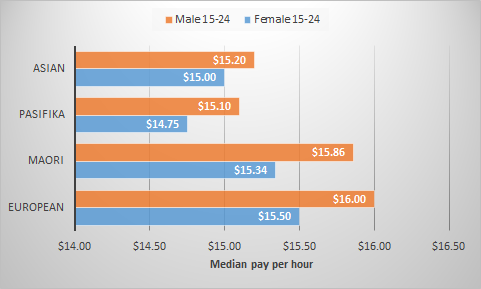
via New Zealand Income Survey 2014 via Human Rights Commission: Tracking Equality at Work
Why next to no gender wage gap for under 45s in New Zealand?
28 Jul 2015 Leave a comment
in discrimination, economics of education, gender, human capital, labour economics, labour supply, occupational choice, politics - New Zealand Tags: gender wage gap
Figure 1: unadjusted median pay per hour by gender and age group, New Zealand, 2014

Source: New Zealand Income Survey 2014 via Human Rights Commission: Tracking Equality at Work.
The gender wage gap by educational attainment
28 Jul 2015 Leave a comment
in discrimination, economics of education, gender, human capital, labour economics, occupational choice Tags: College premium, education premium, gender wage gap
Men's and Women's Earnings by Education (Ph'Ds are the most equal) bit.ly/153m9jZ http://t.co/IPfT15Qwiz—
Catherine Mulbrandon (@VisualEcon) September 03, 2013
Why did the top 1% only pick on men in the great wage stagnation?
27 Jul 2015 Leave a comment
in discrimination, economic history, gender, labour economics Tags: middle class stagnation, reversing gender gap, top 1%, wage stagnation
Average & median incomes diverged more for men than for women as income inequaltiy grew bit.ly/16XXzQq http://t.co/Tp0IAXqxH8—
Catherine Mulbrandon (@VisualEcon) August 20, 2013
The gender gap in occupational deaths and injuries
26 Jul 2015 Leave a comment
in discrimination, gender, health and safety, labour economics Tags: gender gap, reversing gender gap
CHART: Top Ten Most Dangerous Jobs and Percent Male, 2013
@chartoftheday http://t.co/5xfjvM8ll5—
Mark J. Perry (@Mark_J_Perry) May 14, 2015


Recent Comments