Boys, girls and the video games they play
09 Oct 2015 Leave a comment
in applied price theory, economics of education, gender, labour economics Tags: economics of personality traits, gender gap, video games
% women 25-34 & 45-54 with at least tertiary education, English-speaking countries, 2008
06 Oct 2015 Leave a comment
in discrimination, economics of education, gender, human capital, labour economics
With 40 to 50% of women, and many more in Canada, now going on to tertiary education, claims such as recently by the OECD and IMF that there is problems of access to education as a driver of inequality seem even more doubtful.
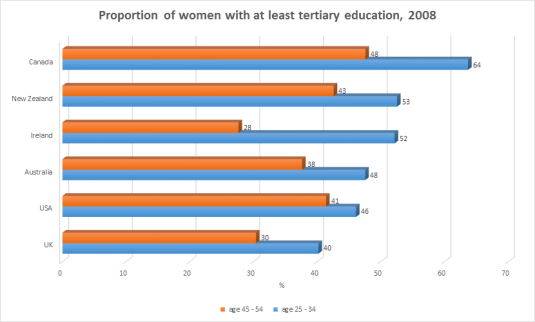
Source: DOING BETTER FOR FAMILIES – OECD 2011, Figure Box 1.3.
Not only do women have to overcome the financing constraint on going onto higher education that so troubles the IMF and the OECD, women of today and yesterday must overcome the dead hand of patriarchy. They have the both the top 1% and all men scheming against them, apparently. Despite this double secret double conspiracy against them, the number of women going on to some form of tertiary education has increased rapidly within a generation from an already high base.
The dating gap on campus
06 Oct 2015 Leave a comment
in economics of education, economics of love and marriage, gender, health and safety, labour economics Tags: assortative mating, asymmetric marriage premium, College premium, dating market, marriage market, power couples, reversing gender gap, search and matching
Why dating in America for college-educated women is completely unfair wapo.st/1L1lULW http://t.co/hTCYCR5GCm—
Know More (@knowmorewp) September 09, 2015
Homicide rates for young American women by race since 1980
04 Oct 2015 Leave a comment
in economic history, economics of crime, gender, politics - USA
The crack cocaine epidemic in the USA in the late 1980s also appeared to lead to a spike in murders of young Black and Latina women.
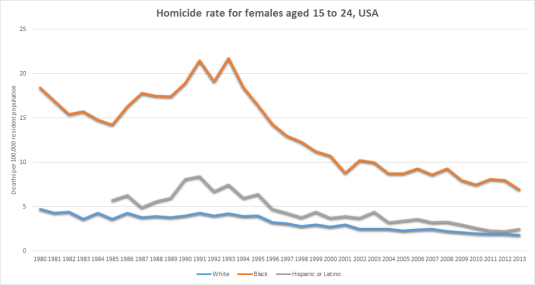
Source: Centres for Disease Control and Prevention.
No data was available on Asian female homicides aged 15 to 24. There is no data on Latino homicide rates prior to 1985.
The reversing gender gap in graduate education
01 Oct 2015 Leave a comment
in discrimination, economics of education, gender, human capital, labour economics, occupational choice, politics - USA Tags: College premium, graduate premium, reversing gender gap
6 years of women earning most PhDs, outnumbering men in grad school 136 to100 @Mark_J_Perry khttp://goo.gl/4uoYLV http://t.co/1hYfbDpdST—
AEIdeas Blog (@AEIdeas) September 17, 2015
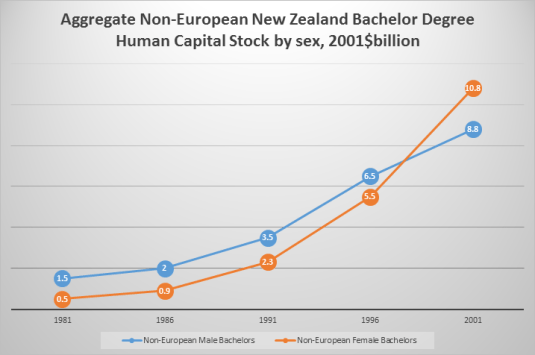
Aggregate New Zealand non-European graduate human capital stock by sex, 1981-2001, $2001 billion
27 Sep 2015 Leave a comment
in economics of education, gender, human capital
Aggregate New Zealand European human capital of graduates, 1981-2001
26 Sep 2015 Leave a comment
in economic history, gender, human capital, labour economics, labour supply, politics - New Zealand Tags: female labour force participation, graduate premium, male labour force participation, postgraduate premium, reversing gender gap
There was rapid growth in the human capital of graduates and postgraduates in New Zealand between 1981 and 2001 according to the census data. The growth in female human capital was particularly rapid and especially so at the postgraduate level.
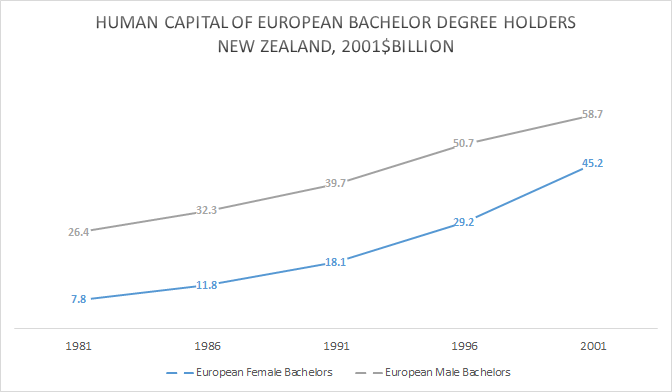
Source: Lˆe Thi. Vˆan Tr`ınh, Estimating the monetary value of the stock of human capital for New Zealand, thesis submitted in partial fulfilment of the requirements for the Degree of Doctor of Philosophy at the University of Canterbury (September 2006).
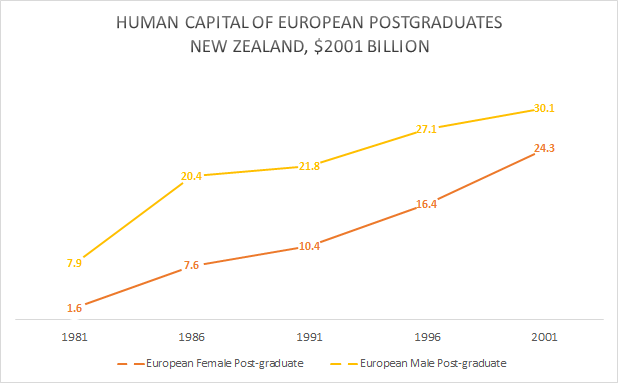
Source: Lˆe Thi. Vˆan Tr`ınh, Estimating the monetary value of the stock of human capital for New Zealand, thesis submitted in partial fulfilment of the requirements for the Degree of Doctor of Philosophy at the University of Canterbury (September 2006).
@RichardvReeves Why did women get a pass on the great wage stagnation and exploitation by the top 1%?
19 Sep 2015 1 Comment
in discrimination, econometerics, economic history, gender, human capital, labour economics, labour supply, poverty and inequality Tags: female labour force participation, gender wage gap, male labour force participation, middle class stagnation, middle-class stand nation, wage stagnation
Few labour markets statistics make much sense unless broken down by gender.
Women working full-time, year-round jobs earned 78.6% of what similar men did in 2014 on.wsj.com/1KlsIC8 http://t.co/amouJSkPMr—
Real Time Economics (@WSJecon) September 19, 2015
Wages growth is no exception with female wages growth quite good for a long period of time after the 1970s – a period in which male earnings stagnated.
The beginning of male wage stagnation seemed to coincide with the closing of the gender wage gap.
U.S. wage growth doesn't look as weak when you account for benefit costs covered by employers on.wsj.com/1JJ2EmV http://t.co/s0tJutTjBy—
Nick Timiraos (@NickTimiraos) July 06, 2015
Presumably if men were previously profiting from patriarchy, that should have some implications for future wage growth and promotions for men as women catch up.
Presumably if men were previously profiting from patriarchy, that should have some implications for future wage growth for men as women catch up. Men lost the wage premium they previously earned from the sex discrimination directly in hiring, wage setting and promotions and investing in more education because they expected to be discriminated favourably at the expense of women.
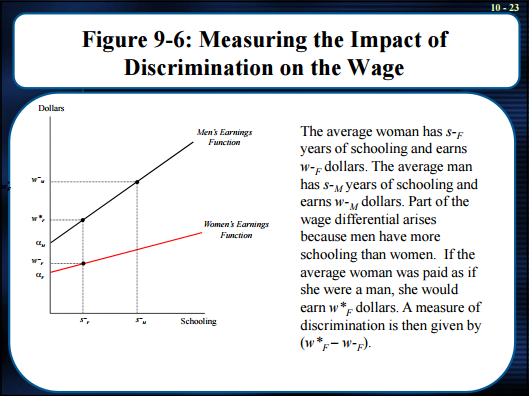
Not surprisingly the convergence in the male-female wage ratios started in the 1970s which was the decade that male wage stagnation started.

The gender wage gap started converging again also pretty much in lockstep with the top 1% starting to grab higher and higher proportions of income.
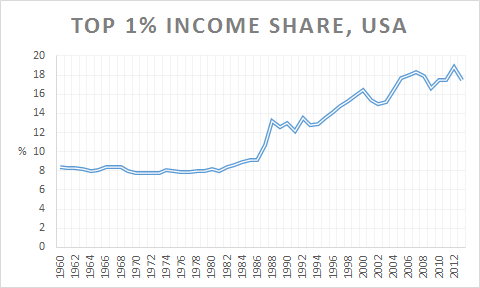
Source: Alvaredo, Facundo, Anthony B. Atkinson, Thomas Piketty and Emmanuel Saez, The World Top Incomes Database.
The biggest #gendergap of them all
19 Sep 2015 Leave a comment
in discrimination, economic history, gender, health economics, labour economics Tags: female life expectancy, gender gap, life expectancies, male life expectancy, reversing gender gap
https://twitter.com/ONS/status/641642361664237569/photo/1
Explore the changing gap between male & female life expectancy over time ow.ly/RXWfC http://t.co/OjZuSlcmOI—
(@ONS) September 09, 2015
Girls on Film
15 Sep 2015 Leave a comment
in discrimination, gender, labour economics, labour supply, occupational choice Tags: gender gap, gender wage gap, Hollywood economics
https://twitter.com/paul1kirby/status/642813666249822208/photo/1

Hollywood movies write women out of the script & create a make-believe world where men do all jobs.Ace chart http://t.co/0eM17kRJKW—
paulkirby (@paul1kirby) September 10, 2015
Mises on feminism
12 Sep 2015 Leave a comment
in constitutional political economy, discrimination, economics of education, gender, labour economics, labour supply, liberalism, occupational choice, Public Choice, rentseeking Tags: economics of fertility, economics of the family, engines of liberation, female labour force participation, feminism, women's liberation
Trends in the British gender wage gap by age band
10 Sep 2015 Leave a comment
in discrimination, economic history, economics of education, gender, human capital, labour economics, labour supply Tags: British economy, gender wage gap
The UK gender pay gap begins at 30(ish)
09 Sep 2015 Leave a comment
in discrimination, economic history, gender, human capital, labour economics, labour supply, occupational choice Tags: asymmetric marriage premium, gender wage gap


Single motherhood and the feminisation of poverty
31 Aug 2015 Leave a comment
in discrimination, economics of love and marriage, gender, labour economics, labour supply, politics - USA, poverty and inequality, welfare reform Tags: asymmetric marriage premium, child poverty, economics and fertility, engines of liberation, family poverty, marriage and divorce, marriage premium, single mothers, single parents
43.1% of single mothers are living in poverty this #MothersDay statusofwomendata.org http://t.co/OgWcmvLnDZ—
IWPR (@IWPResearch) May 10, 2015
Vanishing effect of #religion on the labour market participation of European women
19 Aug 2015 Leave a comment
in economics of religion, gender, human capital, labour economics, labour supply, occupational choice, poverty and inequality, welfare reform Tags: female labour force participation, female labour supply, France, gender gap, Germany, Greece, Italy, Portugal, Spain, Turkey
Vanishing effect of #religion on the labor market participation of European women newsroom.iza.org/en/2015/08/10/… http://t.co/25nx8NiEfk—
IZA (@iza_bonn) August 10, 2015


Recent Comments